Deodar Cedar Care: How to Grow This Himalayan Tree
Before planting a deodar cedar, compare hardiness guidance, estimate its mature spread, and follow a practical care plan for establishment and long-term health.
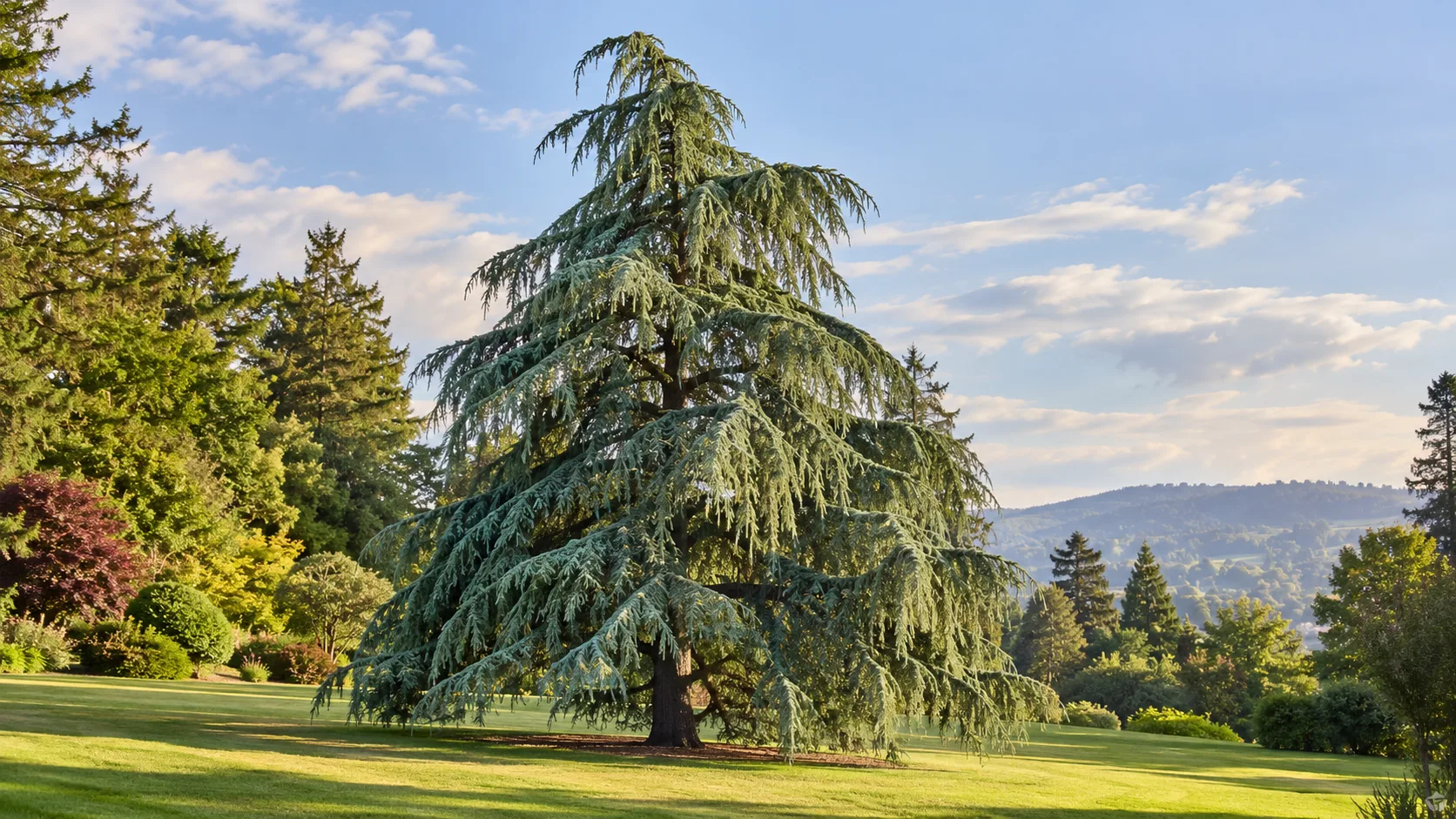
A deodar cedar can anchor a large garden with soft, blue-green foliage and branch tips that sweep downward. It is also a poor choice for a tight lot: mature trees can spread far beyond the silhouette of the young nursery plant, and the crown changes shape as it ages. Plan for the full tree first; watering and pruning are easier once it has a suitable site.
The botanical name is Cedrus deodara. It is a true cedar native to the western Himalaya, not an eastern red cedar (Juniperus virginiana) or a white cedar (Thuja occidentalis). Give it sun, well-drained soil, establishment care, and room to develop its natural form. The details below explain how to judge that room, handle conflicting size and hardiness estimates, and spot the conditions that warrant action.
Deodar Cedar at a Glance
| Feature | What to expect |
|---|---|
| Botanical name | Cedrus deodara |
| Type | Evergreen conifer in the pine family, Pinaceae |
| Native range | Western Himalaya, including parts of India, Nepal, and Pakistan |
| Landscape size | Often listed around 30–50 feet tall and 30–40 feet wide; some trees grow larger |
| Shape | Pyramidal when young, with a drooping leader and sweeping branches; broader with age |
| Light | Full sun is best for a dense, balanced crown |
| Soil | Broad tolerance for soil types and pH, provided drainage is good |
| Main cautions | Large spread, exposure to wind and frost, root-rot risk in wet soil, flammability near structures |
Treat size as a planning range, not a maximum. NC State Extension describes a landscape tree about 30 to 50 feet tall and 30 to 40 feet wide, while Oregon State University Landscape Plants records a broad range that can include much taller trees. Site, cultivar, climate, and age all influence the result, so a nursery tag is not a guarantee of the largest possible size.
Decide Whether Your Site Has Enough Room
Before buying a deodar cedar, stand where you expect to plant it and imagine a canopy at least 30 to 40 feet across. That is a broad landscape estimate, not a claim that every tree reaches the same dimensions. The tree’s long, pendulous limbs also need clearance from roofs, paths, driveways, neighboring trees, and places where low branches would block routine access.
Look above as well as around the planting spot. A spreading crown needs overhead clearance from utility wires, and a wind-exposed corner can damage the leader or young branches. Avoid low ground where water sits after rain, and do not plant where snow or ice routinely falls from a roof. A tree that is too large for the site will not become a manageable small tree through repeated topping; choose a genuinely compact cultivar or another species instead.
Think in mature canopy, not nursery-pot size
Nursery trees look compact partly because they are young. A specimen may keep a strong pyramidal shape for years, then broaden and flatten at the top as it matures. NC State Extension also notes that deodar cedar can be messy and assigns it a high flammability rating; it advises against planting it inside the defensible space nearest a home. Those facts matter if you are choosing a street tree, planting beside a patio, or landscaping in a wildfire-prone area.
If a small conifer is the actual goal, compare named dwarf forms and read the expected mature width on the nursery’s label. Do not assume a tree is small because it is sold in a small pot or because its young branches hang close to the ground. A full-size tree planted as a screen also needs enough spacing for its mature crown; crowded trees become harder to inspect and may lose their distinctive outline.
Identify a Deodar Cedar and the Tree It Is Not
The common word “cedar” is used for unrelated trees. A botanical label is the easiest check: deodar cedar is Cedrus deodara, an evergreen in Pinaceae. Eastern red cedar belongs to the juniper genus, while many “white cedars” are arborvitaes. These plants do not share identical growth habits or care needs, so a general cedar care label can mislead.
Oregon State University Landscape Plants describes deodar cedar as a large, broadly pyramidal conifer with pendulous branch tips and soft, blue-green to gray-green foliage. Young trees usually show a pronounced central leader that droops at the tip. Older trees can develop a wide crown and a flatter top, so a mature specimen may look less like the narrow pyramid shown on a nursery tag.
Needles, cones, and the shifting crown
Look for evergreen needles clustered on short, woody shoots, with some needles appearing singly near the ends of long shoots. The needles are usually soft and gray-green, blue-green, or silvery, depending on the plant. Upright, barrel-shaped female cones sit on branches and break apart while still in the crown to release seeds; the central cone axis can persist after the scales fall. Male pollen cones are smaller and also upright. This cone behavior is more useful for identification than relying on a common name alone.
The photo below shows a blue Atlas cedar, a different species in the same true-cedar genus. It offers a comparison for the blue foliage and sweeping branch habit, but foliage color alone cannot identify a deodar cedar.
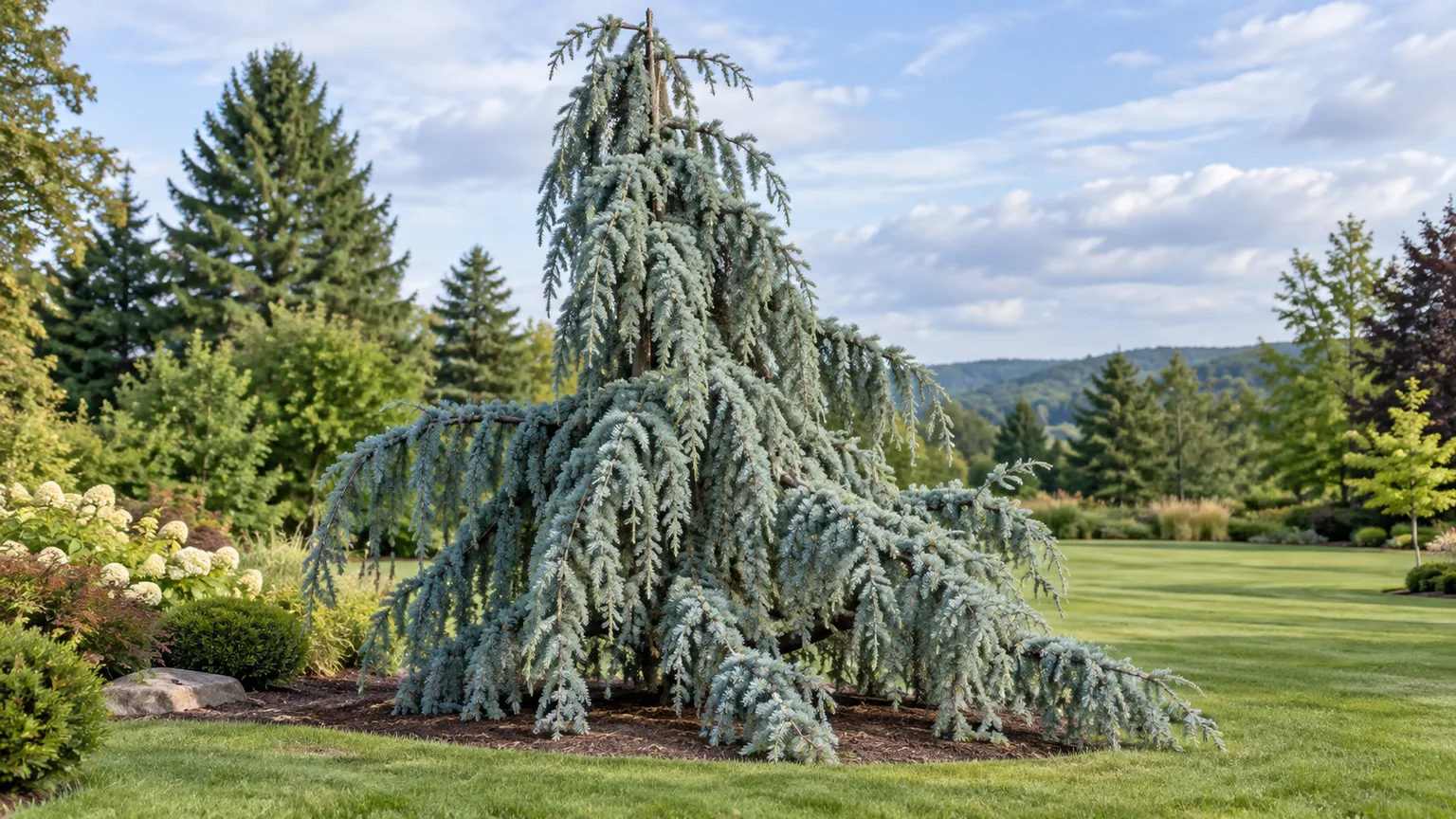
This is a related Atlas cedar, not Cedrus deodara; compare the genus-level look, then use the botanical label and cone or needle traits to identify a tree.
Hardiness, Sun, Wind, and Soil
Deodar cedar grows best in full sun. It may tolerate some light shade, but a sunny, open position usually supports a denser crown and more even branching. Give it air circulation and protection from sweeping winds rather than placing it in a wind tunnel or tight courtyard. NC State Extension notes that frost can damage the species, especially in exposed settings.
Hardiness listings do not agree perfectly. Oregon State University lists the species as hardy to USDA Zone 6; Fine Gardening also gives a 6–9 range, while many American plant guides use 7–9. Those ranges describe reported performance, not a promise for every plant sold under the name. The USDA Plant Hardiness Zone Map uses average annual extreme minimum temperatures, so it cannot capture every factor that affects survival, including a late spring freeze, wind exposure, drainage, cultivar, or how recently a tree was planted. Check the current map for your location, then ask a local nursery which proven cultivar handles your winters.
Soil texture is flexible if water drains through it. NC State describes the tree in rich, well-drained soil that may be moist or occasionally dry; Oregon State favors well-drained, somewhat dry ground; the Royal Horticultural Society lists clay, loam, sand, and chalk. The practical common thread is drainage. Do not put the tree where the root zone stays saturated, and do not add an acidifier automatically: RHS includes acidic, neutral, and alkaline soil conditions for the species.
Planting a Deodar Cedar for Long-Term Stability
Planting quality matters because the root system has to establish before the crown can cope with summer heat, winter wind, or dry spells. Choose a healthy nursery tree with a straight, intact leader and no trunk wounds, girdling roots, or branches rubbing against one another. If the tree is grafted or sold under a cultivar name, keep that name with your planting notes so later pruning and hardiness decisions match the plant you actually bought.
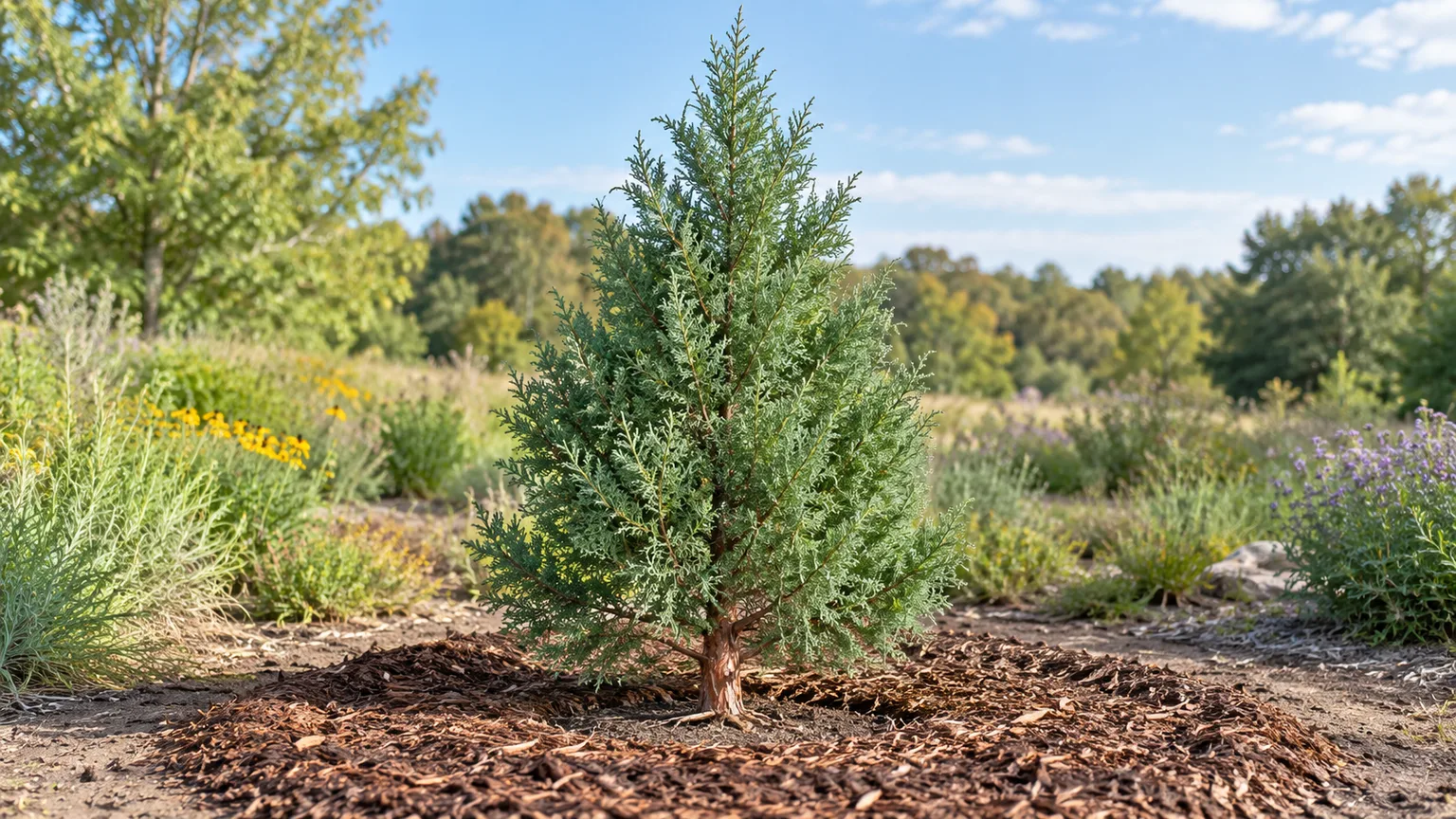
This planting photo shows an eastern red cedar, not a deodar. It illustrates the general goal: a young tree in open ground with a broad mulch ring and no mulch piled against the trunk.
Choose the season and nursery stock
In climates with hot summers, spring after the soil can be worked or early fall after peak heat are sensible planting windows. The calendar is less important than avoiding frozen ground, saturated soil, and periods when the root ball would dry faster than you can keep it watered. If fall planting leaves little time before a severe winter, use spring instead, especially in a colder or exposed location.
Inspect container-grown trees for roots circling the pot. A few fine roots can be loosened, but a woody root girdling the stem or tightly encircling the root ball is a reason to select a better specimen. For balled-and-burlapped stock, follow local guidance for removing ties and basket material. Keep the root ball intact while handling; do not lift the tree by its trunk.
Set the root flare correctly
Dig a hole at least twice as wide as the root ball, with sloping sides, but no deeper than the distance from the bottom of the root ball to the first major roots. The first structural roots or root flare should sit at or slightly above the surrounding grade. If it is buried, the trunk stays too wet and the tree can settle deeper after watering. If the tree came in a container with potting mix piled over the flare, brush that extra mix away before measuring the planting depth.
Backfill with the excavated soil rather than creating a pocket of rich amendment that differs sharply from the surrounding ground. Firm the soil gently enough to remove large air gaps without compacting it into a hard layer, then water slowly so the root ball and surrounding soil settle together. Stake only if the root ball moves or the site is exceptionally exposed; ties should allow slight trunk movement and come off once the tree is stable. Finish with a broad, shallow mulch ring, keeping mulch several inches away from the trunk.
Watering: Establish Roots Without Waterlogging
A newly planted deodar cedar needs attention while its roots extend into surrounding soil. For the first growing season, check moisture at the edge of the root ball and a few inches into the soil rather than watering by a fixed weekly rule. If the root zone is dry, soak it slowly and thoroughly; if it is still cool and moist, wait. Sandy soil, wind, heat, rainfall, and root-ball size all change how quickly it dries.
As the tree establishes, gradually reduce supplemental water instead of abruptly stopping after the first year. In a dry summer, a deep soak is more useful than repeated light sprinkling that wets only the surface. Keep water from pooling at the base. Deodar cedar tolerates some dry periods once established, but drought tolerance does not mean a young tree can go without water or that a stressed mature tree will recover without help.
The soil test is simple: probe the root ball and nearby soil with a finger or narrow trowel. If the planting mix is dry while surrounding clay is wet, the two zones may be shedding water differently; water slowly over the root ball and check drainage. If the soil remains wet for days, stop irrigation and investigate the site before adding more. Persistent waterlogging encourages root and crown rot, one of the more serious problems listed for this species by NC State Extension.
Mulch and Fertilizer
A two- to three-inch layer of organic mulch can reduce moisture swings and protect the soil surface. Spread it in a wide ring as the crown grows, but leave a visible gap around the trunk. Mulch piled into a cone against the bark traps moisture at the root flare and makes it harder to notice insects, cankers, or damage at the base.
Do not fertilize on a calendar simply because the tree is evergreen. If the cedar has weak growth or pale foliage, first check watering, drainage, root depth, light, and pest symptoms. A soil test can show whether a nutrient is actually deficient. If the test supports fertilizer, use a product and rate suited to trees in your region and follow its label; excessive nitrogen will not fix a damaged root system and can drive soft growth vulnerable to weather.
Pruning and Storm Preparation
Most deodar cedars look best with little pruning. Remove dead, broken, rubbing, or clearly diseased branches, and preserve the central leader if you want the classic pyramidal outline. Make a clean cut just outside the branch collar rather than flush to the trunk or leaving a long stub. Pruning during dry weather in late winter or early spring makes the branch structure easier to see before new growth begins, but urgent broken limbs should be handled promptly and safely.
Do not top the tree to keep it short or shear it into a hedge. Removing the top changes the architecture, and cutting into old, needleless wood may leave a permanent bare patch because conifers generally do not refill every old branch from brown interior wood. If a low limb blocks access, consider whether removing it will expose a large trunk wound or spoil the canopy; a certified arborist can assess substantial structural cuts.
Before a storm season, look for a split leader, a hanging branch, or a limb bearing against a roof or utility line. Do not climb or use a pole saw near energized wires. Heavy wet snow can load the broad crown, but tightly wrapping a large evergreen can also abrade branches and trap moisture. For a young tree in a region with recurring snow or wind injury, ask a local arborist or nursery about a loose temporary screen or staking before winter rather than improvising a wrap that constricts the crown.
Cultivars: Full-Size, Dwarf, and Cold-Tolerant
Choose a cultivar for its mature dimensions and local climate, not only its color in a photograph. NC State Extension lists many named forms, including several described as cold-hardy, golden, blue-green, dwarf, prostrate, or globular. Those are horticultural tendencies rather than a universal guarantee; ask for the cultivar’s full name and mature height and spread on the plant label.
- ‘Shalimar’ and ‘Kashmir’ are often selected where improved cold tolerance is a priority. A cold-tolerant cultivar still needs a sheltered, well-drained site while young.
- ‘Feelin’ Blue’ is a prostrate dwarf with blue-green foliage. Its low, spreading habit may suit a rock garden or broad container better than a narrow path edge.
- ‘Snow Sprite’ is a compact, globular selection. Confirm its eventual dimensions because “dwarf” means slower or smaller relative to the species, not necessarily permanently tiny.
- ‘Aurea’ has golden foliage, while ‘Karl Fuchs’ is known for bluish-gray needles. Color, growth rate, and size can vary with age and growing conditions.
Full-size Deodar is a specimen tree for broad lawns, large gardens, or parks. A smaller named form may fit a residential bed, but read its mature width and note whether the nursery’s measurement assumes grafting or regular pruning. If a compact shape depends on continuous cutting, it may be the wrong tree for a low-maintenance site.
Growing From Seed, in a Container, or as Bonsai
Deodar cedar is most often purchased as a nursery-grown tree because a seedling takes patience and may not match a named cultivar. RHS lists seed and semi-hardwood cuttings as propagation options; seed-grown plants are not a reliable way to reproduce a particular color, form, or dwarf habit. For a cultivar, buy a correctly labeled plant rather than expecting its seeds to come true.
Seed propagation
Female cones mature high in the crown and disintegrate there, so collecting seed from a mature specimen may be difficult and unsafe. Use fresh, viable seed from a reputable source, remove any loose papery wings, and sow it in a clean, free-draining medium at the depth recommended by the seed supplier. Keep the mix evenly moist, not waterlogged, and provide bright light after germination. Seedlings need protection from drying wind and strong midday heat while small.
Conifer germination can be uneven, and the right pre-sowing treatment depends on seed freshness and source. Follow supplier or local extension directions for stratification rather than soaking and chilling every seed by a guessed schedule. Once the seedlings have formed roots and can be handled without pulling the stem, pot them individually. Let them grow on in containers before planting into a permanent landscape site; avoid moving a seedling repeatedly, since establishing a deep root system takes time.
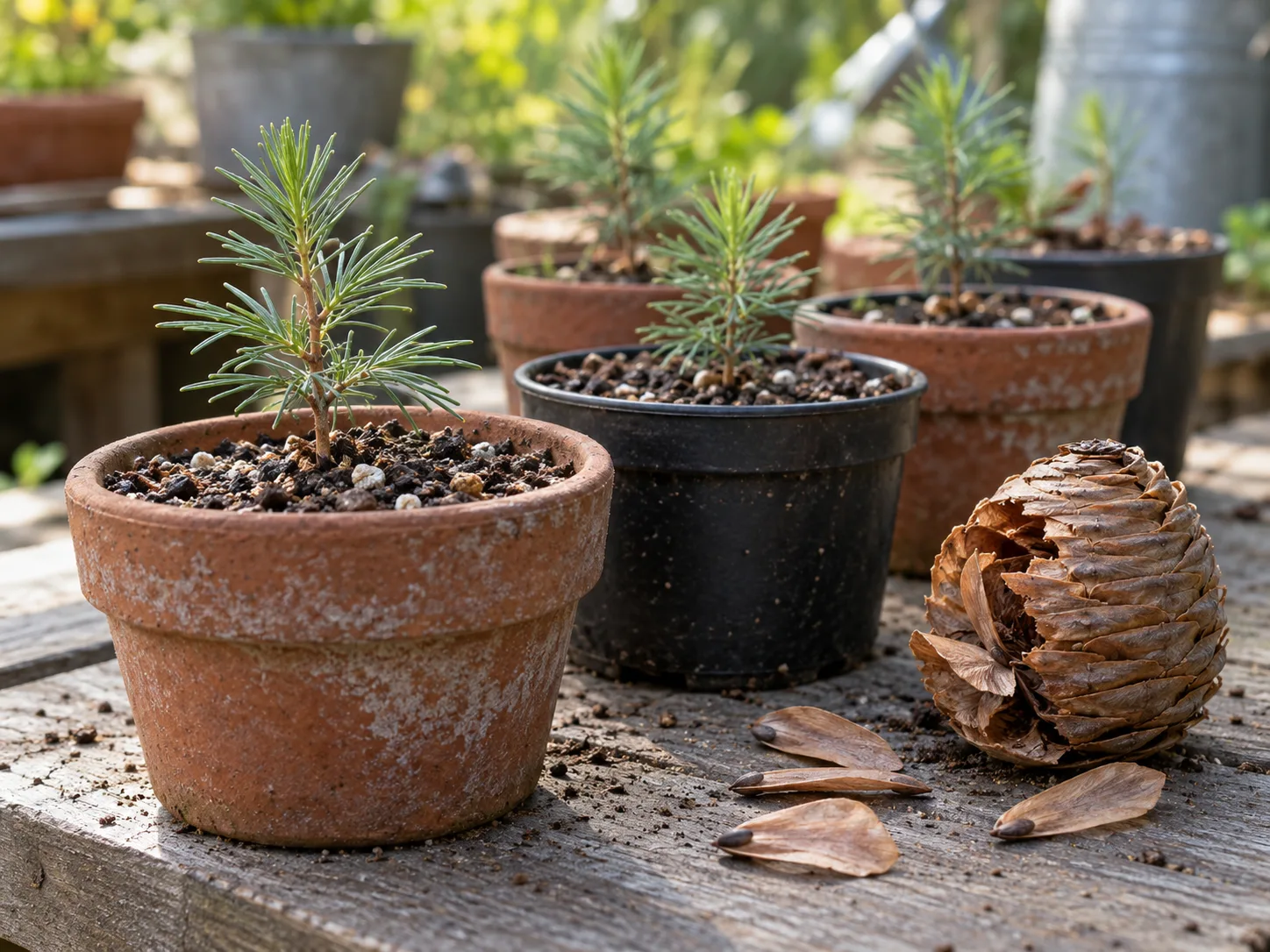
This image shows cedar of Lebanon seedlings, not deodar cedar. It illustrates the scale and container setup of young true cedars; use deodar-specific seed and cultivar labels when propagating this species.
Container culture and bonsai
A young deodar can live temporarily in a large container with generous drainage, but the species is a landscape tree, not a long-term indoor houseplant. A pot dries and freezes faster than open ground, and a vigorous plant eventually needs room for its root system. Use a stable outdoor position with sun, water when the mix begins to dry, and repot before roots become tightly circling or the tree stops taking up water evenly.
A dwarf cultivar is more practical for a container than a seedling of the full-size species. Deodar cedar can be trained as bonsai, but it still needs outdoor light and seasonal conditions appropriate to its cultivar. Keep a bonsai out of a heated room in winter; protect the small root mass from a hard freeze according to local bonsai guidance. If you want a permanent indoor miniature, choose a tropical tree species rather than trying to adapt an outdoor cedar to a warm, dim room.
Troubleshoot Needle Loss, Dieback, and Pests
Evergreen does not mean every needle stays forever. Older needles on shaded interior growth can yellow and drop as the tree replaces foliage, especially when the newer tips remain green and the loss is spread through the inner canopy. A few dropped needles after dry weather or transplanting also do not identify a disease by themselves. Note where browning begins, whether it affects old or new growth, and whether entire branches are declining.
Browning at tips, one-sided scorch, or a sudden change after a hot dry spell points first to exposure and water stress. Check whether the root ball is dry, whether nearby pavement reflects heat, and whether wind or a late frost hit the newest growth. Browning that begins low on the trunk or appears across multiple branches while soil stays wet can indicate root trouble. Avoid adding fertilizer or pesticide before checking the roots, moisture, and planting depth.
Sticky leaves or surfaces beneath the tree may signal aphids feeding on new growth and excreting honeydew. Rinsing a small visible colony with water may be enough; heavy or recurring infestations deserve identification before treatment. The RHS notes susceptibility to conifer aphids, and NC State Extension lists pests including beetle borers and scales as well as diseases such as sooty mold and root rots. Spider mites are more likely in hot, dry conditions and may leave fine stippling or webbing.
Take sudden crown dieback, resin flow with holes or boring dust, a split trunk, or expanding cankers seriously. Several different pests and diseases can produce similar symptoms, and applying a broad insecticide without an identification can harm beneficial insects while missing root or weather stress. Photograph the whole tree and the affected branch, check the soil, and contact a certified arborist or local extension service when decline is progressing. If you prune a small affected branch yourself, disinfect tools between cuts and do not remove large limbs or climb into the canopy.
Winter Care and Fire-Safe Placement
A well-sited, established tree needs little winter attention. Young trees can be more vulnerable to cold, wind, and abrupt temperature swings, especially at the edge of the cultivar’s hardiness range. Keep soil evenly moist going into a dry winter, maintain a mulch ring without touching the trunk, and avoid late-season fertilizer that pushes tender growth. If winter winds repeatedly desiccate the tree, a temporary wind screen on the exposed side may help more than wrapping every branch.
Do not treat a hardiness zone as a substitute for local observation. The USDA map is based on long-term winter minimum temperatures; it does not account for every frost pocket, wind corridor, snow load, or drainage issue in a yard. Planting next to a warm wall may moderate some conditions but can also expose the tree to reflected heat and early bud activity. The best guide is a locally proven cultivar growing in a similar site.
Fire risk changes the planting decision. NC State Extension’s plant profile gives deodar cedar a high flammability rating and cautions against placing it within the home’s defensible space. If you garden in an area where wildfire preparation is part of local guidance, follow your fire authority’s current clearance recommendations and select lower-flammability plants closest to buildings. This is a site-planning constraint, not something pruning alone can solve.
Conclusion
Deodar cedar rewards a gardener who plans for the tree it will become: a broad, evergreen Himalayan conifer with a graceful drooping leader, not a compact shrub that can be trimmed into any space. Pick a cultivar that suits your winter climate, give it sun and wind-aware placement, plant the root flare at the right level, and keep the soil drained while the roots establish.
After that, let the tree keep its natural architecture. Water in response to soil moisture, mulch broadly without piling against the trunk, and prune only for a clear structural reason. If the site is too narrow, wet, exposed, or close to a wildfire-prone home, choose another plant before planting; the right alternative will be healthier and easier to maintain.



