18 Types of Holly Plants for Every Landscape
Compare 18 holly plants by size, berries, light, soil, pollination, and climate so you can choose a safe, well-matched shrub or tree.
Holly is not one plant with one set of rules. The genus Ilex includes more than 400 species, from low evergreen foundation shrubs to large native trees and deciduous shrubs that drop their leaves but hold bright berries through winter. The best choice depends on the job you need it to do: screen a view, fill a wet corner, supply winter color, support wildlife, or fit a narrow foundation bed.
The familiar image of glossy leaves and red berries can also be misleading. Some hollies have black, orange, yellow, or purple fruit. Some have smooth leaves, while others have sharp spines. Many have separate male and female plants, so a healthy shrub can bloom and still produce no berries if a compatible pollinizer is missing. Use the guide below to match the species—and, when relevant, the cultivar—to your site.
What makes holly plants different
Hollies are broadleaf trees and shrubs, not conifers. Their leaves may be evergreen or deciduous, and their small flowers are usually more important for pollination than for display. The fruit botanically is a drupe, but gardeners generally call it a berry. Birds and small mammals use many holly fruits, which makes the plants useful in winter gardens and wildlife plantings.
The first split is evergreen versus deciduous. Evergreen hollies such as American holly, inkberry, yaupon, Japanese holly, and blue holly provide year-round foliage. Deciduous types such as winterberry, Carolina holly, catberry, and finetooth holly give up their leaves in fall, but their bare stems can make the fruit much more visible. Fine Gardening’s overview of Ilex also notes the genus’s unusually broad range of forms, fruit colors, and leaf shapes (Fine Gardening).
The second split is site tolerance. A wetland native is not automatically a good choice for a lawn that stays flooded, and a drought-tolerant species can still need regular water while its roots establish. Soil pH matters, too: several hollies develop yellow leaves when planted in alkaline soil, while many prefer acidic, organic soil with reliable drainage.
Choose a holly by site, fruit, and form
Evergreen or deciduous: the first decision
Choose an evergreen holly when you need a screen, hedge, wind buffer, or winter structure. Then check mature width—not just the height printed on a nursery tag—because a tree that is narrow when young may eventually need more room than a foundation bed provides. American, English, lusterleaf, round-leaf, dahoon, and myrtle-leaf hollies can become small trees or larger landscape plants.
Choose a deciduous holly when seasonal fruit is the main event. Winterberry is especially effective beside a pond, rain garden, or naturally moist border because the leafless stems reveal the berries. Carolina holly and catberry can also bring fruit to native plantings, but their site and climate preferences are more specific than a generic “holly shrub” label suggests.
Berry color is not the whole story
Red berries are traditional, but inkberry and Japanese holly produce black fruit, and some less common species have yellow, orange, or dark purple fruit. Fruit display also depends on sex, bloom timing, pollinator access, weather, and whether birds have already found the crop. A female plant without fruit is not necessarily unhealthy.
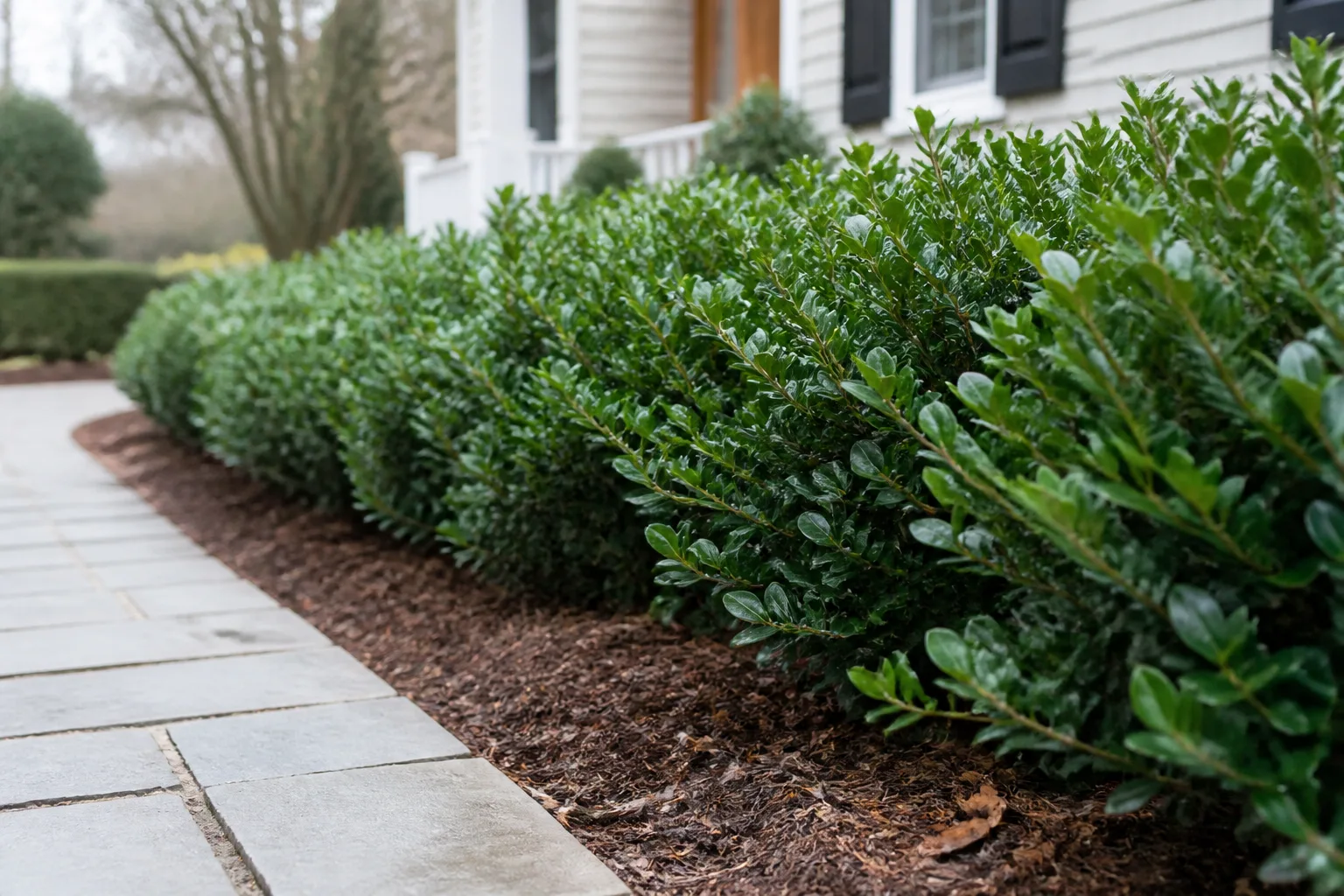
For a hedge, leaf texture and pruning response may matter more than berries. Japanese holly has small leaves and a dense, boxwood-like habit. Inkberry offers a native evergreen alternative but may sucker and become bare at the base with age. Yaupon tolerates heat, salt spray, drought, and hard pruning, but it can form thickets if suckers are left in place. These tradeoffs are more useful than a ranking of “best” hollies.
Holly pollination: why a berry-free female may be healthy
Many holly species are dioecious: male and female flowers occur on separate plants. Only the female plant makes fruit, and it needs pollen from a male whose flowers open at the right time. Planting two hollies that bloom at different times—or two females—will not solve the problem. The University of Georgia Extension recommends checking the sex of the plant and explains that some named cultivars can fruit without a separate male, so the label matters (University of Georgia Extension).
For winterberry, use a compatible male cultivar such as ‘Jim Dandy’ or ‘Southern Gentleman’ and follow the nursery’s pairing recommendation. NC State Extension gives a practical starting point of one male for 10 to 20 female winterberries within about 50 feet (NC State Extension’s winterberry profile). Ratios vary among species and cultivars; for other hollies, a nearby male or a ratio around one male to five females is often used as a starting point (Walter Reeves’ pollination guide).
There are exceptions. Some Chinese holly cultivars, including ‘Burfordii’, can set fruit without a male, and some hybrids are partly or fully parthenocarpic. That does not mean every Chinese holly or every female hybrid will fruit alone. If berries are a purchase priority, buy a cultivar with a documented pollination requirement and place the male close enough for bees to move between plants.
Quick comparison of 18 holly types
The sizes below are approximate mature ranges, not pruning targets. Species, cultivar, climate, soil, and whether a plant is grown as a tree or hedge can change the result. Check the tag and your local extension guidance before planting.
| Holly type | Evergreen? | Approx. size | Fruit and best fit |
|---|---|---|---|
| American holly (Ilex opaca) | Yes | 15–60 ft tall | Red or orange; native specimen, screen, or large hedge |
| Carolina holly (Ilex ambigua) | Usually deciduous | 15–20 ft | Red; southeastern native planting and dry, sandy sites |
| Catberry (Ilex mucronata) | Deciduous | 6–10 ft | Red; cool, moist, boggy, or shoreline habitat |
| Chinese holly (Ilex cornuta) | Yes | 3–25 ft | Red; heat-tolerant hedge or barrier, subject to local invasive checks |
| Winterberry (Ilex verticillata) | Deciduous | 3–15 ft | Red, orange, or yellow cultivars; moist acidic sites |
| Dahoon holly (Ilex cassine) | Yes | About 20–30 ft in the wild | Red; wet coastal or southern woodland planting |
| English holly (Ilex aquifolium) | Yes | 30–50 ft | Red; cool, well-drained sites where it is not invasive |
| Finetooth holly (Ilex serrata) | Deciduous to semi-evergreen | 6–15 ft | Red; cold-climate shrub and winterberry-like display |
| Hawaiian holly (Ilex anomala) | Yes | 30–40 ft | Purple-black; warm, moist Hawaiian landscapes |
| Inkberry (Ilex glabra) | Yes | 5–10 ft; smaller cultivars available | Black; native hedge, rain garden edge, or wildlife planting |
| Japanese holly (Ilex crenata) | Yes | 3–10 ft; many cultivars are 3–4 ft | Black; formal hedge, border, foundation, or topiary |
| Longstalked holly (Ilex pedunculosa) | Yes | 10–30 ft | Red berries on long stalks; distinctive specimen |
| Lusterleaf holly (Ilex latifolia) | Yes | 15–25 ft | Red or orange; large-leaved specimen or woodland screen |
| Myrtle-leaf holly (Ilex myrtifolia) | Yes | 15–30 ft | Red or yellow; wet, warm, coastal-plain planting |
| Round-leaf holly (Ilex rotunda) | Yes | 30–40 ft | Red; large, smooth-leaved specimen or street-tree setting |
| Blue/Meserve holly (Ilex x meserveae) | Yes | 3–15 ft | Red; cold-hardy hedge, foundation, or barrier |
| Yaupon holly (Ilex vomitoria) | Yes | 4–30 ft, depending on form | Red; heat, drought, salt, hedge, topiary, or container |
| Yerba mate (Ilex paraguariensis) | Yes in warm climates | 20–60 ft outdoors | Dark fruit; subtropical specialty or container plant |
The 18 holly types in detail
Native evergreen hollies
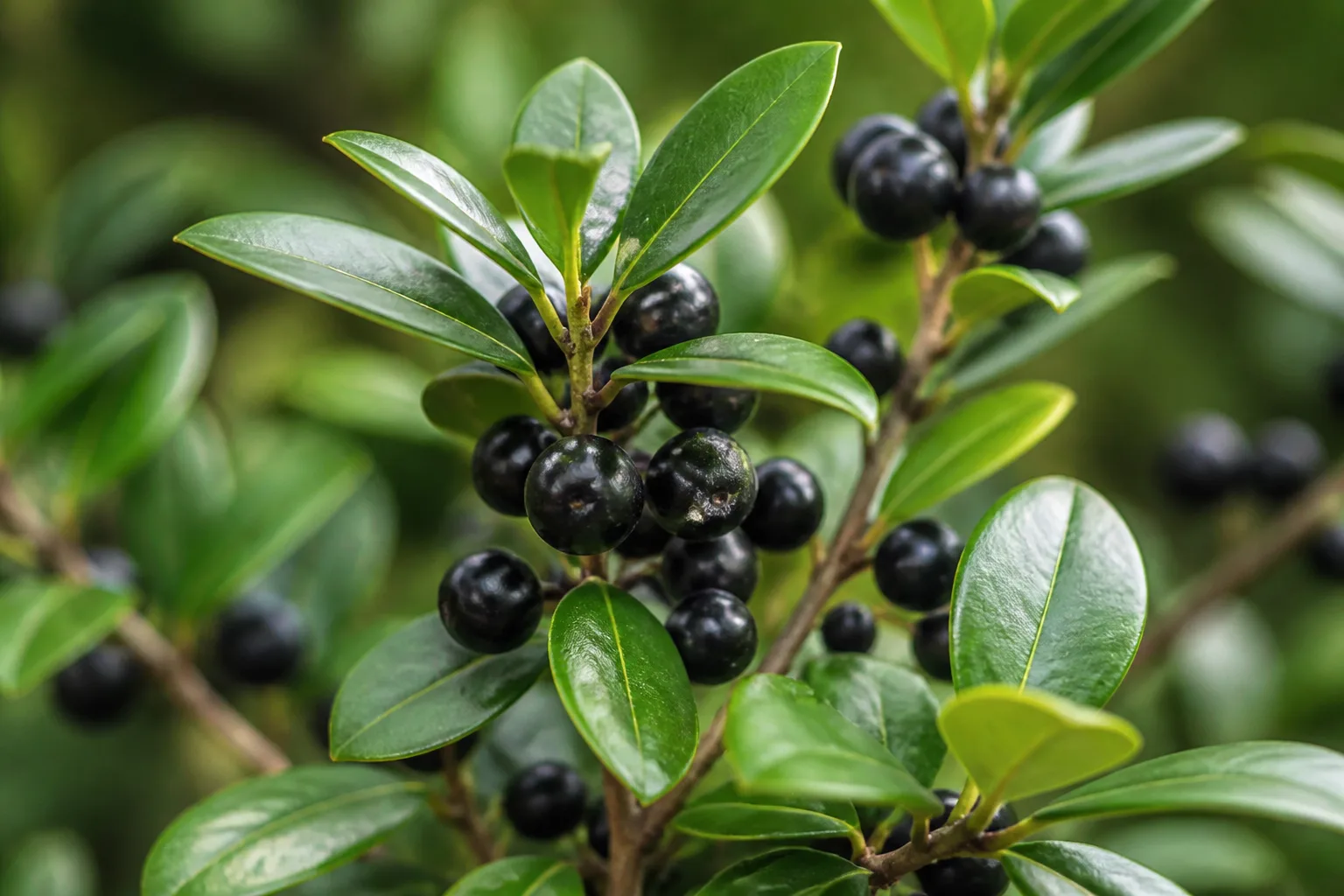
1. American holly (Ilex opaca) is the classic native evergreen tree of the eastern and central United States. It has stiff, spiny leaves and red to orange fruit, and it works best as a specimen, screen, or spacious informal hedge. NC State Extension describes mature trees in the broad range of 40 to 60 feet, while cultivated trees may remain smaller (American holly profile). Give it acidic, moist but well-drained soil, protect it from drying winter wind, and do not squeeze it into a small foundation bed. It dislikes alkaline or limestone soil and does not want standing water.
2. Carolina holly (Ilex ambigua) is a southeastern native that is often deciduous or semi-evergreen depending on climate. Its red fruit and tolerance for drier, sandy conditions make it useful where a bog-loving winterberry would struggle. Give it room to become a small tree or large shrub, and treat it as a regional native rather than a universal substitute for American holly.
3. Inkberry (Ilex glabra) is one of the most versatile native evergreen hollies for the eastern United States. Its spineless, glossy leaves and black berries suit foundation beds, low screens, rain-garden edges, and wildlife plantings. NC State Extension notes that it tolerates moist to occasionally wet soil and can sucker into colonies (inkberry profile). Cultivars such as ‘Densa’ are more compact, but even compact plants can become open or bare at the base as they age. Remove unwanted suckers and prune lightly rather than shearing the shrub into a tight shell.
4. Yaupon holly (Ilex vomitoria) is the warm-climate problem solver. It tolerates a remarkably wide range of soils, drought, salt spray, occasional flooding, and shade, although full sun generally produces denser growth and better fruit. Standard forms can become 10 to 20 feet tall, while dwarf and weeping cultivars are far smaller. It is excellent for coastal screens, native hedges, topiary, and large containers. NC State Extension cautions that it can form thickets if suckers are not removed (yaupon profile). Buy it for its landscape form; do not turn a nursery plant into a homemade tea ingredient simply because the species has a history of use.
5. Dahoon holly (Ilex cassine) is a southern evergreen small tree for moist woods, coastal plains, and wet garden edges. It has relatively smooth leaves, red fruit, and tolerance for shade and wet conditions, but it is cold-sensitive and dislikes root disturbance. NC State Extension’s dahoon holly profile places it in the warm, moisture-loving end of the holly range. Use it where winters are mild and the soil stays consistently moist, not in an exposed northern yard or a compacted planting strip. Its eventual size is easier to manage when the tree has room to develop naturally.
6. Myrtle-leaf holly (Ilex myrtifolia) is another warm, wet-site specialist. Its narrow leaves and red or yellow fruit bring variation to a coastal-plain or swamp-inspired garden. NC State Extension’s myrtle-leaf holly profile notes its preference for moist coastal-plain conditions. It tolerates shade and moist soil but is not a good choice below its warm hardiness range, and its roots resent disturbance. Plant it once in the right place rather than planning to move it after it reaches tree size.
Deciduous and wet-site hollies
7. Winterberry (Ilex verticillata) is the standout choice for bright berries on leafless stems. It is native across much of eastern North America and thrives in moist, acidic soil beside ponds, rain gardens, and woodland margins. It can tolerate some drought once established, but dry soil can reduce or abort the fruit display. It also needs a compatible male plant; select the male by flowering time, not just by another attractive label. Use winterberry when you want a seasonal fruit show rather than year-round screening.
8. Catberry (Ilex mucronata), sometimes listed under the older name Nemopanthus mucronatus, is a deciduous, spineless holly relative with dangling red fruit. It prefers cool, moist, boggy, or shoreline conditions and is a better fit for a naturalistic habitat planting than a clipped foundation hedge. Its open texture can be an advantage beside ferns, sedges, and other moisture-loving plants.
9. Finetooth holly (Ilex serrata) is a deciduous or partly deciduous Asian holly often grown for small red fruits and a winterberry-like silhouette. It suits cooler gardens and can work where a larger winterberry is too coarse, but cultivar hardiness and pollination requirements vary. Ask the nursery which male is compatible before buying a female plant, especially if fruit is the reason for choosing it.
10. Round-leaf holly (Ilex rotunda) is an evergreen Asian tree with smooth, rounded leaves and red fruit. It belongs in a warm, spacious landscape where a large specimen or street-tree form is appropriate—not in a narrow border that will require constant reduction. Its lack of prominent spines makes it more approachable near circulation areas than heavily armed hollies, but mature width still controls placement.
Asian, hybrid, and specialty hollies
11. Chinese holly (Ilex cornuta) is valued for heat tolerance, drought tolerance after establishment, and dense, spiny foliage. Depending on cultivar, it can be a compact hedge or a much larger barrier plant. ‘Burfordii’ is a notable cultivar that can fruit without a separate male, but do not generalize that trait to every Chinese holly. NC State Extension also notes that Chinese holly has escaped or naturalized in parts of the Southeast (Chinese holly profile). Check your state and county invasive-plant lists before planting it near natural areas.
12. Japanese holly (Ilex crenata) is the small-leaved, formal-looking option. Species plants can reach 5 to 10 feet, but many cultivars stay around 3 to 4 feet and respond well to clipping and topiary. Use it for a neat border, low hedge, or foundation planting where the soil is acidic and well drained. NC State Extension notes that high pH can yellow its leaves and that extreme heat and humidity can reduce performance (Japanese holly profile). It is a poor choice for a soggy bed or a hot site with alkaline soil.
13. Blue or Meserve holly (Ilex x meserveae) is a hybrid group prized for blue-green foliage, red fruit, and better cold tolerance than English holly. Plants commonly used in landscapes range from roughly 3 to 8 feet, although some can become larger. Plant a compatible male such as ‘Blue Prince’ near female cultivars when fruit is important; NC State Extension gives a starting ratio of one male for three to five females (Meserve holly profile). It makes a strong cold-climate hedge, but give it acidic, moist, well-drained soil and protection from drying winter wind.
14. English holly (Ilex aquifolium) has the glossy, sharply spined leaves and red berries associated with holiday arrangements. It can become a 30- to 50-foot tree and prefers cool, well-drained conditions rather than hot, humid summers or wet soil. It is also a plant to research locally: NC State Extension identifies it as naturalized or invasive in parts of the Pacific Northwest and lists regional invasive concerns (English holly profile). Do not plant it near wildlands where your local agency discourages it.
15. Lusterleaf holly (Ilex latifolia) makes a statement with very large, glossy leaves—among the largest in the genus—and red to orange fruit. NC State Extension’s lusterleaf holly profile lists it as a sizable evergreen for a spacious landscape. It can become a 15- to 25-foot specimen or screen. Give it room, acidic soil, and protection from extremes; high-pH soil can cause yellow foliage, while very hot, humid conditions may limit performance. It is a better choice for a woodland edge or spacious mixed border than a narrow formal hedge.
16. Longstalked holly (Ilex pedunculosa) earns its name from the long stalks that suspend red berries away from the branches. The Missouri Botanical Garden describes it as a broadleaf evergreen shrub or small, often multi-trunked tree with narrow, glossy leaves and a usual landscape height near 15 feet (Missouri Botanical Garden’s longstalked holly profile). Use it as a distinctive specimen where the fruit can be seen against a simple background; its unusual berry display is the reason to choose it over a generic hedge holly.
17. Hawaiian holly (Ilex anomala) is a warm-climate specialty tree native to the Hawaiian Islands. It is evergreen and can reach roughly 30 to 40 feet, with dark fruit and a preference for moist conditions. It belongs in suitable Hawaiian landscapes rather than being treated as a broadly adaptable mainland shrub. Climate, local availability, and the exact island form should guide the choice.
18. Yerba mate (Ilex paraguariensis) is an evergreen subtropical holly grown primarily for cultural and specialty interest. Outdoors it becomes a substantial tree in warm climates, while cooler gardeners may grow it as a container plant that is moved or protected. Its foliage is associated with a caffeinated beverage, but correct species identification and food-safety guidance matter; this is not a reason to harvest leaves casually from an ornamental plant.
Planting and caring for holly
Light, soil, and water
Most landscape hollies perform best in full sun to partial shade. More sun generally means denser growth and better berry production, but a temperate evergreen holly may appreciate afternoon protection in a hot climate. Deciduous winterberry can grow in partial shade, though heavy shade often reduces flowering and fruit.
Aim for soil that is acidic to slightly acidic, rich in organic matter, and well drained. “Moist” means the root zone does not dry out; it does not always mean the roots sit underwater. Winterberry, inkberry, dahoon, and myrtle-leaf holly are more tolerant of wet conditions than many evergreen species, but even they need the right climate and oxygenated root zone. Test the soil before adding amendments. If a Japanese, American, or lusterleaf holly has yellow leaves, check pH and drainage before reaching for fertilizer.
Plant in fall or early spring when the weather is cool and the ground is workable. Dig a hole about twice as wide as the root ball but no deeper. Set the root flare at the soil surface, backfill with the soil you removed, water slowly, and apply a 2- to 3-inch mulch layer without piling mulch against the trunk. During the first growing season, water deeply enough to moisten the full root ball whenever the upper soil begins to dry; adjust for rainfall and soil type.
Pruning, spacing, and establishment
Measure the plant’s mature width before you decide on spacing. A hedge planted too close to a walk or wall may look full quickly but become a constant pruning project. For a screen, space plants so their mature canopies can overlap lightly; for a specimen, leave enough room to see its natural outline.
Prune most hollies in late winter or early spring before the main flush of growth, removing dead, crossing, or poorly placed branches first. Make reduction cuts back to a side branch rather than repeatedly shearing the outer inch of foliage. Heavy shearing can create a dense green surface with a shaded, bare interior. If you want berries, remember that pruning timing can remove flowering wood or reduce the season’s fruit.
Yaupon and inkberry may send up suckers. Remove unwanted shoots at their origin when they are young. Chinese holly and Japanese holly tolerate shaping, but that does not make a too-large cultivar a good long-term fit. Let a tree-form American, dahoon, lusterleaf, or round-leaf holly develop its trunk and branch structure instead of forcing it into a small hedge.
Pests, yellow leaves, and transplant stress
Common holly problems include leafminers, scale, spider mites, whiteflies, leaf spots, and root disease. Start with diagnosis: inspect leaf undersides, look for sticky honeydew or stippling, and check whether water is pooling around the roots. Improve airflow, correct irrigation, and remove badly damaged material before applying any treatment. Use only a product labeled for the plant and pest, and follow its directions.
Yellow leaves often point to high pH, poor drainage, drought stress, root injury, or winter scorch—not necessarily a need for more nitrogen. American holly is particularly unhappy in limestone-influenced soil, while Japanese and lusterleaf hollies can show chlorosis when pH is too high. Dahoon and myrtle-leaf hollies may decline after root disturbance, so choose the final planting spot carefully. Protect evergreen hollies from drying winter wind and sudden winter sun where that is a known regional problem.
Wildlife, pets, and practical safety
Holly fruit can be valuable wildlife food, but wildlife value is not the same as human edibility. The ASPCA lists holly as toxic to dogs, cats, and horses; its listed toxic principle is saponins, and possible signs include vomiting, diarrhea, and depression. The organization also describes the leaves and berries as low toxicity (ASPCA’s holly safety listing). Keep pets and young children from chewing the plant, and contact a veterinarian or poison-control service promptly after a suspected ingestion.
Spiny leaves can make an effective security barrier, but they can also scratch children, pets, and anyone using a narrow path. Place heavily armed American, Chinese, and English hollies away from play areas, doorways, and walkways. If you want a safer touch point near a patio, consider a smooth-leaved inkberry, yaupon, dahoon, or round-leaf holly—while still checking mature size and site needs.
Finally, screen the plant for ecological fit. English holly is invasive or naturalized in some regions, and Chinese holly has similar concerns in parts of the Southeast. Local invasive-plant lists, county extension offices, and native-plant societies are better final authorities than a generic hardiness-zone chart.
A quick decision guide
- You want a native evergreen with berries: Start with inkberry for a shrub, yaupon for heat and coastal tolerance, or American holly when you have room for a tree.
- You want red berries on bare winter stems: Choose winterberry for a moist acidic site, and buy a compatible male at the same time.
- You need a formal small hedge: Look at compact Japanese holly cultivars or a suitable Meserve holly, matching the plant to your climate and soil pH.
- Your site is hot, dry, or salty: Yaupon is usually the first holly to investigate; Chinese holly may fit in some regions after an invasive-plant check.
- Your site stays moist: Winterberry, inkberry, dahoon, myrtle-leaf holly, or catberry may fit, but choose by climate and drainage—not by the word “wetland” alone.
- You need a large specimen: American, lusterleaf, round-leaf, English, or longstalked holly can provide scale, but verify mature width before planting near a house.
- You have a cold, exposed yard: Meserve holly is often a better evergreen hedge candidate than English holly; protect the planting from winter wind and confirm the cultivar’s zone.
- You have pets or a busy walkway: Keep fruiting and spiny hollies out of reach, and favor smooth foliage where people brush past the plant.
Conclusion
The right holly is the one whose mature size, evergreen habit, moisture tolerance, pollination needs, and regional status match the site. Winterberry is excellent for wet-season fruit, inkberry and yaupon solve different evergreen screening problems, Japanese holly brings fine texture to formal beds, and American or Meserve holly can supply traditional structure in the right climate. Start with the landscape job, confirm the cultivar and pollinator requirements, then plant for the size the holly will become—not the size it is today.