Best Humidifiers for Plants: 9 Tested Options
Compare nine humidifiers for houseplants by room size, mist type, and humidistat accuracy. Learn RH targets, placement rules, and when a tray beats a machine.
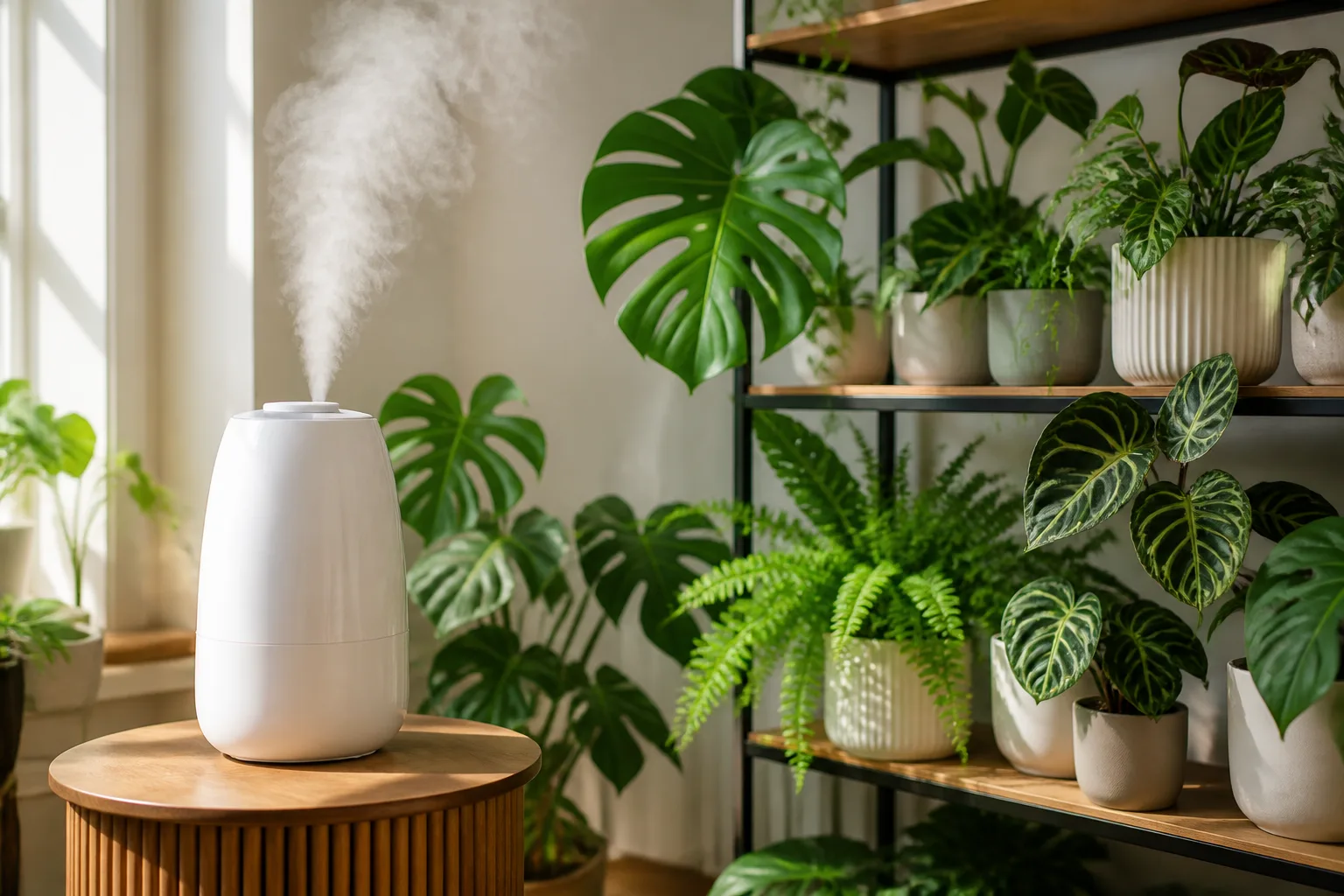
The best humidifier for plants is not the one with the cutest cloud-shaped tank. It is the one that raises relative humidity (RH) at leaf height in the room where your tropicals actually live—without soaking crowns, fogging windows past safe limits, or coating furniture in mineral dust. A $40 cool-mist unit placed for air mixing often beats a $140 tower aimed at a single monstera at six inches.
This guide ranks nine portable humidifiers for common plant-room jobs: a dense bedroom shelf, a single calathea cluster, a sunroom jungle, and everything between. Picks are sorted by room volume, mist type, maintenance tolerance, and control features—not by which box has the most “plant” keywords on Amazon.
Before you buy, read houseplant humidity targets and buy a hygrometer. After you buy, read humidifier placement for houseplants. If you are still deciding between hardware and a tray, see pebble tray vs humidifier.
Quick Comparison: Nine Humidifiers by Plant-Room Job
| Pick | Model | Best for | Tank | Mist type | Humidistat / smart |
|---|---|---|---|---|---|
| Overall | Dreo HM311S | Bedroom plant shelf | 4 L | Cool ultrasonic | Yes + app |
| Smart | Levoit OasisMist 450S | Scheduled RH control | 4.5 L | Warm + cool | Yes + app |
| Bedroom | Vicks FilterFree Plus | Simple nightly run | 1.7 L | Cool ultrasonic | No |
| Small cluster | HoMedics Total Comfort | Desk / windowsill trio | 1.9 L | Cool ultrasonic | Timer only |
| Warm mist | Dreo HM713S | Cold tropical corner | 6 L | Warm + cool | Yes + app |
| Value | Levoit Dual 150 | Single sensitive plant | 3 L | Cool ultrasonic | No |
| Portable | Raydrop | Desk ↔ bedside rotation | 1.7 L | Cool ultrasonic | No |
| Design | Pure Enrichment Cloud | Nightstand aesthetic | 1.8 L | Cool ultrasonic | No |
| Large room | Dreo 735S | Sunroom / floor specimens | 11 L | Cool ultrasonic | Yes + app |
Prices shift seasonally; treat the table as a job map. A humidistat matters when you sleep with the unit running. A huge tank matters when you cannot refill twice daily in a plant-heavy room.
When Your Plants Actually Need a Humidifier
Not every crispy edge means “buy a humidifier.” Penn State Extension is blunt: if the air is comfortable for you in a heated winter home, many houseplants will tolerate it—and light and watering mistakes cause more winter death than humidity alone.
Buy or upgrade a humidifier when:
- A hygrometer at leaf height reads below ~40% RH for weeks while tropical foliage shows stress (calathea, fern, peace lily, fiddle-leaf fig).
- You run forced-air heat and RH crashes into the 20–30% band common in winter (why houseplants struggle in winter).
- Grouping plants and a pebble tray did not move the meter at the shelf—only the air directly above wet stones.
- You keep a large plant room or sunroom where one small desk unit cannot change volume.
Skip or delay when:
- Symptoms match overwatering (yellowing with wet soil, soft stems) or low light (pale stretchy growth)—fix those first.
- RH already sits 50–60% at the canopy; more moisture invites mold on walls and furniture.
- You own mostly succulents and cacti that prefer drier air.
Target Humidity Levels and How to Measure at Plant Height
University of Nebraska Extension places most houseplants around 40–60% RH. Tropical collections often look best near 50–60% at leaf height in winter. Succulents and cacti tolerate much lower; misting them is usually pointless.
Penn State Extension cites ASHRAE’s indoor comfort band of roughly 30–60% RH for people—winter heating often pulls homes below 30%, which is where both humans and moisture-loving plants feel the dryness.
Whole-home caution: EPA humidifier guidance recommends not exceeding ~50% RH when humidifying living spaces because damp areas, dust mites, and mold risk rise above that band. Plant targets and household safety overlap—but they are not identical. Run to a plant-height hygrometer, not a display sitting in the mist plume.
Signs of Low Humidity vs Overwatering and Low Light
Low humidity usually shows as crispy brown leaf margins, leaf curl on thin tropical foliage, dull leaves, and spider mite flare-ups when air is dry and warm. Overwatering adds yellowing lower leaves, soggy soil smell, and soft stems. Low light adds long internodes and faded color without the dry-tip pattern.
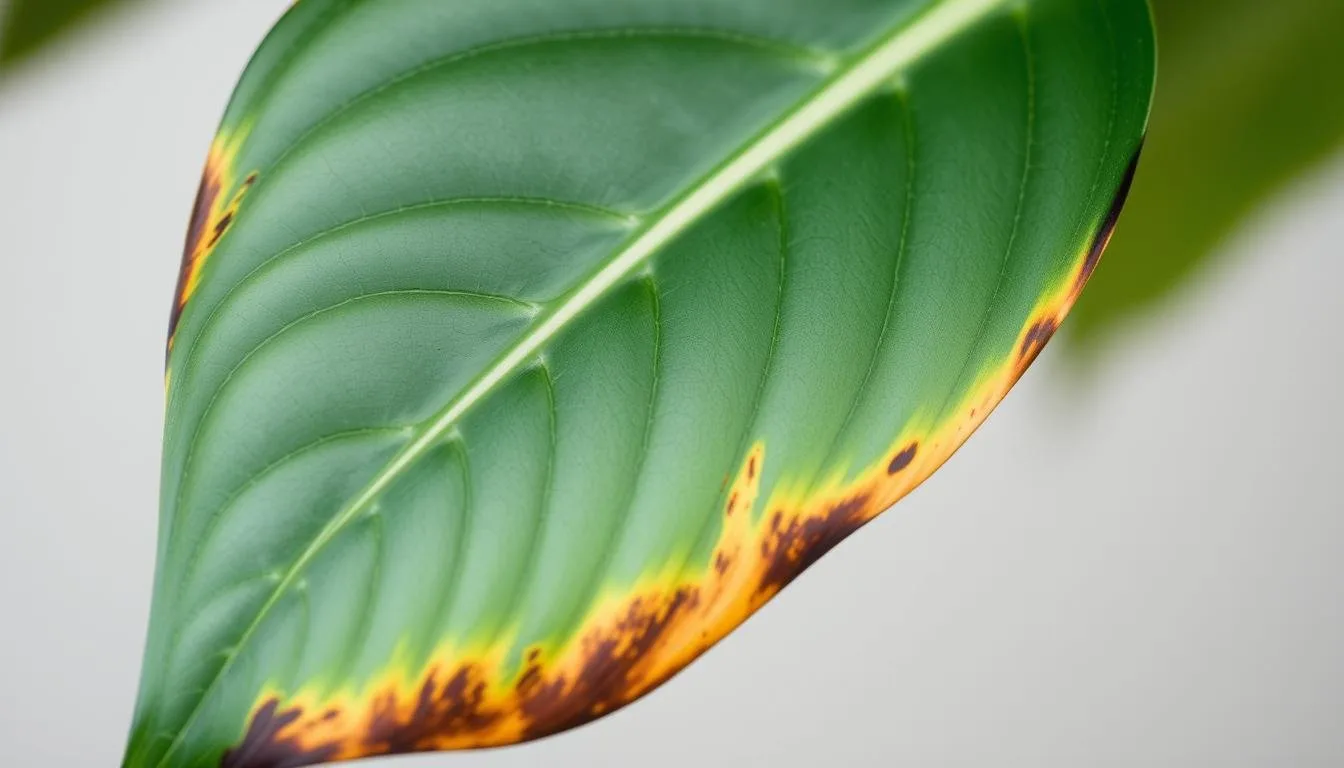
If you water more because leaves look “thirsty” but RH is already high and soil stays wet, you are solving the wrong problem. NC State Extension warns that wilt and yellowing often mean too much water, not drought.
Ultrasonic, Evaporative, and Warm Mist: What Works in Plant Rooms
Ultrasonic cool mist is the default for plant rooms: fine vapor disperses quickly, noise stays low, and units are inexpensive. Trade-off: tap water can leave white mineral dust on leaves and furniture—EPA notes ultrasonic and impeller types disperse minerals and microbes if tanks are dirty. Use distilled or low-mineral water when possible.
Evaporative humidifiers wick water through a filter and blow evaporated moisture. They self-limit humidity somewhat (harder to overshoot), reduce visible “fog,” and cut mineral dust—but filters need replacement and units are louder.
Warm mist heats water before release. It can raise room temperature slightly and feel comforting in a cold plant corner—useful for tropical collections in drafty rooms. Trade-off: weekly cleaning matters more because heat encourages scale and bacterial growth in tanks. Warm mist is not magic for plants; cool mist at the right RH works for most species.
For most growers: cool-mist ultrasonic with a humidistat wins. Choose warm mist when you want heat plus humidity in one cold room full of tropicals.
What to Look for Before You Buy
Tank Size, Runtime, and Real Room Coverage
Manufacturer “square foot” claims assume sealed boxes. Real plant rooms have doors, HVAC, and leaky windows. Use tank size as a runtime and refill guide:
| Tank volume | Typical runtime (medium output) | Best for |
|---|---|---|
| 0.5–1.7 L | 8–12 hours | Desk cluster, 1–3 pots |
| 3–4.5 L | 24–32 hours | Bedroom shelf, 10–20 plants |
| 6 L | 36–60 hours | Medium plant room |
| 11 L+ | Multi-day on low | Large sunroom, tall specimens |
A 4 L class unit is the sweet spot for most bedrooms with a serious plant shelf. A 11 L tower is for when one room holds dozens of floor pots and you refuse to refill twice a day.
Humidistats, Hygrometers, and Smart Controls
A built-in humidistat stops the unit at a set RH—essential for overnight runs. Do not trust the number on the humidifier face if the sensor sits in the mist plume. Pair every purchase with a separate hygrometer at plant height (humidifier placement guide).
Smart app control helps when the plant room is far from the bed—you can check RH and schedule runs without opening a door that dumps humidity. Nice-to-have, not required.
Best Overall: Dreo HM311S 4L Smart Humidifier
Job: Best all-around for a small-to-medium plant bedroom (roughly 200–350 sq ft) with a dense shelf.
The Dreo HM311S balances 4 L capacity, quiet ultrasonic output, top-fill convenience, and app + onboard humidistat at a sub-$60 price. In plant-heavy bedrooms, it typically moves RH from the low-40s toward 55–60% at the shelf when aimed into open air—not directly at leaves—and refills about once a day on medium with a 50% target.
Why plants like it: Adjustable output, long runtime, and no filter cartridge to replace. Why growers like it: Easy wipe-down tank, visible water line, optional essential-oil tray (skip oils if leaves are sensitive).
Limits: No warm mist. Not enough output for a full sunroom alone. Like all ultrasonics, prefer distilled water on dark furniture and fuzzy leaves.
Skip if: You need warm mist in a freezing corner, or you humidify a sunroom larger than ~350 sq ft with one unit.
Specs snapshot: ~4 L tank | up to ~32 hr runtime | ~300 sq ft rated coverage
Best Smart Humidifier: Levoit OasisMist 450S
Job: App-first control for growers who want scheduling, RH targets, and warm + cool mist in one chassis.
The OasisMist 450S is the pick when you want warm and cool mist, a large 4.5 L tank, and VeSync app automation—run to 55% while you are at work, drop overnight, or sync with a smart plug routine. Visible mist output is strong; place it 3–5 feet from foliage so crowns stay dry.
Trade-offs: Cleaning takes longer than simple cool-mist-only units—warm-mist paths need descaling. The app is powerful but optional; you can run from the touch panel. Plant-scan features in the app are fun but RH at leaf height still beats any plant-ID humidity guess.
Skip if: You want a dumb dial humidifier and will never open an app—or you hate descaling warm-mist paths.
Specs snapshot: ~4.5 L | up to ~45 hr | ~430 sq ft rated
Best for Bedrooms: Vicks FilterFree Plus Cool Mist
Job: Simple bedroom humidifier that also supports a modest plant shelf—no app, no learning curve.
The Vicks FilterFree Plus is filter-free ultrasonic cool mist with basic dial control and optional Vicks scent pads (skip pads if you dislike fragrance near sensitive leaves). Growers who run it nightly often see less frequent watering on the same shelf because transpiration slows when air is not desert-dry.
Trade-offs: Bottom-fill tank—flip to refill. No humidistat; pair with a hygrometer and timer discipline. Smaller tank (~1.7 L) means refill before a full night on high. Scent pads are optional; fragrance near fuzzy leaves can irritate sensitive species.
Skip if: You need smart scheduling or a humidistat—you will forget it on high and overshoot RH.
Specs snapshot: ~1.7 L | ~9 hr on high | ~220 sq ft rated
Best for Small Plant Clusters: HoMedics Total Comfort
Job: Compact tabletop unit for a windowsill trio or desk cluster.
HoMedics Total Comfort packs a 0.5 gal (~1.9 L) tank, color nightlight, timer presets, and steady cool mist into a footprint that fits end tables and plant stands. It is ideal when you need localized help for 3–6 pots without humidifying the whole apartment.
Trade-offs: Cleaning access is awkward around the heating chamber—budget weekly wipe-downs. Not a whole-room solution.
Specs snapshot: ~1.9 L | up to ~24 hr on low | ~373 sq ft rated (optimistic for plant rooms—treat as cluster tool)
Best Warm Mist for Tropical Collections: Dreo HM713S 6L
Job: Cold room + tropical humidity—philodendrons, ferns, and monsteras in a drafty corner that needs both warmth and moisture.
The HM713S adds warm mist, a 6 L top-fill tank, and smart controls. Warm output can lift room temperature slightly while pushing RH—helpful when winter glass is cold and tropical leaves curl. Noise stays library-quiet on low.
Trade-offs: Weekly cleaning is non-negotiable on warm-mist paths. Tank is heavy when full—keep the base near the fill station.
Specs snapshot: ~6 L | up to ~60 hr | ~550 sq ft rated
Best Value: Levoit Dual 150 Ultrasonic Cool Mist
Job: Budget top-fill for a single sensitive plant or small cluster.
Levoit’s Dual 150 is the under-$45 workhorse: 3 L top-fill, dial control, quiet operation, wide tank opening for cleaning. RH rise is strong within a few feet—perfect beside one dramatic calathea or a propagation tray.
Trade-offs: No humidistat. Effect fades across the room; do not expect one Dual 150 to fix a 15-foot sunroom.
Specs snapshot: ~3 L | up to ~25 hr | ~290 sq ft rated
Best Portable and Design Picks: Raydrop and Pure Enrichment Cloud
Raydrop Cool Mist — best portable: Under 2 lb, ~1.7 L, dial mist, whisper-quiet. Slide it between a desk plant and a bedside table seasonally. Refill from the bottom opening; soak the tank in vinegar when scale appears— you cannot wipe deep inside every crevice.
Pure Enrichment PureBaby Cloud — best design: Cloud-shaped 0.47 gal tank, color-changing nightlight, adjustable mist dial. Fits nightstands and narrow shelves where a tall tower looks wrong. Cleaning around cloud curves takes patience; use the included brush on the nozzle.
Both are cluster tools, not plant-room engines. Pair with a hygrometer and expect to run on medium-high near the plants you care about most.
Best for Large Plant Rooms: Dreo 735S 11L Smart Humidifier
Job: High-output tower for large bedrooms, sunrooms, and collections with floor specimens.
The 735S puts 11 L and strong ultrasonic output into a slim tower that fits between tall containers. App control, remote, and RH targeting help when you are humidifying hundreds of square feet of plant volume. Refill with a pitcher—too tall for most sinks.
Trade-offs: Many small parts to scrub; nooks collect biofilm if you skip maintenance. Easy to overshoot RH in a closed room—use a humidistat and watch windows for condensation. Mineral dust on nearby leaves signals tap water in an ultrasonic—switch to distilled.
Skip if: You only humidify a six-foot shelf; a 4 L class unit refills less painfully and fits tighter spaces.
Specs snapshot: ~11 L (~2.9 gal) | multi-day on low | ~700 sq ft rated
Placement, Cleaning, and When a Pebble Tray Beats a Machine
Placement quick rules (full detail: humidifier placement for houseplants):
- Start 3–6 feet from the nearest leaves on medium room units; closer only if leaves stay dry.
- Aim mist into open air near the group—not into crowns or soil.
- Elevate the unit 2–4 feet so vapor mixes; avoid soaking carpet.
- Stop if windows condense, leaves stay wet for hours, or you smell mustiness.
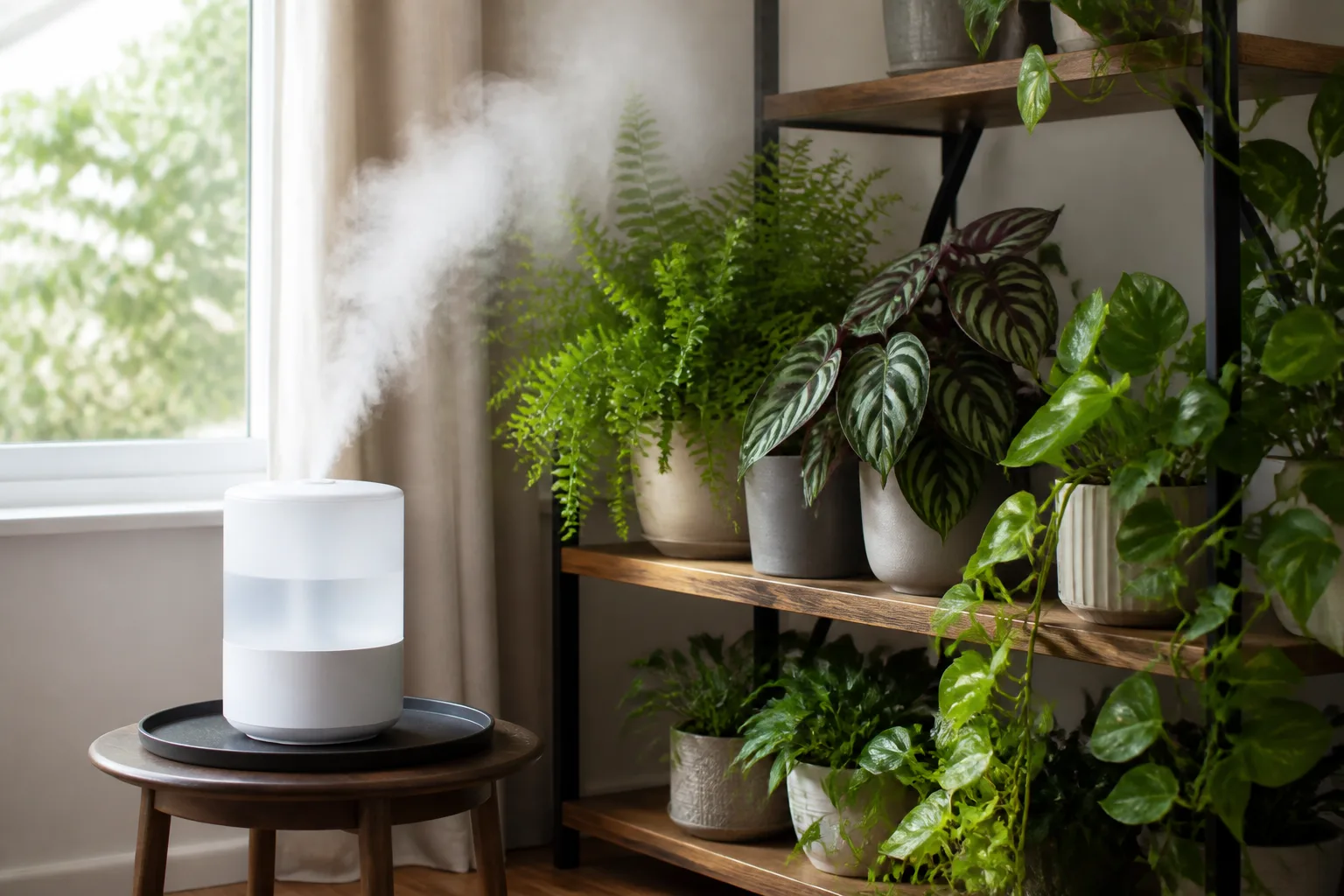
Cleaning: Empty daily when possible. CDC portable humidifier guidance recommends distilled or boiled-and-cooled water, daily emptying, and regular scrubbing. Warm-mist units need weekly descaling. Dirty tanks disperse microbes and minerals—bad for lungs and bad for leaf surfaces.
When a pebble tray beats a humidifier: Penn State Extension notes pebble trays and misting do little for whole-room RH—evaporated water diffuses into the entire space. Trays still help one pot in a stable microclimate when you cannot run a machine (office desk, guest room rules). PlantTalk Colorado favors grouping plants on gravel trays with pot bases above the waterline as a supplemental tactic—better than misting alone.
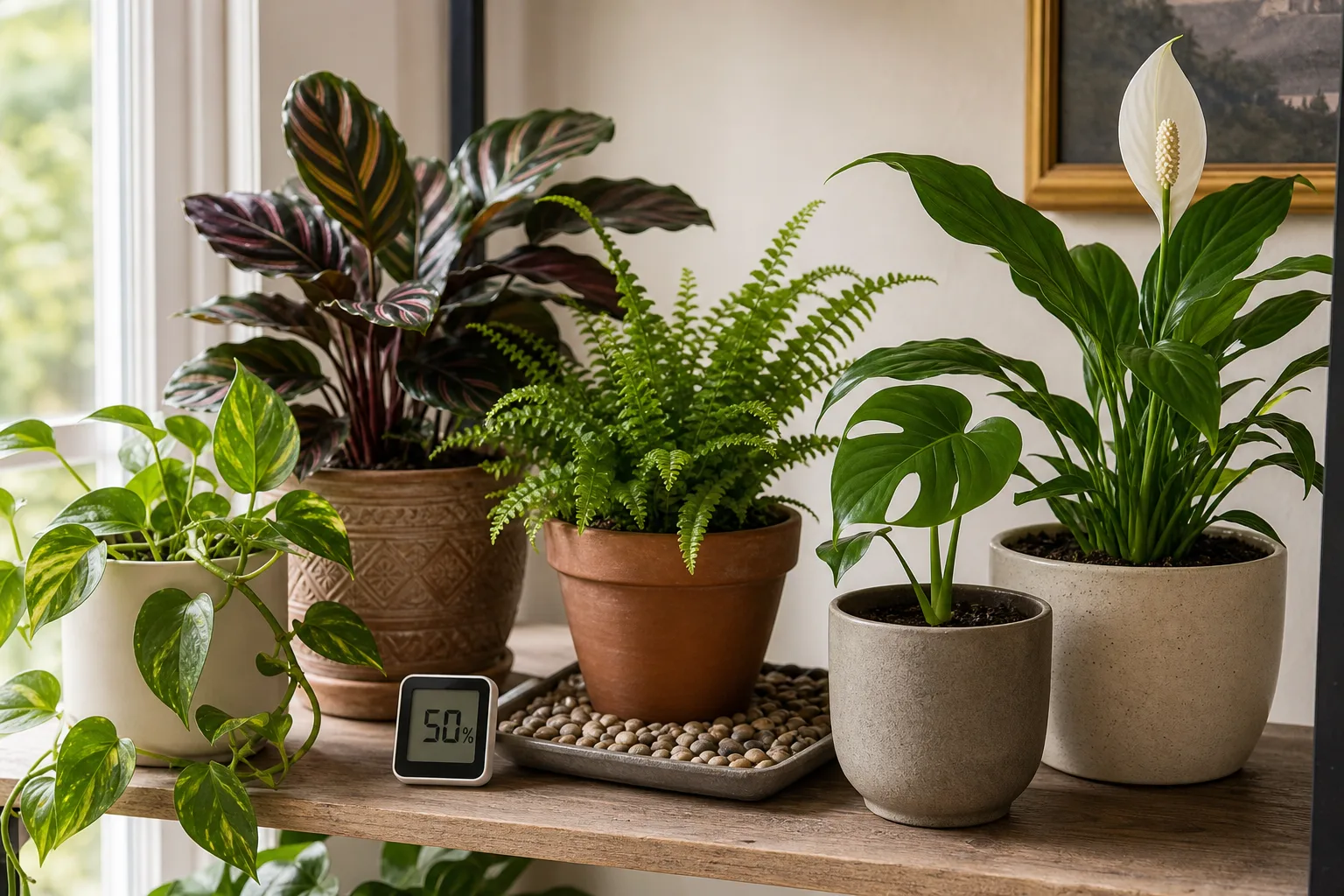
For tray setup, see DIY pebble tray for indoor plants. For the full tray-vs-machine decision, pebble tray vs humidifier.
Conclusion
The best humidifier for plants matches room volume, species, and your maintenance tolerance—not the word “plant” on the packaging. Buy a hygrometer first. If RH at leaf height stays below ~40% and tropical leaves show dry stress after you fix light and watering, a 4 L cool-mist ultrasonic with a humidistat (Dreo HM311S class) covers most bedrooms. Scale up to the 11 L Dreo 735S for sunrooms; scale down to Levoit Dual 150 or Raydrop for single-pot rescue.
Place for air mixing, run to a measured target, clean with distilled water, and stop before windows sweat. When a tray or grouping solves the problem, skip the machine. When winter dryness stacks with heating vents, the right humidifier—placed well—buys you hydrated leaves without drowning roots.