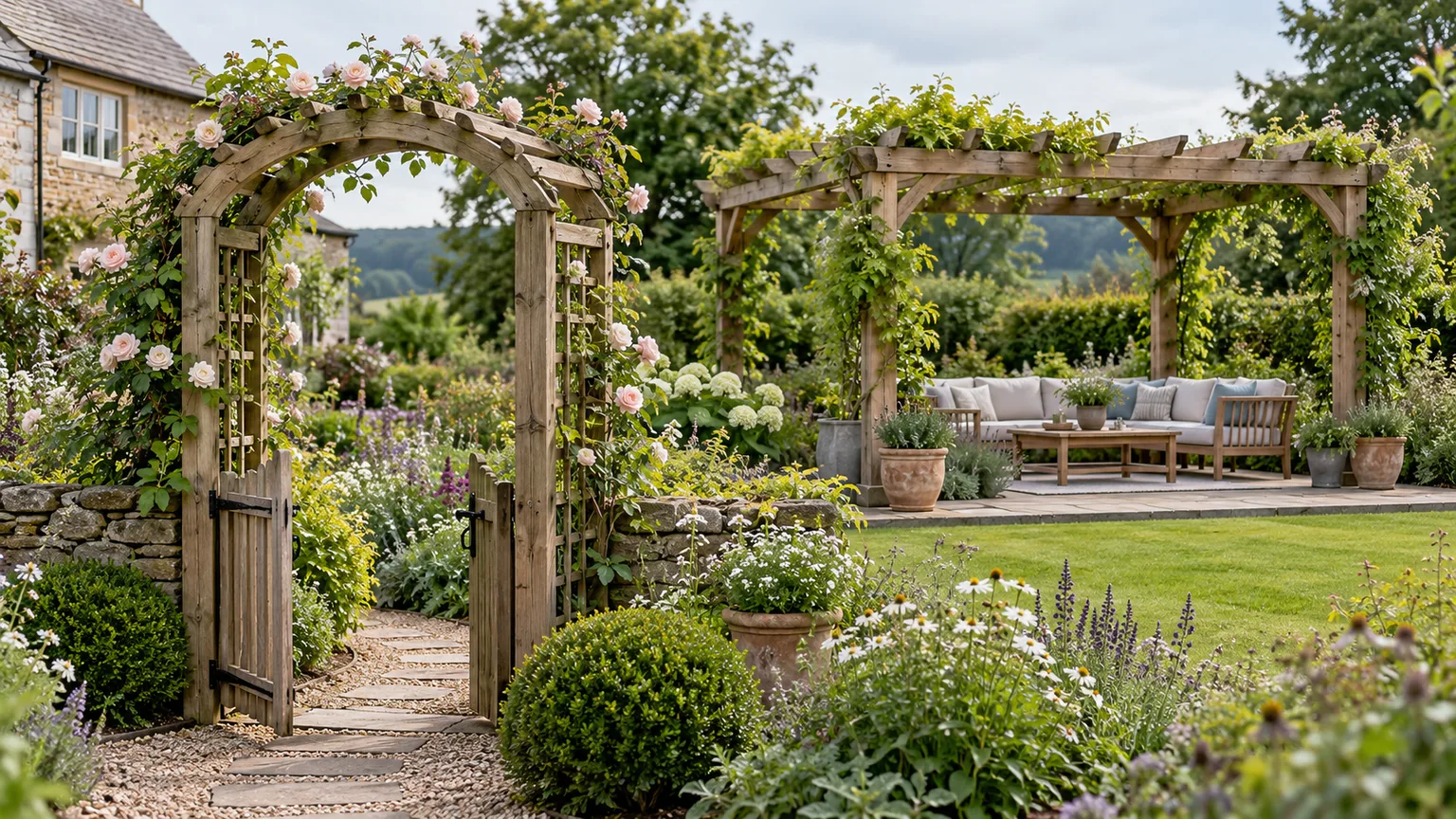
21 Stone Fire Pit Ideas for a Rustic Outdoor Space
Explore 21 stone fire pit ideas, from built-in seating walls to compact gravel patios, plus practical advice on placement, materials, and safe clearances.
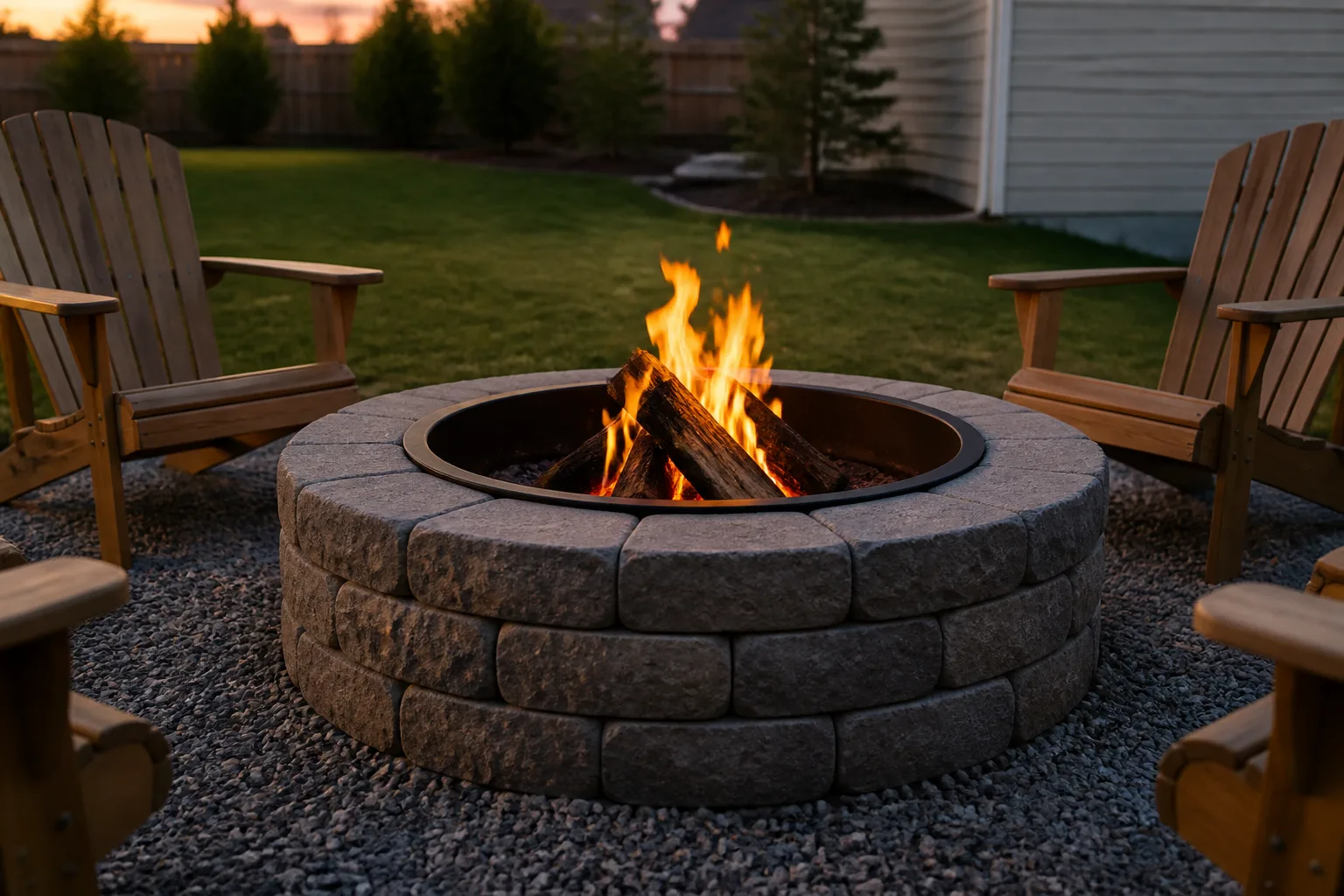
A stone fire feature can make a bare corner feel like a destination, but the most successful design is not necessarily the largest or most elaborate one. It is the one that fits the way people move through your yard, gives every seat a comfortable view, and uses a fire system appropriate for its setting. The stone supplies texture and a sense of permanence; the plan around it determines whether the space is easy to enjoy.
These 21 ideas range from a simple circular fire ring to a terraced patio with built-in seating. Treat them as design starting points, not one-size-fits-all construction plans. Before choosing a look, decide what fuel you want, check local fire rules, and map the complete area—including clearances, chairs, and the path back to the house.
Start With the Yard, Fuel, and Safety Limits
Begin at the site rather than with a catalog image. Note the prevailing wind, slope, views, low branches, nearby structures, gates, and the route people will use to reach the seating. A fire pit that looks tucked away in a photograph may be awkward in a narrow yard, smoke out a neighbor’s windows, or sit too close to a fence once the outer stonework is included.
Fuel changes the design. A wood-burning pit brings crackle, smoke, ash, sparks, and the need to store seasoned wood; its seating zone needs room for tending and ember management. Gas can make ignition and flame adjustment easier, but the burner, connection, ventilation, and decorative media must match the manufacturer’s system. Do not place a gas burner in an improvised stone cavity or assume that a wood-burning ring can be converted by dropping in a burner.
Clearance numbers are not universal. The U.S. Fire Administration advises placing outdoor fire pits at least 10 feet from a home or anything that can burn, while individual authorities may require more: the Kansas State Fire Marshal says 10 feet minimum and 25 feet preferred, and Unified Fire Authority distinguishes among open fires, contained pits, and gas appliances. Check your local fire department, burn restrictions, property rules, and product instructions before fixing the layout. A design that cannot meet the applicable clearance is a design to move or abandon, not a reason to squeeze furniture closer.
21 Stone Fire Pit Ideas, Grouped by Design Job
The ideas below are deliberately varied: some make the pit part of the architecture, others use loose furniture or an open landscape. Each can be scaled, but the surrounding walking area and safe separation need to scale with it too.
Built-In and Architectural Ideas
1. Stitch the pit into a seating wall. Set a round or square fire feature just in front of a low masonry wall so the wall frames the view without enclosing the flames. This works well on a broad patio where chairs alone would feel scattered. Keep the fire component independently rated and leave a clear approach; a wall can guide circulation, but it should not trap people between the fire and a boundary.
2. Make an L-shaped seat wall around a rectangular pit. The long lines of a rectangular burner or firebox pair naturally with an L-shaped bench. It makes a useful corner for conversation and can define the edge of a dining terrace. Leave one side open for entry and use movable chairs at the end so the arrangement can adapt when a larger group gathers.
3. Turn a change in grade into split-level seating. On a sloped yard, a retaining wall can become the back of a lower lounge, with a fire feature centered on its own level terrace. This can feel sheltered and gives the landscape a clear sequence from house to garden. Drainage and retaining-wall engineering matter more than the decorative capstone; avoid placing a flame beneath overhanging branches or a roof.
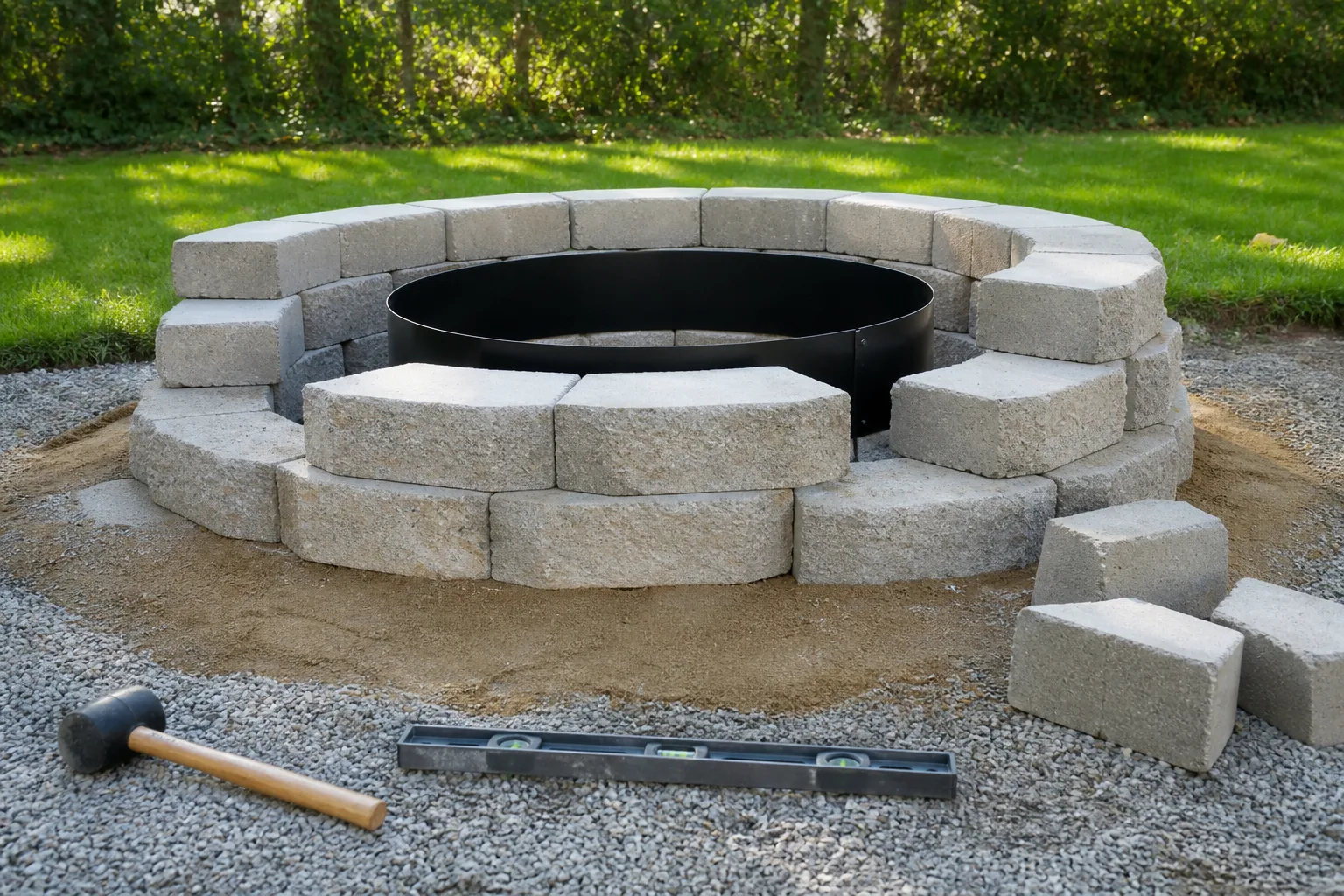
4. Use a raised stone ring as a crisp focal point. A circular ring built from uniform blocks feels orderly while still reading as rustic when the color is warm and the joints are understated. The raised edge helps define the fire zone and gives the patio a strong center. It is a useful option for a flat yard, but check seat heights: a broad cap may be comfortable for a short pause, not necessarily for an evening of sitting.
5. Build a corner court, not a corner trap. A fire feature near the meeting of two garden edges can make an underused part of the yard useful. A small stone pad, two chairs, and a low wall can create an intimate nook without paving the whole lawn. Keep the fire’s required separation from fences and buildings, and preserve an open route out of the nook so guests never have to pass close to the flame to leave.
Natural Forms and Tactile Materials
6. Give a classic circle a Tuscan palette. A ring in ochre, buff, or muted terracotta tones looks settled into a sunny garden, especially beside gravel or warm-toned paving. Repeat one of those colors in a wall cap or path rather than matching every surface exactly. The result feels composed instead of like a single kit dropped onto the patio. Use color and texture for the Tuscan character; do not rely on unverified loose stones for the hot inner firebox.
7. Frame the fire with a boulder-like surround. Large irregular stones create a more geological look than a neatly coursed ring. A mason can arrange them around a purpose-built liner so the outside feels rugged while the inside remains predictable. This suits a meadow edge, woodland garden, or cabin setting. Select pieces that are stable and do not create toe-catching gaps; an uneven sculptural rim is attractive, but it should not wobble under a hand or foot.
8. Pair a steel fire ring with fieldstone. Fieldstone gives a handmade appearance, while a metal ring supplies a defined inner boundary. This layered approach is easier to understand and maintain than asking decorative stone to do every job. Vary the outer stones, but keep the ring level and leave the manufacturer’s required space around any insert. It is a strong fit for an informal yard where a perfectly circular masonry pattern would look too formal.
9. Use brick for a precise, old-world circle. Brick’s regular dimensions make a fire ring or circular patio feel intentional, and a herringbone or radial pattern can add detail without introducing another material. The visual effect works in cottage gardens and older homes with brick paths or chimneys. Outdoor masonry still moves with temperature and weather, so choose components intended for the heat exposure and expect to inspect joints and caps over time.
10. Let lava rock or fire glass add color inside a rated bowl. A stone-clad bowl filled with a compatible burner medium can create a cleaner, more contemporary version of a rustic pit. Dark lava rock disappears into the fire bed; colored fire glass catches light and can pick up a nearby accent color. This is for a listed gas system whose instructions specifically allow that media, not loose glass or lava poured into a wood-burning fire. Keep the surround simple so the flame remains the focal point.
Patios, Paths, and Small-Space Layouts
11. Build a multicolor slate patio around the pit. Slate in charcoal, rust, green, and gray tones can echo a mixed-stone ring without making every piece match. Use the patio pattern to establish a clear seating area, then let the lawn or planting bed begin at a clean edge. Slate varies in texture and may be slick or uneven when wet, so choose a finish suitable for outdoor foot traffic and keep the walking route stable.
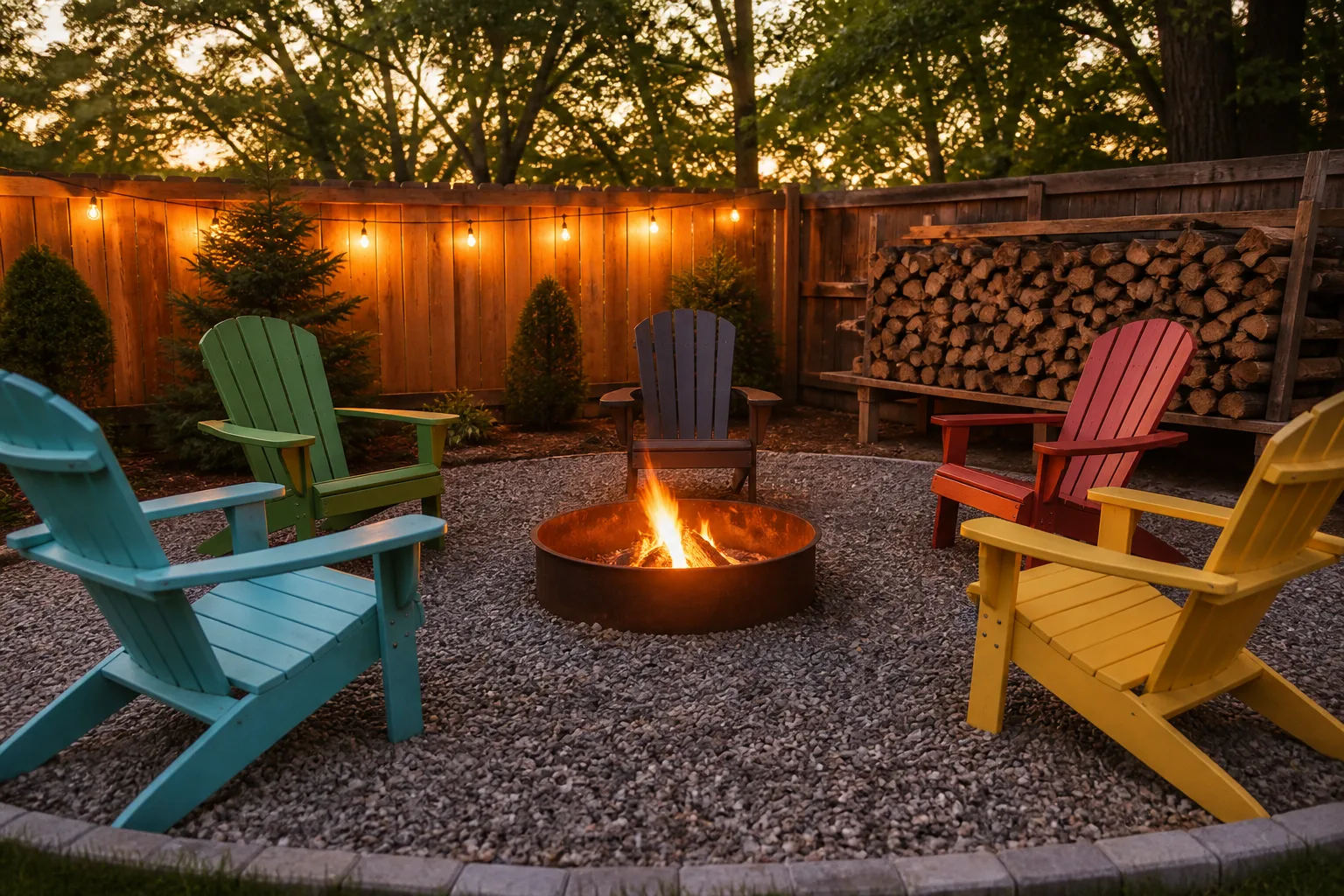
12. Use a compact gravel court for a small yard. A modest stone ring on a contained gravel pad can make a usable gathering spot without a large masonry project. A border keeps gravel from migrating onto lawn or paving; a compacted, level base helps chairs sit steadily. This is one of the most flexible ideas because the furniture can change. It is less comfortable for wheeled chairs and can be frustrating under small chair legs, so test a sample before covering the whole area.
13. Carry the patio stone into a short approach path. A few matching pavers can connect the house to the fire pit and make the space feel planned even when the pit sits apart from a main terrace. A direct route is convenient; a gently bending path can reveal the fire area gradually. Keep turns wide and surfaces even enough for carrying drinks or moving chairs, and avoid placing decorative stepping stones where people will walk in the dark.
14. Use reclaimed granite or oversized slabs as a sparse terrace. A small number of large stones set into a gravel or lawn setting gives a rugged, low-detail composition. The gaps can make the area feel less formal than a full paved patio, while the slabs provide stable spots for chairs and circulation. Salvaged granite can be heavy and difficult to move, so this is a job for careful handling and a properly prepared base—not a casual weekend repositioning after the pit is built.
15. Make a circular patio with a contrasting ring. A simple round patio can be set in a contrasting border of smaller pavers or gravel, making the central fire feature read clearly from the house. This geometry suits a square lawn because it softens hard corners. Keep the diameter honest: allow room for the intended chairs and a path around them before deciding the circle’s outer edge. A ring that only fits the pit may leave nowhere for people to sit comfortably.
Privacy, Planting, and Atmosphere
16. Set the pit toward a view, not toward the back door. A fire feature can orient seating toward a lake, tree canopy, mountain, or sunset instead of simply facing the house. Landscape designers featured in Gardenista’s fire pit roundup use fire pits as outdoor-room anchors and take advantage of views and site character; that is a useful reminder to orient chairs before choosing the pit’s final spot. Confirm that the view-facing arrangement still respects clearance, wind, and a safe route indoors.
17. Create a private retreat with a partial screen. A stone seat wall, open trellis, or carefully placed evergreen screen can make the fire area feel separate from the rest of the yard. Use the screen to block an unappealing view or define a boundary, not to box in smoke or put combustible material beside flame. A partial screen on one side often gives enough enclosure while keeping the horizon and airflow open.
18. Surround the court with plants beyond the fire zone. Planting softens the edge of a gravel or stone patio and helps the feature belong to the garden. Low, drought-tolerant perennials or sturdy shrubs can frame the approach; keep foliage, mulch, and dry plant debris outside the clearance required for the appliance and local fire rules. Plant in beds beyond that zone or use containers that can be moved, rather than treating greenery as a fireproof screen.
19. Terrace a hillside into two outdoor rooms. A lower stone terrace can hold the fire pit, while an upper level remains a dining or gardening area. This separates uses and turns a difficult grade into a reason for the layout. The approach resembles the terraced garden examples in Gardenista and Better Homes & Gardens, where a retaining wall helps create a distinct destination. A sloped site needs real drainage and retaining-wall planning; do not use the fire ring itself as a retaining structure.
20. Add low path lighting to the stone edge. Small, shielded fixtures along a path or seating wall make it easier to find chairs and steps after dusk without competing with the fire. Route wiring and select outdoor-rated fixtures so heat, water, and foot traffic are accounted for. Keep lighting outside the burner’s heat envelope and avoid bright spots aimed into guests’ eyes. The goal is a legible route, not a brightly lit stage.
21. Make a sculptural stone bowl the whole focal point. A carved or cast stone bowl can bring the visual weight of a boulder into a compact patio, especially when there is not room for built-in seating. Treat it as a finished fire appliance, not as a raw rock you can hollow and burn in. Place it on a stable, noncombustible base, then give it a restrained circle of chairs and a clear passage so the unusual object does not dominate every movement through the yard.
Make Stone, Fire, and Fuel Work Together
Stone in a fire pit design can mean the visible outer surround, the patio, a seat wall, or the material that actually contains heat. Those jobs are not interchangeable. A material that looks right in a landscape is not automatically suitable for direct flame, rapid heating, or repeated freeze-thaw cycles. Choose the complete system—fire ring, refractory components, burner, ventilation, and exterior finish—as a unit, and follow the product’s clearances and installation instructions.
Use a Fire-Rated Inner System
For a wood fire, use a purpose-built steel ring or a masonry assembly designed for fire exposure, with compatible firebrick or other specified refractory components where the system calls for them. Let decorative fieldstone, veneer, or concrete block form the outer appearance only when the system allows it. This Old House’s fire pit guidance describes kits pairing heat-resistant blocks with a steel liner, and its natural-stone patio project shows why a substantial hardscape needs a stable, compacted base rather than loose slabs over soft soil. The exact design still depends on the selected product and site.
For gas, use a burner and fire media made for the chosen fuel and bowl. Natural gas and propane installations involve different supply arrangements; a permanent gas connection should be planned with a qualified professional and inspected as local rules require. Do not seal over vents, improvise burner openings, or put an open-flame appliance beneath a roof unless the appliance is specifically rated and permitted for that use.
Drainage matters as much as appearance. Water trapped in a pit, base, or wall can complicate ignition, stain surfaces, or contribute to deterioration as it freezes and thaws. Slope the surrounding patio away from structures where appropriate, keep drains and burner openings unobstructed, and use caps that shed water without trapping it in a cavity.
Position Seating, Circulation, and the Fire
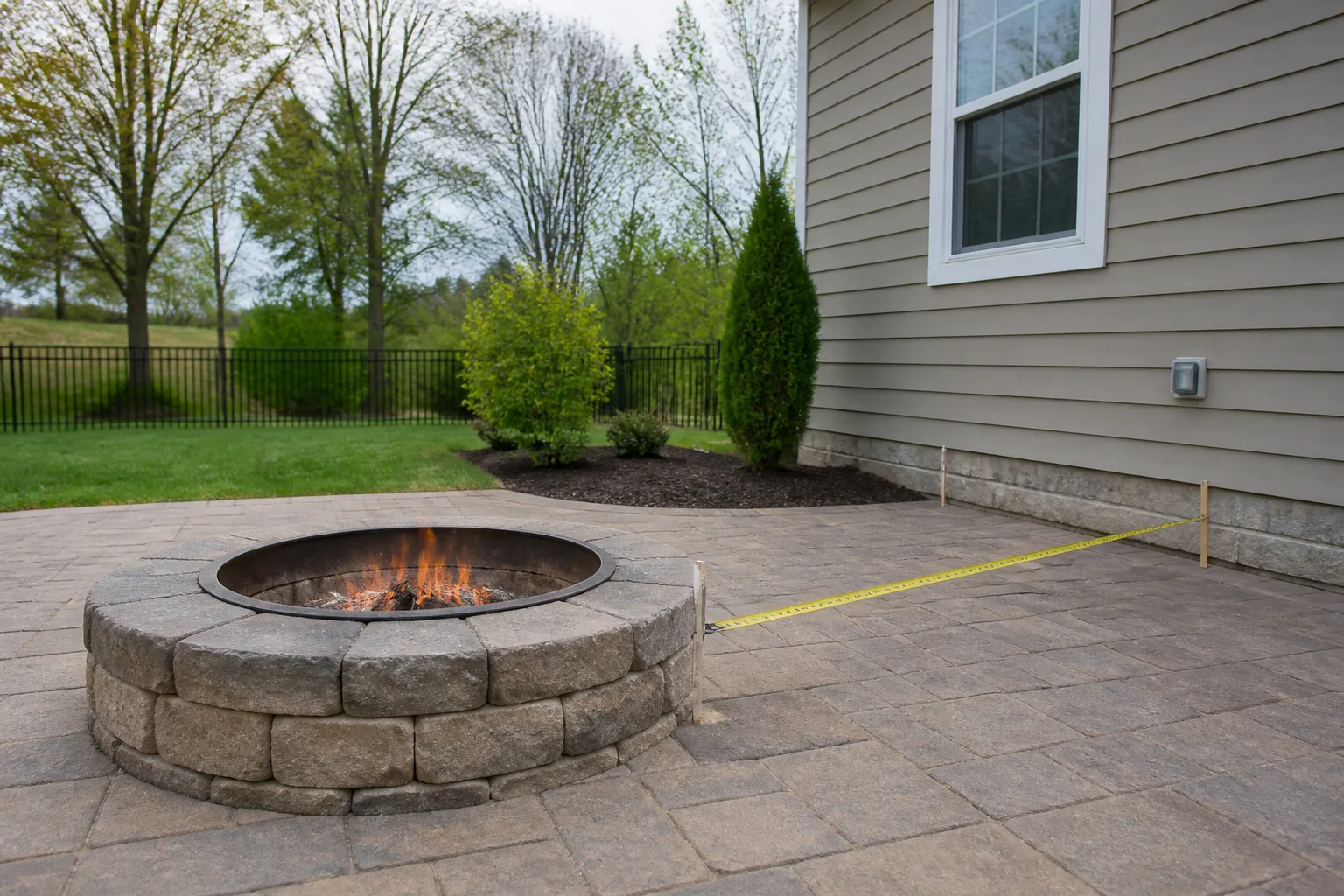
Lay out the whole room before you buy stone. Mark the fire feature’s outside dimension with a hose or rope, then add the chairs in their actual pulled-out position. Leave enough space for people to sit, stand, and pass behind someone without brushing the flame or stepping off the hardscape. This simple mock-up often reveals that the patio needs to grow in one direction, the pit should shift away from a fence, or freestanding chairs make more sense than a fixed bench.
Think in routes, not just circles. There should be an obvious way to enter and leave without crossing the hottest edge, a path back to the home, and enough room to tend a wood fire from the side. Keep children and pets supervised around an active fire. The U.S. Fire Administration advises using a metal screen over wood fires to limit sparks and putting the fire out before leaving the backyard; the City of Minneapolis also lists supervision and extinguishing equipment among its recreational-fire rules. Keep a suitable extinguishing method nearby, and never leave a fire unattended.
Smoke is part of a wood-burning experience, so test the likely wind direction before committing to a permanent location. Avoid lighting a fire in gusty conditions, and respect air-quality alerts and burn bans. If a neighbor’s patio, an open window, or a sheltered seating nook repeatedly sits downwind, a visually perfect placement may be the wrong one. A gas system can reduce smoke from burning wood, but it still needs its own code-compliant clearances and safe installation.
Choose a Stone Look That Fits Your Climate and Upkeep
Match stone scale to the yard. Oversized slabs and massive boulders can anchor a broad, open landscape but overwhelm a narrow townhouse patio. Smaller units create more joints and visual texture, which can suit a compact space, although more joints may mean more upkeep. A quieter stone palette makes planting and firelight stand out; a mixed palette can connect an older patio to a new feature when it repeats only one or two existing colors.
Also consider the surface under chairs. Smooth-cut stone is easier to sweep and more stable for furniture, while rough flagstone looks natural but can catch chair legs or become uneven. Gravel drains well and softens the look, yet it shifts and may not be ideal for anyone using a cane, wheelchair, stroller, or cart. If accessibility matters, choose a firm, stable route and enough turning room first, then add loose gravel only as a border or accent.
Ask a local stone supplier or qualified mason how the proposed material behaves in your climate and use. Freeze-thaw exposure, shade, tree litter, irrigation overspray, and de-icing salts can change maintenance needs. A sealing product may alter color or traction; test it on a sample and follow its label. If the feature is permanent, use a compatible mortar or dry-laid system and expect seasonal checks for movement, cracked joints, loose caps, blocked drainage, and burner wear.
Avoid Design Mistakes That Make a Fire Pit Frustrating
The most common mistake is choosing a pit before checking the site. A large built-in ring can look impressive yet consume the only level area, narrow the route between house and garden, or sit in smoke’s usual path. A quick full-size mock-up with chairs and walking routes exposes these problems while moving the design is still free.
The next mistake is copying one photo’s materials as if they were a tested assembly. Decorative landscape stone does not automatically belong inside the fire chamber, and mortar or adhesive intended for ordinary garden walls may not be rated for repeated heat. Match the inner fire system, outer surround, and fuel; if the design requires retaining walls, gas plumbing, major excavation, or a tall structure, bring in the relevant professional.
Avoid putting the pit under low branches, a roof, or an overhead structure unless the appliance and local rules explicitly permit that installation. Do not surround an active fire with dry mulch, resinous foliage, cushions, or stacked firewood. String lights and lanterns create atmosphere only when safely separated from hot surfaces and kept in sound condition. The U.S. Fire Administration and local fire authorities emphasize clearance, supervision, and complete extinguishing because the attractive landscape setting does not reduce those risks.
Finally, do not pave more than the household will use. A simple gravel court with four movable chairs may suit a small family better than a costly permanent crescent bench. Permanent construction limits flexibility, while loose seating needs storage and rearranging. Choose the trade-off deliberately rather than building the biggest version of the idea.
Turn an Idea Into a Buildable Plan
Use this order to turn an inspiration photo into a practical project:
- Check permission and rules. Confirm fire restrictions, permits, homeowner or rental rules, and the manufacturer’s location requirements. Call your local utility-marking service before any excavation.
- Choose the fuel. Decide whether the ritual and maintenance of wood suit the household or whether a properly installed gas feature is a better fit.
- Mock up the footprint. Mark the outer edge of the pit, clearances, seat positions, chair pullback, and walking path. Test it at the time of day you expect to use it.
- Select the inner fire system. Choose a rated fire ring or gas appliance before the decorative stone so the measurements and ventilation are known.
- Pick the hardscape and finish. Match patio stone to local climate, drainage, footing, and the way guests will move across it.
- Decide where flexibility matters. Keep some chairs, side tables, and screens movable if the yard hosts different gatherings or winter storage is needed.
The site may lead you to a smaller feature, a farther location, or a portable bowl instead of a built-in pit. That is a good design outcome if it makes the space safer and more useful. Gardenista’s landscape examples treat fire pits as part of a larger outdoor room; the hardscape, view, planting, seating, and path work together rather than competing for attention.
Keep the Space Ready for the Next Season
Before each use, clear dry leaves and loose debris from the fire area, check that the ring or burner is intact, and make sure the wind and local conditions permit a fire. Use only the fuel intended for the appliance. For wood, use clean, dry natural fuel; Unified Fire Authority advises against burning garbage, plastics, rubber, oils, or construction waste. Keep a screen in place when appropriate and store matches and ignition tools away from children.
When the fire is finished, follow the appliance instructions to shut down or fully extinguish it. Do not assume that a dark ash bed is cold; leave it undisturbed until it is safe to handle. During the off-season, remove debris, check caps and joints, clear drainage, and cover the appliance only as its manufacturer recommends. Store cushions and loose accessories away from weather and heat, and make repairs before the next gathering rather than after a small movement becomes a larger problem.
Conclusion
The best stone fire pit idea is the one that feels natural in your yard and still leaves room for people to move, sit, and enjoy it comfortably. Built-in seat walls create a finished outdoor room; fieldstone rings and gravel courts feel informal; slate patios and sculptural bowls make stronger statements; planting, lighting, and paths help the feature connect to the wider garden.
Short-list two or three designs, mock up their full footprint, and verify local fire requirements before ordering materials. Choose a fire-rated inner system for the fuel you plan to use, then let the visible stone and surrounding landscape complete the look. A thoughtful plan can make even a modest backyard feel like a place worth lingering after sunset.