How to Transplant Bamboo: Step-by-Step for Gardeners
Move bamboo with less stress: identify running or clumping growth, prepare the new site, protect the root ball, and troubleshoot slow recovery after planting.
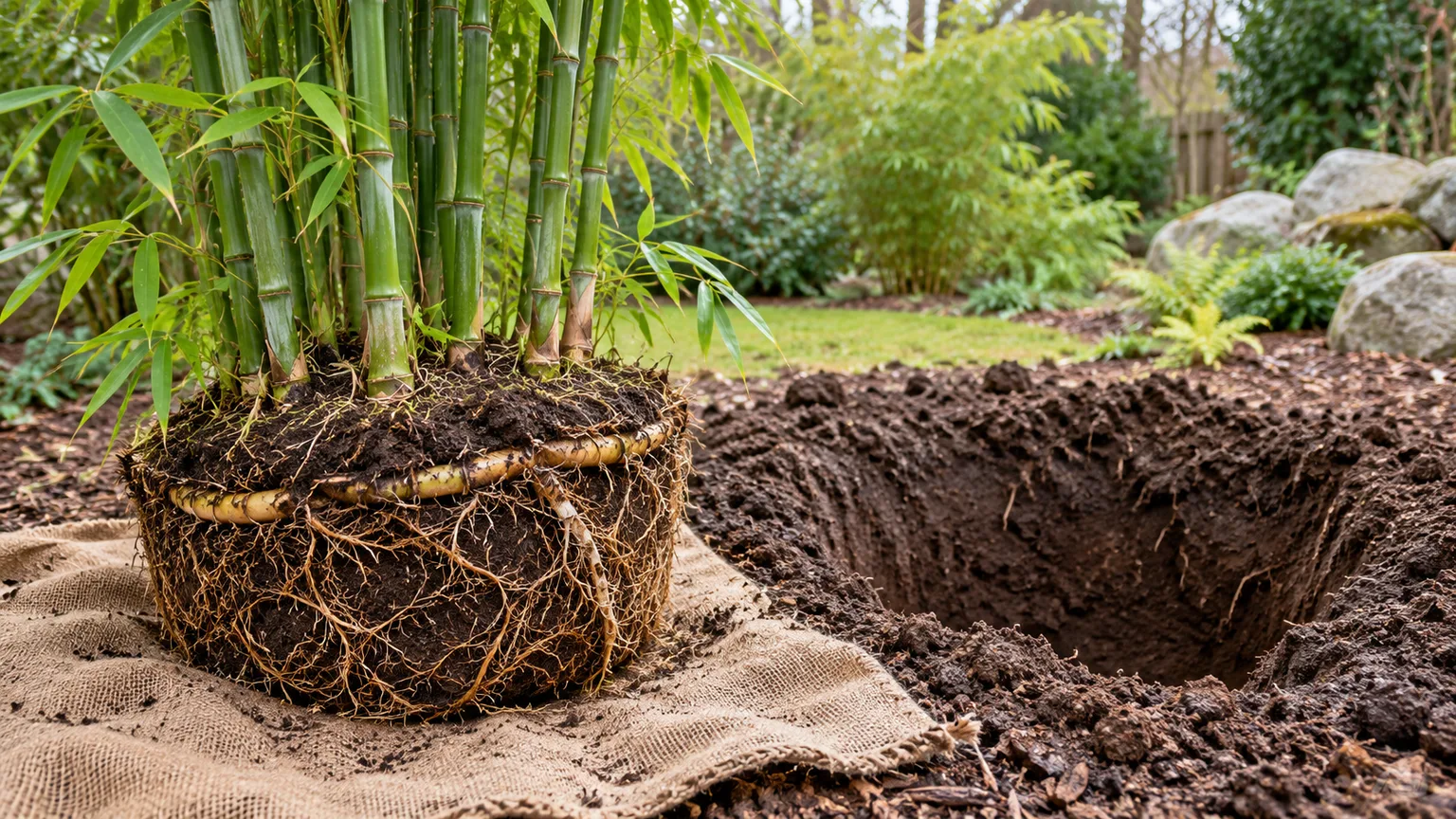
The safest way to transplant bamboo is to move a rooted piece of the plant, not a loose cane: the division needs living rhizome, attached roots, and healthy aboveground culms. Prepare its new site first, work before new shoots emerge or after the season’s growth has finished, and keep the root ball damp and protected from sun and wind from the moment you lift it until you replant it.
One decision should come before the shovel: decide whether you can handle the size of the root mass and whether the new spot is genuinely suitable. Bamboo rhizomes can be dense and tough, so moving an established clump is strenuous work; a smaller, healthy division is often a better transplant than an oversized piece that breaks apart or dries out while you struggle to carry it.
Decide what you are moving before you dig
“Bamboo” covers many garden plants with different growth habits, and a transplant is not just a cane moved from one hole to another. The useful unit is a living section of the underground system with enough roots and rhizome to support the culms above it. If you are moving a whole container plant, the root ball already gives you that unit; if you are splitting a landscape planting, you must deliberately cut one free.
Before choosing a piece, look at the plant for a few minutes. Find where the culms emerge, trace the outer edge of the clump or patch, and note whether new shoots are appearing. Also check where rhizomes could be headed: a transplant that puts running bamboo next to a neighbor’s fence, drain, or prized bed may only relocate the original problem.
True bamboo needs a rooted section, not a bare cane
Garden bamboo is a woody perennial grass. Its underground rhizomes carry buds that can produce new culms, while the smaller roots take up water and help anchor the division. A cut cane without a rhizome-and-root connection is not a reliable transplant; leaving a little soil attached to the culm does not replace the missing underground growth point.
This distinction also prevents a common mix-up: “lucky bamboo” is a Dracaena, not a true bamboo, and it can be propagated from stem sections in ways that do not apply to landscape bamboo. For a garden clump, select a piece with a firm, living rhizome and roots attached to at least one healthy culm. More robust divisions can carry several culms, but the root mass and its condition matter more than a particular stalk count.
Running and clumping types change the risk
Clumping bamboo tends to expand close to its original base, while running bamboo can send rhizomes outward and produce shoots beyond the visible grove. Clemson Cooperative Extension describes this spreading habit as the reason running bamboo can be difficult to control; small rhizome fragments left in soil can also grow again (Clemson Cooperative Extension). That difference matters twice: it affects how far you may need to dig to free a division, and it affects how you contain the plant after the move.
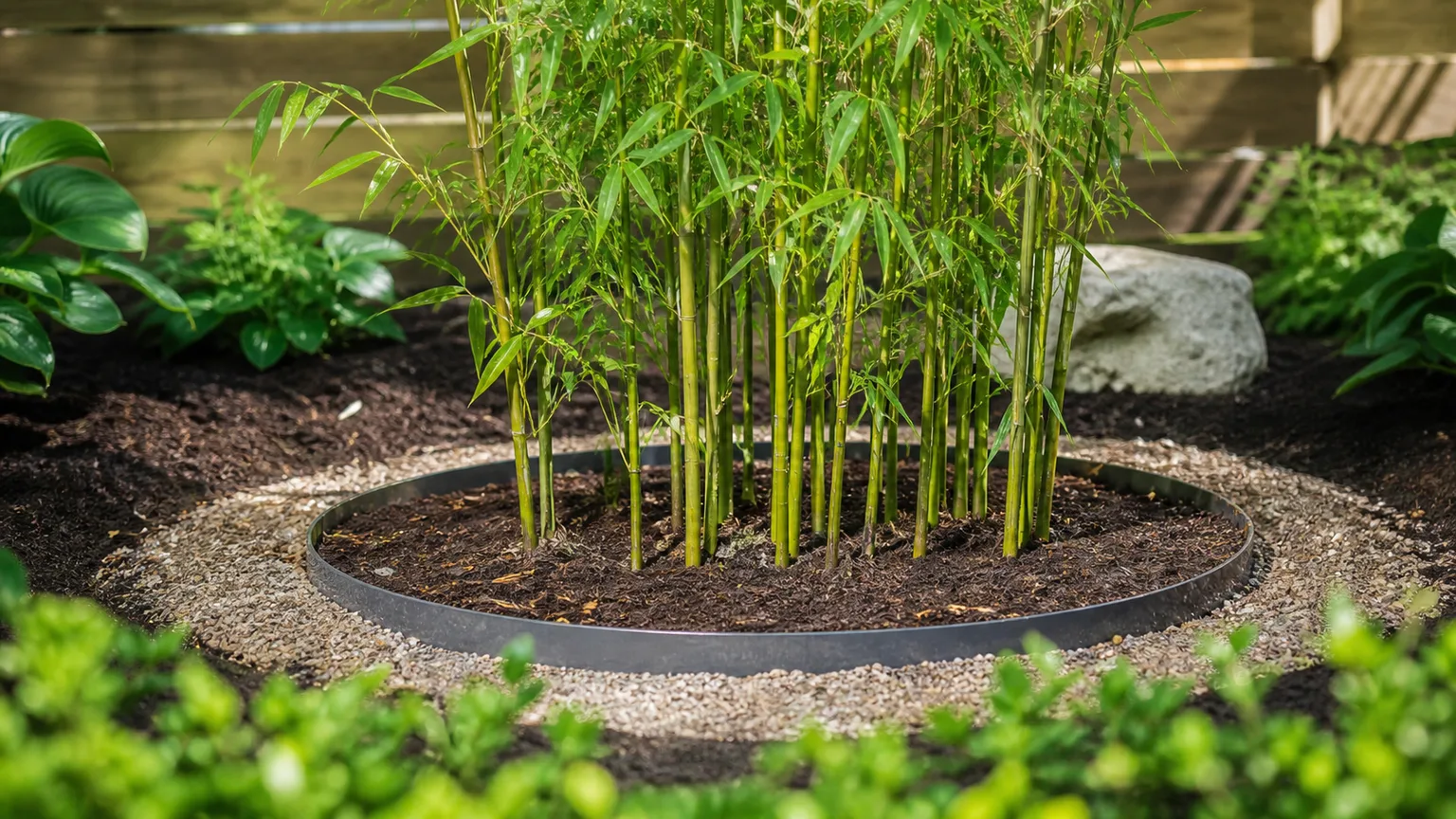
If you do not know which type you have, assume a shoot may be connected to a longer rhizome until you expose it. Do not move soil or cut rhizome scraps into clean beds, and do not plant a running variety in an open area simply because the new clump is small today. Plan a suitable barrier or another contained growing setup before you lift it; a barrier helps manage spread, but it does not eliminate inspection and maintenance.
Time the move around shoots and weather
Bamboo timing is best tied to its growth cycle, not to a date that is supposed to work in every climate. The University of Washington’s Elisabeth C. Miller Library, quoting transplant advice from the American Bamboo Society, says to avoid moving bamboo while it is shooting and to work very early in spring before shooting begins or late in autumn after the growth period ends (Elisabeth C. Miller Library). Use that as a useful framework, then adapt it to your species and local weather.
Look for a mild, cloudy day if you can choose one. Avoid hot sun, drying wind, drought, or hard frost, especially when moving a small division with limited roots.
If your area has a very short warm season, late fall may expose a fresh division to freezing soil before it settles in; in a hot, dry region, early spring may be safer than summer. The right window is a stretch when shoots are not actively emerging and you can reliably water the new planting.
Postpone the job if new shoots are actively pushing through the soil, the plant is already drought-stressed, the ground is waterlogged, or you cannot plant the division promptly. New shoots are vulnerable to breakage, and the parent plant is using stored energy to push them. If a move cannot wait, take the largest intact root ball you can manage, reduce the time roots spend exposed, and understand that recovery is less predictable than a move in a favorable window.
Choose a division that can recover
Do not automatically dig the largest section you can pry loose. A large division carries more roots and stored reserves, but it is heavier, harder to cut cleanly, and more disruptive to the remaining grove.
A very small piece is easier to lift, yet may have too few roots or buds to support its culms. Aim for a sound, manageable balance: several healthy culms, a substantial firm rhizome, and a dense web of attached roots rather than a bare rhizome fragment.
The Miller Library’s quoted American Bamboo Society guidance suggests selecting a recent clump of three or four healthy culms and gives a root-ball diameter of about two feet as a practical target for part of a large clump. Treat that as a reference point, not a universal minimum: bamboo species, culm size, soil, and the gardener’s ability to lift the piece vary. The principle is to keep a generous root-and-rhizome mass around the culms and to avoid choosing a piece that you cannot move without letting it dry or breaking it apart.
Inspect before cutting. Reject divisions with crushed or rotting rhizomes, no firm roots, or culms already collapsing from stress. If the parent bamboo is healthy but the only available piece is too big for safe handling, divide the work with a helper or hire someone with suitable equipment; an injured gardener and a shredded root ball are poor trade-offs for finishing in one session.
Prepare the destination and work area
Get the destination ready before you expose the roots. Digging bamboo can take longer than moving an ordinary perennial, and an open root ball can lose moisture while you are still deciding where it belongs. Have the hole, containment plan, tools, tarp, water, and a helper ready so the plant can go from ground to ground with as little delay as practical.
Match the new site to the species
Choose light, soil moisture, exposure, and room based on the bamboo you actually have. Check the plant’s label or a reliable regional source for its mature size and cold tolerance rather than assuming all bamboo wants the same sun or can survive the same winter. The site should drain after watering; a plant that needs steady moisture still should not be left in a hole that stays saturated.
For running bamboo, decide how its outward growth will be managed before planting. Install an appropriate rhizome barrier or use a contained planter if that suits the species and the planting goal. Clemson Cooperative Extension’s bamboo-control guidance is a useful reminder to inspect for rhizomes and shoots beyond the visible canes; a barrier is a management tool, not a reason to stop checking the perimeter.
Dig the receiving hole wide enough that the roots are not forced into a tight wad, and deep enough to set the plant at the same soil level it had before. The exact width depends on your root ball; leave working room around it rather than relying on a fixed number of inches. Break up compacted soil at the sides, but do not dig a deep basin that settles and buries the culm bases after watering.
Gather tools and a safe lifting plan
For a small clump, use a sharp, sturdy spade and a clean pruning saw or loppers for roots too thick to sever with the spade. A mature bamboo root system can defeat a dull shovel, so do not keep bouncing on a damaged tool or swing an axe near your feet. Wear sturdy shoes, gloves, and eye protection; keep other people clear of the cutting line, especially when using a saw or powered tool.
Lay a tarp beside the plant before digging. It gives you a place to support the root ball, makes dragging a manageable division easier, and reduces the time the roots sit exposed on dry soil.
If the piece is too heavy to lift safely, use a second person and a sensible lifting technique, or stop and use appropriate professional equipment. Do not try to catch or hold a root ball that is sliding off a spade.
Lift and replant bamboo in a controlled sequence
The sequence is simple, but the details protect the part of the plant you cannot see. Water the parent plant beforehand if its soil is dry, identify the division, cut around it, keep it covered and moist, and put it in the prepared hole at its original depth. Work steadily rather than rushing with a blunt tool or leaving a lifted plant in direct sun while you excavate the destination.
Water, mark, and expose the root ball
If the ground is dry, water the bamboo the day before so the soil is workable and roots are not already under moisture stress. Mark the selected culms with a loose tie, then mark a circle around the root ball you intend to keep. This helps you avoid accidentally digging an oversized, unmanageable section and makes it easier to preserve enough soil around the feeder roots.
Start your trench outside the marked edge and work down carefully. Bamboo rhizomes can travel horizontally and may run into neighboring plants, so use the spade to expose the connections instead of driving blindly through the center of the grove. Where a root or rhizome crosses the trench, uncover enough of it to see what you are cutting and which side stays connected to the chosen division.
The shovel depth should be determined by the actual roots and rhizomes, not by a fixed depth copied from a generic transplant recipe. Continue around the piece until you can identify the lower and side connections. If you hit a thick woody rhizome, change to a sharp saw or another suitable cutting tool rather than repeatedly smashing the same spot and loosening the root mass.
Cut the rhizomes cleanly
Use deliberate cuts to separate the division. Keep the selected culms attached to a generous rhizome-and-root section, and make clean cuts through the connections to the parent grove. A sharp spade may cut smaller rhizomes; thicker sections may need a pruning saw or similar tool that can make a controlled cut without tearing the whole ball apart.
Before you lever the division free, check that you have cut all remaining connections. Slide the spade under the root ball and lift only enough to confirm it is loose.
If it resists, find the remaining rhizome instead of pulling hard on the culms; yanking by the canes can strip roots from the piece or crack the culm base. Preserve a soil core around roots when you can, but prioritize keeping the rhizome and roots intact over keeping every crumb of old soil.
The parent plant will have a cut edge. Remove loose fragments from the work area and keep them from being mixed into other soil.
If you have removed a large section, water the remaining grove and check it later for exposed rhizomes or damaged culms. You do not need to excavate the whole planting just because you took one division; the goal is a clean separation and a stable remaining clump.
Keep the division shaded and damp
Set the root ball on the tarp and cover it immediately with damp burlap or another breathable covering if planting is delayed. Bamboo rhizomes and roots should not be left to dry; the Miller Library’s quoted advice emphasizes keeping them moist even during a short transfer. Keep the root mass shaded and out of wind, and move it to the new site as soon as practical.
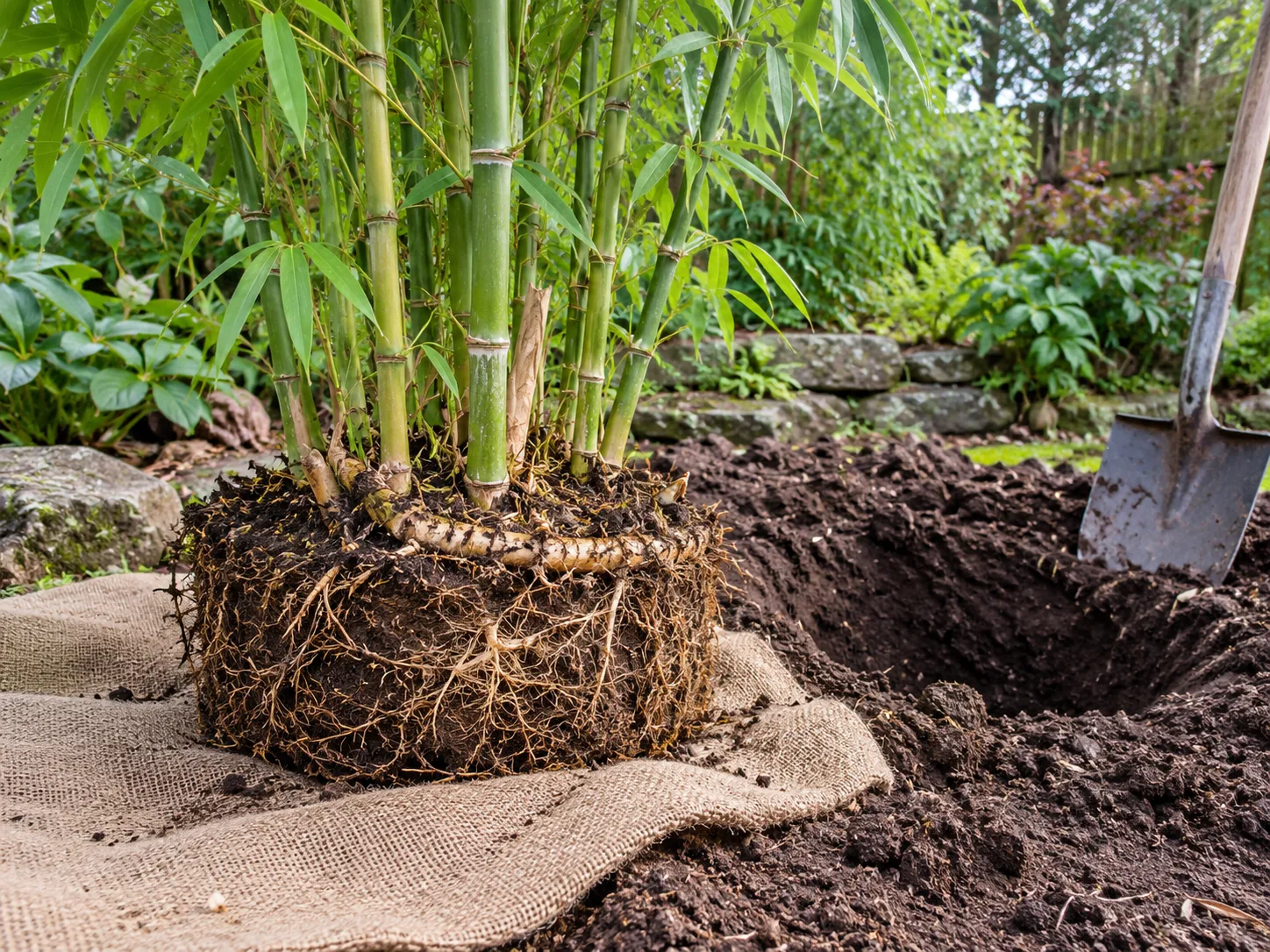
Moist means protected from drying, not submerged in a bucket of water for hours. Standing water can dislodge soil and deprive roots of air, while an uncovered root ball can dry quickly in sun or breeze. If the transplant must travel by vehicle, secure it so the culms and roots do not get crushed, keep the root mass wrapped, and avoid leaving it in a hot parked vehicle.
Replant at the former soil line
Lower the root ball into the prepared hole and turn it so the culms face the direction you want the clump to grow. Use the visible former soil line, if you can identify it, as your guide. Fill around the roots with the excavated soil, firming gently by hand so large air pockets close without compacting the soil into a hard block.
Water slowly after backfilling to settle soil around the roots. If the plant sinks, lift it back to the original level before adding more water; burying the culm bases deeper than before can leave the division too wet and unstable. Add a layer of organic mulch over the root zone to slow evaporation, leaving a clear gap around the culm bases so the mulch does not stay pressed against them.
Do not add a heavy dose of fertilizer to compensate for root loss. A freshly divided plant needs functional roots and stable moisture before it can use extra nutrients well. If soil improvement is needed, focus on the planting area’s drainage and structure before the transplant, and follow local soil-test advice rather than changing the root zone with a large, abrupt amendment.
Move bamboo from a pot without breaking the root mass
Container bamboo is easier to reach but can be more tightly packed than an in-ground clump. Water the plant first if the mix is dry, then tip the pot or slide the root mass out while supporting its weight; pulling hard on the culms can tear the plant away from the root ball. If the roots have formed a dense mat, set the ball on a tarp and inspect where natural divisions can be separated.
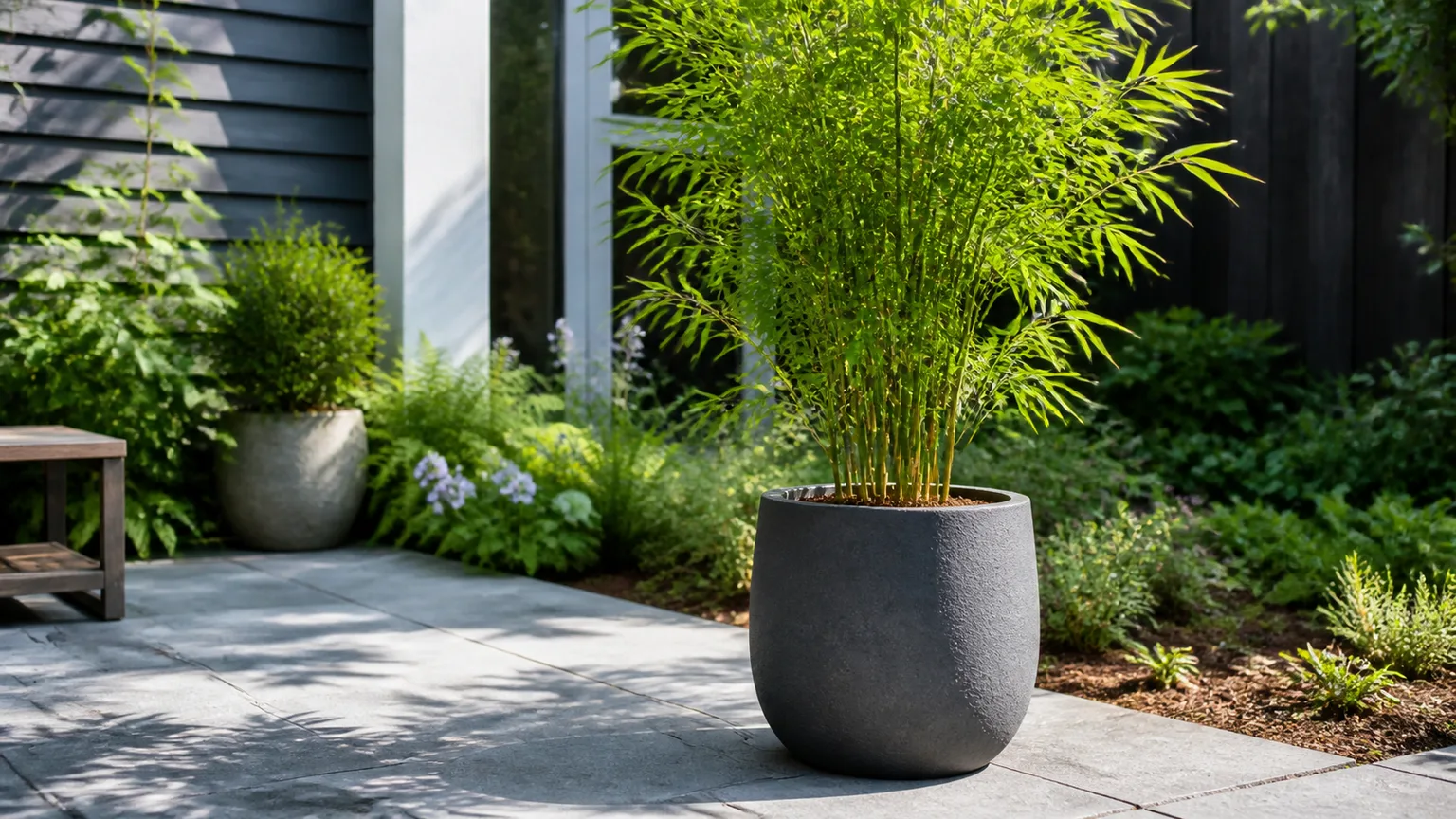
Bamboo Garden’s guidance for its Sugi planters describes dividing a root mass into halves or smaller pieces when a container is full, and notes that a removable planter bottom can make transplanting easier (Bamboo Garden’s planter guidance). That is a useful container-specific distinction: you can choose a division by working with the exposed root ball, rather than digging around an underground grove. Still keep each piece attached to roots and rhizome, and use a sharp saw if the dense mass will not separate cleanly by hand.
For a move to a larger pot, choose one with adequate drainage and enough room for the root ball, not an enormous container that remains wet around a small division. Set the bamboo at its existing depth, fill the gaps with a suitable potting mix, and water until the entire root ball is moist and excess drains freely. For a move to the landscape, follow the site and containment checks above; a running bamboo does not become clumping simply because it spent time in a pot.
Aftercare: steady moisture, no saturation
The first goal after planting is to prevent the roots from alternating between dry and waterlogged. Check the soil near the root ball, not just the mulch surface, and water deeply when that area begins to dry. How often you need to water depends on heat, wind, soil, rainfall, and whether the division is in a pot or the ground; a sandy bed in warm weather dries faster than a shaded, moisture-retentive site.
Do not follow a rigid schedule that tells you to water every day regardless of conditions. Bamboo Garden’s care guidance warns that new bamboo can suffer from both too little and too much water, and notes poor growth in hot or windy conditions when new plants do not get sufficient moisture (Bamboo Garden’s bamboo-care guide). Use that as a prompt to check the root zone: if it is still damp and the site drains slowly, wait; if it is dry below the surface, water thoroughly and reassess.
Protect the division from avoidable stress while it settles. Keep weeds and turf from competing close to the root ball, maintain a moderate mulch layer, and shield the plant from drying wind if the weather turns severe.
Do not keep moving it, lifting it to inspect roots, or dividing it again while it is recovering. Give the plant a stable location and time to rebuild its root system.
If you moved a running type, inspect the containment area during the growing season and remove or redirect shoots that appear outside the planned boundary. A new transplant may not spread far immediately, but the absence of visible shoots in the first weeks does not prove the rhizomes have stopped growing. Keep a record of where the original division was planted and check likely escape routes such as lawn edges, paving joints, and fence lines.
Read recovery signs without overreacting
A transplanted bamboo may pause aboveground growth while roots re-establish, and foliage can look less vigorous after the move. One stressed leaf does not tell you whether the division will live. Check that the root zone is moist but not flooded, the culms stay upright and firm, the soil drains, and new growth appears during the plant’s normal growing period.
If leaves roll or curl during a hot afternoon but look better later, heat and water demand may be contributing. Check moisture at root depth before watering again.
If the soil is wet for days, smells sour, or water pools around the base, improve drainage or move excess water away rather than adding more irrigation. If it is dry several inches down and the culms are losing vigor, water slowly enough to wet the root ball, not just the top layer.
Worsening collapse, soft or blackened tissue at the base, a persistently soggy root zone, or culms that become brittle and die back are more concerning than a temporary pause. Remove only clearly dead or broken material and correct the growing condition you can identify.
Do not dig the bamboo up again just to look for new roots; repeated disturbance can set recovery back further. If the division has no firm rhizome or living roots, the original selection may have been too small or damaged, and better aftercare cannot replace missing viable tissue.
Conclusion
Successful bamboo transplanting starts with a viable division and ends with patient, evidence-based aftercare. Choose the move outside the active shooting period when weather is mild, keep a firm rhizome and plenty of attached roots with the culms, prepare the new site and containment first, and protect the root ball from drying while it is out of the ground.
Once planted at its former depth, keep the root zone evenly moist and well drained, watch for both drought and standing water, and give the bamboo time to respond. If the division would be too heavy to lift safely or the new location cannot contain its growth, delay the job and make a better plan before you cut into the grove.



