How to Grow and Care for Hardy Kiwi Vine
Plan hardy kiwi vine care from planting to harvest, including cultivar choice, pollination, trellis training, pruning, watering, and frost protection.
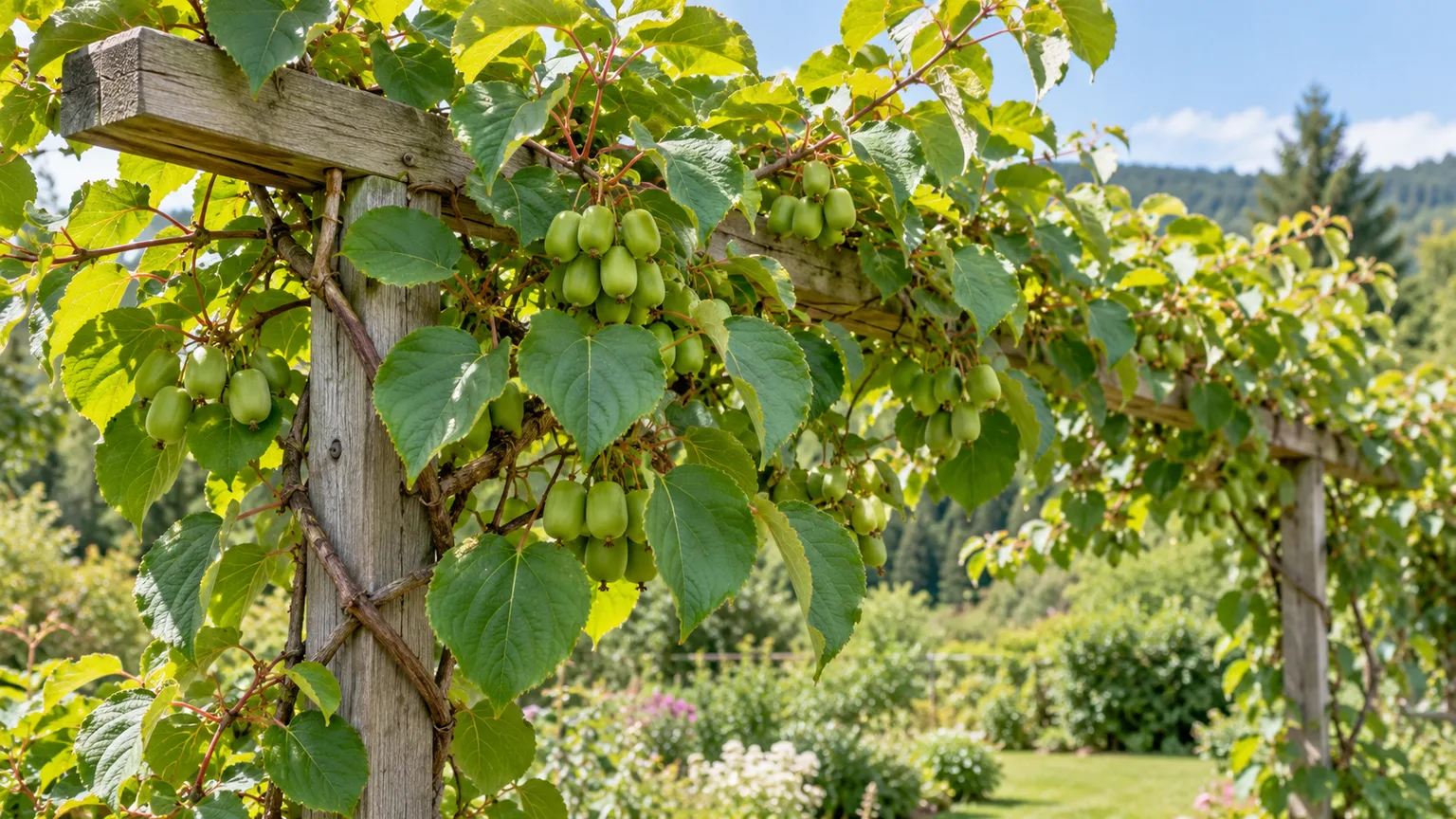
Hardy kiwi is a fruiting vine for gardeners who can give it two things before it gets going: a strong permanent support and enough room for a large woody canopy. Most named varieties also need a male pollenizer beside female fruiting vines, so a healthy plant can grow for years without producing a single berry if you buy the wrong combination.
The name usually refers to Actinidia arguta, whose smooth, grape-sized fruits are eaten whole. Some sellers also use “hardy kiwi” for A. kolomikta, a more cold-tolerant vine usually grown for ornamental foliage, and the familiar fuzzy grocery-store kiwi is a different, less cold-hardy species. Start with the botanical name and the cultivar label: care is broadly similar, but fruiting, vigor, flowering time, and winter performance are not interchangeable. Penn State Extension and the UW-Madison Extension kiwifruit guide describe the main hardy species and the practical demands of growing them.
Know which kiwi you are buying
Actinidia arguta is the usual choice when the goal is edible kiwiberries. It grows as a long-lived, deciduous, twining woody vine; the small smooth fruit comes in green, bronze, or red-tinged forms depending on cultivar. In a home garden it can cover a pergola or T-bar, but it can also grow through a fence, tree, or shrub if left to climb wherever it finds a hold. Its mature size is therefore better understood as “needs a structure and regular pruning” than as a fixed height on a plant tag.
A. kolomikta is often sold as Arctic kiwi or Arctic Beauty. It is generally less vigorous and is best known for ornamental leaves, especially on male plants, whose foliage can develop white and pink variegation as the vine matures. It is not the same fruiting proposition as A. arguta: if harvest is your priority, ask the nursery which species and named cultivar it is selling, whether the plant is male or female, and which pollinator is compatible.
Do not use a winter-hardiness zone as the whole answer to “Will it fruit here?” A dormant vine can survive winter yet lose new shoots or flowers to late frost; summer length, wind exposure, cultivar, and local budbreak timing all affect a crop. North Carolina Extension notes the vine’s vigor, while the RHS stresses spring frost protection. Ask a local extension office or fruit nursery which cultivars ripen reliably in your region.
Decide whether your site suits a fruiting vine
Choose the site before you buy the vine. Hardy kiwi tolerates some shade, but full sun generally supports flowering and fruit ripening; deep shade can give you leaves without many flowers. In hot, dry climates, some afternoon shade may reduce heat stress. A sheltered position also helps protect long shoots from wind.
The soil should stay evenly moist while still draining freely. Drought slows growth and berry swelling; waterlogged soil deprives roots of oxygen and favors crown or root problems. Slightly acidic to near-neutral soil is a useful target, but test before adding lime or sulfur, especially in alkaline or compacted ground.
Think about the future canopy, not the nursery pot. UW-Madison Extension describes A. arguta as a strong grower that can climb into trees. Allow room for the support and ground-level pruning access; avoid planting beside utility wires or where the vine would cross a property line.
Choose a cultivar and solve pollination before planting
Most hardy kiwi cultivars are dioecious: male and female flowers occur on separate plants. The male makes pollen but no fruit; the female bears fruit only when its flowers receive compatible pollen at the right time. For a conventional planting, buy at least one labeled male and one labeled female whose bloom periods overlap. Penn State Extension recommends roughly one male for six females, while UW-Madison suggests a male can serve about four females; for a home garden, one male with one to several female vines is a practical starting point, provided the varieties are compatible and flower together.
A self-fertile cultivar such as ‘Issai’ can set fruit without a separate male, which suits a small site. Treat “self-fertile” as a convenience, not a promise of a heavy crop: Penn State reports that ‘Issai’ has performed poorly in its Pennsylvania trials and tends to have smaller fruit and less vigor than standard cultivars. Local results may differ, so check the label and regional nursery advice rather than assuming that every plant called hardy kiwi is self-pollinating. NC State Extension also distinguishes cultivars that may fruit alone from those that produce more reliably with a male.
‘Ananasnaya’, often shortened to ‘Anna’, is a vigorous female variety grown for sweet fruit and needs a compatible male. ‘Arctic Beauty’ is generally sold as a male of A. kolomikta, prized for variegated foliage and useful as a pollen source only for compatible female plants of that species. Before ordering, write down each plant’s species, sex, flowering period, expected mature size, and stated pollinator. If you already have a vine, keep its tag or photograph the label; “kiwi” alone is not enough information to select a partner.
If flowers appear but fruit does not, check pollination before adding fertilizer. Confirm that the vine is female, that a male of the same or compatible species is flowering nearby, and that frost did not brown the flowers. Cold rain during bloom can also limit pollinator activity. A very young vine may not have reached bearing age; Penn State notes that some hardy kiwi can take five to nine years to fruit, while RHS and other regional guidance report earlier starts under favorable conditions. The variation is real, so use a cultivar-specific expectation rather than treating a few nonbearing years as proof the plant is defective.
Install a permanent trellis first
A hardy kiwi vine becomes heavy with old wood, leaves, and fruit. A short tomato cage, decorative lattice, or loose fence panel is not a long-term support. Install the trellis before planting so you can position the vine and its main trunk where the structure can carry the mature canopy. A T-bar or pergola gives an overhead plane for horizontal arms; strong wires on posts or a well-built wall can work when the arms are spaced for access and airflow.
A useful fruiting framework has one main trunk rising to a top wire, then permanent horizontal cordons that carry shorter fruiting canes. The shape is easier to inspect and prune than a tangle of whips climbing in every direction. Use sturdy posts set deep enough for local soil and wind, with tensioned wire or a reinforced crossbar. If you plan to attach wires to an existing fence or wall, check that the structure can take years of added weight and lateral pull.
Plan a path under or beside the canopy so you can tie, prune, and harvest without a ladder. A pergola can shade a sitting area, but the thick growth may become hard to thin and harvest from the top. For fruit, accessibility is more useful than maximum coverage. The RHS kiwi guide and BBC Gardeners’ World both describe training kiwi on durable horizontal supports and keeping the framework open enough to manage.
Plant and establish the vine
In cold-winter regions, plant container-grown kiwi in spring after the soil is workable and the immediate threat of a hard freeze has passed. In milder climates, the best planting window may differ; avoid planting into hot, dry weather unless you can keep the root ball consistently moist. Choose a sound nursery plant with its cultivar and sex clearly identified. If it is bare-root, keep roots from drying and plant promptly; if container-grown, loosen any circling roots gently without tearing the root ball apart.
Dig a broad hole rather than a deep pocket amended with rich compost. Set the plant at the same depth it grew in its pot, spread the roots outward, backfill with the native soil you removed, and water slowly so soil settles around the roots. Incorporate mature compost across a broad planting area if a soil test or poor soil condition supports it, but do not concentrate strong fertilizer in the planting hole. Mulch the root zone with a few inches of organic material and leave a small open ring around the crown so the stem does not stay wet.
Keep the young vine watered through its first growing seasons, especially during dry, windy spells. A rain gauge helps you judge what nature supplied; a finger or narrow trowel in the root zone tells you whether the soil is moist below the surface. The RHS recommends regular watering while kiwi establishes and during prolonged dry periods. Keep weeds and lawn grass from competing directly with the plant, and use a loose tie to attach the best shoot to a temporary stake until it reaches the trellis wire.
Train the trunk and cordons in the first two years
The first goal is a straight trunk, not a wide mass of leaves. Select the strongest, best-positioned shoot and guide it upward to the top wire; remove competing shoots from the base so the plant puts growth into one clear leader. Check ties often and loosen them before they constrict the stem. If the leader bends or breaks, choose the strongest replacement shoot and retrain it rather than letting several trunks compete.
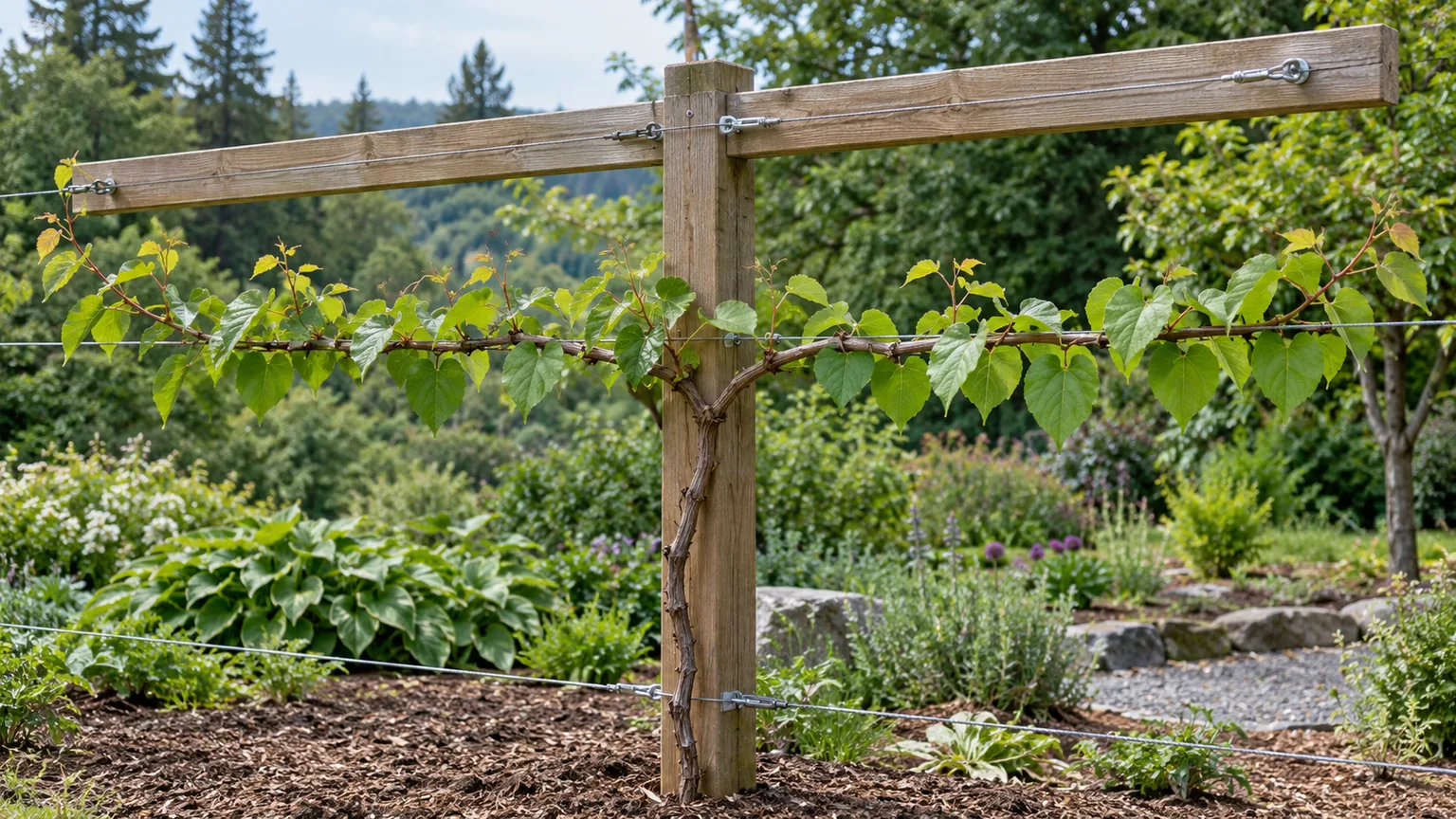
When the leader reaches the planned height, encourage two side shoots to become horizontal cordons, one in each direction. Tie them gradually along the wire while they are flexible. The cordons form the permanent skeleton; side shoots growing from last year’s wood will become the fruiting framework. Remove shoots that head into the center, cross one another, or crowd the trunk, but keep enough healthy leaf area for a young plant to establish roots.
A vine may race ahead in its second or third season, but rapid extension is not the same as a finished framework. Keep extending the trunk and cordons, then begin renewing the fruiting canes along them. The Penn State training guidance recommends starting in the first year and emphasizes setting the permanent structure early; the Gardeners’ World kiwi guide describes the same trunk-and-cordon approach. Tie long shoots to prevent wind damage and prune them before they wrap around nearby plants or supports.
Water for steady growth, not soggy roots
A young kiwi needs regular moisture because its roots are still exploring the soil. Water slowly over the root zone, then let excess drain. In dry weather, check moisture several inches down before watering again; do not rely on a wilted leaf as the only signal, because both dry soil and damaged, saturated roots can make foliage droop. Deep watering less often is usually more useful than a light sprinkle every day.
Once established, a vine may need little extra water in a rainy climate, but drought during shoot growth or fruit swelling can reduce growth and crop quality. Mulch conserves moisture, but keep it off the trunk and do not use it to conceal standing water or a poorly drained planting spot. In containers, check more often because a large leafy vine can dry its root ball quickly on a hot or windy day. Make sure water can escape through the drainage holes rather than pooling in a decorative outer pot.
A simple routine works better than a rigid weekly quota: observe recent rainfall, check the root zone, and water when it is drying rather than saturated. The RHS care guide advises extra watering in prolonged dry periods, while Raintree Nursery’s kiwi-growing guide explains why deep, root-zone watering should change with soil, sun, wind, and plant age.
Feed by soil and growth, not habit
Hardy kiwi grows quickly, which makes it tempting to feed heavily. Resist the urge to add high-nitrogen fertilizer whenever new growth looks slow. Excess nutrients can push long, soft shoots that shade the fruiting zone, complicate pruning, and may be injured by winter cold; young roots are also susceptible to fertilizer burn. First check that the vine receives enough sun, that roots are not waterlogged, and that weeds are not taking moisture and nutrients.
A soil test is the best way to decide whether to add nutrients or correct pH. For a home planting, a spring mulch of finished compost can improve the soil surface and release nutrients gradually. If a test or local extension recommendation calls for a fertilizer, use the labeled amount for the plant’s age and soil, and place it over the root zone rather than against the trunk. Do not copy a commercial orchard’s schedule to a small garden without accounting for plant age, soil, and climate.
Extension recommendations differ by region and production system: Penn State advises no fertilizer in the planting year and cautious, incremental feeding later because roots burn easily, while RHS recommends that routinely mulched, healthy garden plants generally do not need regular feed. Use the more cautious rule unless a soil test or weak growth diagnosis points to a deficiency. Avoid late-season nitrogen that could keep the vine growing when it should be hardening off.
Prune in both seasons
Pruning has two jobs: keep a manageable framework and renew the young wood that will carry flowers. Hardy kiwi flowers form on shoots that grow from one-year-old canes, so indiscriminately cutting back every young stem can remove next season’s crop. Conversely, leaving every vigorous shoot creates shade and a dense tangle with less accessible fruit. Mark the trunk and permanent cordons, then decide which canes are structural, which are fruiting, and which are expendable before making large cuts.
In winter, while the vine is dormant, remove dead, broken, tangled, and badly placed growth first. Keep healthy one-year-old canes spaced along the cordons for next season’s fruiting shoots, and shorten or remove older canes that have already fruited and are crowding the framework. Extension and horticultural guides commonly leave fruiting canes at regular intervals along each cordon; Penn State describes spacing them roughly 8 to 12 inches apart in its system. The exact number of buds and amount of wood to remove depends on cultivar and trellis design, so do not treat a severe commercial prune as a universal home-garden recipe.
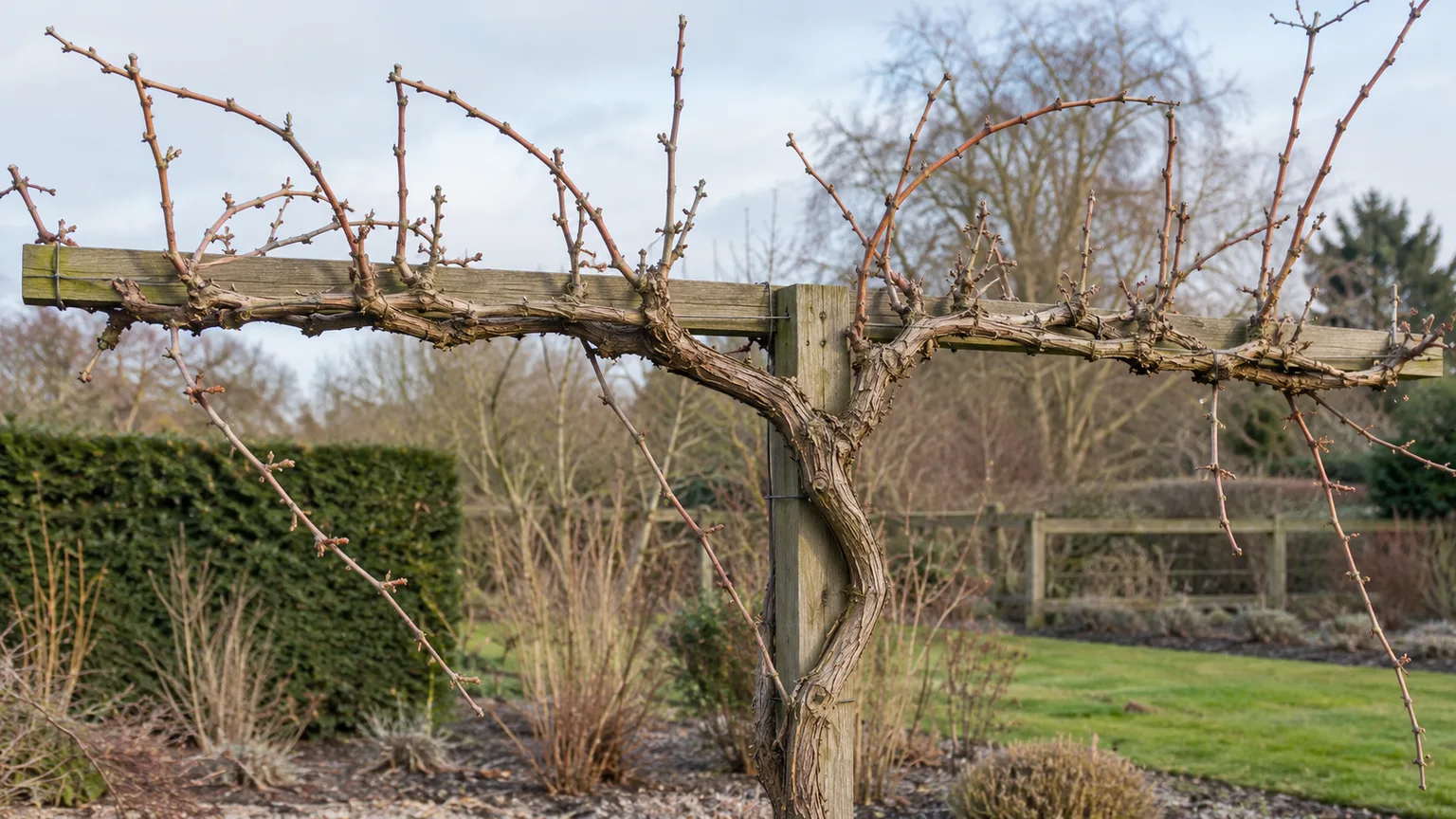
In summer, after flowering and fruit set, tie in selected new shoots, remove water sprouts that race straight upward from old wood, and thin shoots that cross or shade the canopy. On fruiting shoots, shorten the excess growth beyond the last flower or developing berries rather than stripping off all leaves. Penn State advises summer cuts to leave four to six leaves beyond the last flower; use that as a starting point and follow local advice for your cultivar. If you grow a male pollinizer, let it flower before trimming it back so it has a chance to provide pollen.
The RHS describes winter and summer pruning as a twice-yearly routine, and UW-Madison Extension notes that winter pruning is important for fruit production. Prune before active growth begins in late winter, but avoid working in extreme cold when wood is brittle. When the vine is badly neglected, thin it over more than one season if possible; a one-time hard renovation can sacrifice most of the next crop and expose a large amount of old wood to sun and weather.
Manage frost, wind, and winter
A hardy kiwi’s dormant wood can tolerate colder winters than fuzzy kiwifruit, but new shoots and flowers are vulnerable in spring. A late frost may burn leaves or prevent fruit set, so avoid cold-air pockets. Winter survival and harvest reliability are separate questions.
Before a forecast frost, cover a small vine with breathable horticultural fleece and secure the edges. Remove it when the threat passes and the day warms. A pergola canopy may be too large to cover, so prioritize exposed shoots and avoid frost-prone sites. Do not lay plastic directly on foliage.
Protect the site from strong wind and mulch the root zone, keeping wet material off the crown. The RHS recommends protecting spring shoots and bringing unripe fruit in before a hard autumn frost. In colder climates, choose a locally proven cultivar and do not assume a frost-damaged shoot means the whole vine is dead.
Grow hardy kiwi in a container with realistic expectations
Container culture can work for a compact cultivar, but it does not turn a vigorous vine into a small patio shrub. The pot must be large, stable, and free-draining, with a support that can take wind and woody growth. Choose a self-fertile cultivar if you have room for only one plant.
Start in a pot only a little larger than the nursery root ball, then move up as roots fill it. Use outdoor potting mix, not garden soil, and anchor a trellis to the pot or a nearby structure. A mature container is hard to move, so decide where it will overwinter first.
Check moisture more often than in-ground plants; water the full root ball and let excess drain. Top-dress with compost or use container fertilizer as labeled. Prune regularly, but remember that hard pruning cannot compensate for cramped roots or a weak support. In-ground planting is usually easier for a dependable crop.
Diagnose common growing setbacks
Leaves, no flowers. Check age first; a seed-grown vine may stay juvenile for years. Then check sun, excess nitrogen, and whether pruning removed all one-year-old wood. Do not try to force bloom by drought-stressing the roots.
Flowers, little fruit. Confirm that the plant is female and a compatible male blooms at the same time; only a labeled self-fertile cultivar can reliably fruit alone. Then consider frost or cold, wet bloom weather. Record each plant’s bloom dates if the problem repeats so a nursery can check for a mismatch.
Brown leaves, wilt, or stalled growth. Check soil moisture first: dry soil needs a deep soak, while saturated soil needs better drainage. Wind scorch or frost often concentrates on exposed or newly opened shoots. Remove dead growth only after the damage is clear, and avoid fertilizing stressed roots.
Small or uneven fruit. Consider shade, pollination, drought during berry swelling, and the cultivar’s normal size. Gray mold or shriveled fruit calls for removing affected berries and improving airflow; crown decline needs local diagnosis because root disease has several causes.
Monitor pests, diseases, and wildlife
Hardy kiwi is not pest-proof. Penn State Extension lists Japanese beetles, leafrollers, thrips, spider mites, root-knot nematodes, and diseases including Phytophthora root rot and Botrytis fruit rot. Identify the damage first: chewing holes, stippled leaves, and wet-soil decline call for different responses. Check leaf undersides and photograph symptoms before treating.
Remove rotting fruit and thin a congested canopy so foliage dries. Avoid routine broad-spectrum insecticide on a flowering vine; pollinators visit the flowers, and any pesticide used on an edible crop must be labeled for that use. Send persistent symptoms to a local extension service instead of spraying by guesswork.
Wildlife may be more noticeable than insects. Birds can take ripe fruit, deer browse foliage, rodents damage roots, and cats may rub or dig around scented stems. Secure fruit netting carefully to avoid trapping birds, and keep the trunk base visible so you can spot animal damage.
Harvest and ripen kiwiberries
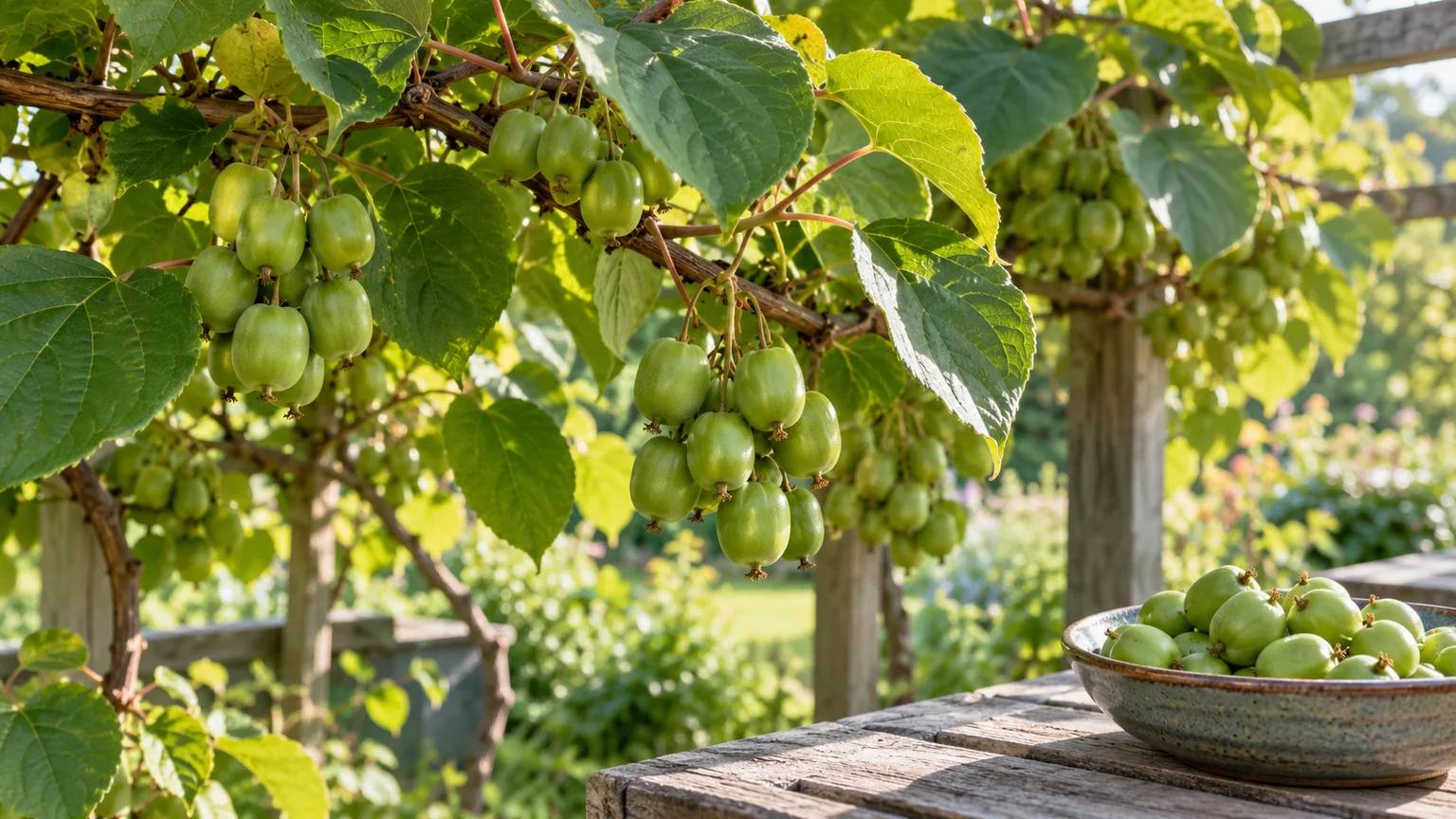
Hardy kiwi fruits are smaller than fuzzy grocery-store kiwis and have smooth, edible skin. Harvest usually falls from late summer into autumn, but varies by cultivar and climate. Do not rely on dates alone: berries may mature unevenly, especially after a cool summer.
When fruit reaches full size and begins to soften or color, pick a small sample and leave it at room temperature for a few days. Taste it after it softens; if it is sweet and aromatic rather than sharply tart, begin harvesting the rest in several passes. Some varieties can be allowed to soften on the vine and may drop when ripe, but picking before a hard frost protects the remaining crop. For storage, remove damaged fruit, keep sound berries cool, and bring small batches to room temperature as you plan to eat them. The Penn State harvest guidance describes both vine-ripened and after-ripened harvest, while Gardeners’ World notes that kiwi can be picked and ripened indoors when the season is too short.
Keep a harvest note with the cultivar, first pick, taste, and frost date. Next year, compare maturity by taste as well as color. Pick in several passes if sunny clusters soften before shaded fruit, and handle berries gently so unripe fruit stays attached.
Propagate a vine without losing cultivar certainty
Softwood cuttings and ground layering can produce a new plant that keeps the parent’s sex and cultivar identity. Take material only from a healthy, labeled vine, and label the new plant immediately. The RHS describes both methods for kiwi.
Seed is less predictable. Seedlings may differ from the parent and can be male or female, so a seed-grown vine is a poor shortcut when the goal is a known fruiting cultivar. It may also take years to flower before you can identify its sex. If you want berries from a particular variety, buy a named, vegetatively propagated plant or take a cutting from a named vine rather than planting seeds from supermarket fruit.
For a home cutting, use clean tools and a free-draining medium, keep it lightly moist, and protect it from strong sun until roots develop. Timing and success vary by cultivar; harden rooted plants gradually before moving them outdoors.
Keep vigorous vines out of trees and woods
A trained vine is manageable; one left to scramble through trees can shade and weigh down shrubs, and ground-touching stems may root. Michigan State University’s Midwest Invasive Species Information Network tracks A. arguta as an emerging escape in the northeastern United States, where wildlife disperses fruit and stems can resprout. The concern is regional, not universal.
Check local invasive-species guidance before planting beside woods. Keep the vine on its support, remove unwanted rooted shoots, and collect fruit if local rules recommend containment. If it has reached a canopy or natural area, ask a land manager or tree-care professional about removal. See the MSU MISIN record for the regional monitoring details.
Conclusion
Hardy kiwi is a rewarding fruit vine when the planting is planned around its real scale. Choose the species and named cultivar first, confirm whether it needs a male partner, install a permanent support, and train one trunk with horizontal fruiting arms instead of letting the shoots run wherever they find a hold.
For dependable care, keep the root zone moist but well-drained, feed only when soil or growth calls for it, prune during dormancy and again in summer, and protect young shoots when a late frost threatens. Expect the first crop to take time, test a few berries before harvesting the full vine, and keep the canopy out of trees and nearby wild areas. Those choices do more for long-term success than any single fertilizer or watering schedule.



