How to Grow and Care for Korean Spice Viburnum
Learn how to grow Korean spice viburnum, from planting and watering to pruning after bloom, choosing cultivars, and diagnosing poor flowering.
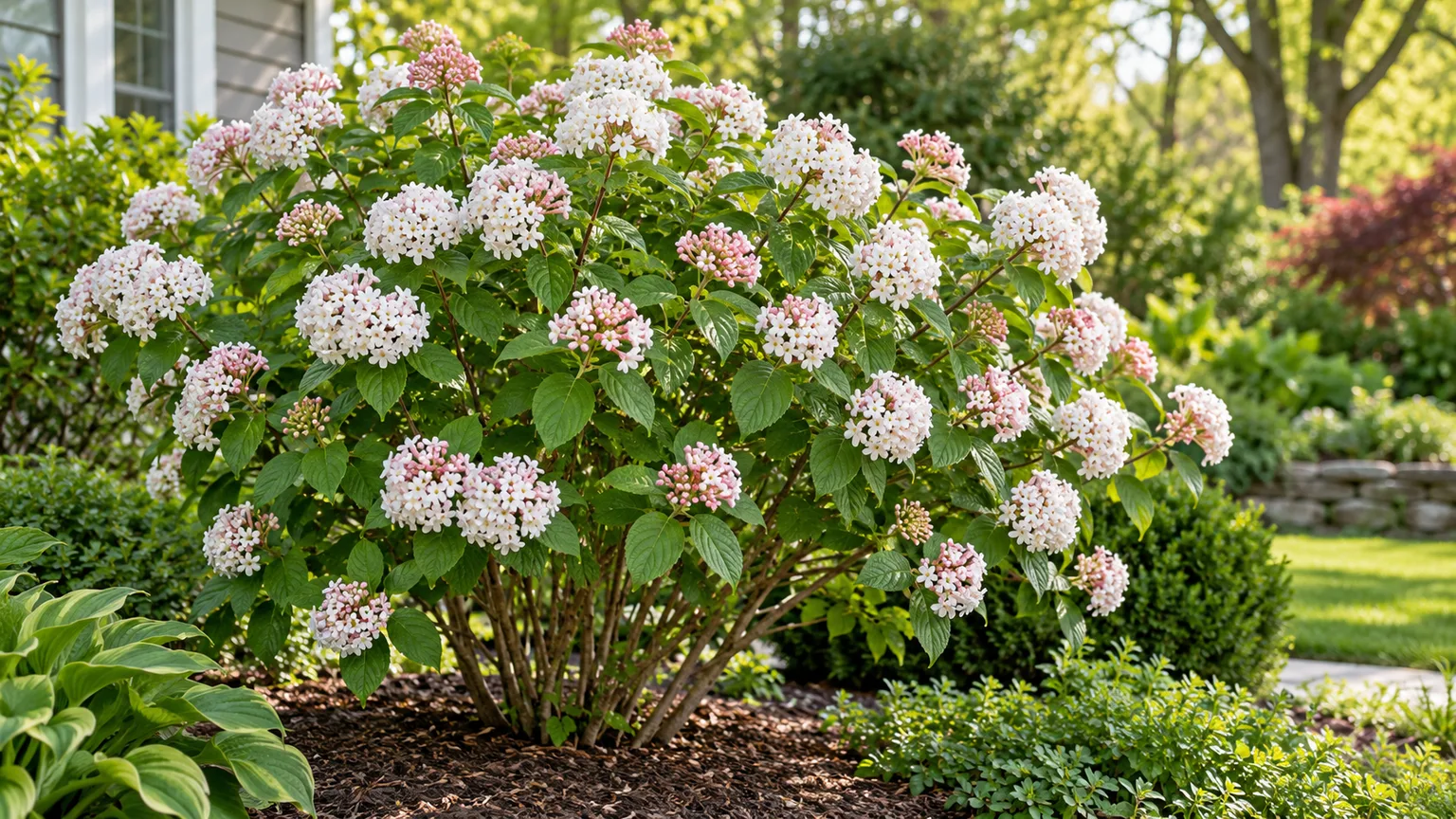
A Korean spice viburnum earns its place near a walk, patio, or open window in spring, when pink buds open into rounded white flower clusters and their spicy, clove-like scent carries through the garden. The shrub also offers a dense green summer outline and wine-red autumn leaves, but it is not a tiny foundation plant: the species commonly reaches 4 to 8 feet in both height and spread, depending on site and reference. Plan for the mature width first, then choose a cultivar if your space is tighter.
The botanical name is Viburnum carlesii. It is a deciduous shrub native to Korea and Japan, and it performs best when its roots stay moist but not waterlogged. Most problems gardeners blame on “fussy viburnum care” come down to three avoidable choices: planting in shade so dense it suppresses bloom, leaving a new shrub dry through its first summer, or pruning after the next season’s flower buds have already formed. The guidance below helps you avoid those mistakes while separating the true species from similarly scented hybrids.
Korean Spice Viburnum at a Glance
| Feature | What to expect |
|---|---|
| Botanical name | Viburnum carlesii |
| Type | Rounded, multi-stem deciduous shrub |
| Typical landscape size | About 4–8 ft. tall and wide; allow more room unless the tag confirms a compact selection |
| Hardiness | Commonly listed for USDA zones 4–7; local heat and winter exposure still matter |
| Light | Full sun to light or partial shade; more sun generally supports heavier bloom |
| Soil | Moist, well-drained loam, clay, or sandy soil; slightly acidic to neutral is a useful target, not a prerequisite |
| Bloom | Early to mid-spring, with pink buds opening to white or pinkish-white rounded clusters |
| Main appeal | Strong fragrance, spring bloom, rounded habit, and possible wine-red fall color |
| Pruning | Minimal; shape just after flowering because it blooms on old wood |
Size references vary. NC State Extension describes a typical 4-to-6-foot shrub, while the Morton Arboretum gives a broader 4-to-8-foot range; specimens can exceed those dimensions in favorable conditions. Use the nursery’s cultivar-specific mature-size information, and give an unnamed species plant enough elbow room rather than designing around the smallest number you find.
How to Identify the Species Before You Buy
Look for a deciduous, rounded shrub with opposite pairs of simple, oval leaves. The leaves have toothed edges and a soft, somewhat textured surface; young foliage can emerge coppery before maturing to muted green. In fall, a well-sited plant may turn wine-red or burgundy, though fall color is variable and should not be the sole reason you buy it.
The flowers are the most distinctive feature. V. carlesii produces compact, hemispherical clusters—roughly 2 to 4 inches across—of small flowers that open from pink or red-tinged buds into white blooms. They are not the broad, flat lacecap flower heads associated with some other viburnums. The fragrance is often described as spicy, clove-like, or sweet, and can be noticeable several yards away on a warm, still day. NC State Extension’s plant profile documents the rounded shrub, pink buds, white fragrant flowers, and opposite leaves; the Morton Arboretum’s profile provides a useful second reference for its form and scent.
Garden centers may label the shrub “Korean spice bush,” “Korean spice viburnum,” or simply Viburnum carlesii. Check the botanical name on the tag, not just the common name. “Spicebush” can also refer to unrelated plants such as Lindera benzoin, and several viburnums share a spring fragrance while differing in size, leaf texture, bloom cluster, and hardiness.
Cultivars and Hybrids: Read the Plant Tag Carefully
A cultivar is a selected form within a species; a hybrid has parents from more than one species. Both can be sold under familiar “Korean spice” names, so the Latin name tells you what you are actually buying. This distinction matters because mature size and flower form can differ more than the name on a display sign suggests.
For a smaller garden, ‘Compactum’ is the clearest compact choice. The Morton Arboretum lists it at roughly 3 to 4 feet tall, while other references give a similar compact range. ‘Aurora’ has vivid pink-red buds and typically reaches about 6 to 8 feet tall and wide in arboretum references, so do not assume its name means compact. ‘Spiro’, marketed as Spice Girl®, is a vigorous V. carlesii cultivar; its trade name and cultivar name are not interchangeable, and its listed size is commonly around 6 to 8 feet. Compare current nursery tags and allow for local variation instead of relying on a retailer’s product photo.
‘Cayuga’ is not simply a cultivar of pure V. carlesii. It is sold botanically as Viburnum × carlcephalum ‘Cayuga’, a backcross involving V. carlesii and the fragrant snowball viburnum hybrid. Its clusters are larger and it is often selected for improved tolerance to bacterial leaf spot and powdery mildew, but its eventual size is unusually inconsistent across references. NC State Extension’s profile for ‘Cayuga’ lists a broad 4-to-10-foot range, so treat the label’s local nursery dimensions as a planning check, not a promise.
Other fragrant shrubs are true hybrids, not forms of the species. Viburnum × juddii combines V. carlesii with V. bitchiuense and tends to be broader, with looser flower clusters. Viburnum × burkwoodii has different parentage and often grows larger. V. × carlcephalum combines Korean spice viburnum with V. macrocephalum and is known for very large snowball-like clusters. These hybrids can be excellent plants; the point is to buy them intentionally, with the hybrid name and mature spread in view. Oregon State University’s plant profile for V. × juddii explains its parentage and broader form.
Choose a Site for Sun, Fragrance, and Mature Spread
Give Korean spice viburnum full sun or partial shade. Six hours of direct light usually gives the strongest flowering, while a site with morning sun and light afternoon shade can be a sensible compromise in a region with hot summers. Deep shade may keep the shrub alive but produces fewer flower buds, a looser shape, and slower drying after rain.
Choose a location where the flower scent will be useful: beside a path, a patio, an entry, or a window you open in spring. Avoid placing it where a powerful scent would be unwelcome, such as directly beside a bedroom window if anyone in the household is scent-sensitive. If you want a row, measure between centers and use each plant’s expected mature width. For an unselected species plant, spacing only 4 feet apart may create crowding as the shrubs mature; compact cultivars and a clipped hedge are different design decisions.
Air movement helps the foliage dry and makes routine inspection easier. Do not wedge the shrub into a narrow foundation bed simply because it is small at purchase. A mature plant should be able to keep its natural rounded outline without being sheared every few weeks or forced against siding, a fence, or a walkway.
Soil and Drainage Matter More Than a Perfect pH
Korean spice viburnum is adaptable to clay, loam, and sandy soils, but its roots need oxygen. The useful target is evenly moist soil that drains after rain. Avoid a low pocket where water stands for days, a compacted construction edge, or a pot-like hole dug into heavy clay and filled with loose compost. A shrub that repeatedly wilts despite wet soil may have damaged or oxygen-starved roots, not a need for more water.
Slightly acidic to neutral soil is appropriate, but the shrub tolerates a wider pH range than strict acid-loving plants. Do not add sulfur, lime, or a bag of “acid soil” automatically. If leaves are persistently pale or growth is weak despite reasonable moisture and light, test the soil before correcting pH; a high pH can limit nutrient availability, but indiscriminate amendments can make a healthy site less suitable. NC State Extension lists acid through neutral soil and several soil textures, while the Morton Arboretum notes the species’ pH adaptability and preference for moist, well-drained soil.
When to Plant Korean Spice Viburnum
Plant in spring or early fall when the soil is workable and temperatures are moderate. Spring gives roots a full growing season before winter; early fall can work well where the shrub has several weeks to establish before the ground freezes. In hot-summer regions, avoid planting during a heat wave unless you can keep the root ball evenly moist and protect the transplant from severe afternoon stress.
Container-grown shrubs are usually the easiest stock to handle. Before purchase, inspect the stems and leaf undersides for scale-like bumps, sticky residue, distorted tips, or dieback. Slide the plant from its pot if possible: a dense mat of circling roots is not a reason to reject it automatically, but the outer roots should be teased apart or lightly corrected before planting. Reject stock with a sour-smelling, waterlogged root ball or extensive dead branches.
How to Plant It Without Burying the Roots
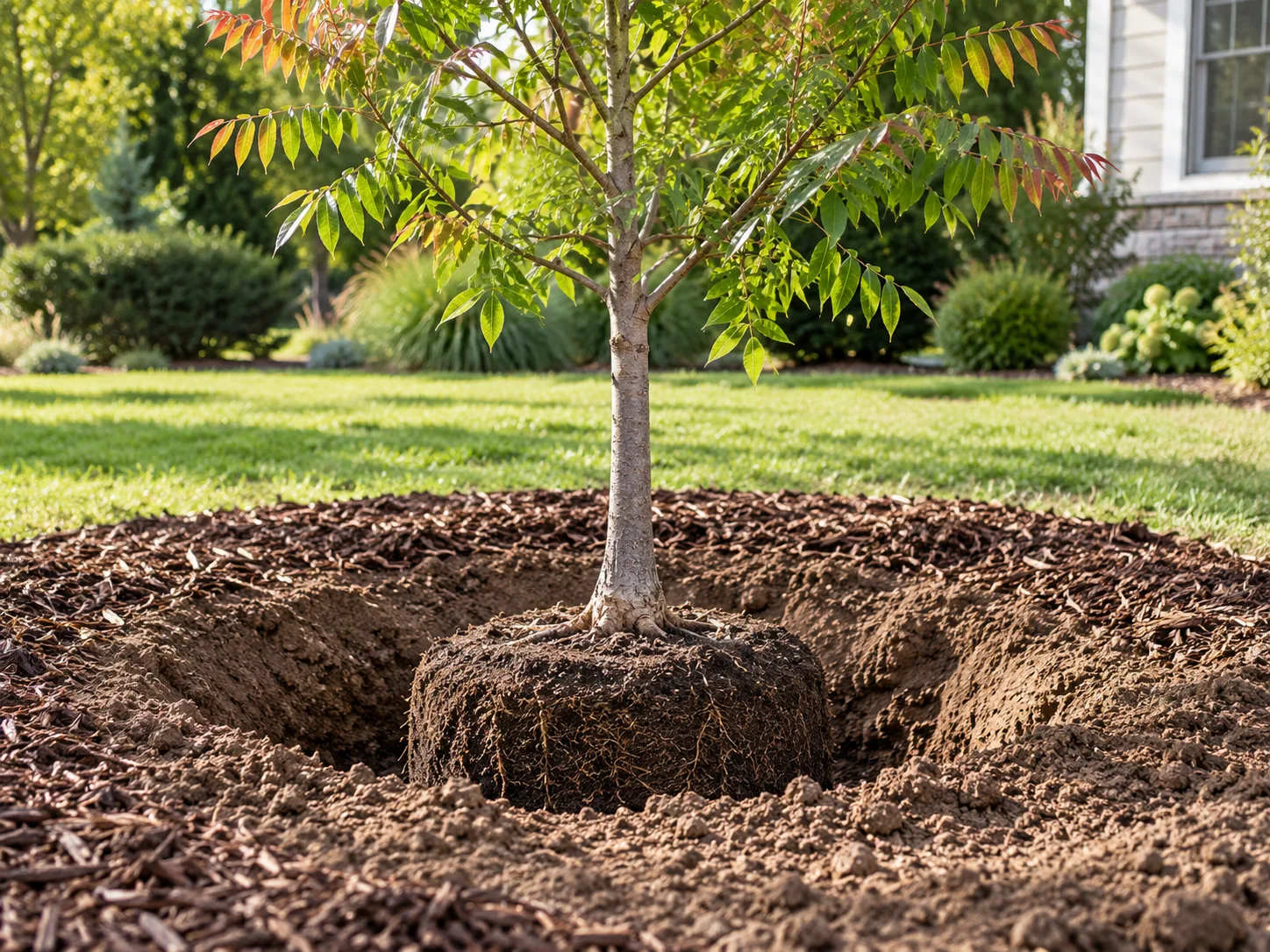
Set the root flare—the point where the first major roots spread from the stem—at or slightly above finished soil level. This is more important than making the hole exceptionally rich. A buried flare and a deep planting hole can keep the crown wet and contribute to gradual decline.
- Find the root flare. Remove excess potting mix from the top of the root ball until the first structural roots are visible. Measure from that point, not from the top of a mound of nursery soil.
- Dig wide and shallow. Make the hole about two to three times the root ball’s width and no deeper than the distance from the flare to the bottom of the root ball. Roughen glazed sides in clay soil so roots can move outward.
- Correct circling roots. Loosen the outer roots with fingers. If they form a tight mat, make a few shallow vertical cuts or straighten the major roots outward; do not leave a woody root girdling the stem.
- Set and backfill. Place the shrub upright, check the flare from several directions, and backfill with the excavated native soil. Avoid a pocket of rich amendment that drains differently from the surrounding bed.
- Water and mulch. Soak the root ball and surrounding soil slowly to settle air gaps. Spread 2 to 3 inches of organic mulch over the root zone, but leave a clear gap around the stems.
If the plant is intended as a loose screen, lay out the full mature width before digging. It is easier to set correct spacing before the first shrub is in the ground than to solve overcrowding with repeated hard cuts years later.
Watering During Establishment and Afterward
During the first growing season, check the original root ball and the surrounding soil rather than watering by a fixed calendar. Nursery root media can dry faster than the garden soil around it, so probe both areas a few inches down. When the root ball begins to dry, water slowly at its base until the soil is moist through the depth of the roots; then wait for the surface to begin drying again. Daily sprinkling often wets only the top layer and encourages shallow roots.
For the first several weeks after planting, inspect every few days during warm, dry weather. As roots move into the surrounding soil, the interval can lengthen, but heat, wind, sandy soil, and limited rainfall shorten it again. A leaf that droops in late afternoon and recovers by morning is a cue to check moisture, not an automatic instruction to flood the bed. If the soil is already wet, investigate drainage or root damage before adding more water.
Established plants tolerate some short dry spells, but that does not make them drought-proof. A prolonged dry period can cause browned margins, early leaf drop, or reduced flower-bud development for the following spring. Give a deep soak during extended drought, especially where roots compete with lawn or tree roots, and keep mulch over the feeder-root zone. Oklahoma State University lists the species as heat- and drought-tolerant once established, while still recommending moist, well-drained soil; “tolerant” should be read as a survival range, not as a reason to let a new shrub dry out.
Mulch and Fertilizer: Keep the Routine Light
A broad, moderate mulch layer stabilizes moisture and reduces competition from turf. Keep it about 2 to 3 inches deep and pull it back several inches from the stems. Replenish only what has decomposed; piling mulch into a cone against the shrub’s base can trap moisture and hide borer damage.
Most Korean spice viburnums in average garden soil do not need routine fertilizer. If a soil test identifies a deficiency or the shrub has weak growth despite adequate light and water, use a modest, label-directed shrub fertilizer in spring. Do not feed heavily to force growth, and avoid late-summer nitrogen that can push tender shoots near frost. Compost used as a thin surface dressing is usually enough for a healthy plant in ordinary soil.
Spring Flowers, Fall Color, and Berry Set
The flower display arrives in early to mid-spring, but the calendar shifts with latitude and the year’s weather. In many gardens, red-pink buds open to white flowers over a short window, and fragrance is strongest when temperatures are mild. A late freeze can brown open flowers or damage buds; it does not mean the plant is dead if the stems and leaf buds remain healthy. The shrub’s opposite, toothed leaves fill in after bloom, then may turn burgundy or wine-red in fall. The Royal Horticultural Society’s species profile summarizes its pink buds, white fragrant spring flowers, red autumn foliage, and black fruit.
Small red drupes may darken to bluish black later in the season, but fruit is neither guaranteed nor the plant’s main ornamental feature. The shrub can flower without a pollination partner. To improve the chance of fruit, viburnums generally benefit from compatible, genetically distinct plants blooming at the same time; two shrubs that are clones of one cultivar may not provide that diversity. A nearby compatible viburnum may be sufficient, so do not crowd two full-size shrubs into a narrow bed solely for berries. The New York Botanical Garden’s plant reference service explains why genetic similarity can reduce viburnum fruit set. Treat the berries as ornamental and do not eat them; the RHS advises that the fruit is not for consumption.
Prune Right After Bloom to Keep Next Year’s Flowers
Korean spice viburnum sets flower buds on the previous season’s growth. If you shear or substantially shorten branches in late summer, fall, or winter, you can remove the buds that would have opened the next spring. For routine shaping, wait until the flowers fade and prune promptly, while allowing enough time for new shoots to mature before winter.
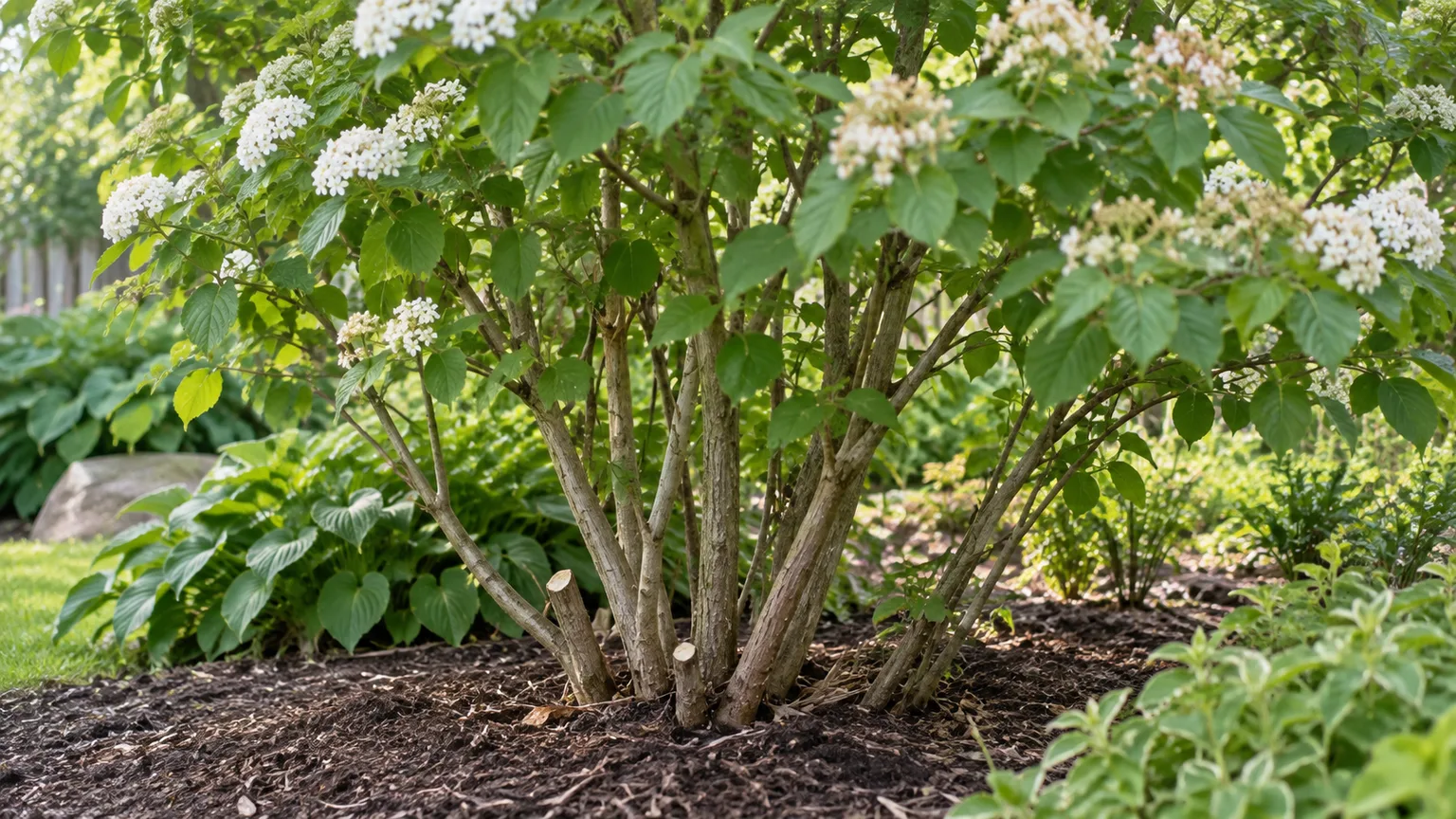
Start with broken, dead, diseased, or rubbing stems. Remove a few of the oldest stems at ground level if the center has become congested; use clean, sharp bypass pruners and avoid leaving stubs. To reduce height, shorten selected branches to a lower side branch rather than cutting every tip into a flat shell. Step back between cuts—the goal is a balanced natural outline, not a tightly clipped ball. The RHS viburnum growing guide classifies V. carlesii among viburnums needing little or no pruning, and its species profile places pruning after flowering. Fine Gardening’s viburnum troubleshooting guide likewise emphasizes restraint and the cost of renewal cuts.
A neglected, oversized shrub can be renovated, but a severe cutback sacrifices much or all of the next bloom and may not be the best choice for a slow-growing plant. Reduce size over several post-bloom seasons by removing a portion of the oldest stems at the base each year. If you need to cut the whole shrub down to the ground to fit the space, replacement with a smaller cultivar is often a better long-term decision than repeating a drastic cycle.
Pests and Diseases: What to Inspect First
This is generally a low-maintenance shrub, but “usually trouble-free” does not mean immune. Aphids often distort young leaves and shoot tips. Look underneath curled leaves for small soft-bodied insects, cast skins, or sticky honeydew. A few curled leaves do not justify spraying the whole shrub; identify the insect, watch whether beneficial predators are present, and remove or rinse small localized colonies when practical. If a treatment is necessary, use only a product labeled for that ornamental plant and pest, following its directions and pollinator precautions. The RHS species profile lists aphids as a possible pest, and University of Vermont Extension’s response to a Korean spice viburnum diagnosis notes that early leaf curl can have more than one cause.
Viburnum crown borers deserve attention when the shrub loses vigor from the base upward. Warning signs include swollen or cracked lower stems, exit holes, sawdust-like frass, sparse foliage, and branch dieback. Avoid mower and string-trimmer wounds, maintain reasonable moisture, and ask a local extension office to help confirm the diagnosis before choosing a control; the Morton Arboretum’s borer guide describes the stem damage and host range, including Korean spice viburnum.
Leaf spots or a white powdery coating are more likely when foliage stays damp in dense shade. Improve airflow by removing only congested stems, water at soil level when possible, and clear badly infected fallen leaves. The University of Minnesota Extension’s viburnum diagnostic guide distinguishes powdery mildew, rust, downy mildew, and bacterial leaf spot by their appearance. If spots spread rapidly or several branches die back, take clear photos and contact a local plant clinic rather than guessing at a fungicide.
Troubleshoot Sparse Bloom, Leaf Curl, and Dieback
When a shrub has healthy foliage but few flowers, begin with the previous year’s conditions. Too much shade is a common cause; check how many hours of direct sun reach the shrub after nearby trees leaf out. Pruning at the wrong time is another: if you cut it in autumn or winter, the missing flowers may be the result of removed buds. A young nursery plant may also need time to establish before it produces a full display, and hard frost at bloom time can damage flowers without harming the whole plant.
For curled or undersized leaves, inspect before treating. If insects or sticky honeydew are present, aphids are plausible. If leaves are clean but growth remains stunted, check whether the root flare is buried, the site stays saturated, mulch is piled against stems, or the root ball dried during establishment. Repeated spring deformity, unusual color patterns, or symptoms that do not match insects or water stress may need a local diagnostic service. Several different causes can look alike from a distance.
For branch dieback, test the soil moisture several inches down and inspect the lower stems for holes, cracking, or injury. A shrub sitting in wet soil may have root trouble; one that has been dry for weeks may show crisp leaf edges and early drop. Avoid fertilizing a stressed plant as a first response. Correct the water or drainage issue, remove clearly dead wood after confirming its limits, and reassess new growth instead of stacking multiple treatments at once.
Growing Korean Spice Viburnum in a Container
A compact cultivar such as ‘Compactum’ can be grown in a large outdoor container, but container culture is less forgiving than planting in the ground. The root zone heats and dries faster, and it can freeze more severely in winter. Choose a heavy pot with several drainage holes, sized to leave room around the root ball but not so oversized that wet mix remains unused for long periods. Use a well-draining outdoor potting mix rather than garden soil packed into the container.
Place the pot where the shrub receives sun or light shade and where spring fragrance can be enjoyed. Check moisture more often in hot or windy weather, and water until excess drains from the bottom. Do not leave the container standing in a saucer of water. In cold climates, protect the pot or move it to a sheltered, unheated location when temperatures threaten to freeze the root ball; a plant hardy in the ground may be less hardy in an exposed container. Repot when roots circle densely or growth becomes difficult to maintain, and replace some of the mix rather than routinely adding fertilizer.
Propagation: Cuttings Are More Predictable Than Seed
Softwood cuttings taken in late spring or early summer are a practical way to try propagating V. carlesii. Select healthy, nonflowering new shoots, cut several short pieces with at least a couple of nodes, remove the lower leaves, and insert the bare lower portion into a clean, free-draining propagation mix. Keep the mix evenly moist and the cuttings in bright, indirect light with high humidity, then check periodically for root development. Rooting time and success vary with cultivar, shoot maturity, and conditions; do not treat a four-week schedule as a guarantee. The RHS propagation guidance for viburnums recommends early-season softwood cuttings for V. carlesii.
Seed is slower and less predictable. Fruit set may be sparse, seed dormancy can delay germination, and seedlings will not necessarily reproduce the traits of a named cultivar. If the plant has a cultivar name, check the plant tag and current propagation rights before reproducing it for sale or distribution. For most home gardeners who want a particular flower color, habit, or mature size, buying the correctly labeled plant is more reliable than raising it from seed.
Winter Care Across the Hardiness Range
The species is commonly listed for zones 4 through 7, although references and local performance vary. NC State includes zones 4a–7b, while the Morton Arboretum’s regional profile focuses on zones 5–7 around northern Illinois and Chicago. These listings are not contradictory so much as climate-specific: a shrub can tolerate colder winter lows yet perform differently under hot, humid summers, late freezes, wind, or poor drainage. Use your local extension service and the nursery’s cultivar information when you are at the edge of the range.
In the ground, an established shrub within its suitable range generally needs no elaborate winter wrap. Keep mulch in place over the root zone, water during a dry fall before the soil freezes, and do not fertilize late in the growing season. A newly planted shrub in a windy or borderline-cold site may benefit from a temporary wind screen, but wrapping tightly can trap moisture and break branches. Container plants need more protection because their roots have less insulation; shelter the pot rather than bringing a deciduous outdoor shrub into a warm living room.
Conclusion
Korean spice viburnum is easiest to grow when you give it enough space, morning-to-afternoon light, and soil that stays moist without remaining soggy. Buy by botanical name, check the actual cultivar size, water attentively during establishment, and prune only after the fragrant spring flowers fade. If bloom, foliage, or fruit is disappointing, inspect light, pruning history, moisture, and plant identity before reaching for fertilizer or pesticide. That sequence keeps care simple and lets Viburnum carlesii develop its rounded form and spring scent over time.



