10 Best Low-Maintenance Indoor Plants for Busy People
10 genuinely forgiving indoor plants that thrive with minimal care. Includes pet-safe picks, watering guides, common mistakes, and a quick comparison table for busy plant parents.
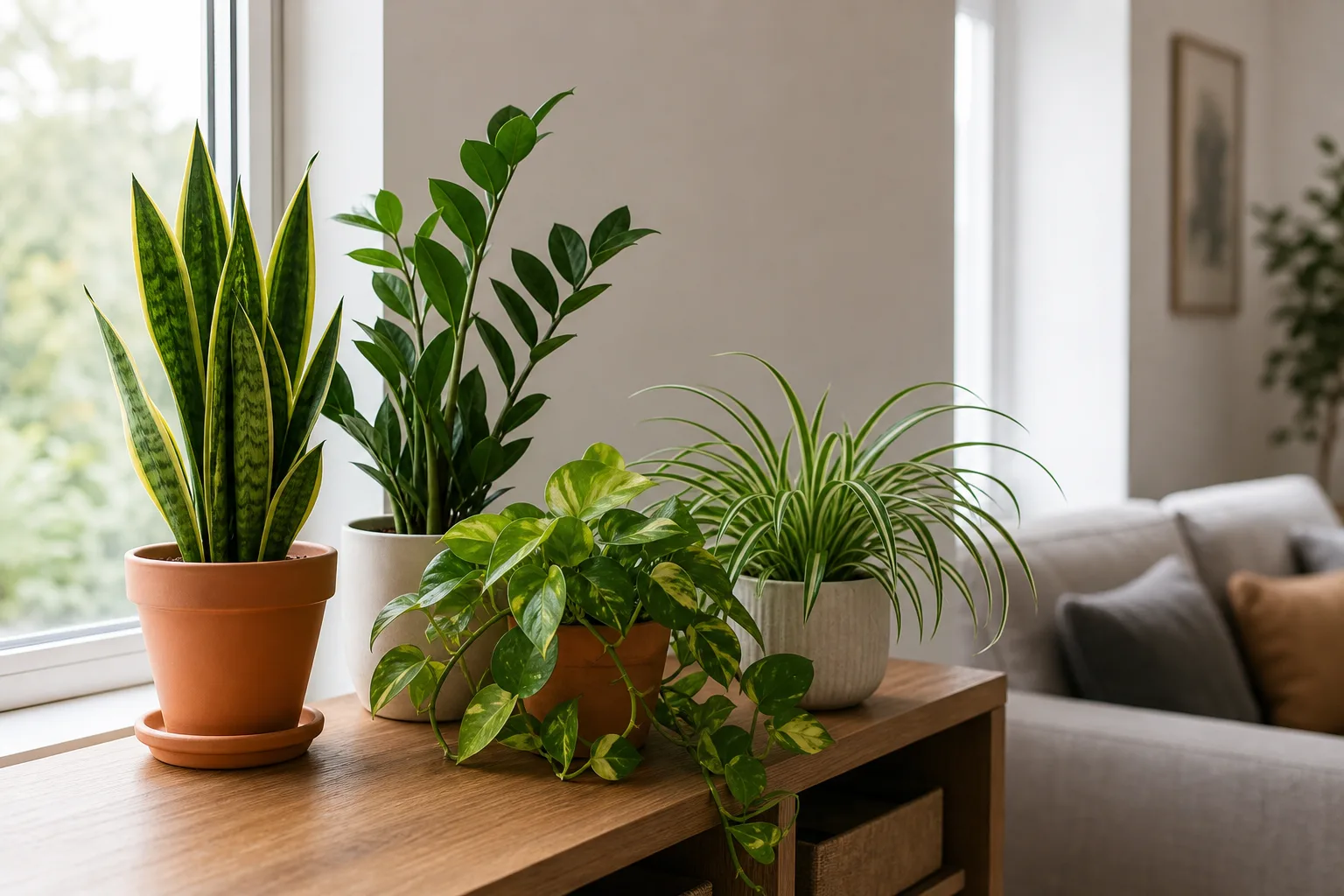
10 Best Low-Maintenance Indoor Plants for Busy People
If you work long hours, travel often, or have never kept a plant alive for more than a few months, this guide is for you. Low-maintenance doesn’t mean “impossible to kill” — no plant is — but the 10 plants below tolerate missed waterings, imperfect light, and the kind of benign neglect that kills fussier species within weeks.
The difference between a plant that thrives and a plant that dies isn’t how much time you spend on it. It’s choosing a plant whose needs match the care you’re actually going to provide. Every plant on this list forgives the most common busy-person mistake: forgetting to water.
How These Plants Were Selected
Not every plant labeled “easy-care” at a garden center lives up to the claim. Each plant below meets at least four of these five criteria, verified against university extension resources and LeafyPixels plant-care data:
Missed-watering tolerance. Can the plant survive an extra week (or more) between waterings without permanent damage? Plants that wilt dramatically but bounce back within hours are included. Plants that crisp up and never recover are excluded.
Light flexibility. Does the plant handle a range of light conditions — from bright indirect to lower-light corners — without losing form or health? Variegated varieties that revert in lower light get clear warnings.
Normal indoor humidity. No plant on this list requires a humidifier, pebble tray, or daily misting to survive in typical air-conditioned or heated homes. A few prefer higher humidity but tolerate average indoor air.
Low repotting and pruning demand. These plants grow slowly enough that repotting every 1–3 years is sufficient. None require frequent deadheading, staking, or aggressive pruning to look presentable.
Pest resistance. While no plant is immune to pests, the plants here are not magnets for spider mites, mealybugs, or scale under normal indoor conditions. Those with known pest sensitivity are flagged with a warning.
Evidence Strength Overview
| Benefit | Evidence strength | Realistic home expectation |
|---|---|---|
| Survives 2–4 weeks without water | Strong — consistent across extension sources and grower experience | True for Snake Plant, ZZ Plant, Cast Iron Plant, Ponytail Palm; less reliable for Peace Lily and Spider Plant in hot, dry homes |
| Tolerates low light | Moderate to strong — plant-specific | Snake Plant and ZZ Plant handle very low light; Pothos and Philodendron survive it but grow slower; Jade Plant and Ponytail Palm decline without bright light |
| Pet-safe (non-toxic) | Strong — ASPCA-verified for listed plants | Spider Plant, Cast Iron Plant, Parlor Palm, Ponytail Palm confirmed non-toxic; all others listed are toxic to cats and dogs |
| Air-purifying in real-world homes | Weak — NASA Clean Air Study (1989) used sealed chambers, not ventilated homes | Do not rely on any houseplant to meaningfully purify room air; choose plants because you enjoy them |
Quick Comparison Table
| Plant | Best For | Light | Water Every | Pet-Safe? | Main Risk |
|---|---|---|---|---|---|
| Snake Plant | Near-total neglect | Low to bright indirect | 3–4 weeks | No | Root rot from overwatering |
| ZZ Plant | Dark corners, forgetful owners | Low to bright indirect | 3–4 weeks | No | Mushy stems from overwatering |
| Golden Pothos | Trailing greenery, low light | Low to bright indirect | 1–3 weeks | No | Root rot; leaf burn in direct sun |
| Spider Plant | Pet owners, hanging baskets | Medium to bright indirect | 1–2 weeks | Yes | Brown tips from fluoride or dry air |
| Peace Lily | Low-light rooms, visual cues | Low to medium indirect | 1 week (when it droops) | No | Chronic underwatering causes crisp edges |
| Jade Plant | Sunny windowsills, decades-long ownership | Bright light (4+ hours) | 2–4 weeks | No | Leggy growth in low light |
| Cast Iron Plant | Deep shade, cold drafts | Low to medium indirect | 2–3 weeks | Yes | Slow growth; nothing else fazes it |
| Heartleaf Philodendron | Shelves, beginner trailing | Low to bright indirect | 1–2 weeks | No | Root rot from soggy soil |
| Ponytail Palm | Forgetful waterers, pet homes | Bright light | 3–4 weeks | Yes | Overwatering; low light = no growth |
| Aglaonema | Low-light color, desks | Low to medium | 1–3 weeks | No | Cold drafts; soggy soil |
1. Snake Plant
Best for: People who want maximum greenery for minimum effort
Difficulty: Very easy
Light: Low light to bright indirect; tolerates some direct morning sun
Water: Every 3–4 weeks; let soil dry completely between waterings
Best placement: Bedroom, living room corner, hallway, office cubicle
Pet safety: Toxic to cats and dogs if ingested (ASPCA)
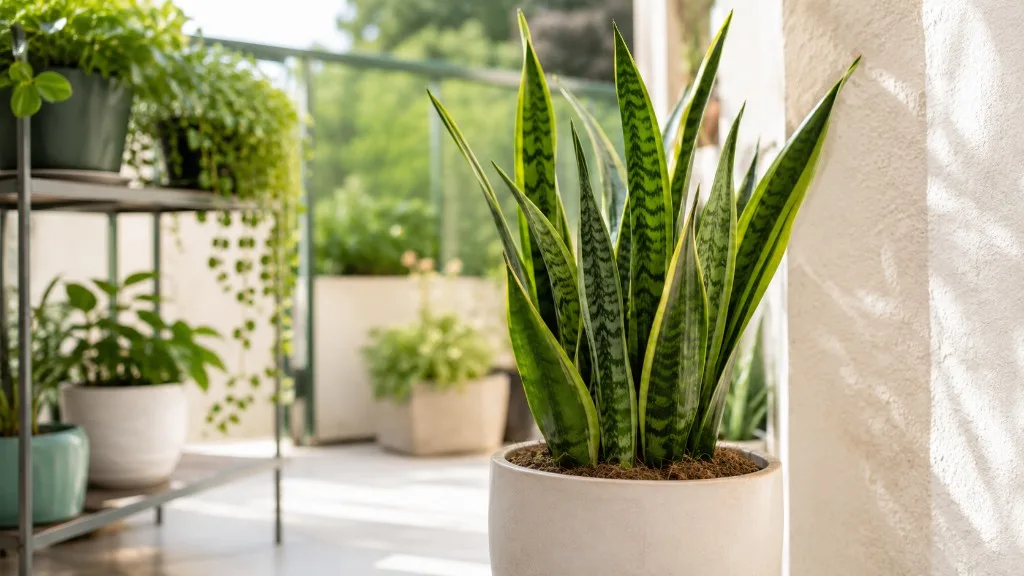
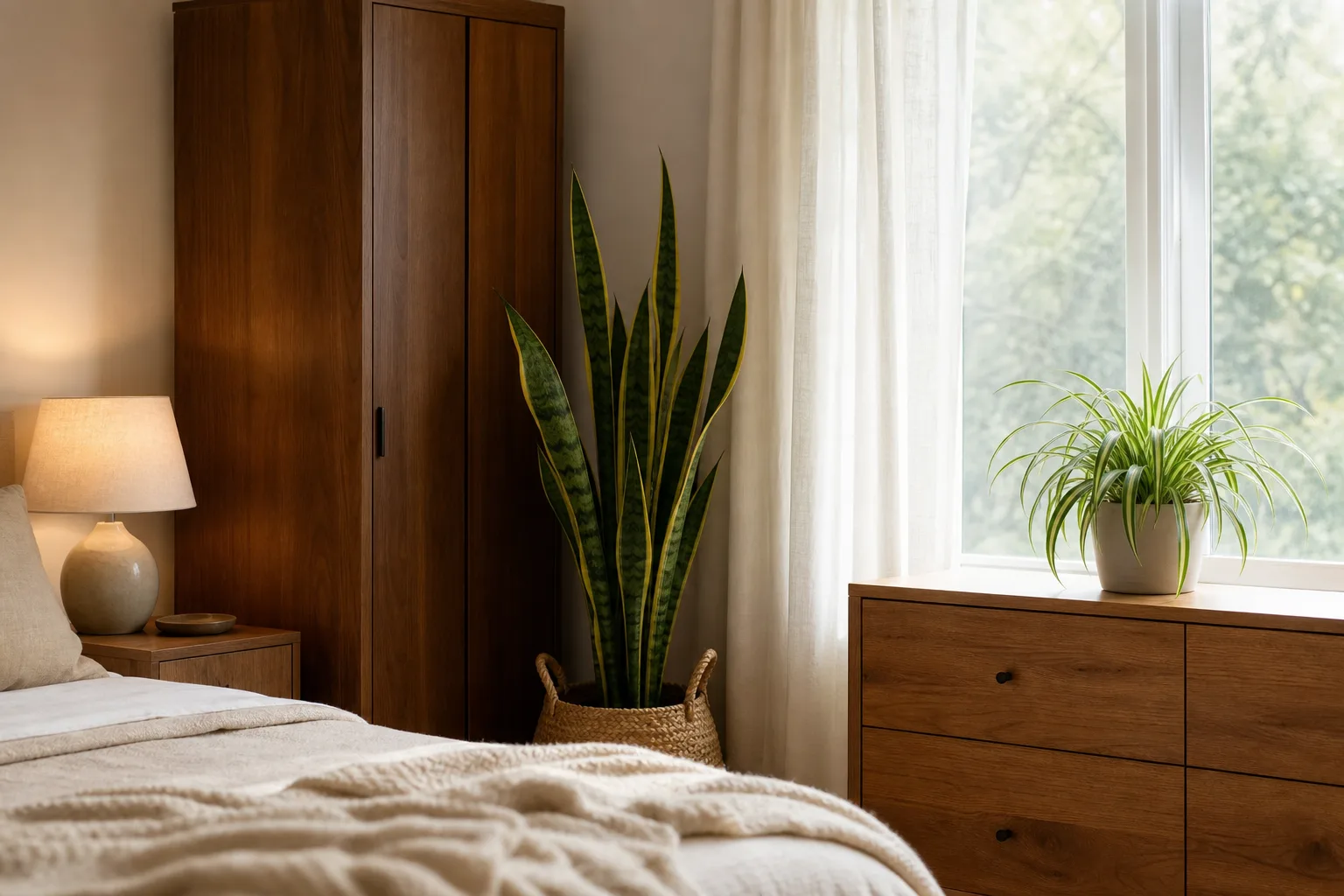
The Snake Plant (Sansevieria trifasciata) converts carbon dioxide to oxygen at night — a rare trait among houseplants — which is why it’s commonly recommended for bedrooms. But that’s not what makes it great for busy people. What matters is that a Snake Plant can go a full month without water in winter, survives in a dim hallway, and won’t punish you if you forget about it entirely for weeks.
The upright, sword-shaped leaves store water efficiently, and the plant uses a type of photosynthesis called Crassulacean Acid Metabolism (CAM) that reduces water loss. This is the same adaptation you see in desert succulents, which explains why Snake Plants rot so quickly when overwatered.
Why it works: High drought tolerance, extreme light flexibility, pest resistance, and zero pruning or shaping requirements.
Care tip: Water from the bottom by placing the pot in a saucer of water for 15–20 minutes. This prevents water from collecting in the leaf rosettes, where trapped moisture causes rot.
Common mistake: Treating it like a tropical foliage plant and watering weekly. The number one way to kill a Snake Plant is overwatering. If you see yellowing or mushy leaves at the base, you’ve watered too much — stop immediately and check for root rot.
Avoid this plant if: You have cats or dogs that chew on plants and cannot place it out of reach. All Sansevieria species are toxic to pets.
Useful care guides:
- Snake Plant care guide
- Snake Plant watering guide
- Snake Plant light guide
- Snake Plant problems guide
2. ZZ Plant
Best for: Near-zero natural light and people who forget they own plants
Difficulty: Very easy
Light: Extremely low light to bright indirect; avoid direct sun
Water: Every 3–4 weeks; let the top 2–3 inches of soil dry completely
Best placement: Windowless bathroom, dark hallway, north-facing room, office with only fluorescent lighting
Pet safety: Toxic to cats and dogs if ingested (ASPCA)
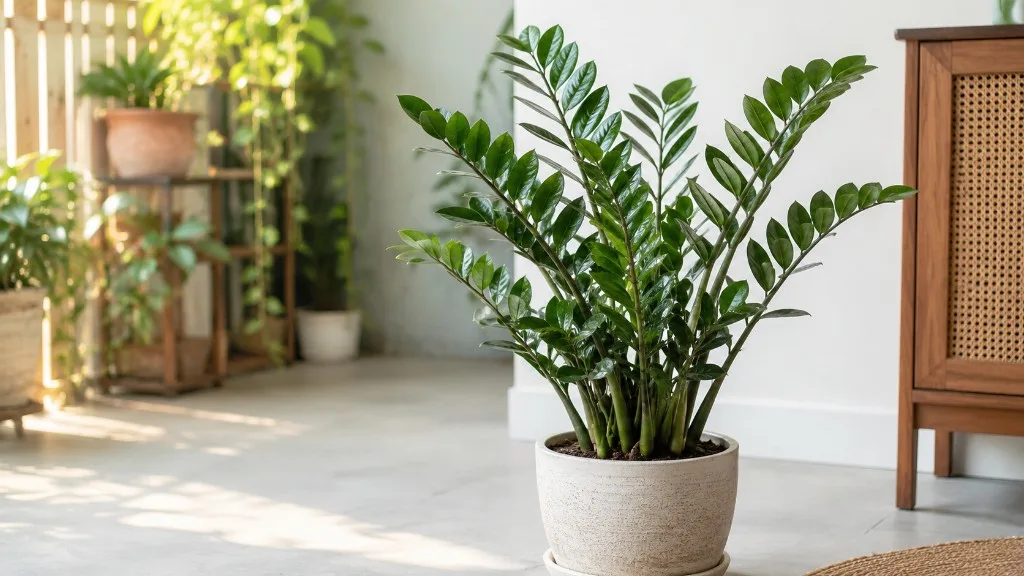
The ZZ Plant (Zamioculcas zamiifolia) is probably the single most neglect-tolerant houseplant available. It stores water in thick, potato-like rhizomes underground, which means it can survive drought conditions that would kill almost anything else in a pot. Its glossy, dark green leaflets look almost artificial — which is fitting, because it needs so little care that guests sometimes assume it’s fake.
Native to Eastern Africa, the ZZ Plant evolved to handle extended dry seasons followed by bursts of rain. That rhythm — long dry spells, then a thorough soak — is exactly what it needs in your home. In low light, it essentially pauses: no new growth, minimal water consumption, just existing quietly in the corner. It’s not dying; it’s waiting.
Why it works: Rhizome-based water storage, extreme low-light tolerance, pest resistance, and slow growth that eliminates frequent repotting.
Care tip: If you travel for 2–3 weeks at a time, water your ZZ Plant thoroughly right before you leave and again when you return. It will be fine. Dust the leaves with a damp cloth every few months — glossy leaves collect dust and look dull without a quick wipe.
Common mistake: Watering on a calendar schedule without checking the soil first. A ZZ Plant in a dark, cool room might need water once a month. The same plant in a bright, warm room might need it every 2–3 weeks. Always check the soil.
Avoid this plant if: You have pets that dig or chew — all parts of the ZZ Plant contain calcium oxalate crystals that cause oral irritation, vomiting, and difficulty swallowing if ingested.
Useful care guides:
- ZZ Plant care guide
- ZZ Plant watering guide
- ZZ Plant light guide
- ZZ Plant propagation guide
- ZZ Plant problems guide
3. Golden Pothos
Best for: Trailing greenery almost anywhere, first-time plant parents who want visible growth
Difficulty: Very easy
Light: Low light to bright indirect; avoid harsh direct sunlight
Water: Every 1–3 weeks, when the top inch of soil is dry
Best placement: Shelf, bookcase top, hanging basket, desk with a small trellis
Pet safety: Toxic to cats and dogs if ingested (ASPCA)
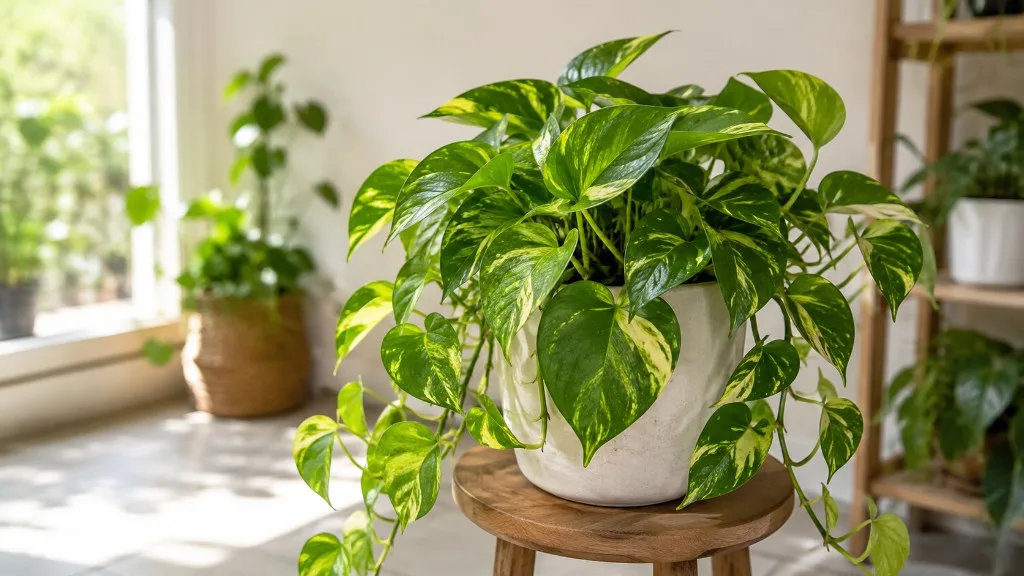
Golden Pothos (Epipremnum aureum) is the most forgiving trailing plant you can buy. It grows in water alone, roots from cuttings in days, and visibly wilts when thirsty — then bounces back within hours of watering. For a busy person, that clear “I need water” signal is more valuable than any care schedule.
The heart-shaped leaves develop golden variegation in brighter light and stay mostly green in lower light. In the right conditions, vines can reach 6–10 feet indoors within a year or two. If you want a plant that rewards minimal effort with dramatic growth, this is it.
Pothos is also one of the easiest plants to propagate. Snip a 4–6 inch stem below a node, drop it in water, and roots appear within 1–2 weeks. You can fill an entire room with Pothos from a single plant over time.
Why it works: Clear visual thirst signals, roots easily in water, grows in a wide range of light, recovers quickly from underwatering.
Care tip: If the leaves look pale and the variegation is fading, the plant needs more light. Move it closer to a window — but not into direct sun, which scorches the leaves. If the vines get stringy with long gaps between leaves, it’s reaching for more light.
Common mistake: Overwatering because “the soil looks dry on top.” Pothos roots rot in constantly wet soil. The top inch should feel dry before you water again. If you see yellow leaves dropping from the base, it’s a sign of overwatering.
Avoid this plant if: You have cats that climb shelves — Pothos is toxic and a trailing vine is hard to keep out of reach if you have determined climbers.
Useful care guides:
- Pothos care guide
- Golden Pothos care guide
- Pothos watering guide
- Pothos light guide
- Pothos propagation guide
- Pothos problems guide
4. Spider Plant
Best for: Pet owners, hanging baskets, and anyone who wants free baby plants
Difficulty: Very easy
Light: Medium to bright indirect; tolerates some lower light but slows growth
Water: Every 1–2 weeks; let the top inch of soil dry between waterings
Best placement: Hanging basket near a window, elevated shelf, bathroom with decent light
Pet safety: Non-toxic to cats and dogs (ASPCA)
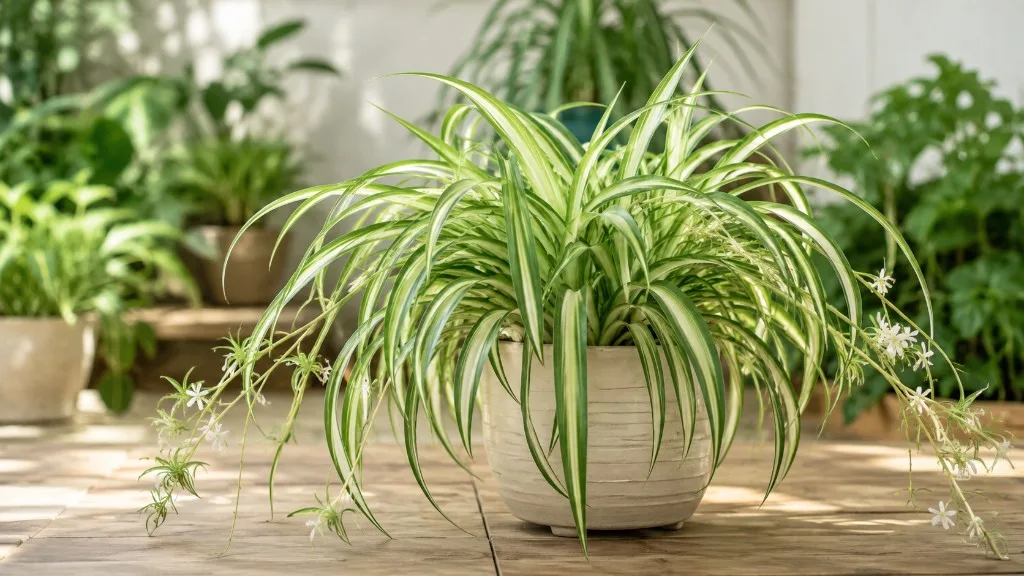
The Spider Plant (Chlorophytum comosum) is one of the few truly pet-safe plants that also qualifies as genuinely low-maintenance. It grows quickly, produces trailing stems of “spiderettes” (baby plants) that you can snip off and pot up, and communicates thirst clearly through faded, droopy foliage.
Its grass-like, arching leaves are variegated with white or yellow stripes in the most common varieties. In a hanging basket or elevated planter, Spider Plants create a fountain of cascading foliage that fills vertical space without taking up floor area — ideal for small apartments.
One quirk: Spider Plants are sensitive to fluoride and chlorine in tap water, which causes the characteristic brown leaf tips that many owners mistake for underwatering. Switching to filtered water, rainwater, or distilled water usually solves it.
Why it works: Pet-safe, produces free propagations, clear visual cues for watering, handles a range of light conditions.
Care tip: When the spiderettes develop small root nubs at their base (usually when they’re 2–3 inches across), snip them off and place them in a small pot of moist soil next to the mother plant. They root within 2–3 weeks and make excellent gifts.
Common mistake: Chasing brown tips by watering more. Brown tips are almost always a water quality issue (fluoride, chlorine, or salt build-up), not a watering frequency issue. If the soil is damp and the tips are still browning, switch water sources — don’t reach for the watering can.
Avoid this plant if: You only have very low light. Spider Plants survive in low light but become thin, pale, and stop producing spiderettes. They need at least medium indirect light to look their best.
Useful care guides:
- Spider Plant care guide
- Spider Plant watering guide
- Spider Plant light guide
- Spider Plant propagation guide
- Spider Plant problems guide
5. Peace Lily
Best for: People who need a plant to tell them exactly when to water
Difficulty: Easy
Light: Low to medium indirect; avoid direct sun
Water: Every 1 week on average — but water when the leaves start to droop, not on a schedule
Best placement: Bathroom, north-facing room, bedroom, shaded desk
Pet safety: Toxic to cats and dogs if ingested (ASPCA)
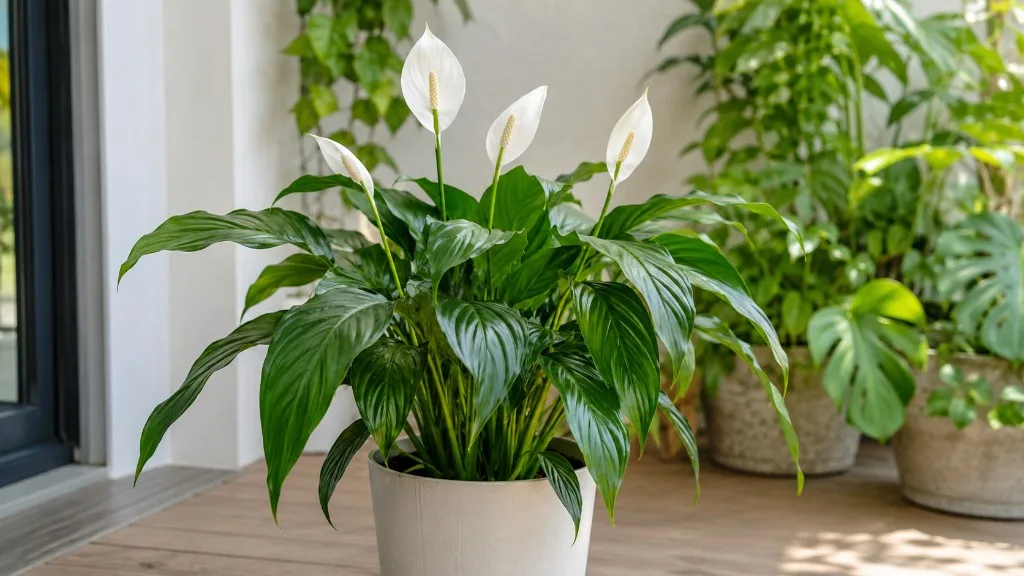
No plant communicates thirst more clearly than a Peace Lily (Spathiphyllum). When the soil gets dry, the entire plant deflates — leaves go limp, stems droop, and it looks dramatically dead. Water it, and within 2–4 hours, it’s standing upright again like nothing happened. For a busy person who doesn’t want to remember a watering schedule, this built-in alert system is invaluable.
Peace Lilies also bloom indoors, producing white spathes (the white “flower” is actually a modified leaf surrounding the true flowers on the central spadix). In low to medium light, they may flower less often or not at all, but the glossy dark green foliage is attractive on its own.
The trade-off is that Peace Lilies are less neglect-tolerant than Snake Plants or ZZ Plants. If you consistently wait until the plant is fully collapsed before watering, the leaf tips will crisp and brown permanently. A day or two of drooping is fine; a week is not.
Why it works: Unmistakable visual thirst signal, handles low light, blooms indoors, recovers well from moderate underwatering.
Care tip: Once you’ve had your Peace Lily for a few weeks, you’ll notice a rhythm — maybe it droops every 7 days in summer and every 10–12 days in winter. Check the soil when it first starts to droop (not when it’s fully collapsed) and water then. You’ll avoid the crispy-tip problem while still relying on the visual cue.
Common mistake: Misinterpreting every droop as thirst. If the soil is wet and the plant is drooping, the problem is root rot from overwatering, not underwatering. Peace Lilies can droop from both extremes. Always check the soil before watering.
Avoid this plant if: You travel for more than 10 days at a time with no one to water. Peace Lilies don’t have the extreme drought tolerance of succulents or ZZ Plants, and a prolonged dry spell will cause permanent damage.
Useful care guides:
6. Jade Plant
Best for: Sunlit spaces and people who want a plant that outlives them
Difficulty: Easy
Light: Bright light; at least 4 hours of direct or very bright indirect sun daily
Water: Every 2–4 weeks; let soil dry completely between waterings
Best placement: South-facing or west-facing windowsill, bright balcony (sheltered), sunroom
Pet safety: Toxic to cats and dogs if ingested (ASPCA)
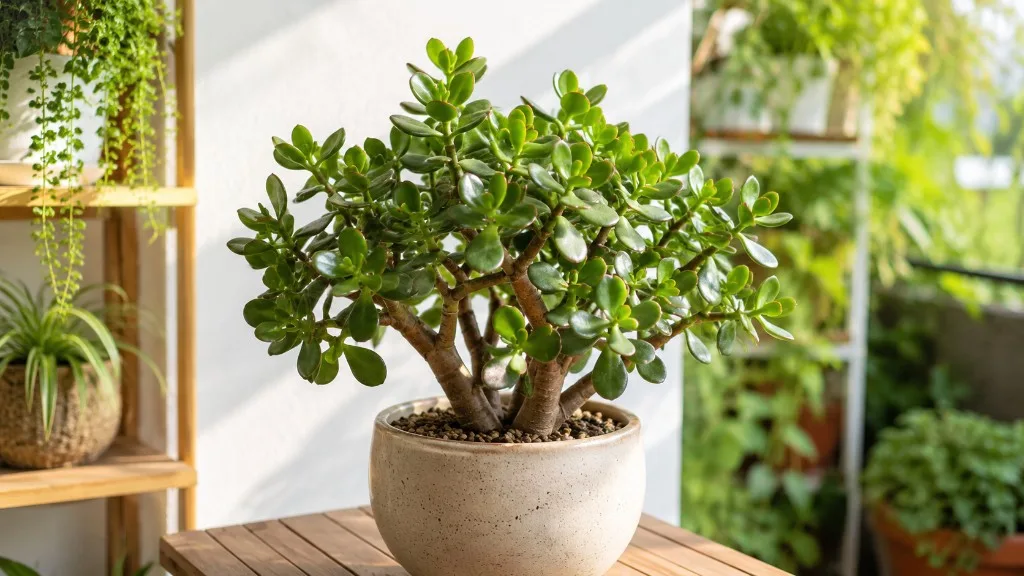
The Jade Plant (Crassula ovata) is a succulent that grows into a miniature tree with a thick trunk, woody stems, and fleshy, coin-shaped leaves. With proper light, a Jade Plant can live for decades — 50 to 70 years or longer — and become a family heirloom. Its low-maintenance profile comes from succulent adaptations: water-storing leaves, slow growth, and minimal feeding needs.
The catch is light. Unlike Snake Plants or ZZ Plants, Jade Plants need real brightness to stay compact and healthy. In low light, they stretch toward the window, developing weak, leggy stems that snap under their own weight. If you have a sunny windowsill and tend to underwater rather than overwater, a Jade Plant is nearly trouble-free.
Evidence label: Strong for longevity and drought tolerance; light requirement is non-negotiable. Jade Plants in low light conditions become etiolated (stretched) within weeks and do not recover their compact form without pruning and relocation.
Why it works: Succulent water storage, minimal watering frequency, decades-long lifespan, pest resistance under good light.
Care tip: If lower leaves shrivel and drop, you’re underwatering — step up the frequency slightly. If leaves turn soft, yellow, or translucent and drop, you’re overwatering. The leaves should feel firm and plump.
Common mistake: Treating it like a tropical plant and giving it frequent small sips of water. Jade Plants want a thorough soak followed by a complete dry-down. Water deeply until it drains from the bottom, then let the soil go bone-dry before watering again.
Avoid this plant if: You only have north-facing windows or deeply shaded rooms. Jade Plants decline rapidly without bright light. There is no workaround — this plant needs sun.
Useful care guides:
- Jade Plant care guide
- Jade Plant watering guide
- Jade Plant light guide
- Jade Plant propagation guide
- Jade Plant problems guide
7. Cast Iron Plant
Best for: Deep shade, cold drafts, and conditions that kill everything else
Difficulty: Very easy
Light: Very low to medium indirect; tolerates deep shade
Water: Every 2–3 weeks; let soil dry partially between waterings
Best placement: Dark hallway, north-facing room, drafty entryway, room with minimal windows
Pet safety: Non-toxic to cats and dogs (ASPCA)
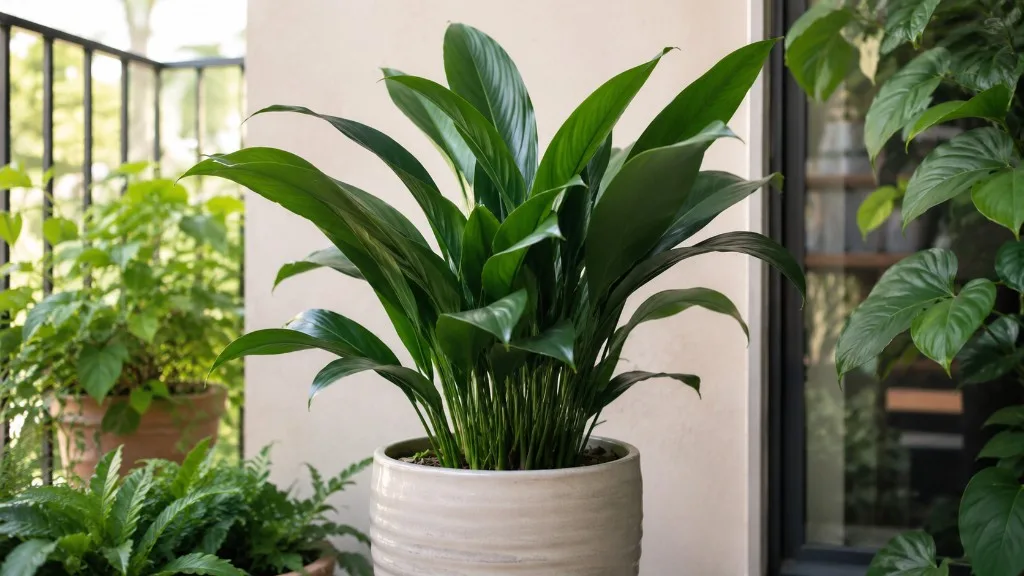
The Cast Iron Plant (Aspidistra elatior) earned its name honestly. It survived Victorian parlors with coal-fire pollution, gas-lit rooms with near-darkness, and the temperature swings of uninsulated homes. Today, it handles the modern equivalents: windowless offices, air-conditioned apartments, and the kind of neglect that comes from simply forgetting you own a plant.
The long, dark green leaves grow directly from the soil on individual stems, reaching 12–24 inches tall. Growth is slow — sometimes just one or two new leaves per year — but the plant itself is steady and resilient. It’s also one of the few genuinely low-maintenance plants that is pet-safe, making it a standout choice for households with cats and dogs.
Evidence label: Strong for shade tolerance, cold tolerance, and drought tolerance across multiple extension sources. The trade-off is slow growth — do not expect dramatic changes month to month.
Why it works: Extreme shade tolerance, cold tolerance, drought tolerance, pet-safe, pest resistance, minimal care demands.
Care tip: Clean the leaves every 2–3 months with a damp cloth. In very low light, dust accumulates faster than the plant can grow new leaves, and dusty leaves photosynthesize less efficiently — compounding the low-light challenge.
Common mistake: Repotting too often or into too large a pot. Cast Iron Plants grow slowly and prefer to be slightly root-bound. Repot every 2–3 years, and only go up one pot size.
Avoid this plant if: You want fast, visible growth or colorful foliage. The Cast Iron Plant’s strength is quiet endurance, not drama.
Useful care guides:
- Cast Iron Plant care guide
- Cast Iron Plant watering guide
- Cast Iron Plant light guide
- Cast Iron Plant propagation guide
- Cast Iron Plant problems guide
8. Heartleaf Philodendron
Best for: Shelves, hanging pots, and anyone who wants a trailing plant that’s even easier than Pothos
Difficulty: Very easy
Light: Low to bright indirect; avoid direct sun
Water: Every 1–2 weeks; let the top inch of soil dry between waterings
Best placement: Bookshelf, top of kitchen cabinet, hanging basket, desk edge
Pet safety: Toxic to cats and dogs if ingested (ASPCA)
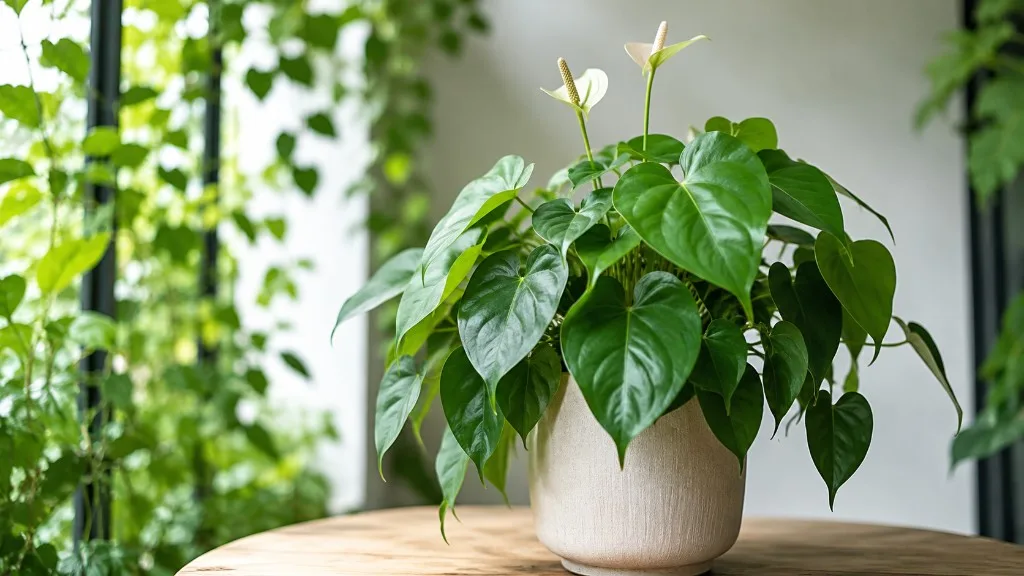
The Heartleaf Philodendron (Philodendron hederaceum) is sometimes confused with Pothos, but there are differences worth knowing. Its leaves are thinner, more delicate, and consistently heart-shaped, while Pothos leaves are thicker and more variable. In practice, both are extremely forgiving, but Heartleaf Philodendron is slightly more tolerant of low-light conditions and grows with a softer, more cascading habit.
Like Pothos, it roots easily in water from stem cuttings. If you have one healthy plant, you can propagate a dozen more over a year with almost no effort. Vines can trail 4–6 feet or more indoors, making it an excellent choice for high shelves and hanging planters where the foliage can cascade downward.
Why it works: Rapid growth in decent light, extreme propagation ease, handles low light, clear thirst signals, recovers quickly from underwatering.
Care tip: Pinch back the growing tips every few months if you want a bushier, fuller plant rather than a few long, sparse vines. Each pinched tip encourages branching at the node below.
Common mistake: Letting the vines trail across furniture or the floor where they can’t photosynthesize effectively. The leaves need to face the light source. If the trailing portions are in shadow, they’ll drop leaves and leave you with bare, stringy stems.
Avoid this plant if: You have pets that climb and chew — all Philodendron species contain calcium oxalate crystals that are toxic when ingested.
Useful care guides:
- Heartleaf Philodendron care guide
- Heartleaf Philodendron watering guide
- Heartleaf Philodendron light guide
- Heartleaf Philodendron propagation guide
- Heartleaf Philodendron problems guide
9. Ponytail Palm
Best for: Forgetful waterers who want a sculptural, pet-safe statement plant
Difficulty: Easy
Light: Bright light; at least a few hours of direct or bright indirect sun daily
Water: Every 3–4 weeks; the bulbous trunk stores water — let soil dry completely
Best placement: South-facing or west-facing windowsill, bright living room, sunroom
Pet safety: Non-toxic to cats and dogs (ASPCA)
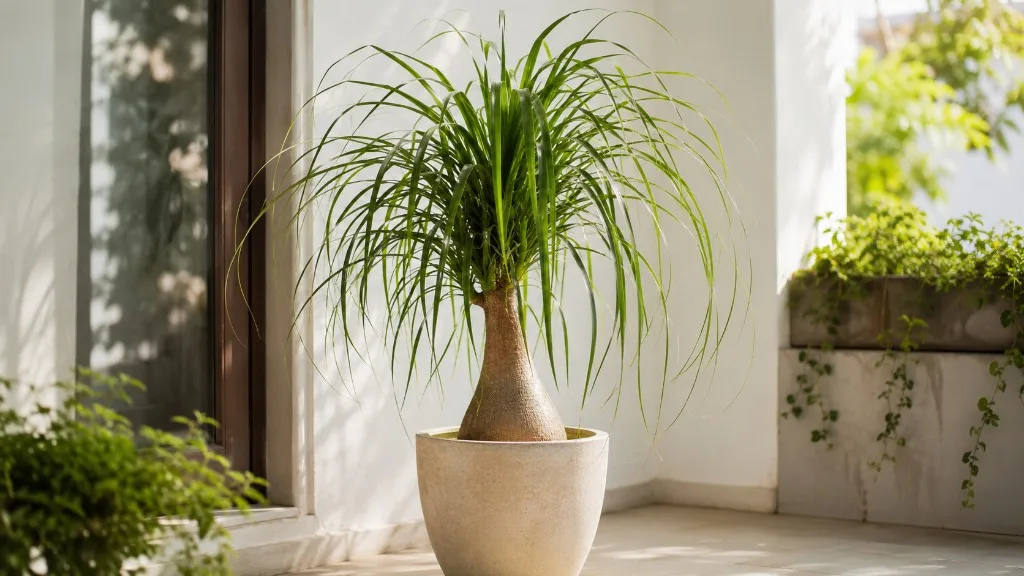
The Ponytail Palm (Beaucarnea recurvata) is not a palm at all. It’s a succulent native to southeastern Mexico, and its swollen, bulb-like trunk (called a caudex) stores enough water to get through extended droughts. The cascading, ribbon-like leaves sprout from the top, giving it the silhouette of a palm tree without the humidity demands or pest sensitivity of actual palms.
For busy people, the Ponytail Palm’s water-storage mechanism is the equivalent of having an emergency savings account for your plant. It can go a month or more without water in cooler months. The trunk visibly shrinks slightly when water reserves are running low, then plumps back up after a thorough drink — a built-in moisture gauge if you know what to look for.
Evidence label: Strong for drought tolerance and longevity (specimens can live 100+ years). Light requirement is firm — insufficient light prevents the caudex from developing and causes thin, weak foliage.
Why it works: Caudex-based water storage for extreme drought tolerance, pet-safe, pest-resistant, sculptural appearance with minimal maintenance.
Care tip: If the leaf tips turn brown and crispy, it’s usually a sign of low humidity or accumulated salts from fertilizer — not necessarily underwatering. Flush the soil with plain water every few months to prevent salt build-up, and avoid fertilizing more than once or twice a year.
Common mistake: Treating the Ponytail Palm like a tropical palm and watering weekly. The swollen trunk is a water reservoir — if it’s plump and firm, the plant has plenty of water. In winter, you might water it once every 5–6 weeks.
Avoid this plant if: You only have low light. The Ponytail Palm needs brightness to maintain its compact form and develop the characteristic caudex. In low light, growth stops and the trunk remains thin.
Useful care guides:
- Ponytail Palm care guide
- Ponytail Palm watering guide
- Ponytail Palm light guide
- Ponytail Palm problems guide
10. Aglaonema
Best for: Adding color to low-light corners without extra work
Difficulty: Easy
Light: Low to medium indirect; tolerates low light better than most colorful plants
Water: Every 1–3 weeks; let the top 1–2 inches of soil dry between waterings
Best placement: Desk, coffee table, shaded shelf, bedroom corner, office
Pet safety: Toxic to cats and dogs if ingested (ASPCA)
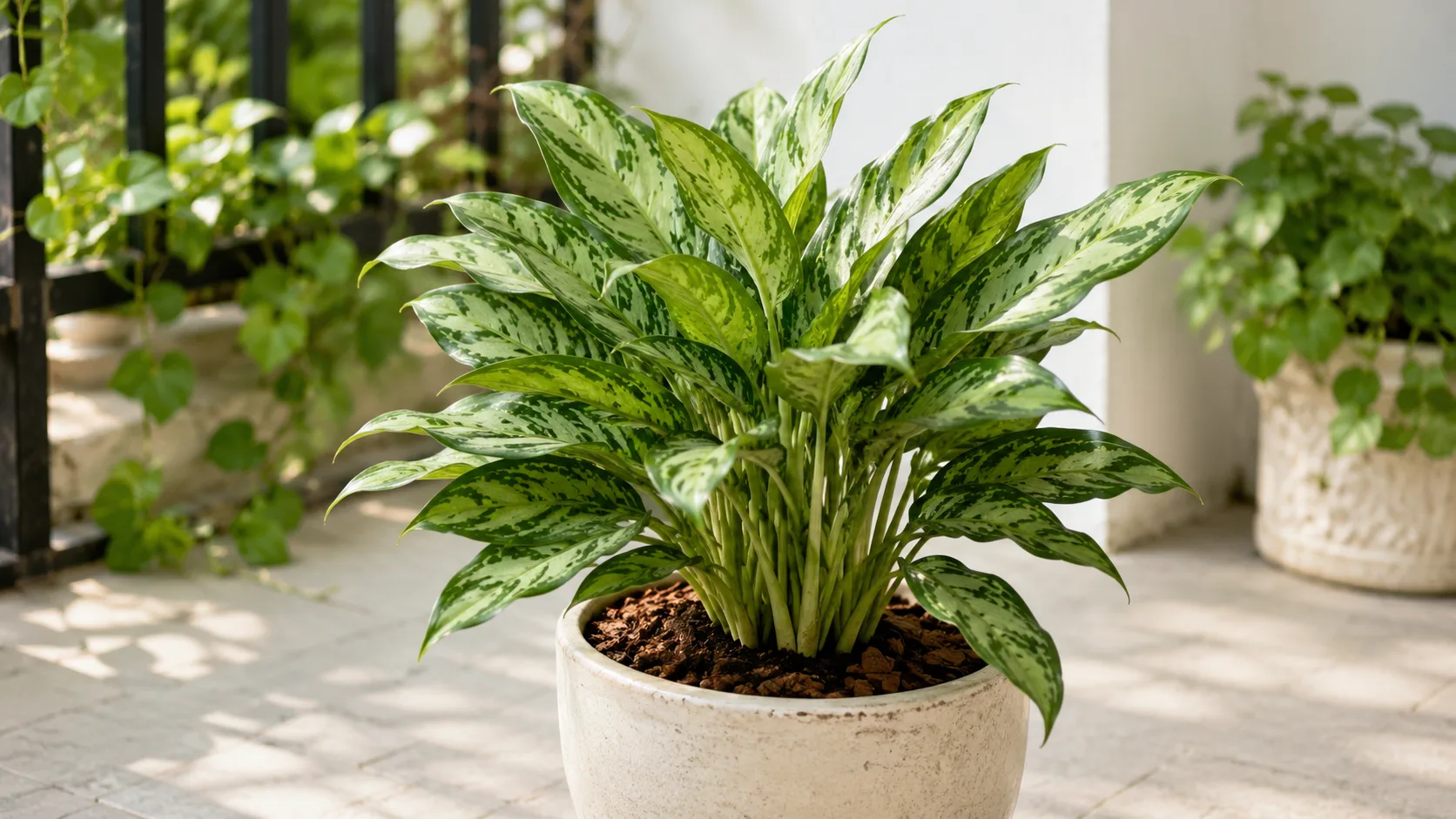
Aglaonema (Chinese Evergreen) is one of the few plants that combines low-light tolerance with genuinely colorful foliage. Depending on the variety, leaves can be silver, pink, red, cream, or deep green with intricate patterns. Popular varieties like Aglaonema Silver Bay, Red Siam, and Lady Valentine are widely available and equally forgiving.
In terms of care, Aglaonema sits between the extreme neglect-tolerance of a ZZ Plant and the moderate needs of a Peace Lily. It won’t survive a month without water, but it forgives occasional forgetfulness and thrives in conditions where many colorful plants (like Calathea or Begonia) would fail within weeks. It’s also slow-growing, which means repotting is infrequent — typically every 2 years.
Why it works: Colorful foliage in low light, forgiving watering needs, slow growth, pest resistance, wide variety of cultivars.
Care tip: The more variegation (white, pink, or red patterns) an Aglaonema has, the more light it needs to maintain those colors. Solid green varieties handle the lowest light. If your variegated plant is losing its patterns and turning mostly green, it needs more light.
Common mistake: Placing it near a cold draft from an air conditioner, open window in winter, or exterior door. Aglaonemas are sensitive to temperatures below 60°F (15°C) and will show damage as yellowing leaves, often mistaken for a watering or light problem.
Avoid this plant if: Your home gets very cold in winter (below 60°F / 15°C), or if you have pets that chew plants and cannot place it out of reach.
Useful care guides:
- Aglaonema care guide
- Aglaonema watering guide
- Aglaonema light guide
- Aglaonema propagation guide
- Aglaonema problems guide
Best Plants by Your Situation
If you’ve scanned the list and want a fast answer based on your specific scenario, here’s how to match your situation to the right plant:
For the truly forgetful waterer (3+ weeks between watering): Snake Plant, ZZ Plant, Ponytail Palm. These three store water in their leaves, rhizomes, or trunk and can handle a full month of neglect without complaint.
For low-light rooms and dark corners: ZZ Plant, Snake Plant, Cast Iron Plant. These three tolerate conditions where most plants slowly decline. The Cast Iron Plant specifically handles deep shade better than almost any other houseplant sold at retail.
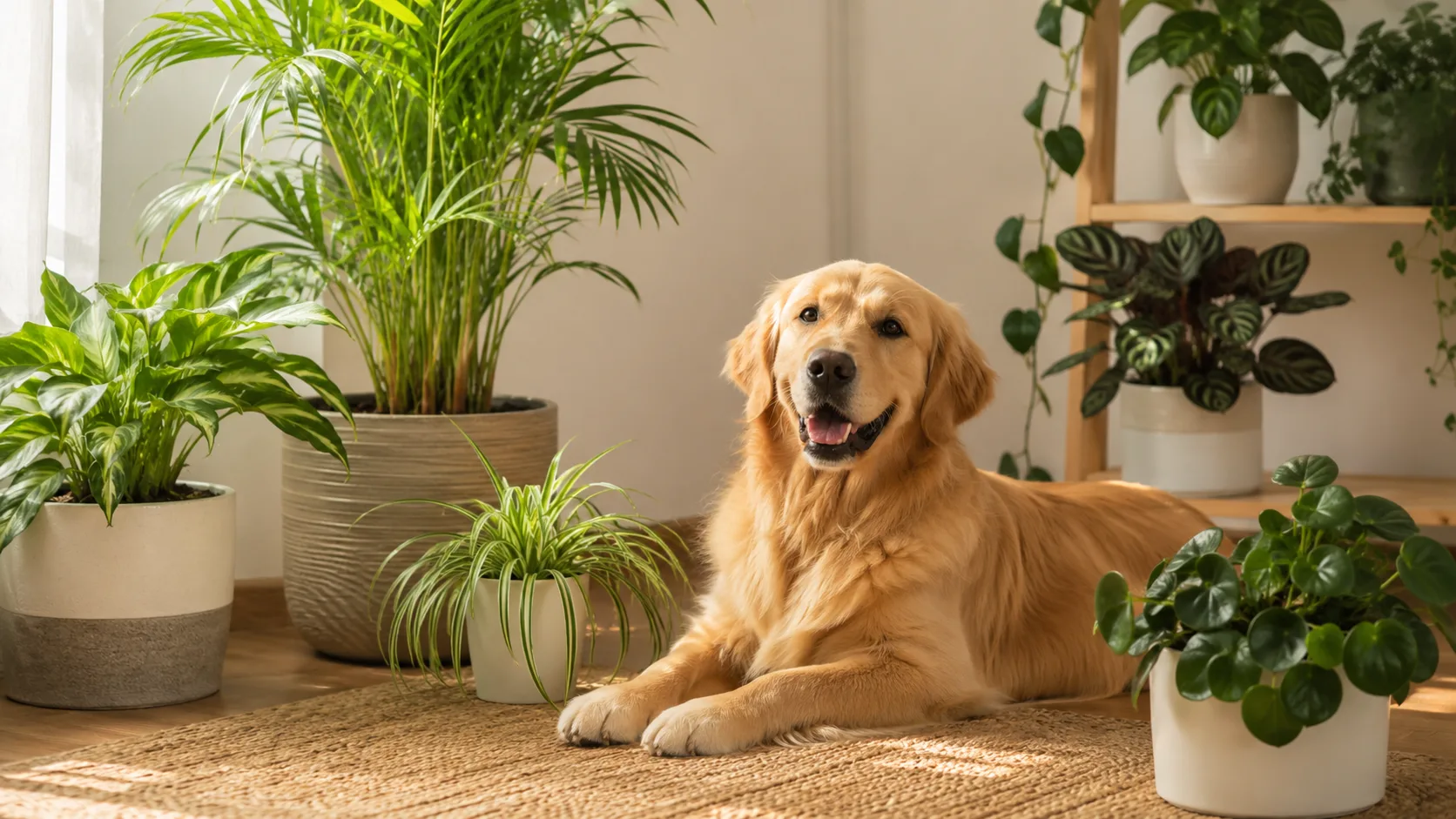
For pet owners (cats and dogs): Spider Plant, Cast Iron Plant, Ponytail Palm. All three are confirmed non-toxic by the ASPCA. If you choose any other plant on this list, place it in a hanging basket, high shelf, or room your pets cannot access.
For people who want visible growth and the satisfaction of propagation: Golden Pothos, Heartleaf Philodendron, Spider Plant. These three grow fast enough to notice, root easily from cuttings or pups, and fill out a space within months.
For the person who wants a plant that outlives them: Jade Plant, Ponytail Palm. Both can live 50+ years with minimal care. Snake Plants and ZZ Plants also last decades but grow more slowly.
For adding color without adding hassle: Aglaonema. It’s the only low-light-tolerant plant on this list that comes in pink, red, and silver varieties without demanding the humidity and attention that colorful plants like Calathea require.
Common Mistakes That Kill “Unkillable” Plants
Even the most forgiving plants have limits. These are the five mistakes that kill low-maintenance plants the most often — and how to avoid every one of them.
1. Watering on a fixed schedule instead of checking the soil. No plant drinks on a calendar. Light, temperature, humidity, pot size, and the season all affect how fast soil dries out. Stick your finger in the dirt. If it feels cool and damp 2 inches down, do not water — even if “it’s been 10 days.”
2. Choosing a plant for how it looks in a dark corner instead of matching it to the light you actually have. A Jade Plant or Ponytail Palm placed in a dim hallway will not adapt — it will slowly starve. Pick from the low-light-tolerant list for dark spaces, and reserve bright-light plants for windowsills.
3. Using a decorative pot with no drainage hole. The most common cause of death for indoor plants is roots sitting in stagnant water. Always use a nursery pot with drainage holes inside a decorative outer pot, or drill a hole in the decorative pot itself. No drainage = eventual root rot for every plant on this list.
4. Misting leaves instead of watering the soil. Misting does not meaningfully raise humidity unless you do it continuously. For the plants on this list, it’s unnecessary — all of them tolerate normal indoor humidity. If you mist as a substitute for checking soil moisture, you’re keeping the surface damp while the root ball goes dry or, worse, soggy at the bottom.
5. Assuming “low-maintenance” means “no-maintenance.” Every plant needs occasional attention: dusting leaves, checking for pests, trimming dead foliage, and eventually repotting. The difference is frequency, not elimination. A Snake Plant might need attention 5–6 times a year. A Calathea might need it every few days. Both still need you.
Conclusion: Where to Start
If you’ve never kept a plant alive before and want the safest possible entry point, buy a Snake Plant or a ZZ Plant. Both are widely available, inexpensive, and forgiving enough to survive while you learn what “check the soil” actually means in your specific home.
If you have pets, start with a Spider Plant or a Cast Iron Plant. They’re safe, affordable, and just as forgiving as the pet-toxic alternatives.
If you want something you can propagate, share, and watch grow — something that makes you feel like a plant person — get a Golden Pothos. Put it somewhere bright but indirect, water it when the top inch dries out, and within a few months you’ll be snipping cuttings and potting up new plants.
No plant on this list is impossible to kill. Overwater any of them persistently enough, and you’ll find the limit. But start with the right match between your habits and the plant’s tolerance, and you’ll discover what millions of busy people have already figured out: keeping plants alive is mostly about choosing the right ones.