10 Rose Colors and Varieties You Can Grow at Home
Compare 10 rose varieties by color, fragrance, growth habit, and garden use, then learn why blue, green, and rainbow roses need a closer look.
A rose’s color is only one part of choosing a plant that will earn its space. The same flower that looks perfect in a nursery photograph may mature into a shrub twice as wide as your border, bloom in one spring flush instead of all summer, or lose its leaves to disease in your climate. Start with the spot and the job you want the rose to do, then choose a color and cultivar that match.
Garden roses span reds, pinks, whites, yellows, oranges, purples, apricots, and striped blends. Green flowers are unusual but real; a naturally garden-ready, clear-blue rose has long been the exception, and the newest research still does not make it a standard plant you can order for a home border. The ten choices below are named cultivars with distinct colors and habits, followed by a reality check on green, blue, and rainbow roses.
Start with the rose’s job, then choose its color
If you want long stems to cut for a vase, begin with hybrid teas such as ‘Mister Lincoln’ or ‘Peace’: they typically carry large flowers on individual stems. For a border filled with clusters, look at floribundas such as ‘Julia Child’ or ‘Iceberg.’ Shrub roses such as ‘Buff Beauty’ make more sense when you want an arching, full plant rather than exhibition-style single stems. BBC Gardeners’ World explains these class differences well, but cultivar tags still matter because size, fragrance, and disease response vary within each class.
Before buying, check four things on the label or breeder’s page: mature height and width, hardiness for your winter, whether it repeats after its first flush, and the cultivar’s disease performance in your region. Iowa State Extension notes that many hybrid teas need winter protection in colder regions and can struggle with black spot or powdery mildew without regular management. A floribunda label does not guarantee resistance either; Illinois Extension recommends choosing by the named cultivar, not by rose class alone.
Ten garden roses with distinct color stories
These are examples to help narrow a search, not a universal ranking. Retail names can vary by country, and stock changes from year to year, so use the cultivar or registration name on the nursery tag to confirm you are buying the rose you intended.
1. Mister Lincoln — deep red for fragrance and long stems
‘Mister Lincoln’ is a classic hybrid tea with velvety crimson-red blooms, long stems, and a strong rose fragrance with spicy notes. It repeats through the growing season and can reach roughly 3 to 6 feet tall, so it suits a sunny cutting bed or the back of a border better than a narrow walkway. The Royal Horticultural Society profile describes its repeated summer-to-autumn bloom, while the American Rose Society’s fragrance overview lists it among notable fragrant cultivars.
This is a good choice when scent and classic red form matter more than a compact footprint. Its height, fragrance, and long-stem habit are not the same thing as carefree performance: roses vary in disease pressure by region, so look for local reports on black spot and foliage health before planting several.
2. Lady Emma Hamilton — tangerine orange for a warm border
‘Lady Emma Hamilton’ opens from dark, orange-tinged buds into tangerine-orange, cupped flowers with yellow-orange petal backs. David Austin lists it as a repeat-flowering English shrub rose with a strong fruity fragrance that includes pear, grape, and citrus notes. The breeder’s cultivar profile is useful for checking its flower color and habit before ordering.
Its color is more vivid than a pastel apricot, so it works as a focal point against deep green foliage or cool purple-blue companions. Give it enough room for a bushy shrub shape and do not assume the orange will look identical in every photograph; bloom age, weather, and light change how warm or muted the petals appear.
3. Julia Child — butter gold in repeat clusters
‘Julia Child’ is a floribunda valued for butter-gold flowers held in small clusters and a sweet, licorice-like fragrance. The Sydney branch of the Rose Society of New South Wales describes it as a free-flowering floribunda with cupped, old-fashioned blooms. Its clustered habit gives a border more repeated color than a single large bloom on a stem.
This is a useful yellow if you want a compact-looking shrub effect rather than a tall cutting rose, but still check the plant’s mature size where you live. “Yellow rose” covers everything from cool lemon to deep gold; Julia Child sits toward the warm butter end, and its abundant clusters make the shade easy to read from a few steps away.
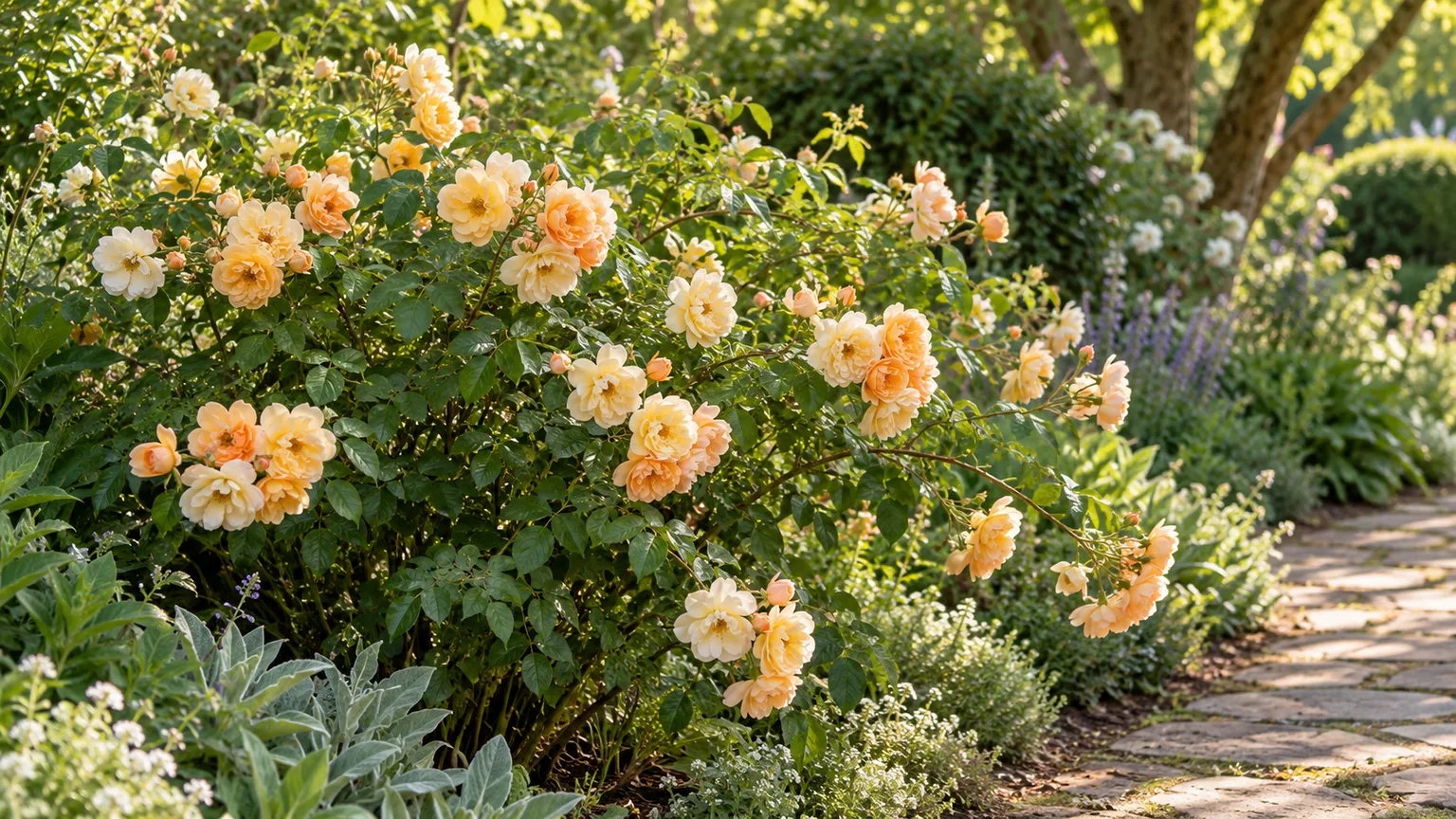
4. Buff Beauty — apricot that softens to cream
‘Buff Beauty’ is a hybrid musk shrub with loosely arranged clusters that move through buff, apricot, honey, and yellow tones. The RHS notes that flowers may fade toward cream in hot conditions and describes a strong fragrance and a late-season flush; the mature shrub can reach about 6½ feet. See the RHS reliable-rose profile before placing it near a path or small patio.
The color changes are part of the appeal, but the plant’s arching shape needs space to show well. Choose it for an informal border or a large mixed planting, not as a tight, clipped mound; if you want a smaller container rose in the same warm palette, search specifically for a compact apricot cultivar.
5. Queen Elizabeth — clear pink in a tall grandiflora
‘Queen Elizabeth’ is a tall grandiflora with luminous, double pink blooms held on long stems. Chicago Botanic Garden describes a plant that can mature to about 6 feet and flower from early summer until frost, with moderate fragrance. Its upright structure is useful at the back of a border or as a vertical pink accent when a low, spreading shrub would disappear.
Give it room above neighboring plants and leave enough space for air to move through the foliage. If you need a shorter edging rose, do not buy this one because the bloom color is right; select a compact pink floribunda or ground-cover type and compare the mature spread on the tag.
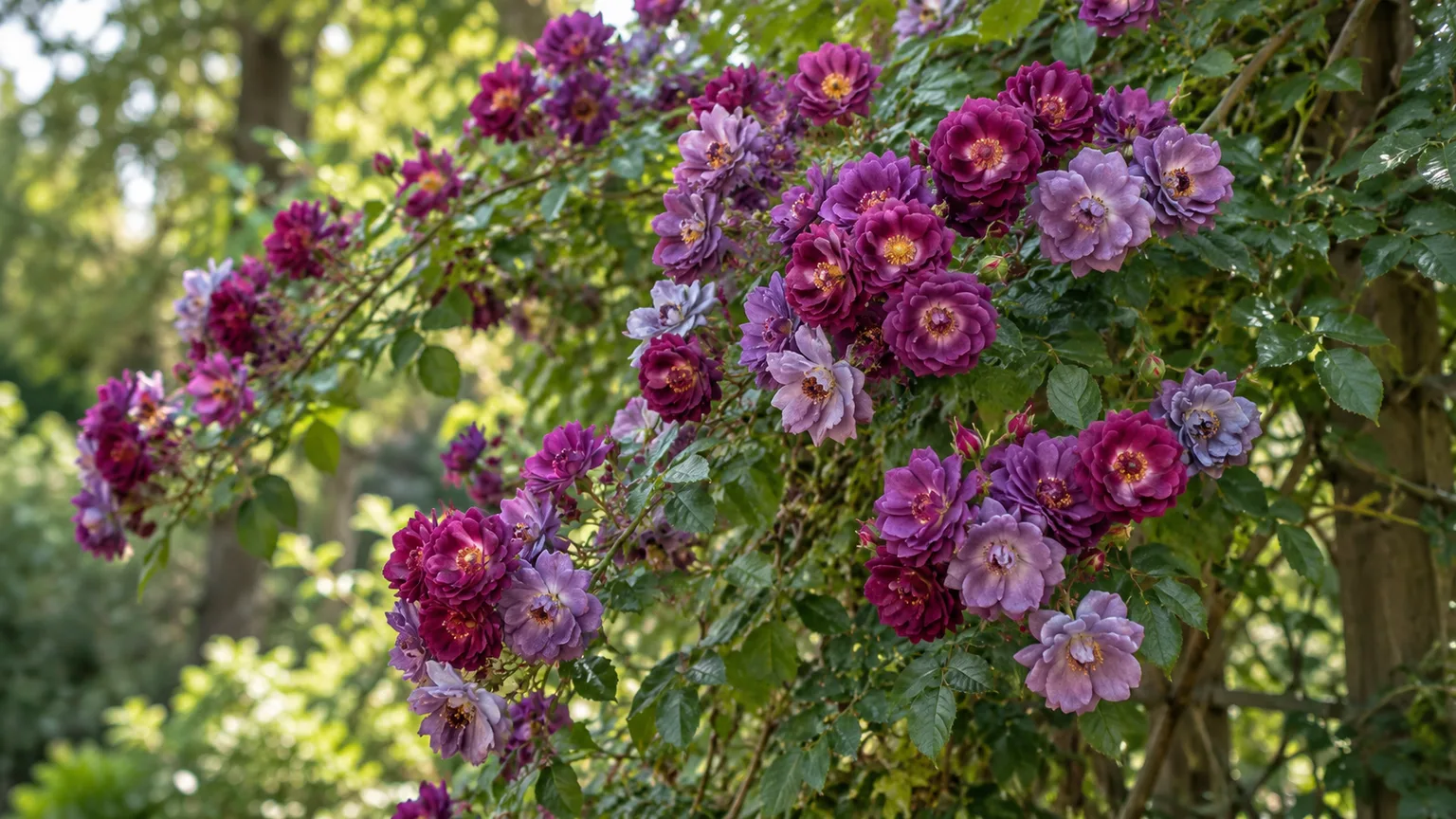
6. Ebb Tide — smoky mauve-purple for compact spaces
‘Ebb Tide’ has fully double blooms in a smoky mauve-purple range, a noticeable fragrance, and a relatively neat, compact habit. The RHS profile describes repeat flowering through summer and autumn and a height around 75 centimeters. That smaller scale makes it easier to place near the front of a border than a large purple climber.
The color reads as plum or violet rather than blue. If you want a taller, arching purple rose instead, an old rambler such as ‘Veilchenblau’ gives a different shape and bloom season; compare those habits before you choose, because matching color does not mean matching garden use.
7. Iceberg — white clusters for a bright border
‘Iceberg’ is a floribunda known for clusters of white flowers, often opening from pink-tinted buds, and repeat bloom through the season. Illinois Extension describes pure-white, double flowers on upright plants around 3 feet tall. It works where you want white flowers in quantity, a pale counterpoint to saturated roses, or a bloom that remains legible in evening light.
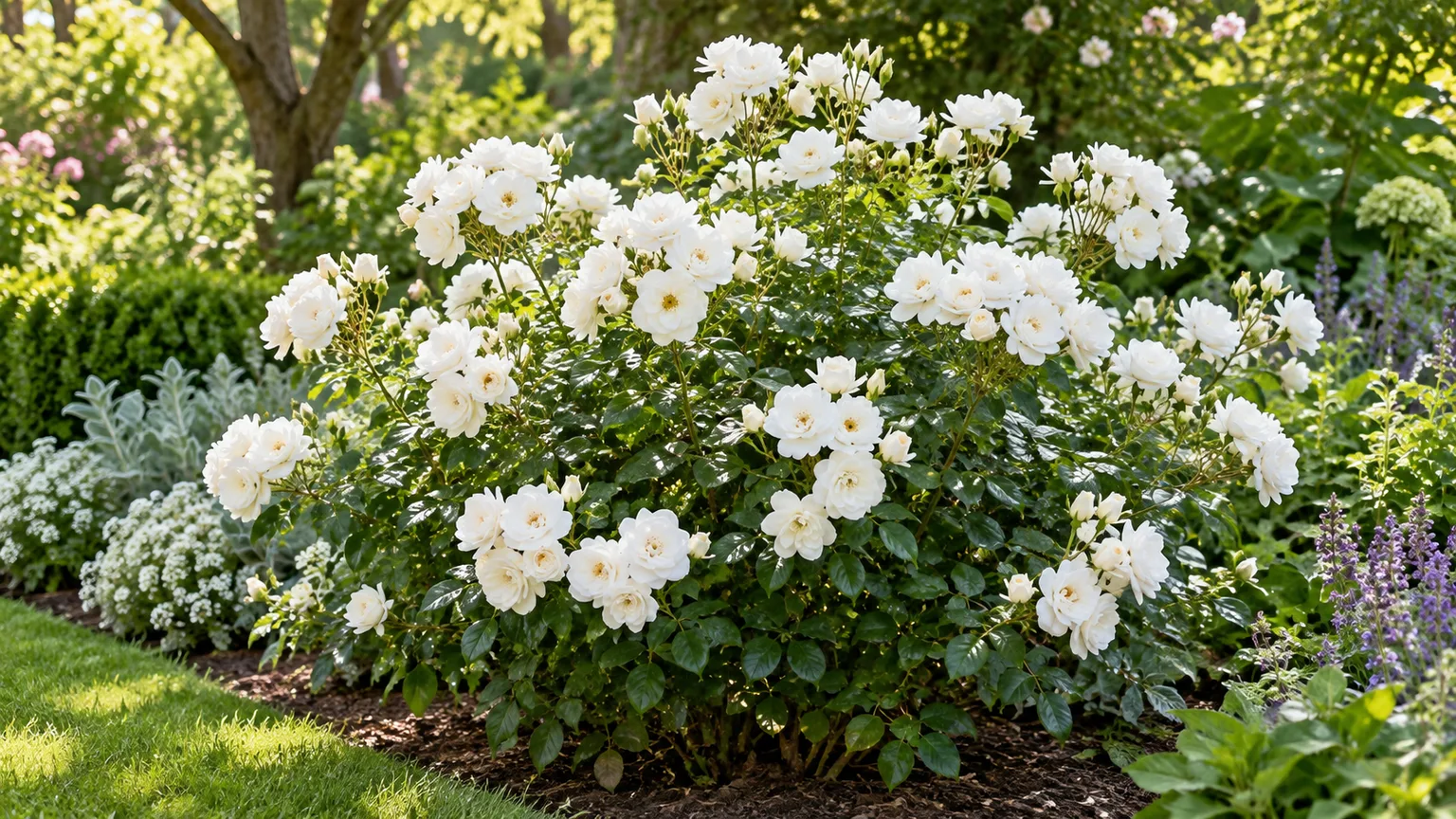
White is not automatically low maintenance. Like other roses, ‘Iceberg’ can be affected by disease in conditions that favor black spot, and disease resistance depends on cultivar and local climate. If your garden is humid or rainy, prioritize local foliage-health reports and good spacing rather than choosing by bloom color alone.
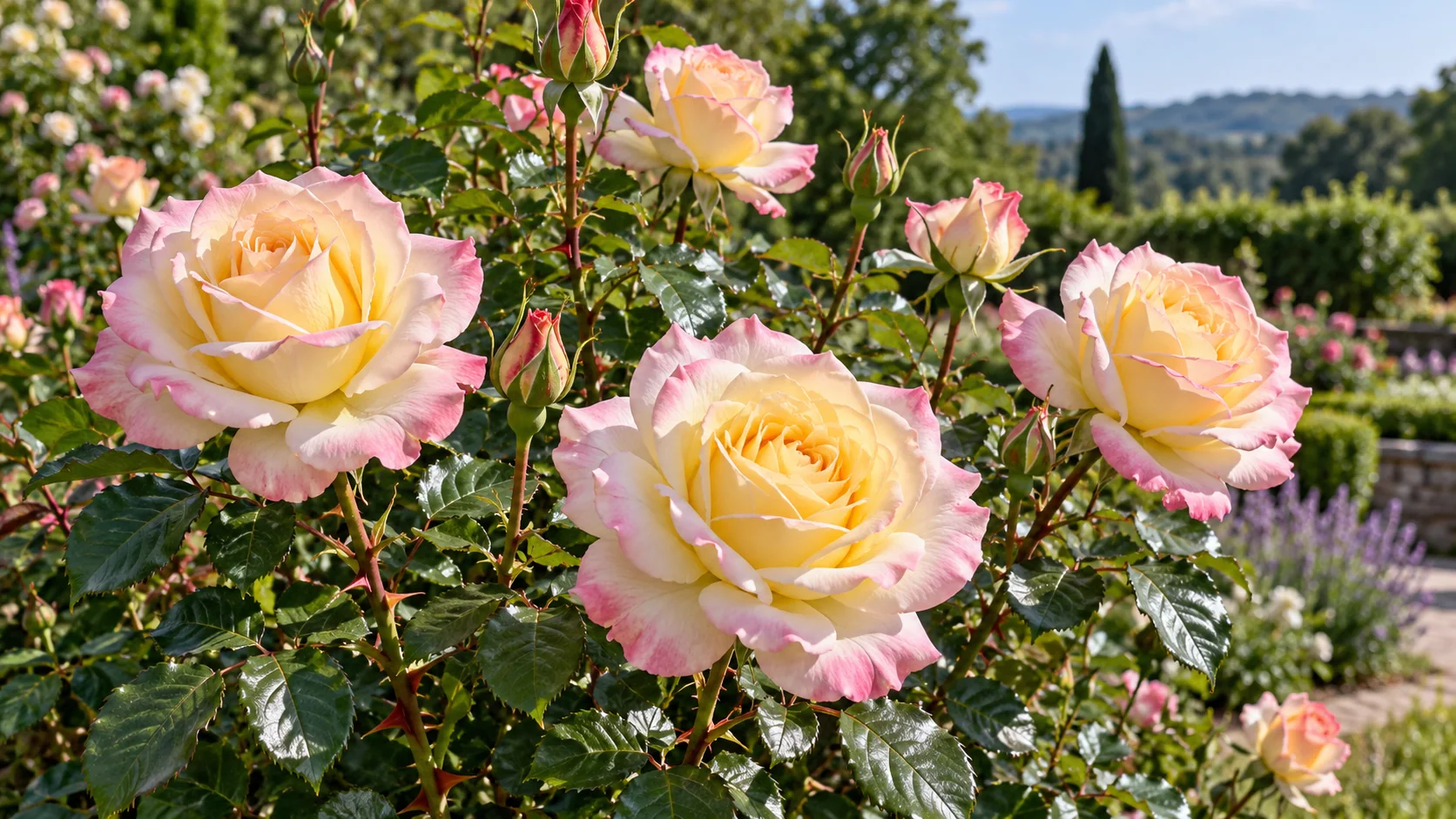
8. Peace — creamy yellow washed with pink
‘Peace’ is a large hybrid tea whose creamy-yellow flowers take on pink at the edges, with the blush often deepening as the bloom ages. The RHS profile describes fragrant, high-centered flowers that can reach about 15 centimeters across and repeat through summer and autumn. This cultivar is a strong fit if you want a large cut flower that looks softer and less uniformly red or yellow.
Its changing edge is an expected feature, not a sign that a mislabeled plant has appeared. You may see more pink on one bloom than another, so assess the whole plant over several openings rather than judging a rose from a single nursery image.
9. Scentimental — burgundy and white stripes
‘Scentimental’ is a floribunda with striped burgundy-and-white flowers and a spicy, damask-style fragrance. The American Rose Society includes it among its notable fragrant roses. It offers more pattern than a solid-color cultivar, which makes one bush an obvious focal point in a small border.
Striping is not a predictable, identical repeat printed on each bloom. The proportion and placement of light and dark can vary among flowers, so pair the rose with a calm background rather than another high-contrast pattern. Confirm its mature spread and local availability before planning around it; unusual cultivars can be less consistently stocked than common red, pink, or white roses.
10. Rosa chinensis ‘Viridiflora’ — an unusual green rose
‘Viridiflora’ is the green rose for a collector or a gardener who enjoys botanical oddities. The RHS explains that its unusual blooms are formed from green and brown bracts rather than ordinary petals, and that they can be borne almost continuously from early summer into late autumn. The plant is a small, twiggy shrub, roughly 0.5 to 1 meter tall.
That structure is exactly why it is a poor substitute for a conventional green-petaled rose in a bouquet. It looks strange and fascinating rather than like a standard rose tinted green, and it may be susceptible to common rose diseases. Buy it for novelty and its unusual form, not because you expect a classic florist-style bloom.
Blue and rainbow roses: what can actually live in a garden?
For a garden bed, treat roses labeled blue as purple, lilac, mauve, or violet-blue unless the seller explains exactly what the plant is. Cultivars such as ‘Ebb Tide’ and ‘Veilchenblau’ are genuine garden roses, but their natural colors sit in the violet or purple range. A clear royal-blue rose plant is not a normal nursery selection.
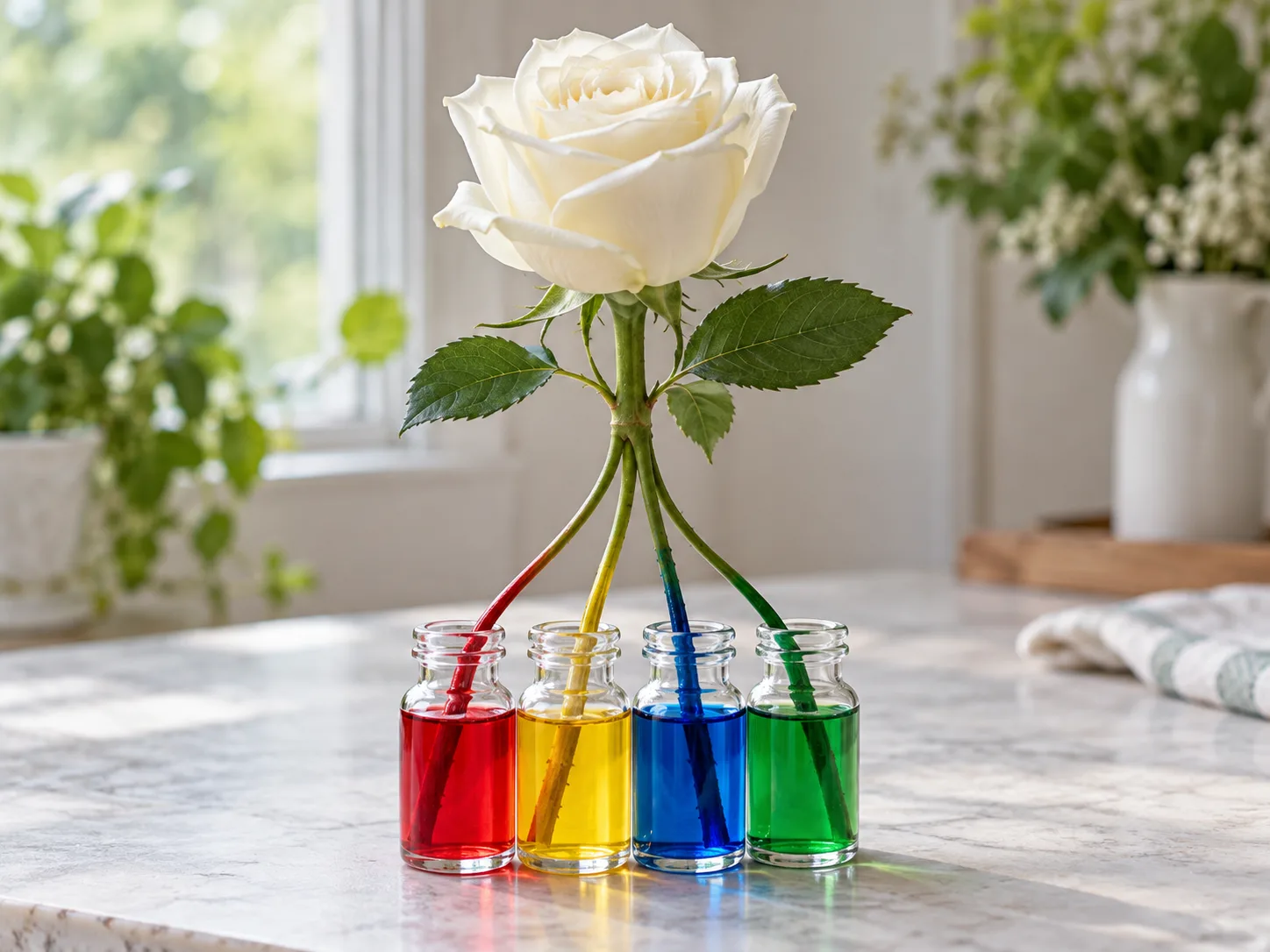
Rainbow roses are a different case: the vivid multicolored flowers sold by florists are cut roses dyed after harvest. A common method uses a white cut stem split into sections that drink different colored solutions; the colors travel into the petals, but the plant does not pass that pattern to a new flower. They are a novelty for a vase, not a cultivar you can plant and expect to rebloom in rainbow shades.
The 2026 blue-rose update
There is a real research update, but it needs a clear boundary. In September 2026, Suntory reported violet-blue flowers produced by combining blue pigments with nearly colorless co-pigment molecules; the work involved genetically engineered roses and greenhouse and field trials, not a standard home-garden release. Its research summary and the International Horticultural Congress presentation listing describe the project as further research toward bluer roses.
The earlier genetically engineered rose APPLAUSE accumulates delphinidin, a pigment common in blue flowers, but the published rose hue was blue-purple rather than a clear garden blue. The Journal of Japan Association on Odor Environment paper notes that it was marketed in Japan in 2009. These developments are fascinating, but neither means a gardener should expect to buy a robust, ordinary blue rose bush at a local nursery today.
Why rose color changes between blooms
A rose’s color is a combination of genetics, pigments, petal age, light, and growing conditions. ‘Peace’ naturally gains pink as its petals age, while the RHS notes that ‘Buff Beauty’ can fade toward cream in heat. Even within one bush, bud, fresh bloom, and fading flower may look like different colors; that progression is part of how many roses read in a border.
Do not try to change a rose’s color by copying the soil-pH tricks used for some hydrangeas. Rose cultivar color is not reliably switched from pink to blue by acidifying garden soil; choose a cultivar bred for the shade you want. A peer-reviewed study of temperature and light effects on rose coloration found those conditions can influence flower color, and the American Rose Society’s judging guidance also notes that some cultivars show different color intensity under different seasonal light.
If a mature rose suddenly produces flowers that are plainly unlike its normal cultivar, look for a shoot emerging from below a graft union before assuming its color mutated. Many roses are grafted, and a vigorous rootstock shoot can produce different flowers; if you see a below-graft shoot, remove it at its point of origin. Normal fading within the same bloom is not the same thing as a rootstock takeover.
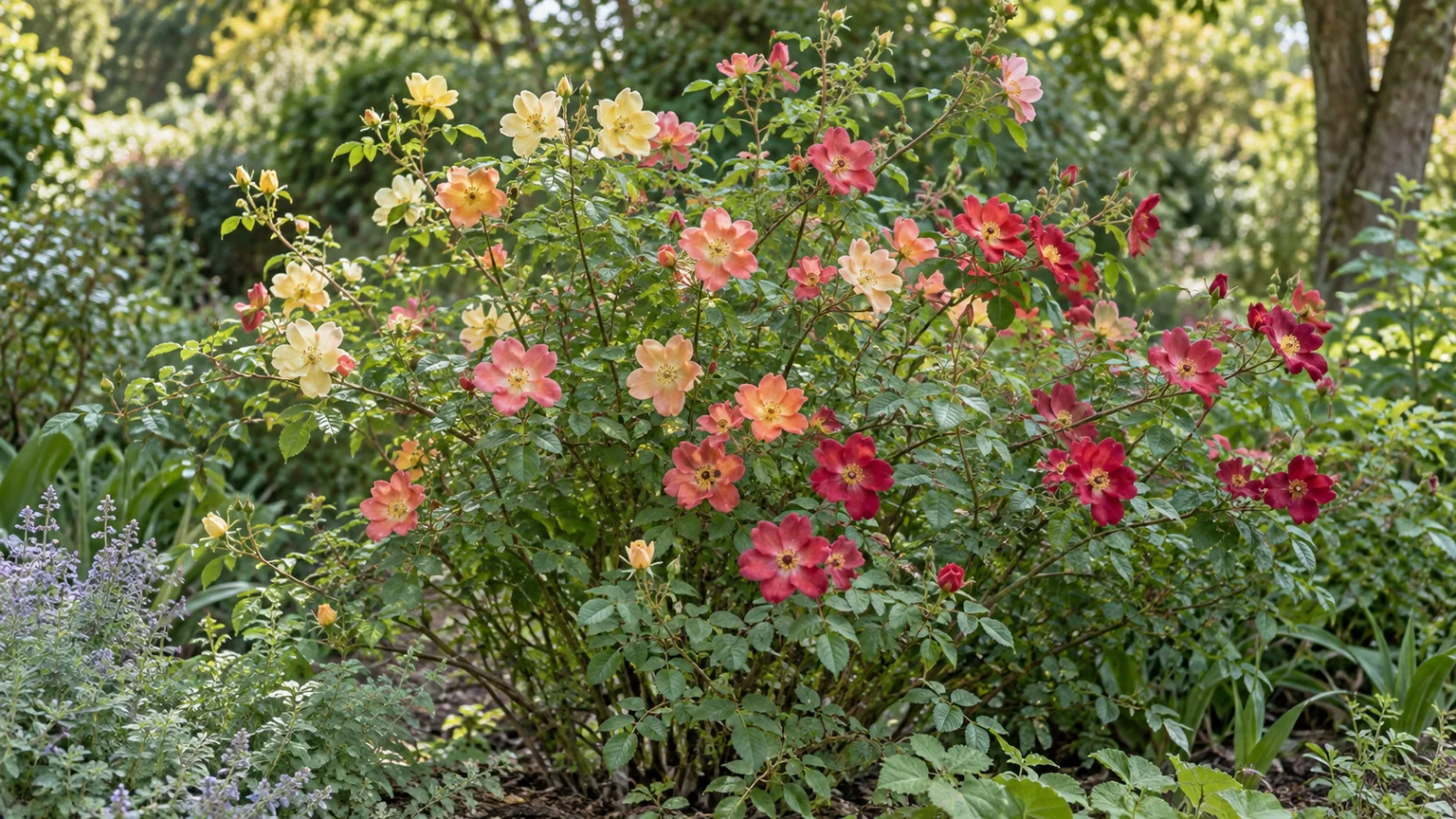 Its color stages are described in the RHS profile for ‘Mutabilis’.
Match the cultivar to climate, maintenance, and space
Use color as the last filter in a practical buying sequence: first identify the light and soil conditions, then measure the space, decide whether you want cut stems or clusters, and check hardiness and local disease reports. Most roses flower best in sun and well-drained soil, but some tolerate light shade; the RHS growing guide recommends seeing roses in bloom when possible, especially when fragrance or precise color matters.
Disease-resistance labels are helpful clues, not guarantees. Illinois Extension distinguishes resistance that holds across settings from performance that changes with location and growing conditions, and advises gardeners to assess named cultivars locally. In a humid or rainy garden, give airflow more weight; in a cold region, verify winter hardiness; in a small yard, pay more attention to width than the number printed beside the height.
Rose classes help with layout, but they do not replace the mature-size figure. Hybrid teas tend to be upright and useful for cutting, floribundas carry clustered flowers, shrub roses can spread or arch, and climbers need a support sized for the canes. For example, a 6-foot shrub like ‘Buff Beauty’ and a 75-centimeter ‘Ebb Tide’ may both bring purple-apricot-adjacent tones into the same border, but they need completely different placement.
Plan companion colors without overcrowding the bed
Color combinations are easiest to manage when one rose has the starring role and its companions repeat or soften a color already in the bloom. A purple rose can look richer beside pale yellow flowers, an apricot rose can sit with blue-violet perennials, and white roses can bridge saturated pinks and reds without turning the border into a patchwork. Use mature plant widths to set spacing before buying companions; crowded roses are harder to inspect and care for.
If you are choosing a rose as a gift, remember that color symbolism is cultural convention, not a horticultural trait. People may associate a color with romance, ceremony, or cheerfulness, but those meanings vary by culture, context, and personal preference. The recipient’s taste and the rose’s practical fit are more reliable guides than a universal color code.
Conclusion
There is a rose for nearly every garden color palette, but the best choice is the named cultivar whose mature size, flowering pattern, scent, hardiness, and disease performance fit your site. Start with the rose’s job, then decide whether you want a solid red like ‘Mister Lincoln,’ a warm apricot shrub like ‘Buff Beauty,’ a compact smoky purple like ‘Ebb Tide,’ or an unusual green novelty such as ‘Viridiflora.’
For blue or rainbow, check what the product actually is: mauve and violet garden roses are real plants, the newest violet-blue results remain research, and rainbow roses are dyed cut flowers. When a plant tag and a photo disagree, trust the cultivar name and local growing information, then let the first season’s blooms show you how that rose expresses its color in your garden.