Should You Put Roses in Sugar Water? A Florist's Take
Should you put roses in sugar water? Get the clear verdict, safer flower-food choice, measured fallback, and steps for longer-lasting blooms.

The clearest answer is no—do not put cut roses in plain sugar water as your default treatment. Sugar can be useful in a properly formulated flower preservative, but table sugar by itself adds food for the roses and for the microbes competing in the vase. Without the rest of the formula and a clean-care routine, the sweetened water can become cloudy faster and shorten the bouquet’s useful life.
If you have a fresh bouquet in front of you, use a commercial flower-food packet at the dilution on its label. If you do not have one, clean plain water with freshly cut stems is a safer, more controllable fallback than guessing at a kitchen recipe. The biggest gains usually come from the vase, the cut, the water changes, and the location—not from adding a single ingredient.
The short answer: do not use sugar by itself
Think of a flower-food packet as a small system, not a bag of sugar. It is intended to help cut flowers take up water, provide a usable carbohydrate source, and keep the vase solution from becoming a friendly place for microbes. The balance matters because a cut stem has no roots supplying water or nutrients, but it is also an open piece of plant tissue sitting in a warm, nutrient-rich environment.
Sugar water handles only one part of that problem, and even that part is incomplete. A spoonful of sugar does not clean a vase, reopen a crushed stem, remove rotting leaves, or protect petals from heat. In the wrong conditions, it simply makes the water more supportive of microbial growth while the rose still struggles to hydrate.
That is why the florist-style recommendation is flower food plus good stem care, not sugar instead of flower food. If the packet is missing, start with plain water and physical care rather than trying to recreate a commercial preservative by eye.
Why sugar belongs in flower food—but not alone
Freshly cut flowers still have living tissue and stored reserves. A preservative may include sugar because a cut bloom can use a carbohydrate source while it continues opening and holding its petals. But that benefit is useful only when the water remains suitable for uptake and the solution does not quickly turn dirty.
What commercial flower food is trying to balance
Commercial flower food is designed around competing needs. The carbohydrate portion supports the flower, while the rest of the formulation adjusts the solution and helps limit the microbial population that can clog the stem’s water-conducting tissue. Exact ingredients and concentrations vary by product, so the label’s water volume is part of the treatment—not a suggestion to use a whole packet in any vase.
The RHS advises dissolving cut-flower food before adding stems and notes that proprietary food is likely to be more effective than homemade preservative. UF/IFAS likewise says commercial mixtures work best for controlling microbes and hydrating stems. (RHS; UF/IFAS Gardening Solutions) That is the important distinction: commercial flower food is a measured formula; pantry sugar is one ingredient removed from its context.
Do not add extra sugar, vinegar, soda, aspirin, vodka, or bleach to a commercial solution. More ingredients do not make a more professional treatment. They make the concentration unpredictable and can leave you unable to tell whether a problem came from the rose, the water, or the mixture.
Why a sweet vase can turn sour quickly
The vase is a small ecosystem. Plant debris, submerged foliage, residue inside the container, and the cut stem itself provide places for microbes to grow. Adding sugar can increase the available food in that system, while a dirty vase or warm room gives it more time and better conditions to multiply.
As microbes build up, the water may become cloudy or smelly and the stem base may feel soft or slimy. The result is not always an instant collapse; more often, the rose drinks less effectively, the head bends, and the outer petals lose firmness. If that is happening, adding more sugar addresses the wrong problem.
The practical rule is simple: if the water looks or smells wrong, reset the vase. Remove the roses, wash the container, remove any damaged tissue, recut the stems, and refill with fresh water or a newly diluted packet. Never try to rescue cloudy water by pouring in more preservative.
A practical ranking of rose-vase treatments
The best choice depends on what you have available, but the order is consistent. A correctly diluted commercial flower food is the first choice; plain clean water is a sound second choice; homemade sugar-and-acid mixtures are an optional fallback with more room for error.
Commercial flower food, used as directed
Use the packet that came with the bouquet or a flower preservative sold for cut flowers. Measure the water first, empty in the stated amount, stir until the powder is dissolved, and then add the prepared stems. If you split a bouquet between two vases, split the water and food proportionally rather than using the full packet in both or in a small container.
Flower food cannot reverse a bouquet that was already old, dehydrated in transit, harvested too tightly, or damaged at the stem base. It is also not a substitute for washing the vase. Its role is to support a good care routine, not to make neglect harmless.
Plain water when you have no packet
Plain water is better than an improvised sweet solution when you are unsure of the recipe. Wash the vase, fill it with fresh water, remove every leaf that would sit below the waterline, and give each stem a clean recut. Then change the water as soon as it becomes cloudy and keep the arrangement cool.
This fallback is less ambitious but easier to control. You cannot overdose plain water, and frequent refreshing removes some of the accumulated debris that would otherwise remain around the stem. A bouquet in clean water with an open, well-prepared stem can outperform one in sugar water that is too concentrated or sitting in a dirty container.
Homemade vinegar-and-sugar water as a fallback
If you specifically want a homemade preservative, use a published formula rather than free-pouring. The RHS gives this lower-strength mixture for one liter of water: one tablespoon of vinegar and one teaspoon of sugar. Stir it completely before placing in the flowers, and treat it as a fallback—not as an equal replacement for commercial flower food. (RHS)
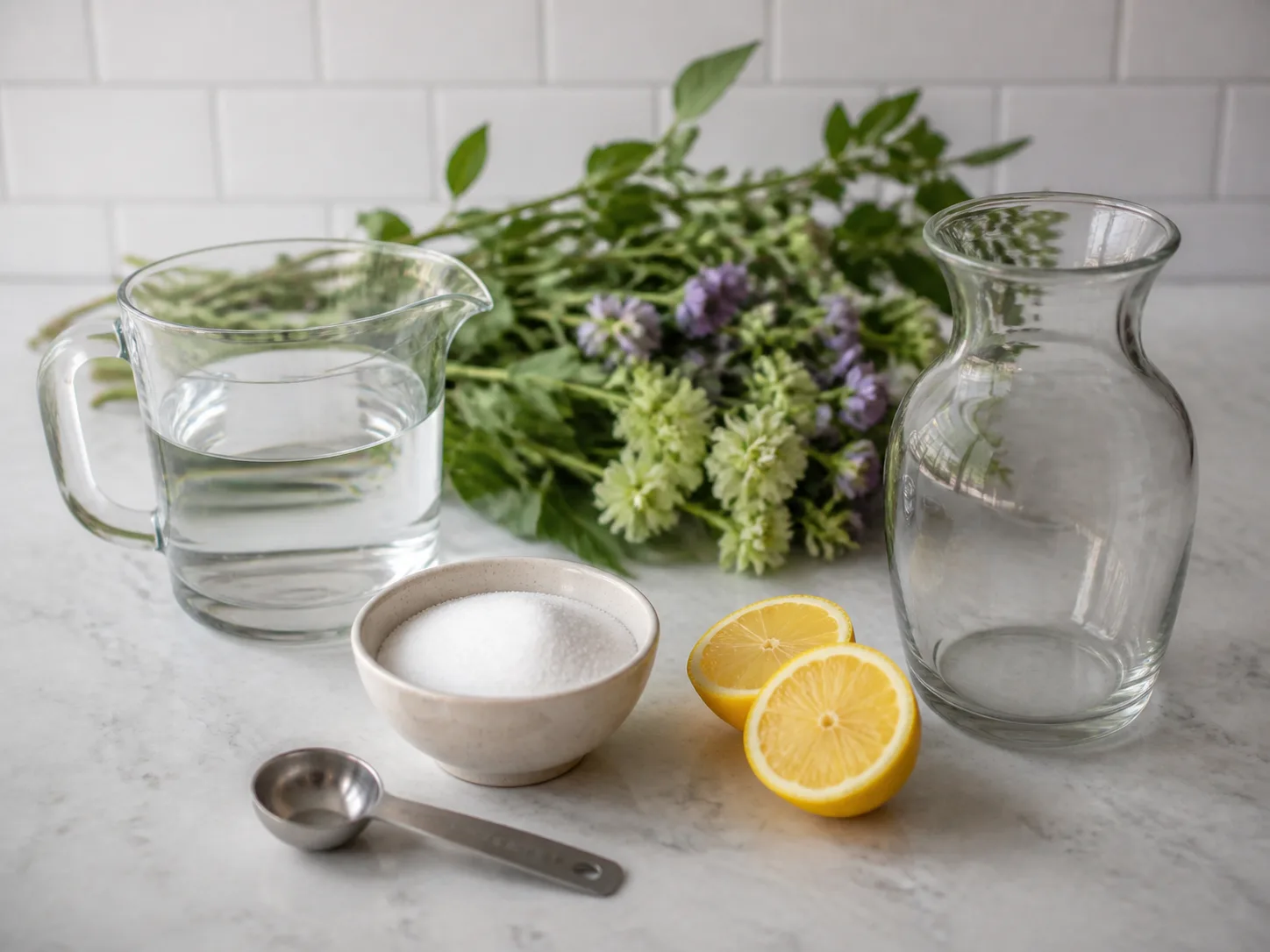
Gardening Know How also describes vinegar as an acidifying ingredient that is not a stand-alone solution and warns that household ratios vary. Its guidance discusses sugar and tiny amounts of bleach in some homemade recipes, but that is precisely why I would not improvise the bleach: the margin between “small amount” and flower-damaging concentration is not useful household precision. (Gardening Know How)
Avoid lemon-lime soda, aspirin, vodka, copper coins, and random combinations for the same reason. They may sound as if they each solve one piece of the problem, but a viral recipe is rarely calibrated for your water volume, rose variety, vase size, or room temperature. Never mix household cleaners or add a chemical to a vase just because a recipe uses a few drops; if you cannot measure and identify the complete formula, use clean water instead.
Prepare the vase before you prepare the recipe
The first ten minutes of care often matter more than the additive. RHS conditioning guidance and UF/IFAS both put clean containers, clean cuts, and the removal of submerged leaves ahead of the display step. (RHS; UF/IFAS Gardening Solutions)
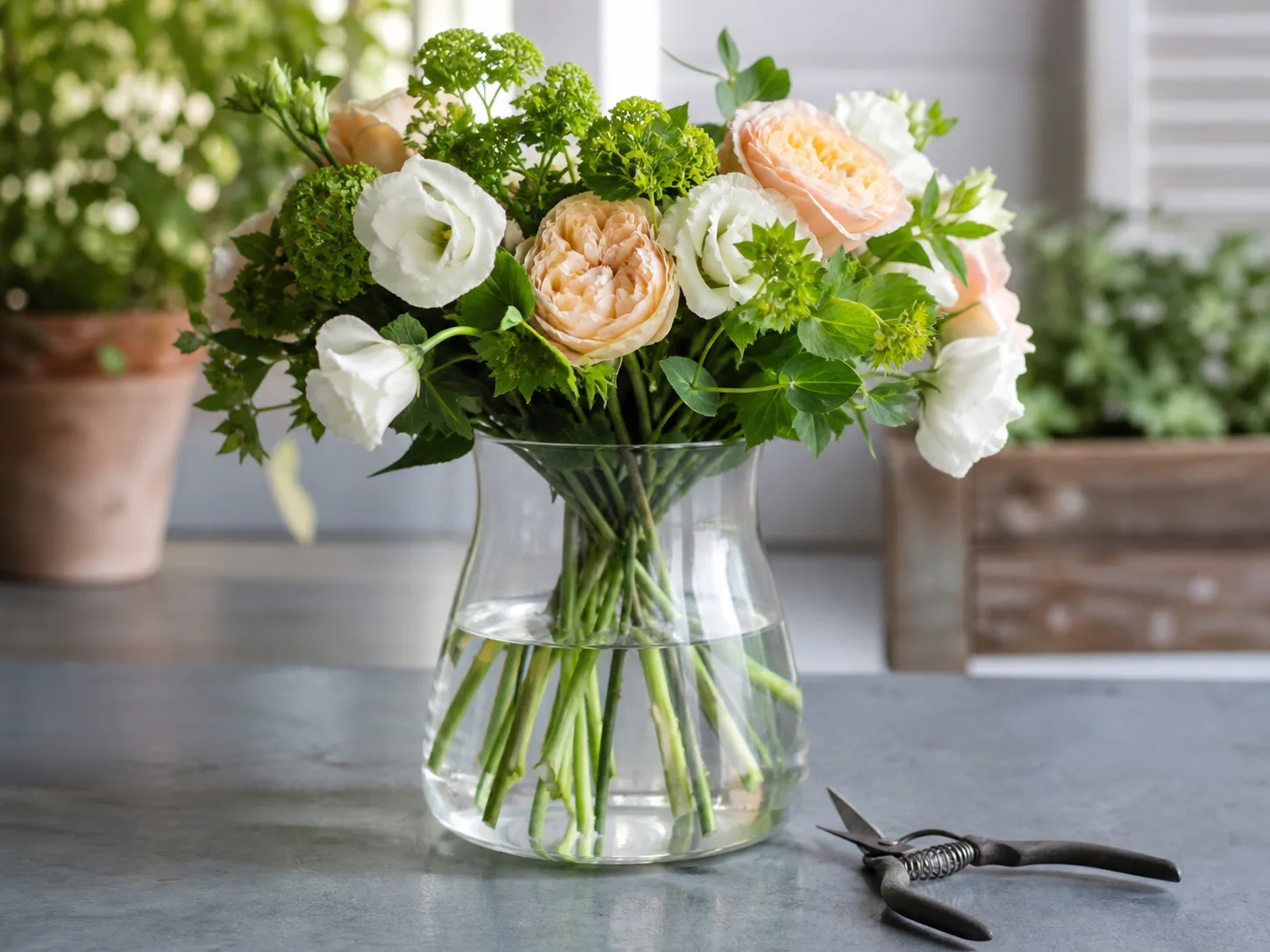
Wash the vase and remove only submerged leaves
Wash the vase with dish detergent and a bottle brush or clean cloth, rinse it thoroughly, and remove any slippery residue from an earlier arrangement. A quick swirl of water is not enough if the inside feels slimy or carries old flower debris. The goal is a clean starting surface, not sterile laboratory equipment.
Strip leaves from the part of each stem that will sit underwater. Leave healthy upper foliage in place when it does not touch the water; leaves contribute to transpiration, which helps draw water through the stem. UF/IFAS specifically cautions against stripping all foliage and against removing rose thorns to improve vase life, because thorn removal wounds the stem and can create an entry point for microbes. (UF/IFAS Gardening Solutions)
You can remove a thorn if it is dangerous for a child, pet, or person arranging the bouquet, but do it for handling safety—not because it preserves the rose. Use clean scissors or snips and avoid tearing a long strip of outer stem tissue.
Recut every stem cleanly
Use a sharp, clean knife, floral shears, or pruners to remove about an inch from the base of each stem. Make a clean angled cut rather than crushing the stem with a dull pair of household scissors. HGTV’s cut-flower guidance also recommends a sharp tool and a slight underwater angle, while RHS advises a clean angled cut without jagged edges. (HGTV; RHS)
Cut the stems immediately before they go into water. If you need to arrange slowly, keep the prepared flowers in a clean bucket of water rather than leaving the cut ends exposed on the counter. The point is to restore an open path for water uptake and keep the fresh cut from drying before it reaches the vase.
You do not need to obsess over the exact angle or make the stem as long as possible. A fresh, uncrushed end and enough water depth to cover the lower stem are more useful than a perfect-looking diagonal. Recut a little more during later water changes if the base has softened, darkened, or developed residue.
Garden-cut roses have one extra advantage: timing. The RHS recommends cutting flowers in the morning, when stems are fully turgid, and placing them in water as soon as possible. If you cut from a garden in the heat of the day, let the stems recover in a bucket of water in a cool place before arranging. Bought roses have their own harvest and transport history, so a short conditioning period can help even when the bouquet looks fine on arrival. (RHS)
Use clean, cool-to-lukewarm water rather than very hot or icy water for the normal vase fill. The exact temperature matters less than avoiding extremes and keeping the solution fresh. If your tap water is strongly treated, very hard, or has an obvious odor, you can use filtered water for the next refill, but do not let water-quality troubleshooting distract from the higher-impact fixes: a clean vase, a clean cut, and removing submerged foliage.
Give woody rose stems extra conditioning
Roses have woody stems, so they benefit from more deliberate conditioning than a soft-stemmed filler flower. The RHS recommends an additional vertical cut through the base of a rose stem to about 5 centimeters (2 inches) after the main recut. It also warns that hammering the stem base can increase bacterial infection and is generally unnecessary. (RHS)
For a newly purchased bouquet, put the prepared roses in clean water in a cool place for a few hours before moving them to a warmer display area. This gives stems time to rehydrate and can be especially helpful after a hot car ride, a dry delivery box, or a long wait between purchase and arranging.
Do not expect a tight, immature rose bud to open simply because you add sugar. The RHS notes that roses picked in too tight a bud may fail to develop fully, while blooms already close to the end of their life may decline quickly even with excellent care. Starting condition sets a ceiling that no vase recipe can remove. (RHS)
The maintenance routine that protects vase life
Once the roses are prepared, maintenance becomes a small repeating reset rather than a daily chemistry experiment. Check the water level every day or two, look at the stem bases, and pay attention to the room around the vase.
Refresh water before it turns cloudy
For most home arrangements, change the water every two to four days, and sooner if it clouds, smells, contains fallen petals, or feels slick. The RHS recommends changing the water and recutting a little from the stem bases every two to four days; UF/IFAS says to remove the flowers, recut the stems, and replace the solution if it becomes cloudy. (RHS; UF/IFAS Gardening Solutions)
Use this reset sequence:
- Pour out the old water and remove the roses from the vase.
- Wash away residue and rinse the vase thoroughly.
- Remove any leaf or petal that fell below the waterline.
- Recut a small amount from each stem with a sharp, clean tool.
- Refill with fresh water and add flower food only at its stated dilution.
- Return the roses to their cool display spot.
If you are using the RHS homemade fallback, make a fresh batch when you refresh the vase rather than topping up a weakening solution with more sugar. If you are using commercial food, do not keep adding powder to compensate for evaporation; prepare the correct concentration for the new water volume.
Choose a cool, stable display spot
Roses last longer when their petals are not being pushed through repeated heat and dehydration cycles. Keep the vase away from direct sun, radiators, fireplaces, heating vents, hot appliances, and strong drafts. A bright room is fine; a hot sunbeam on the petals is not.
Keep the bouquet away from the fruit bowl as well. Ripening fruit releases ethylene, a plant hormone associated with aging, and cut flowers placed nearby may decline sooner. UF/IFAS and the RHS both include cool placement and separation from ripening fruit in their cut-flower advice. (UF/IFAS Gardening Solutions; RHS)
The refrigerator is not a default storage solution for a living-room bouquet. Household refrigerators have fluctuating temperatures, drying airflow, food odors, and crowded shelves; a cold draft can be as unhelpful as a heater. If a florist gives you specific overnight instructions for a particular arrangement, follow those instructions, but for ordinary home care choose a cool, stable room.
How to revive drooping cut roses
First check the water and the stem, not the sugar jar. If the vase is low, refill it; if the water is cloudy, perform the full reset; if the stem base is slimy or dark, recut above the damaged section and move the rose to a clean solution.
If the head is drooping but the petals still look fresh, re-cut the stem and place the rose in deep clean water in a cool location for a few hours. The RHS specifically suggests re-cutting drooping roses and trying a hot-water treatment after the recut; its broader guidance reserves hot-water sealing for certain drooping-stem plants, so use that treatment cautiously and only according to a reliable flower-care source rather than pouring boiling water over the whole bouquet. (RHS)
Support the rose temporarily if the head is heavy, but do not force a bent stem straight with a tight tie. A crushed or split stem may not recover, and a bloom with translucent, mushy, or rapidly browning petals is usually past a useful rescue. Remove that stem so it does not add decaying material to the rest of the vase.
Normal aging vs. a failing bouquet
Not every brown petal means the water failed. Roses naturally open, lose their outer guard petals first, soften at the edges, and eventually fade. A few outer petals that are dry or bruised can be removed carefully if the inner bloom is firm and the stem is still taking up water.
Decline is more concerning when several signs arrive together: the water turns cloudy, the stem base becomes soft, the head bends sharply, petals brown from the outside inward, and the whole bloom loses firmness soon after a water change. That pattern points to dehydration, blocked water uptake, heat stress, microbial decline, or an already-old flower—not simply a need for more sugar.
Tight buds that never open can reflect harvest stage rather than poor vase care. Roses cut too early may not have enough development left to finish opening, so buy or cut blooms with some color showing and a bud that feels firm rather than completely closed. A good preservative can support a viable bud; it cannot manufacture missing maturity.
Common mistakes that shorten rose vase life
Most failed rose arrangements follow a few repeatable patterns. Correcting these usually gives you more benefit than changing from one internet recipe to another.
- Using a dirty vase: Residue and old debris give microbes a head start before the new roses arrive.
- Leaving leaves underwater: Submerged foliage breaks down and pollutes the solution.
- Crushing the stems: A blunt cut damages the water-conducting tissue at the exact place the flower needs it most.
- Using the entire food packet in a small vase: Overconcentration is not extra care; follow the product’s water ratio.
- Topping up cloudy water: Cloudiness calls for a complete wash and fresh solution, not more additive.
- Removing every leaf or stripping thorns: Keep healthy upper foliage and avoid unnecessary stem wounds.
- Putting roses beside fruit, heat, or direct sun: Ethylene and temperature stress can outpace any preservative.
- Treating a dying rose as thirsty: If the stem is soft and the petals are collapsing, extra water may only spread the decline through the vase.
Conclusion: use the complete treatment, not a single ingredient
Sugar is not the villain in flower food; sugar alone is the incomplete treatment. For cut roses, use a commercial flower-food packet at its stated dilution when you have one. If you do not, use clean plain water while you wash the vase, remove submerged leaves, recut the stems, and keep the bouquet cool.
If you choose to try a homemade preservative, use a measured published formula such as the RHS mixture of one teaspoon of sugar and one tablespoon of vinegar per liter, and replace it with a fresh batch during a full vase reset. Do not stack ingredients or guess at bleach and other chemicals. The repeatable routine—clean vase, open stem, fresh solution, cool placement, and timely water changes—is what gives roses their best chance.