When to Fertilize Blueberries for Healthy Growth
Fertilize blueberries in spring around budbreak, but do not guess at the dose. Learn how soil pH, plant age, and late-season growth change the schedule.
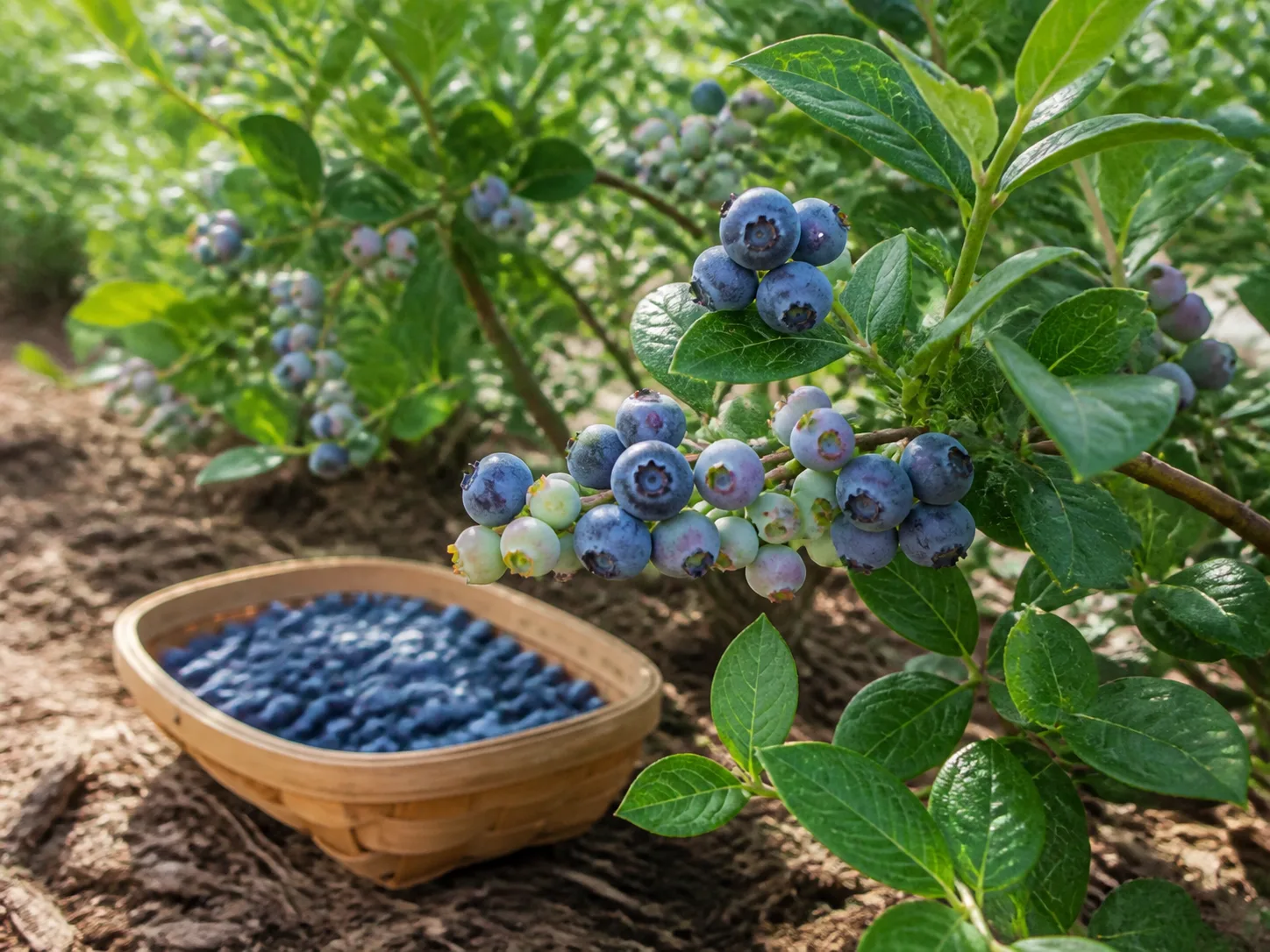
For most established blueberry bushes, apply fertilizer once in early spring, just before or as buds begin to swell. That timing gives roots access to nutrients as new shoots and leaves start growing, without tying the job to a month that may be early in one region and late in another.
Treat that as a starting point, not a universal prescription. Blueberries are shallow-rooted and sensitive to excess fertilizer salts, so the right amount depends on the product label, plant age, soil test, cultivar, and local climate. If the soil pH is too high, adding more fertilizer may not solve the problem; the roots can have trouble taking up nutrients even when those nutrients are present.
Quick timing answer
Feed an established blueberry bush in spring, before active growth is underway or around budbreak. If you missed that window, do not compensate with a double dose: use the normal label rate only if the product’s instructions and your local growing conditions still call for it.
Many gardeners only need one spring application. A second, smaller feeding may be appropriate when a local extension recommendation, a soil or tissue test, or the fertilizer label calls for split applications. The key is to decide based on the plant and the growing system, not on a blanket rule that every bush needs three feedings each year.
Why budbreak is the useful spring cue
Blueberry bushes begin the season with stored energy in their roots and stems. As buds swell and new shoots start to extend, the plant enters a period of active growth; spring feeding can make nutrients available during that transition.
The cue is easier to use than a calendar date. In a mild coastal garden, buds may swell weeks before they do in a colder inland yard, and a warm spell can move growth forward even when the calendar says winter. Watch for buds losing their tight, dormant look, not just the first fully expanded leaves.
Fertilizing too early into frozen or waterlogged ground is unhelpful: roots are not actively taking up nutrients, and granules can be moved by runoff. Waiting until leaves have fully expanded is not automatically a disaster, but it may be later than necessary for a slow-release product. Practical guides from Gardening Know How and Savvy Gardening both place the primary feeding in spring, while the University of Georgia’s blueberry guidance ties timing to budbreak and the production system.
Let your region and growth stage set the calendar
“Early spring” can mean February in a warm southern growing area and April or May in a colder region. Even within one region, an exposed bed that warms early can move ahead of a shaded or frost-pocket site. Use bud development and local extension timing together.
Blueberries are grown as northern highbush, southern highbush, and rabbiteye types, among others. They differ in chill needs, bloom timing, and harvest season, so the same week on the calendar will not line up with the same plant stage everywhere. A local extension publication is more useful than a national month-by-month schedule when it is written for your blueberry type and climate.
The University of Georgia Cooperative Extension’s commercial recommendations for mature southern highbush and rabbiteye plants in southern Georgia split nitrogen around budbreak and several weeks later, with a region-specific postharvest program under certain conditions. Those rates and dates are designed for particular cultivars, spacing, soils, and production systems; they are not a dose schedule to copy for a single backyard bush. They do show why local growing stage matters more than a universal “feed three times” rule.
Is one feeding enough?
For a healthy bush growing in garden soil, one modest spring feeding is a sensible default. Blueberries are not heavy feeders, and a bush that is growing well in a suitable pH range may need less fertilizer than a struggling one—or none at all if a soil test shows adequate nutrients.
Consider splitting the label-recommended annual amount into two applications only when the label or local extension guidance supports it. Split applications can make sense in sandy, fast-draining soil where nutrients leach readily, or where a regional program aligns feeding to budbreak and later fruit development. Dividing the same total dose does not mean doubling the amount.
Do not add another feeding simply because the bush has not grown quickly. Shade, drought, poor drainage, root damage, weeds competing for water, or a pH problem can all limit growth. Fertilizer cannot correct those conditions, and repeated feeding may add more salts without addressing the cause.
Newly planted blueberries need a lighter start
Do not give a newly planted bush the same dose as a mature shrub. Freshly disturbed roots are more vulnerable to fertilizer salts, and the small root ball has not yet explored the surrounding soil. A conservative backyard approach is to avoid fertilizer in the planting hole and skip a routine full-strength feeding until the plant is established.
Guidance differs by production system. Savvy Gardening advises against feeding during the first year in a home garden, while a University of Georgia establishment program for field-grown bushes delays fertilization for four to six weeks after planting so roots can begin to grow beyond the original root ball. Those are not interchangeable recipes; the appropriate approach depends on the plant size, planting season, substrate, fertilizer, and local advice.
If the nursery tag or a local extension guide gives a first-year schedule, follow that exact product and rate. Otherwise, prioritize steady moisture and a correctly prepared acidic root zone, then start conservatively when the bush is actively growing. Never apply a mature-bush rate to a small liner or new transplant.
When to stop fertilizing
For most home gardens, stop routine nitrogen feeding after spring or early summer unless a local blueberry guide calls for another application. Late nitrogen can encourage soft new shoots that may not harden before cold weather, and late-season growth is not a shortcut to more berries the following year.
There are regional exceptions. In southern production areas with longer seasons, extension programs may include postharvest applications for specific blueberry types and systems. For example, University of Georgia Cooperative Extension’s schedule describes several postharvest feedings for mature plantings, with the final application timed ahead of the first killing frost. That is a local, crop-specific recommendation—not a reason to fertilize every northern backyard bush in autumn.
If you garden in a short-season climate, avoid adding nitrogen late in summer or fall unless an extension recommendation for your area explicitly says otherwise. A plant that looks tired late in the year is not necessarily hungry; cooling weather and normal dormancy change leaf color and growth.
Start with a soil test, not a symptom guess
Before changing fertilizer, test the soil around the root zone. Blueberries generally do best in acidic soil; a common target is around pH 4.5 to 5.5, although extension recommendations may narrow the range for a particular region or production system.
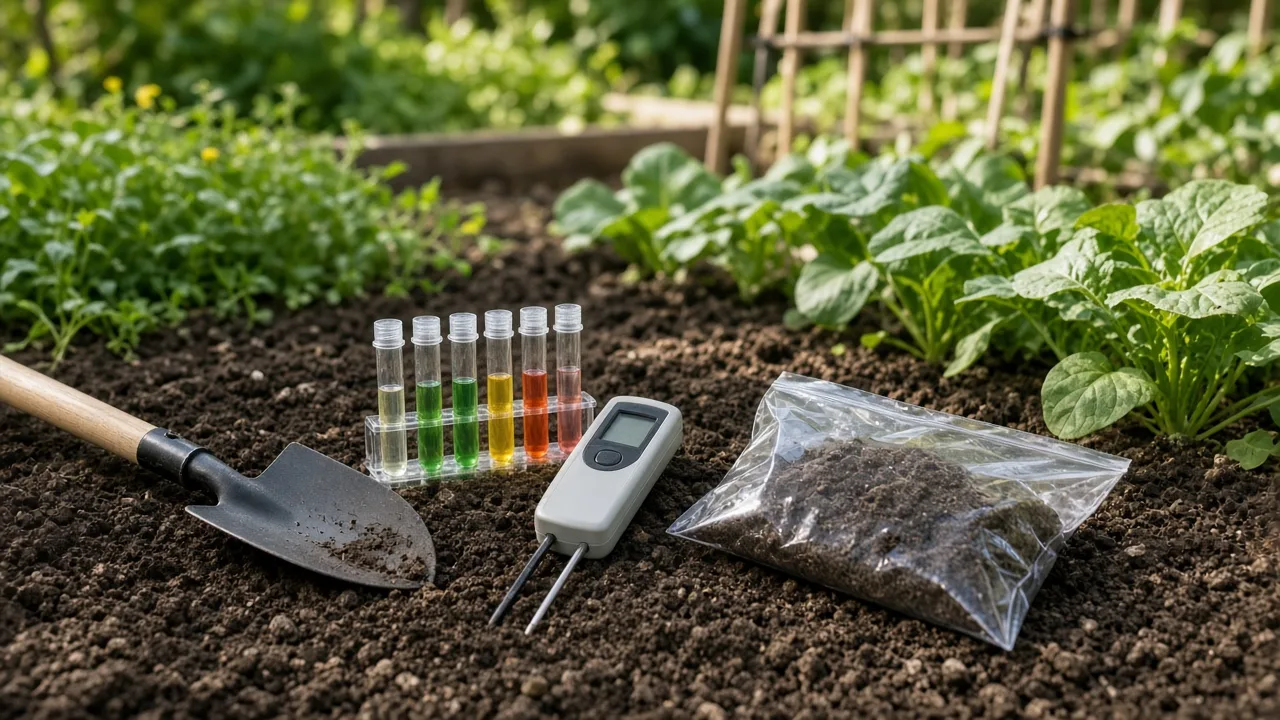
Ask for a test that reports pH and nutrients, then follow the lab’s recommendation for blueberries if available. A home pH probe can be useful for tracking a trend, but a laboratory analysis can also help distinguish low nutrient levels from a pH barrier. Test again when the lab or local extension service recommends it, especially after applying a soil amendment.
High pH can make iron and other nutrients less available to roots. That means yellow leaves may reflect nutrient lockout rather than a lack of fertilizer in the soil. Fertilizer can supply more of the same nutrients without correcting why the bush cannot access them.
If the soil is too alkaline, handle pH correction as its own job. Elemental sulfur is sometimes used to lower soil pH, but it acts gradually and the amount depends on starting pH and soil texture. Do not guess at a sulfur dose or expect a single application of an acid-loving fertilizer to quickly reset the soil. The soil lab can recommend a suitable amendment and re-test interval.
Choose a fertilizer by the job it needs to do
First decide whether the bush needs nutrients, a pH adjustment, or both. A blueberry fertilizer or acid-loving-plant product may be appropriate, but the product name alone does not tell you whether its nutrient analysis fits your soil test.
Read the full label. Compare the guaranteed analysis, nitrogen source, instructions for blueberries or fruiting shrubs, and the dose for the plant’s size or container volume. Do not assume that a higher first number on an N-P-K label means a better product; blueberries can be damaged by excess nitrogen and salts.
If your pH and nutrient levels are already in range, more fertilizer is not automatically beneficial. Conversely, if the pH needs correcting but the nutrient test is sufficient, applying a high-nitrogen product just to make the soil more acidic can overfeed the bush. Separate the decision about feeding from the decision about acidifying.
Nitrogen form matters
Blueberries generally perform best with ammonium-based or suitable slow-release nitrogen sources. The University of Georgia’s guide to fertilizing blueberries in pine-bark beds recommends ammonium or slow-release nitrogen and notes that nitrate may be used in small amounts in that specialized production context. For a home gardener, choose a product labeled for blueberries or acid-loving plants and avoid making nitrate-heavy fertilizer your default without local guidance.
Ammonium sulfate is one possible source, but it is concentrated and can lower pH while supplying nitrogen. That makes it a poor product to apply blindly: if your soil is already sufficiently acidic or has adequate nitrogen, it can push the root zone or nutrient level in the wrong direction. Do not substitute a commercial production rate for a home-garden label rate.
Avoid excess salts and chloride
Blueberry roots are sensitive to fertilizer salts. University of Georgia Cooperative Extension warns that overfertilization can cause salt injury, including scorched leaves and shoot dieback. Concentrated granules placed against the crown or roots can burn even when the total amount seems small.
Avoid products with unnecessary chloride or a high salt load, and do not stack several products that deliver the same nutrients. A “berry food,” an acidifier, and a general-purpose fertilizer may overlap in nitrogen; adding all three can quietly turn a modest program into an excessive one. Use one product at its labeled rate unless a soil test or extension recommendation says otherwise.
How much fertilizer should you apply?
There is no safe universal number of ounces per bush. Dose depends on the percentage and form of nutrients in the product, bush age and size, whether it is in the ground or a pot, the soil’s nutrient reserves, and local growing conditions. Follow the product label’s blueberry directions first, then use soil-test guidance to determine whether the plant needs the full rate.
If a label gives a rate per square foot, measure the area it covers rather than estimating from the bush’s age. If it gives a rate by plant size, use the actual mature canopy or pot volume specified by the manufacturer. Do not convert a per-acre rate from a commercial extension table into a backyard dose by guesswork; row spacing, plant density, and application timing are built into those recommendations.
Measure granular fertilizer with a dedicated scoop or scale. Spreading an unmeasured handful makes it easy to double-dose one bush and underfeed another, especially if the application is repeated later. Record the product and amount so you can avoid adding another round because you forgot the first.
Where to place granules and whether to water them in
Scatter granular fertilizer evenly over the root zone beneath the branches, extending toward the canopy edge. Keep it away from the base of the stems, where concentrated fertilizer can injure bark and surface roots. Blueberry feeder roots are shallow, so do not dig or rake deeply to bury the granules.
Apply to moist soil when rain is not heavy enough to wash granules away. Water lightly after application if the label directs you to, or if the surface is dry; this helps dissolve the product and move it into the upper root zone. Do not saturate poorly drained ground, because blueberries also suffer when roots remain waterlogged.
A layer of pine bark, pine needles, or another suitable mulch can help conserve moisture and moderate soil temperature, but it should not be piled against stems. If applying fertilizer through mulch, follow the product label: some labels direct gardeners to pull mulch back and replace it, while others permit surface application. Do not disturb the shallow root mat while doing the work.
Container blueberries need a separate plan
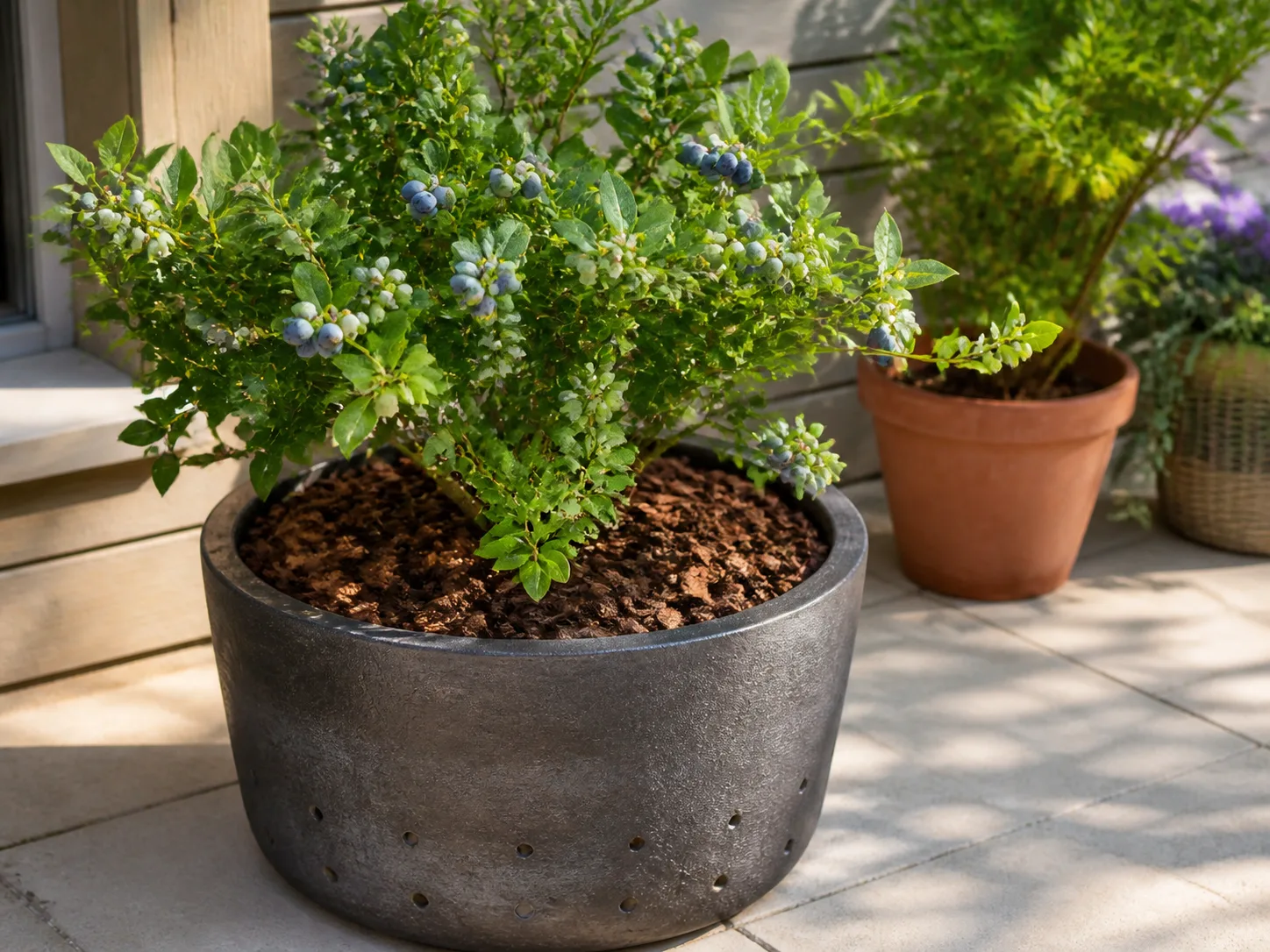
A container has less soil volume than a garden bed, so fertilizer can accumulate or wash out more quickly. Use a blueberry-appropriate potting mix and a fertilizer whose label explicitly covers container plants; the container rate may be based on pot diameter, volume, or watering frequency rather than the in-ground dose.
For a newly potted plant, wait until it has settled and resumed active growth unless the potting mix or fertilizer label provides a different startup schedule. Many mixes contain starter nutrients, and adding another product immediately can raise salt levels. If growth is poor, check moisture, drainage, root crowding, and pH before increasing the feed.
Container plants may need small, label-directed applications during active growth, particularly when frequent watering leaches nutrients. Do not use a soluble fertilizer at every watering unless the product label specifically recommends that schedule for blueberries. Empty saucers after watering, and avoid letting excess fertilizer solution sit around the roots.
A simple yearly schedule for home gardeners
Use this table as a conservative framework for a typical established bush in garden soil. The product label and local extension recommendations take priority, especially if you grow in a container, have sandy soil, or garden in a region with a long growing season.
| Plant stage | What to do | What to avoid |
|---|---|---|
| Late winter to early spring, buds swelling | Test the soil if due; apply one label-rate feeding if needed | Feeding frozen, saturated soil or guessing at a dose |
| Several weeks later, if a local plan calls for a split | Apply only the remaining portion of the label-directed annual amount | Treating the second application as an extra full dose |
| Harvest and early summer | Watch growth, water consistently, and check for a diagnosed deficiency | Feeding automatically because fruit is forming |
| Late summer and fall | Stop routine nitrogen in short-season regions unless local guidance says otherwise | Applying late nitrogen to force soft growth before winter |
If the bush is vigorous, leaves are a healthy green, and the soil test is satisfactory, do not force a second application onto the schedule. A simple plan you can repeat accurately is safer than a complicated calendar that ignores what the plant and soil are telling you.
Diagnose weak growth before adding more
Yellow leaves, short shoots, and a small crop can point to nutrient stress, but they do not prove the bush needs fertilizer. Check the pattern and timing: iron-related chlorosis often appears as yellow tissue between greener veins on newer leaves, while nitrogen shortage tends to affect older leaves first. Those are clues for testing, not a substitute for it.
Also check whether the plant has enough sun, steady water, and good drainage. Drought can limit nutrient uptake; persistently wet soil can damage roots; shade can reduce growth and fruiting. A bush crowded by weeds may compete for water and nutrients even when the fertilizer program is adequate.
Avoid treating reddish leaves as an automatic nitrogen-deficiency signal. Cold temperatures and seasonal dormancy can redden foliage, and other nutrient imbalances or root stress can produce similar symptoms. Compare affected new and old leaves, inspect the soil moisture, and get a test before applying a corrective fertilizer.
Signs you have overfertilized
Leaf-edge scorch, sudden wilting, browning, or shoot dieback after feeding can indicate salt injury, especially if fertilizer was applied in a pile or directly beside the crown. Excess nitrogen can also push long, soft shoots and leafy growth while doing little to solve a pH or root problem.
If you suspect overfertilization, stop feeding and review the amount and label. Where drainage is good and the product label or local extension guidance supports it, a thorough watering may help move soluble salts below the shallow root zone; do not flood a poorly drained bed or already waterlogged container. If symptoms are severe, contact your local extension office and provide the fertilizer label, dose, timing, and a soil test.
Do not respond to leaf scorch by adding a different nutrient. Salt injury, drought, root disease, and pH-related chlorosis can look alike from a distance. A diagnosis prevents the “one more product” cycle from worsening the damage.
Mistakes that make feeding less effective
- Using a calendar instead of bud stage. Local spring arrives at different times; watch the buds and check regional advice.
- Applying fertilizer to fix high pH. Soil acidification takes a separate, measured plan.
- Copying a commercial rate. Per-acre programs assume a particular plant density, cultivar, and production system.
- Feeding a transplant like a mature bush. Newly disturbed roots are more vulnerable to fertilizer salts.
- Putting granules against the stems. Spread the measured amount across the root zone instead.
- Working fertilizer deep into the soil. Blueberry feeder roots lie near the surface and can be damaged by cultivation.
- Adding late nitrogen by habit. In a short season, late growth may not harden before winter.
- Diagnosing from a single leaf color. Test the soil and check water, drainage, and growth stage before treating.
Conclusion
For most established blueberry bushes, spring around budbreak is the best time to fertilize. Start with a soil test, choose a blueberry-appropriate product, and apply only the label-directed amount across the shallow root zone.
One spring feeding is enough for many backyard plants; a split or postharvest schedule belongs to situations where the product label or local extension guidance supports it. If the bush looks weak or the leaves are discolored, test and diagnose first. Blueberries reward careful, measured feeding more reliably than frequent doses.