Water Droplets on Indoor Plant Leaves: Causes Explained
Water droplets on indoor plant leaves often come from guttation or condensation. Learn how to tell the difference and when wet soil calls for a closer check.
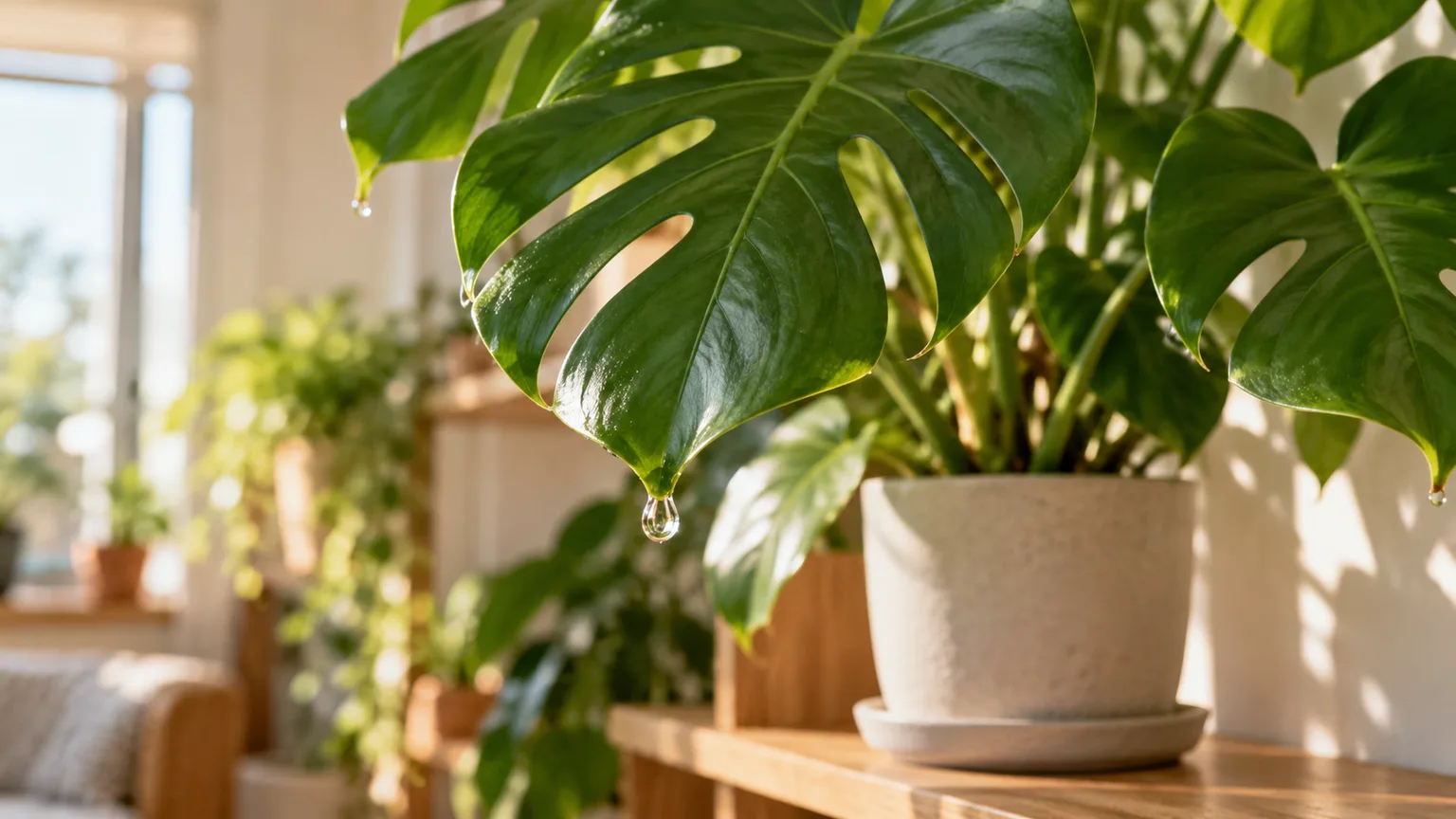
If you find a bead of water hanging from a Monstera leaf in the morning, the plant is probably releasing liquid through guttation. If moisture coats the broad surface of several leaves and the nearby window is wet too, condensation is more likely. If the drops feel sticky or appear on stems and shelves, inspect for insect honeydew or another plant secretion before changing how you water.
The first clue is not how much water you gave yesterday. It is where the drops form, when they appear, whether they feel tacky, and what the soil and plant look like. A single clear bead at a leaf tip can be normal; the same bead alongside persistently saturated mix and yellowing leaves deserves a closer check.
Start With Where the Droplet Forms
Drops that repeatedly collect at a leaf tip or along the outer edge overnight are most consistent with guttation. A fine film spread across the blade, multiple plants, and cool window glass points more toward condensation. Sticky patches that wander across leaves, petioles, stems, or the surface below the plant call for a pest check.
These patterns are useful clues rather than laboratory tests. A droplet can move downhill as the leaf tilts, mix with dust or spray residue, or dry before you see it. Track the plant for two or three mornings: note whether the same leaf tips become wet, whether the room or cabinet is damp, and whether drops appear after watering or after a cool night.
Do not reduce watering because you noticed one drop. Guttation can happen in a healthy plant with moist roots, and condensation can occur without any watering problem at all. Look for a second piece of evidence, especially how quickly the potting mix dries and whether the plant’s leaves and stems remain firm.
Why Guttation Forms Drops at Leaf Tips
Guttation is the release of liquid water from intact plant tissue, usually at leaf margins or tips where specialized structures called hydathodes sit. It differs from a leaf sweating visible water across its whole surface: the liquid exits at particular points connected to the plant’s water-conducting tissue.
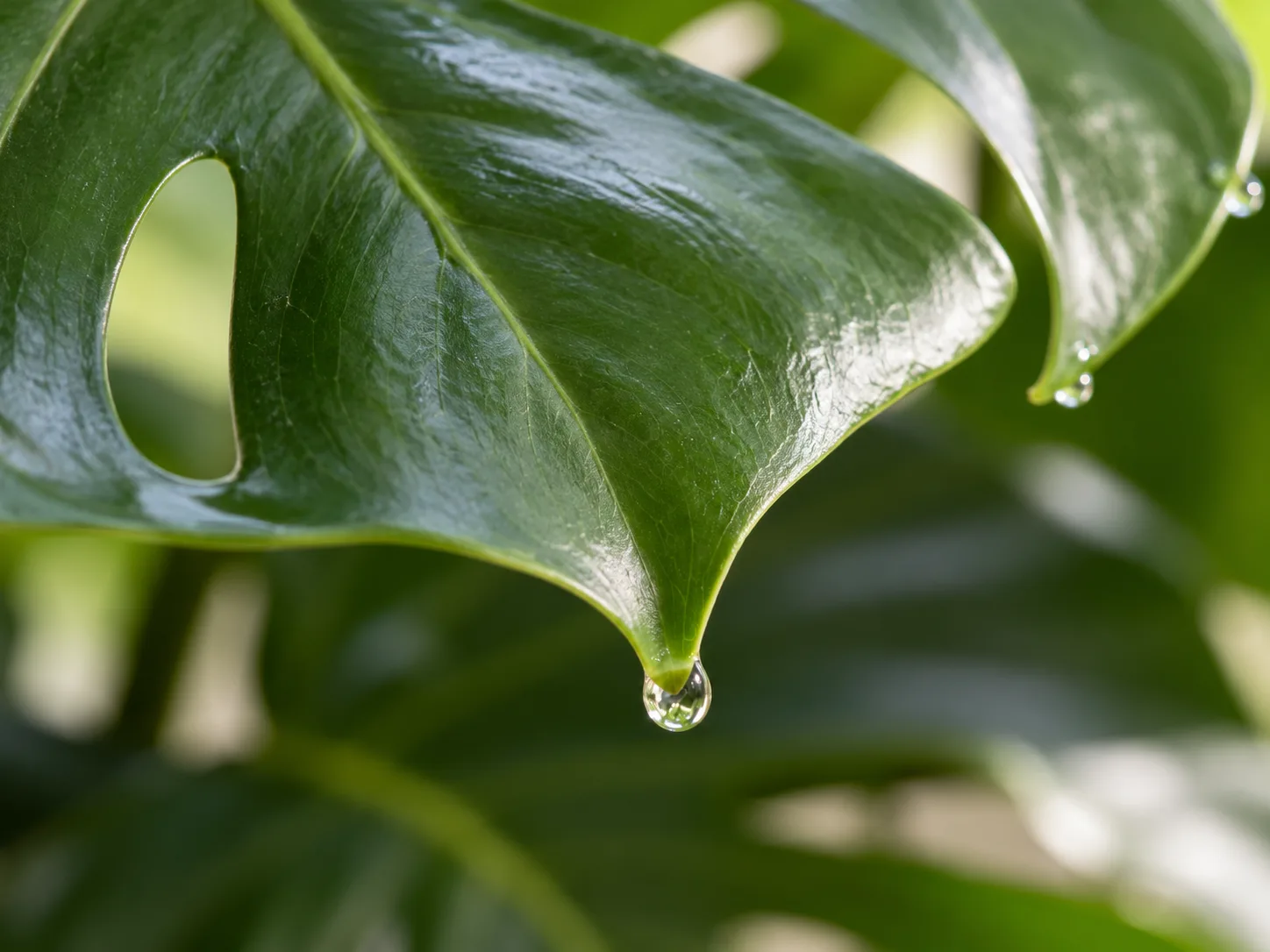
The University of Missouri Extension describes guttation as a pressure-release process. When roots continue taking up water but transpiration has slowed, pressure can build in the plant and push droplets through hydathodes near the ends of leaf veins. Guttation liquid can carry dissolved minerals and sugars, so a dried drop may leave a faint mark rather than evaporating as cleanly as distilled water. (University of Missouri Extension: Guttation)
Hydathodes and root pressure
Hydathodes are not the same as stomata. Stomata are pores across leaf surfaces that regulate gas exchange and the movement of water vapor. Hydathodes occur at particular vein endings or margins and can release liquid when the plant’s internal water pressure favors outward flow.
Root pressure is a “push” explanation for this small, visible release. Most daytime water movement through a plant is driven by water evaporating from leaves and pulling a connected column upward through the xylem; guttation can occur under different conditions, when root uptake continues while that evaporative pull is low. University of Minnesota’s horticulture text distinguishes these push and pull mechanisms and identifies root pressure as the cause of guttation. (University of Minnesota: Plants and Water)
That distinction matters because “the plant is getting rid of excess water” is too simple as a diagnosis. Guttation is a normal physiological process, not a reliable moisture meter and not proof that the pot is waterlogged. The plant may have sufficient moisture for active roots, and the room’s nighttime conditions may make the droplets visible.
Why drops often appear overnight
Guttation is more likely to be noticeable when roots are moist and water loss from leaves is low. At night, light and temperature often fall, evaporation slows, and stomata may be less open than during the day. If the root zone is still active, the resulting pressure can make drops collect at fixed leaf tips or edges.
That is why you may notice droplets after a thorough watering, following repotting into fresh mix, or during a warm, humid growing period. The timing does not prove that you watered too much. A plant watered normally can still guttate if its roots are absorbing water while the room is still and humid overnight.
Foliage Factory’s houseplant guide also treats the repeatable tip-and-margin pattern as a practical clue and recommends checking for sticky residue or signs of pests before blaming watering alone. The pattern is useful, but it should be combined with soil and plant observations rather than treated as a diagnosis by itself. (Foliage Factory: Guttation in Houseplants)
Transpiration Is Usually Invisible
Transpiration is the movement of water from roots through the plant and out of leaves as water vapor, mostly through stomata. The vapor mixes into the air; under ordinary indoor conditions, you do not see it as a bead that forms at one particular leaf tip. University of Minnesota’s horticulture material explains how light, temperature, humidity, wind, and water availability affect transpiration.
People sometimes use “transpiration” as a catch-all for any moisture associated with a leaf. That blurs two different observations. Transpiration can add water vapor to the air around a plant; if a leaf or nearby surface cools enough, vapor can condense into visible water. But the visible beads then formed by condensation on a surface, not because liquid transpiration dripped through stomata.
This distinction prevents a frustrating care response. Improving airflow can help a persistently damp room or crowded plant shelf dry more evenly, but it does not switch off the plant’s essential water-vapor exchange. Likewise, reducing watering is not a direct treatment for ordinary transpiration. First decide whether you are seeing a liquid released at leaf tips or moisture settling over surfaces.
When Condensation Is the Better Explanation
Condensation forms when water vapor in air meets a surface cool enough for that vapor to turn back into liquid. A leaf beside a cool window can collect dew-like moisture just as a cold glass collects beads in a warm room. In an enclosed plant cabinet, terrarium, or humidifier corner, condensation may appear on glass, pots, leaves, and other nearby surfaces at once.
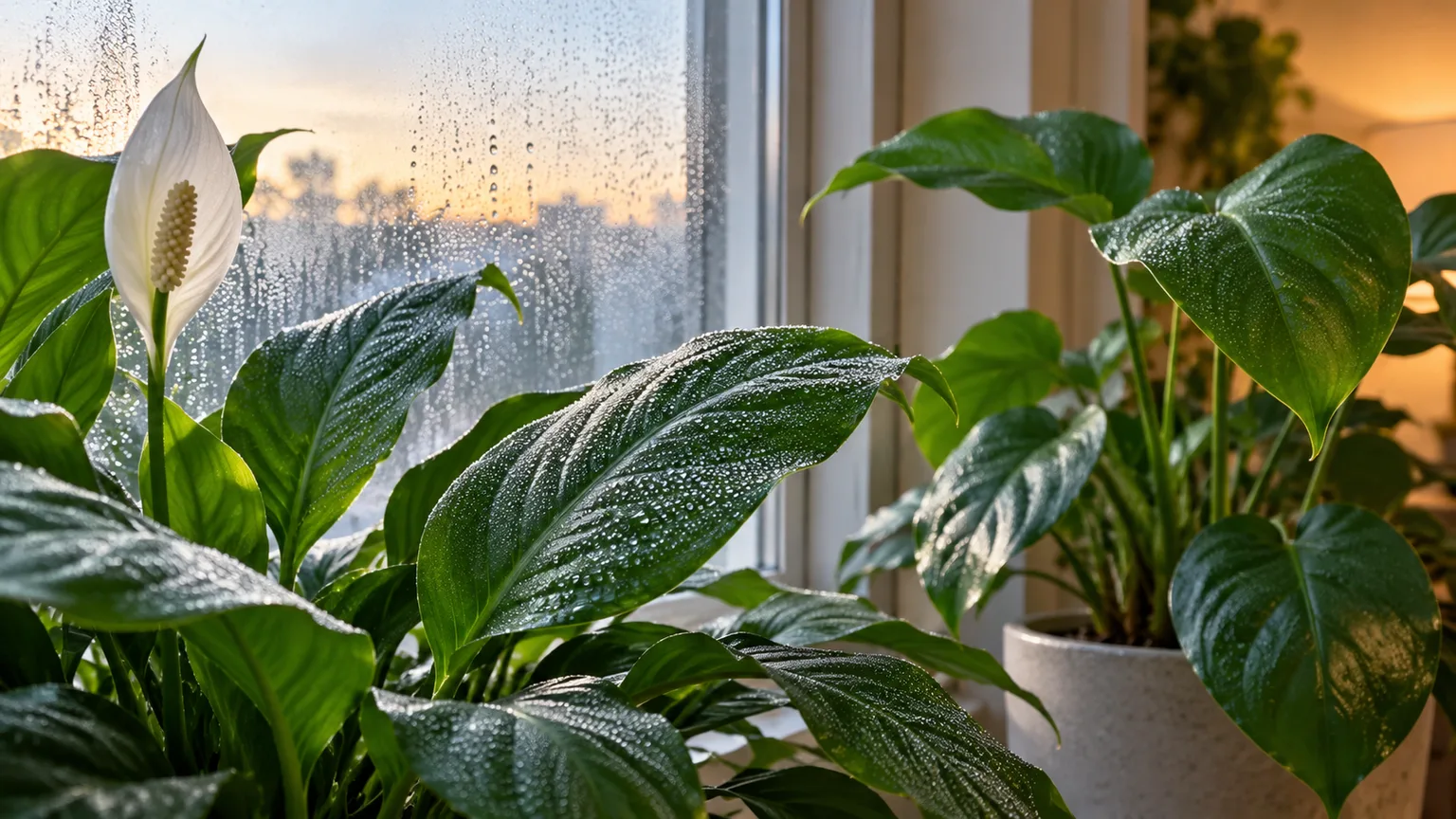
Look for distribution. Condensation often appears as many small beads or a light film across a broad area, and you may find matching moisture on the window or enclosure wall. Guttation more often repeats at specific leaf ends or margins. A mix is possible: a guttation droplet may be joined by condensation, especially in a humid room.
The Growing Leaf’s indoor-plant guide uses the same practical comparison: check whether the pot or nearby surfaces are wet as well as the foliage. That check is more useful than trying to identify a droplet by appearance alone. (The Growing Leaf: Why Indoor Plants Drip Water)
If several plants in one cool, humid spot are wet, inspect the room before altering each plant’s care. Move foliage slightly away from cold glass, open a cabinet briefly if it is designed to ventilate, or reduce direct humidifier output on the leaves. Avoid a sudden, harsh change in humidity: a plant adapted to a humid enclosure may respond poorly to abrupt drying.
Compare Guttation, Condensation, and Sticky Residue
Use the pattern as your starting point, then verify it with the soil and whole plant. The table is a field guide, not a substitute for checking the leaf and pot directly.
| What you notice | More likely explanation | What to check next |
|---|---|---|
| Clear drops at the same tips or margins, often by morning | Guttation | Root-zone moisture, drainage, and whether the plant otherwise looks healthy |
| Fine beads across broad leaf surfaces, with wet glass or nearby objects | Condensation or dew | Cool surfaces, room humidity, cabinet ventilation, and humidifier direction |
| Sticky droplets on leaves, stems, petioles, or shelves | Honeydew, nectar, or another secretion | Leaf undersides, nodes, fresh growth, and whether the drops repeat at glandular points |
| Wetness exactly at a tear, cut, or snapped stem | Sap from damaged tissue | Recent pruning, handling, or a bent or broken petiole |
| A clean wet patch after watering or misting | Splash or spray residue | Whether the moisture fades after the foliage dries |
Honeydew deserves special attention because it can look like water at first. Aphids, soft scale, mealybugs, and whiteflies feed on plant sap and excrete a sugary residue; it may remain tacky and spread beyond leaf tips. Check undersides and leaf joints with a flashlight. A few clear beads on a healthy plant are not evidence of pests, but sticky trails or visible insects justify identification before treatment.
Some plants also make nectar-like secretions at particular glands. If a sticky droplet appears repeatedly on the same petiole or stem point while the plant is growing normally and you cannot find insects, do not assume the plant is infested. Compare location and recurrence, then keep watching rather than applying pesticide “just in case.”
A 10-Minute Diagnostic for Dripping Houseplants
You do not need to unpot the plant to identify most harmless droplets. Use the same sequence whenever you notice them, and record what changes from one morning to the next.
Check location and timing
Start with a dry leaf or tissue and blot one drop. Note whether it sits at a leaf tip, on the outer margin, across the blade, or at a damaged spot. Then inspect the same plant early the next morning and later in the day. Drops that repeatedly appear at the same leaf endings overnight support guttation; a broad wet film that fades as the room warms supports condensation.
Look around, not only at the leaf. Are the window, shelf, pot exterior, or neighboring plants damp? If so, an environmental source is more plausible. If only a few leaves on one plant have tip-bound drops, guttation moves higher on the list. If the source remains unclear, wait and observe instead of making several care changes at once.
Check texture and nearby surfaces
Water usually feels slick and disappears as it dries. Honeydew often feels tacky, may leave a shiny residue, and can collect on surfaces beneath the plant. Use a clean tissue rather than tasting the liquid; appearance and texture can guide the inspection, but neither confirms the cause with certainty.
Look beneath leaves, around petioles, at stem joints, and on the newest growth. Small bumps, cottony clusters, ants, distorted leaves, or black surface growth alongside sticky liquid raise the possibility of sap-feeding pests. A specialist houseplant discussion from Foliage Factory likewise advises checking for honeydew sources when sticky moisture appears away from leaf tips. Isolate a plant only when you find a plausible pest sign or a spreading problem, not just because the leaf is wet.
If a clear bead appears on a repeatable point while the rest of the plant and shelf stay clean, do not escalate to pest treatment. A gentle wipe is enough when the liquid is about to drip on furniture; wiping does not fix or harm the process that produced it.
Check soil, pot, and whole-plant signs
Feel the mix at the root zone, not just its dry-looking top. A wooden skewer, finger, pot weight, or a moisture meter used at the same depth can help; each has limits, especially in a large pot or chunky bark mix. Check whether water can drain from the container and whether a decorative cachepot or saucer is holding runoff against the nursery pot.
Then check the plant. Firm stems and leaves, active new growth, and a pot that dries at a reasonable pace are reassuring. Yellowing that continues, limp leaves while the mix stays wet, a soft or dark base, or a sour smell point toward root stress and deserve more attention than droplets alone.
Do not pull the plant out just to confirm one morning’s guttation. Root inspection becomes reasonable when several warning signs agree or the potting mix remains wet far longer than is normal for that plant, container, and season.
When Guttation Is Harmless—and When to Investigate
Occasional guttation on a firm, growing plant is usually a normal event. It does not by itself mean the plant is “crying,” diseased, or overwatered. Young or vigorous plants and broad-leaved tropicals such as Monstera, Alocasia, pothos, philodendrons, and peace lilies may make the pattern especially easy to spot, but any plant’s response varies with species and conditions.
Guttation becomes a useful prompt to review care when it is frequent and paired with other evidence of a root-zone problem. Examples include mix that stays saturated, a pot without working drainage, water left in a cachepot, repeated yellowing, soft stems, or a plant that wilts even though its roots are wet. The symptoms together matter; there is no universal number of drops that defines overwatering.
If you suspect overwatering, check whether the container drains and whether the root ball is staying wet because the pot is oversized, the mix is compacted, light is low, or the room has cooled. Do not respond by leaving every species bone-dry. A thirsty peace lily, a drought-tolerant succulent, and an orchid in bark do not share one watering threshold.
University of Missouri Extension notes that guttation fluid can rarely provide a route for bacteria to enter leaves, but it does not present ordinary guttation as a common disease diagnosis. Keep leaves clean and remove standing water if your plant is already showing spots or disease symptoms, but do not use one clear drop as a reason to spray, prune, or repot. (Missouri Extension discussion of guttation)
How to Adjust Watering Without Overcorrecting
If the plant looks healthy and the mix is drying as expected, keep its normal routine. Guttation may stop by itself as light, temperature, humidity, and root uptake change. If the plant is repeatedly wet and showing root-stress clues, adjust the conditions that keep the root zone saturated rather than following a fixed rule such as “water every other week.”
Before the next watering, check the moisture at a depth appropriate for the plant. Water thoroughly when the root zone reaches the plant’s normal threshold, allow excess water to drain, and empty the saucer or cachepot. For a plant that likes evenly moist soil, “dry enough” does not mean bone-dry; for a succulent, allowing more of the mix to dry is usually part of its normal cycle.
If the surface is wet but the pot has no drainage, do not pour in more water until you understand where existing water is going. If a potting mix has collapsed and stays saturated, consider whether repotting into a suitable, airier mix is warranted—but make that decision based on persistently poor drainage or root condition, not droplets. Repotting a healthy plant solely to stop guttation adds stress without treating a demonstrated problem.
Change one factor at a time. Moving a plant away from a cold window can reduce condensation; adjusting irrigation may help a persistently wet root ball; improving gentle air circulation can help a damp enclosure. If you change watering, keep a short note of the date, soil feel, pot weight, and leaf condition. The next watering decision will then be based on the plant’s response rather than a drip that may have been harmless.
Which Indoor Plants Commonly Guttate?
Guttation is not limited to one houseplant family. It is simply more noticeable on plants with leaves whose tips or margins make droplets easy to see. Monstera, Alocasia, Philodendron, Syngonium, pothos, peace lily, and some other tropical foliage plants commonly appear in indoor growers’ observations. Many smaller droplets evaporate before anyone notices them.
A plant’s name does not confirm the cause. Two Monsteras in different rooms can behave differently because one has a recently watered, warm root ball and the other sits in a cool, breezy space. A plant that never guttates is not automatically dry or unhealthy, either.
This is why care advice should begin with the individual pot and its setting. Check the plant’s normal moisture preference, pot size, mix, drainage, seasonal light, and room temperature. Use species tendencies to decide where to look—not to skip the inspection or prescribe the same watering interval to every plant.
Do Droplets Leave Marks or Spread Disease?
Guttation liquid is not chemically identical to distilled water. It can contain dissolved compounds from the plant, so a droplet that dries on a dark leaf, shelf, or windowsill may leave a small mineral or sugary mark. This is a cosmetic issue; a pale ring by itself does not prove disease or fertilizer burn.
If you want to clean a leaf, wipe it gently with a soft damp cloth and support the blade so it does not crease. Use plain water on delicate foliage, and test an inconspicuous leaf first if you are unsure about the plant’s surface. Do not use leaf shine or household cleaners to remove a mark; they can leave residues the plant does not need.
Prolonged wetness can matter for some plants if it coincides with poor airflow or an existing bacterial or fungal problem. The sensible response is proportionate: let leaves dry, remove dead debris, avoid repeatedly wetting susceptible foliage, and investigate spots that expand or return. A few transient drops on an otherwise healthy leaf do not justify fungicide or bactericide.
Keep Drops Off Furniture Without Harming the Plant
Move the pot to a washable tray or waterproof plant stand if a drip lands on wood, fabric, electronics, or a book. Make sure the tray catches runoff without leaving the pot base submerged. You can also rotate the plant so a dripping tip hangs over the tray, but avoid sharply bending a mature leaf just to redirect one bead.
If condensation is the source, move foliage a little away from a cold pane or direct humidifier plume and leave room for air to circulate. In a closed cabinet, follow the cabinet’s ventilation routine; do not create a strong draft across a tropical plant. In a naturally humid room, droplets may still form during cool periods, so a liner under the plant is often the simplest solution.
For guttation, gently blot drops when they appear if you need to protect nearby surfaces. You do not need to wipe every leaf each day or stop normal watering. If you also see sticky residue, inspect for pests; if you see persistent wet soil and decline, reassess the root zone. Those are different problems and deserve different fixes.
Conclusion
Water droplets on indoor plant leaves are most often guttation at fixed leaf tips or margins, condensation spread across cool surfaces, or sticky residue that needs a pest check. Transpiration normally releases water as vapor, so it is not usually the direct source of a bead you can wipe from a leaf.
Start with the pattern and timing, then look at nearby surfaces, texture, potting-mix moisture, drainage, and the plant’s overall condition. Leave a healthy plant’s occasional guttation alone; adjust watering only when wet soil and other root-stress signs support that decision. This simple sequence helps you protect your plant—and your furniture—without turning one harmless drop into an unnecessary care change.