Windmill Palm Care: Growing Trachycarpus Fortunei
Grow a windmill palm with less guesswork: choose a sheltered site, water by soil condition, protect container roots, and spot serious crown problems early.
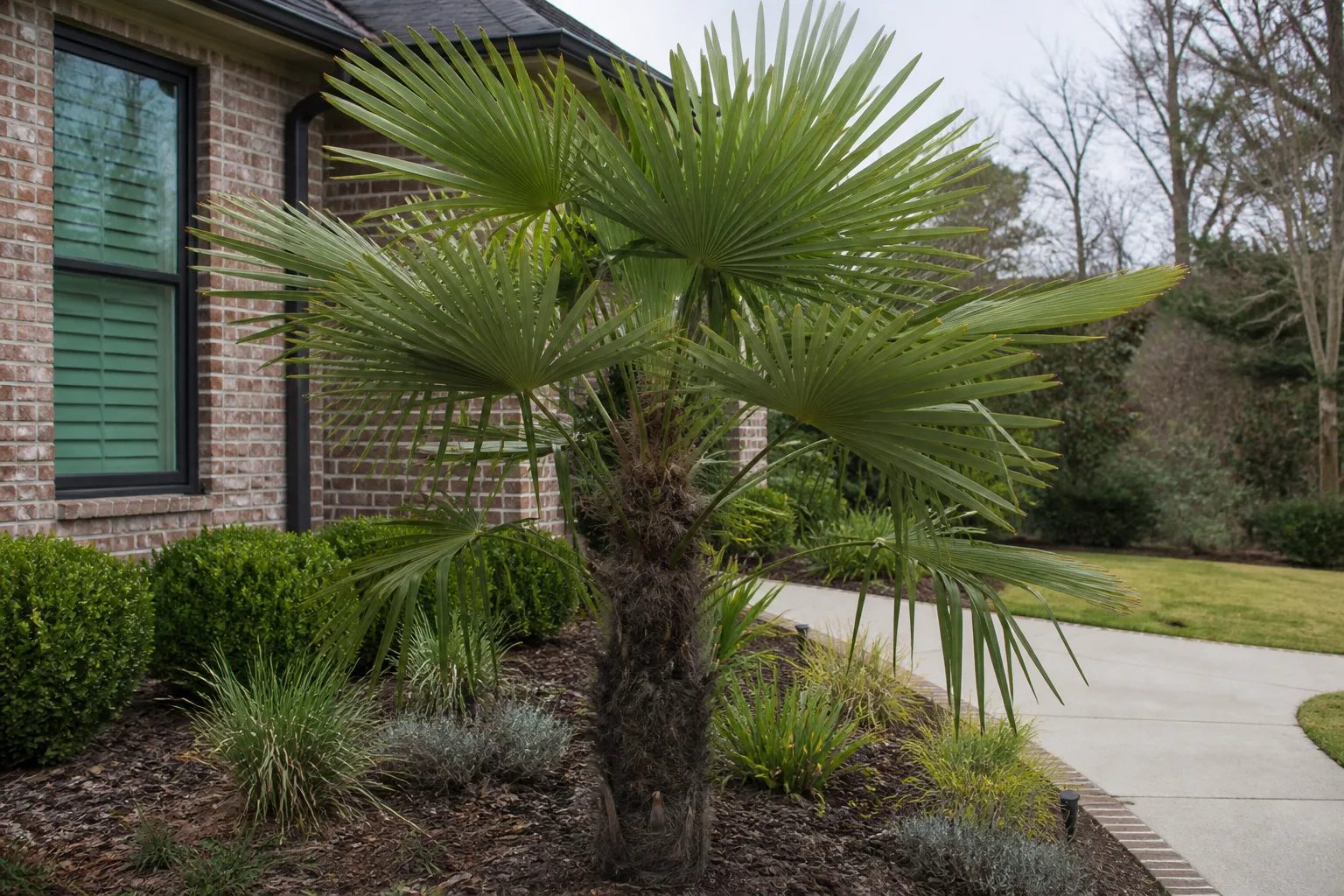
A windmill palm (Trachycarpus fortunei) brings the fan-shaped silhouette of a tropical palm to gardens that get real winters. Its cold tolerance is unusual for a palm, but “hardy” does not mean carefree: a young tree in wet soil and an exposed, drying wind can fare worse than the same species in a sheltered courtyard.
The decisions that matter most are made before planting. Choose a site with room for the eventual crown, give the roots fast drainage, and plan for the coldest weather your garden actually gets—not only the lowest temperature printed on a plant tag.
Know what a windmill palm can—and cannot—do
This evergreen palm is also called Chinese windmill palm, Chusan palm, or hemp palm. Its identifying features are a single, upright trunk covered in coarse brown fibers and a crown of rounded, fan-shaped fronds. Those fibers are old leaf bases; they are part of the palm’s naturally shaggy look, not a sign that the trunk needs cleaning.
Windmill palm grows slowly and generally works best as a specimen or a small-group accent, not as a quick privacy screen. Sources give different mature-height estimates because plants grow at different rates in different climates: UF/IFAS says established landscape specimens rarely exceed about 25 feet, while the RHS lists a potential height above 12 meters. Leave room for a substantial evergreen crown and do not assume a young nursery palm will stay compact. UF/IFAS and the RHS plant profile show why local growing conditions matter when estimating size.
If your yard is small, ask a regional nursery about a compact selection such as ‘Wagnerianus,’ whose leaves are smaller and stiffer than the species form. NC State Extension lists it as a cultivar, but even a compact-leaved selection still needs room for a trunk and crown; it is not a miniature palm that can be kept small by topping. NC State Extension
Choose climate and site before buying
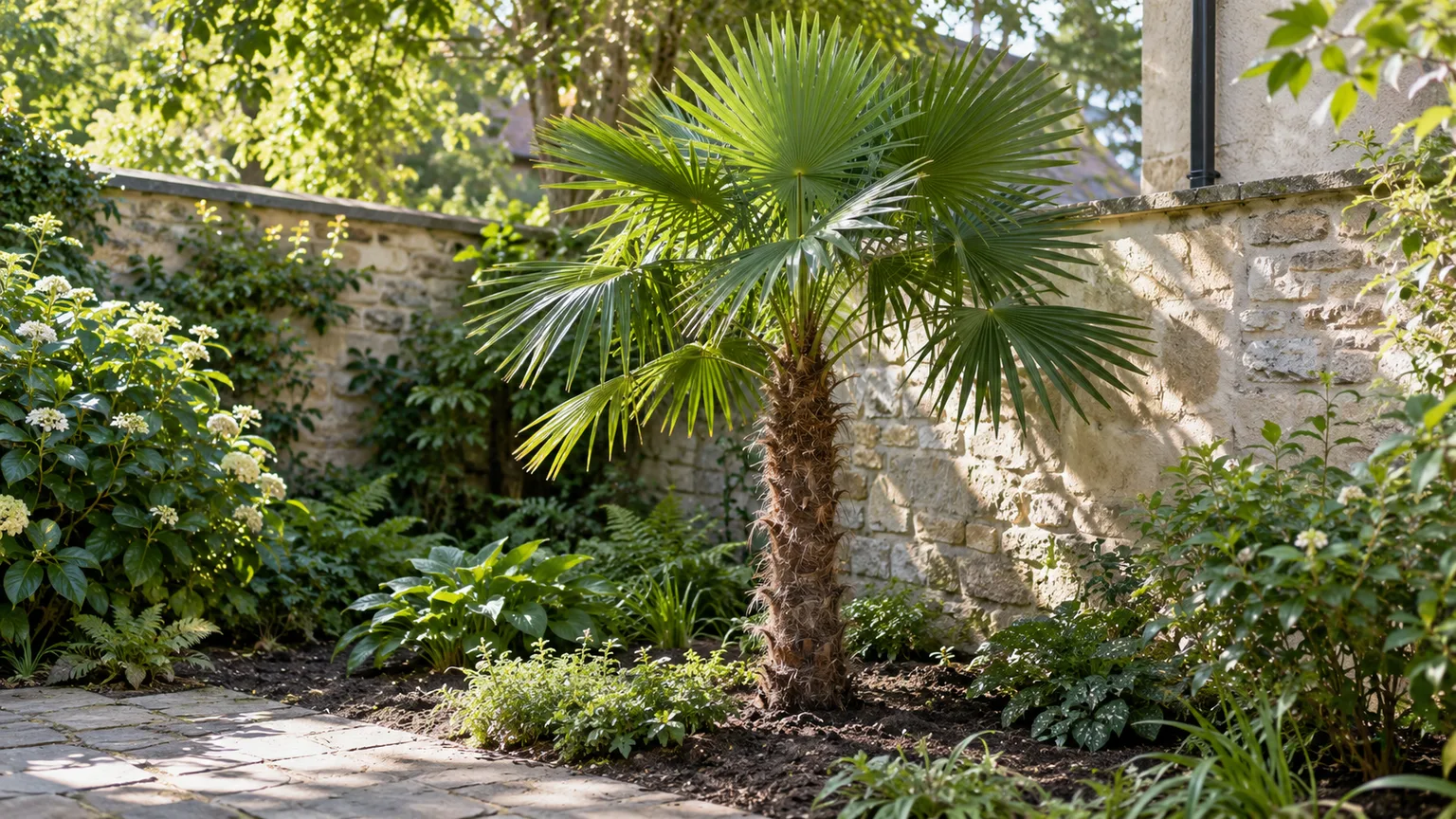
A windmill palm can suit a temperate landscape, but its cold hardiness is only one part of the fit. It also needs soil that drains, enough light to support steady growth, and shelter from the strongest winter and prevailing winds. A protected, well-drained spot beside a wall or among larger shrubs can be a better choice than an open lawn exposed to gusts.
Think beyond the palm’s current height. Fronds arch outward and can reach several feet across, so keep the crown clear of narrow paths, roof eaves, overhead wires, and places where people will brush past it. The fibrous trunk and broad leaves make it an architectural accent; they are not reasons to plant close to a foundation or to assume the tree’s roots will tolerate a small, compacted hole.
Use hardiness zones as context, not a warranty
UF/IFAS describes windmill palm as hardy in USDA Zones 8A–11 and notes that it can handle temperatures near 10°F. NC State Extension lists a wider set of zone ratings, and the RHS uses the UK H5 scale. These ratings are not perfectly interchangeable: each reflects a different climate system and a plant’s likely performance in a broad region, not a promise that every specimen survives a specific thermometer reading. UF/IFAS · NC State Extension · RHS
A brief dip toward 10°F is not the same as a week of hard freezes, cold wind, and saturated ground. Plant age, how well roots are established, exposure, freeze duration, and the temperature of the root zone all affect the outcome. If your winters fall below the plant’s usual range, grow it in a movable container or treat it as a plant that may need protection rather than relying on a single minimum-temperature figure.
Plant it where wind and heat are moderated
Windmill palms tolerate full sun, but afternoon shade can reduce stress in hot-summer regions. In cooler climates, a sunnier position may help the palm make the most of the growing season; the trade-off is that an exposed spot can dry the soil faster and tear the broad fronds. UF/IFAS recommends partial shade and notes that full-sun plants may need irrigation during dry spells, while NC State Extension advises some shade and protection from strong or cold winds.
Look at the wind pattern around the house before choosing a spot. A sheltered courtyard, the lee side of a building, or a bed protected by shrubs can soften gusts without placing the palm in deep shade. Avoid planting it where wind funnels between buildings, where roof runoff saturates the roots, or where the only available space is an exposed, sun-baked corner with little access to irrigation.
Give roots drainage and a steady start
The soil should hold enough moisture for roots to establish but release excess water after rain or irrigation. Windmill palm tolerates a range of soil textures and pH, yet poor drainage is a more important problem than whether the soil is slightly acidic or alkaline. In heavy clay, improve the planting area’s structure across a broad bed or choose a raised, naturally draining location; putting gravel in the bottom of a narrow planting hole does not fix a waterlogged site.
Prepare the site by checking how water behaves after a soaking rain. If it remains pooled for hours or the soil stays sticky and airless, plant higher or choose another site. Mix compost into a broad planting area if the soil is depleted, but do not create a rich, loose pocket surrounded by compacted clay: water can collect in that pocket and leave roots sitting wet.
Set the root ball at the right height
Plant in spring or early fall when the soil is workable and the palm has time to establish before severe heat or cold. Set the top of the root ball level with the surrounding grade, as it sat in the nursery pot. A square hole a little wider than the root ball gives roots access to loosened soil; the hole should not be deeper than the root ball.
Backfill with the soil you removed, firm it gently, and water slowly to settle air gaps. Keep mulch several inches away from the trunk so the fibrous base stays uncovered and the crown is not buried by soil or compost. A planting guide from BBC Gardeners’ World Magazine likewise keeps the palm at its original pot depth and waters it in; that simple detail reduces the risk of burying the trunk while the roots settle.
Water by soil condition, not a weekly rule
Water a newly planted palm deeply enough to moisten the root ball and the surrounding soil, then let the surface begin to dry before watering again. During the first growing season, check the soil every few days in hot or windy weather and less often in cool, rainy weather. The goal is steady moisture through the root zone while it establishes, not a permanently damp planting hole.
After the palm is established, it can tolerate dry spells better than many palms, but drought tolerance does not mean it never needs irrigation. During a prolonged dry period, water slowly at the root zone rather than sprinkling the fronds. A finger check or narrow trowel test a few inches below the surface is more useful than a calendar: sandy soil may dry quickly, while clay can stay wet long after the surface looks dry.
For a container, let the upper layer of mix dry slightly, then water until excess drains from the bottom. Empty the saucer; roots left in standing water can rot. In winter, water only when the root ball is actually dry and conditions are mild enough for the water to drain—do not add water to cold, saturated soil just because the palm has not been irrigated on schedule.
Feed lightly and only when needed
A healthy palm in fertile, draining soil may need little supplemental fertilizer. If growth is weak or older fronds are yellowing, first review light, water, drainage, and cold exposure; fertilizer cannot repair damaged roots or a freezing crown. A soil test can help separate a nutrient shortage from a watering or root problem.
When feeding is appropriate, use a slow-release fertilizer labeled for palms and follow its label for rate and timing. UF/IFAS names an 8-2-12 slow-release palm fertilizer for its Florida conditions, but that formula is not a universal prescription for every soil or region. Avoid heavy doses of general lawn fertilizer around the palm, especially products high in nitrogen and low in potassium or magnesium. UF/IFAS
Apply fertilizer over the root zone rather than against the trunk, and water it in as directed. If yellowing continues after a measured application, pause before adding more; nutrient excess and salt buildup can also stress roots. Use your local extension service’s recommendations when a soil test identifies a specific deficiency.
Grow in a container with a winter plan
Windmill palm can grow in a large pot, which is useful where ground temperatures are too low or garden space is limited. Choose a heavy container with several unobstructed drainage holes and a stable base; the crown can catch wind, and a lightweight pot may tip as the palm grows. Use a well-draining container mix rather than dense garden soil, and do not jump to an oversized pot that remains wet for too long.
The main container trade-off is winter exposure. The ground buffers temperature changes around roots, while a pot loses heat from its sides and bottom. A palm that could survive in a sheltered landscape may suffer in the same climate when its root ball freezes repeatedly, so move the pot against a protected wall, into an unheated bright shelter, or into a cool conservatory before severe cold arrives.
A potted palm can spend the warm season outdoors, but bring it back outside gradually after indoor overwintering. Give it a sheltered, partly shaded transition before exposing leaves to intense sun or strong wind. If you keep it indoors for more than winter, choose the brightest available location and monitor growth closely; a palm that outgrows its room or receives too little light is not a good candidate for permanent indoor culture.
Protect the crown and roots during cold spells
Start with prevention: plant in a sheltered site, maintain drainage, and spread a few inches of mulch over the root area before winter without piling it against the trunk. Mulch moderates the soil’s temperature and moisture swings, but it cannot make a wet planting hole safe. Keep the palm watered during dry autumn weather so it enters winter hydrated, then avoid soaking cold soil.
For a forecast prolonged hard freeze, loosely gather the fronds and cover the crown with breathable horticultural fleece or burlap. Avoid tightly packing the crown with wet material or sealing the entire plant in plastic, which can trap moisture and cause damage when temperatures rise. Remove or open the wrap during a mild spell so the crown can dry and ventilate; re-cover if another severe freeze is expected.
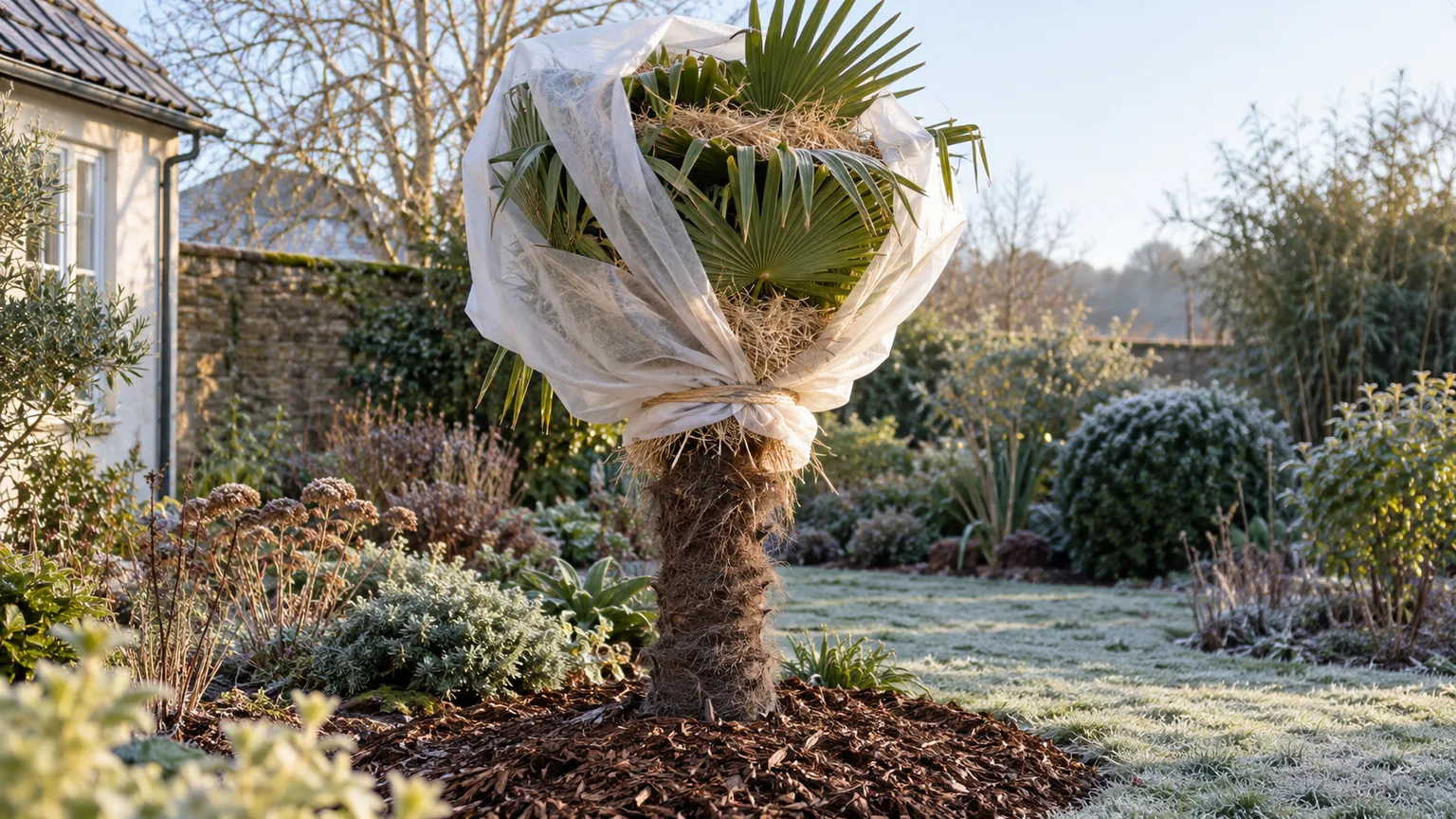
A windmill palm’s cold tolerance is not a guarantee against every winter. The risk rises with prolonged subfreezing weather, drying wind, waterlogged soil, and a young or recently transplanted palm. The RHS specifically recommends shelter from strong or cold winds and protection from hard winter frosts; Gardeners’ World also recommends breathable wrapping and mulch during extended cold. A container needs extra protection because its roots are less insulated than roots in the ground.
Prune conservatively; keep the growing point
Windmill palms do not need routine shaping. Remove a frond only when it is fully brown, broken, or diseased; a partly green frond still feeds the plant. Fronds that are ragged from wind may look untidy but can remain useful, and cutting them off will not make the next leaves more wind-resistant.
Never cut the central spear or the crown to control height. The growing point sits at the top, and serious injury there can kill the palm. Do not shave away the fibrous trunk to make it look smooth, either: those old leaf bases are normal. If the tree is too large for the site, ask a qualified arborist to assess it or replace it with a genuinely smaller species rather than topping a palm.
Use clean, sharp tools and avoid pruning overhead if you cannot reach safely from the ground. A tall palm can require professional access, and climbing or using a ladder around stiff fronds is an unnecessary risk. The RHS lists no routine pruning requirement; the practical job is occasional cleanup of fully dead leaves.
Propagate from seed—or a rare offset
Seed is the most practical way to raise new windmill palms, but it is a slow route to a landscape-sized tree. Plants are dioecious: a male and a female palm produce different flowers, and a female needs pollen from a male to set viable seed. If you have a single palm with no fruit, it may simply be a male, a female without nearby pollen, or an immature tree.
Use fresh, fully developed seed from a known palm rather than old, dried seed of uncertain age. Remove the fleshy outer layer, rinse the seed, and sow it shallowly in a clean, freely draining medium. Keep the medium evenly moist—not waterlogged—and warm; germination timing varies, so do not discard a pot after a few weeks. Once seedlings form, give them bright light and protect the roots from cold while they are small.
A seedling is not guaranteed to match a named cultivar, and it may take many years to create the trunked look people want. RHS also lists propagation from suckers, but offsets are not something to expect on every plant; if one appears, separate it only when it has its own roots and can be removed without cutting into the parent’s growing point. RHS and NC State Extension describe seed propagation, while NC State notes the need for male and female plants for seed production.
Understand flowers, fruit, and male and female plants
Mature windmill palms can send out long, drooping clusters of small yellowish flowers in summer. Because the species is dioecious, a tree bears male or female flowers, not both on the same plant. A female may produce dark blue to nearly black fruit after pollination; a male can flower without ever forming fruit.
That distinction matters if you want to grow seedlings or avoid fruit drop around a patio. One palm can still be an attractive specimen without a mate, and fruit set is not a reliable way to judge whether a young palm is healthy. If fruiting matters, ask the nursery whether the plant’s sex is known and whether a compatible flowering palm grows nearby; young stock is often sold without a confirmed sex.
Troubleshoot frond color and crown changes
A single brown or yellow frond does not identify one specific problem. Wind, winter exposure, drought, excess water, normal aging, and nutrition can create overlapping symptoms. Start by noting which leaves changed, how quickly the change spread, and what the soil has been doing; then inspect the crown and roots before changing the care routine.
Diagnose brown tips before changing irrigation
Brown leaf tips can follow a dry spell, wind exposure, salt, or root stress. Check moisture a few inches below the surface and examine the planting area after rain. If the root zone is bone dry, water slowly and deeply; if it is wet for days, improve drainage or reduce irrigation rather than adding more water.
Look at the pattern as well as the color. A few weather-damaged leaf edges on an otherwise stable palm call for monitoring, while rapid browning across several fronds deserves a closer check of the crown and roots. Do not fertilize a brown-tipped palm simply because the damage looks like a nutrient issue; first rule out drought, soggy soil, and cold injury.
Separate old lower fronds from whole-crown yellowing
The oldest leaves sit at the bottom of the crown and eventually turn yellow, then brown, as the palm replaces them. A slow change limited to one or two lower fronds is different from many leaves yellowing at once, yellowing that moves into new growth, or a palm whose overall vigor is declining. Remove an old frond only once it is fully brown.
If several fronds yellow, check whether the soil is dry, waterlogged, compacted, or salty before reaching for fertilizer. Palms can show nutrient problems, but yellowing alone cannot tell you which nutrient is missing. Take photographs, note the timing, and use a soil test or extension diagnosis rather than layering on a palm fertilizer “just in case.”
Treat a loose central spear as an urgent clue
The newest leaf emerges as the central spear. If it turns brown, collapses, or pulls free with almost no resistance, the crown may be damaged by cold or rot; this is more serious than old lower leaves browning. Do not tug repeatedly or pour a pesticide or fungicide into the crown without a diagnosis.
Cold damage can take weeks to show, so a palm may look acceptable during a freeze and decline as growth resumes. Keep the crown as dry as practical, photograph the symptoms, and contact a local extension office or qualified palm specialist. In Louisiana, the LSU AgCenter documented date palm lethal decline in Chinese windmill palms and warned that similar disorders can look alike; confirmation required diagnostic testing. LSU AgCenter
Manage pests and diseases with a diagnosis
Windmill palm is often trouble-free, but scale insects and palm aphids can occur, and roots in persistently wet soil are vulnerable to rot. Inspect both sides of the fronds and the bases of the leaves when growth looks weak. A few pests on one leaf are not the same as a spreading infestation, so identify the insect before choosing a treatment.
UF/IFAS also lists lethal yellowing, lethal bronzing, and leaf spots among possible problems. These are not interchangeable names for one condition, and a yellow frond by itself does not establish a disease diagnosis. The LSU report is a useful caution: date palm lethal decline was confirmed on windmill palms in Louisiana, but its symptoms overlap with other palm problems and positive identification required testing. UF/IFAS · LSU AgCenter
If the central spear dies, many lower leaves discolor quickly, or decline continues despite correcting an obvious water problem, contact your county extension office or a plant diagnostic laboratory. Do not inject antibiotics or remove a palm based only on a photograph or a general web description; local disease presence and confirmed diagnosis change what action is appropriate. For routine scale or aphids, start with identification and cultural stress reduction, then follow regional extension guidance for any treatment.
Conclusion
Windmill palm care comes down to matching this slow-growing palm to a site where its roots drain, its leaves have shelter, and its eventual crown has room. A hardiness rating can help narrow the choice, but freeze duration, wind, wet soil, and whether the palm is in the ground or a pot determine how much protection it needs.
Plant at the nursery depth, water according to soil moisture, and avoid pruning green fronds or the central spear. If the lower leaves age gradually, observe; if several fronds decline at once or the crown spear loosens, seek a diagnosis before applying fertilizer or disease treatments. That measured approach gives Trachycarpus fortunei the conditions to establish and keeps ordinary leaf wear from becoming a guessing game.