Black Spots on Phalaenopsis Orchid Leaves: Causes and Care
Black spots on Phalaenopsis leaves can be harmless scars or fast-moving rot. Compare texture, smell, position, and spread, then take the safest next step.
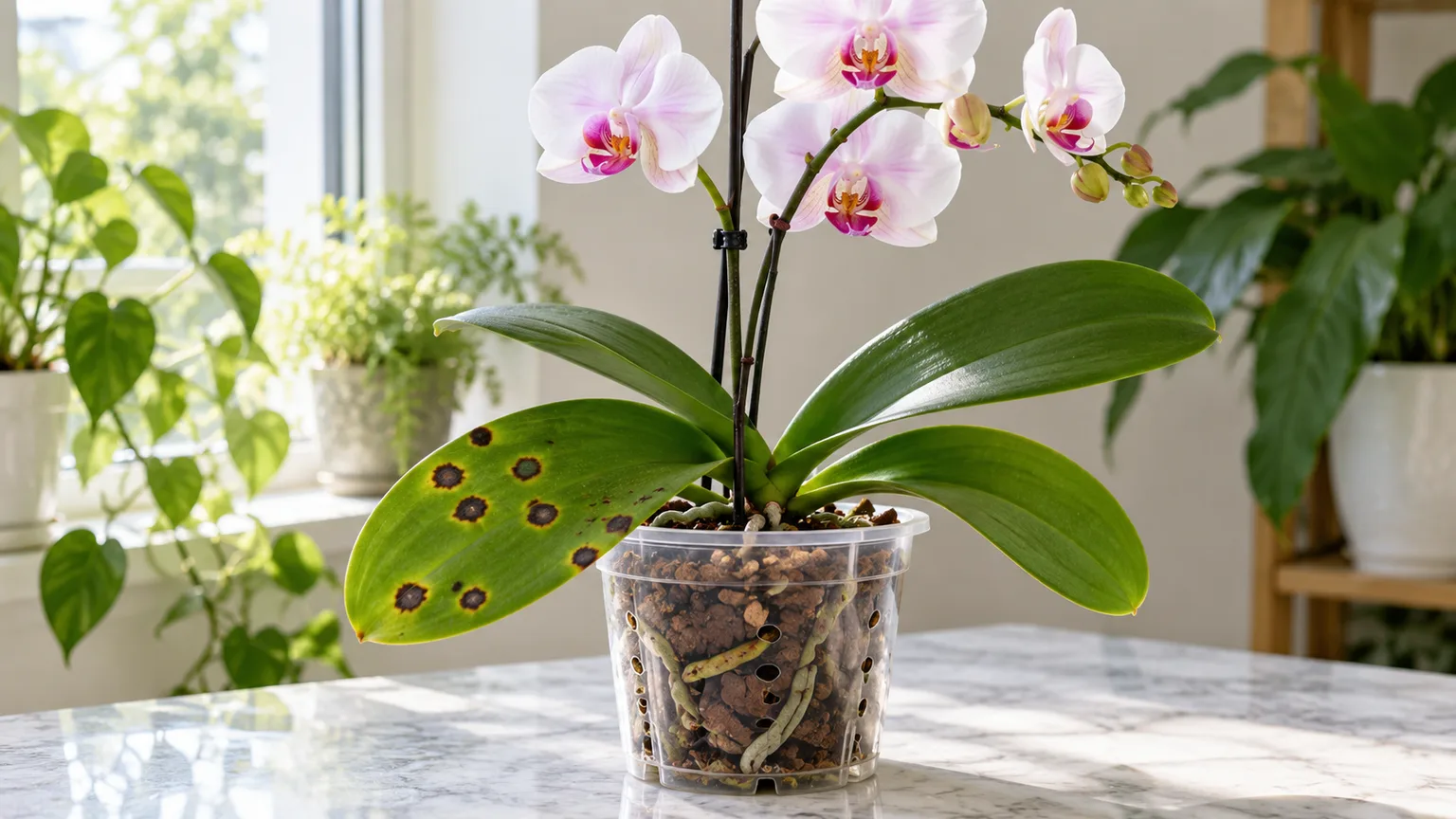
A black mark on a moth orchid leaf is a symptom, not a diagnosis. It may be a permanent bruise or sun-scorched patch, but a wet, soft lesion that enlarges can signal bacterial disease or black rot and deserves immediate attention.
Before you cut anything, move the plant away from your other orchids, keep water from running off its leaves or pot, and look at the spot in good light. Its texture, position, smell, and speed of change are more useful than color alone. Several orchid problems turn dark, and the wrong treatment can waste time or damage healthy tissue.
What to do first when you notice a dark spot
Treat an unexplained spot as potentially contagious until you know whether it is active. Set the orchid on a separate tray away from neighboring plants; do not let drainage water, a shared soaking bowl, or splashes from watering reach other pots. Wash your hands after handling it, and use a clean tool if you need to touch the affected area.
Do not mist the plant or wet the lesion while you investigate. Take a clear photo, note which leaf and side are affected, and check whether the spot is dry or damp without squeezing it. Compare again later the same day and the next morning. A small mark that stays dry and unchanged is less urgent than one that grows, turns translucent, softens, or reaches the leaf base.
If the tissue is rapidly collapsing, visibly wet, foul-smelling, or close to the crown, keep the plant isolated and move to the urgent steps below. If it is firm, dry, and stable, avoid emergency pruning until you have checked for sun, cold, or mechanical damage. Removing sound leaf tissue unnecessarily creates a wound and reduces the plant’s working leaf area.
What active disease usually looks and feels like
Infectious spots often begin as small, translucent or water-soaked marks, then change color as tissue dies. They may develop a yellow margin, become brown or black, and feel soft or sunken. Some diseases spread quickly; others remain isolated or progress over weeks. That progression matters more than whether the spot is perfectly round.
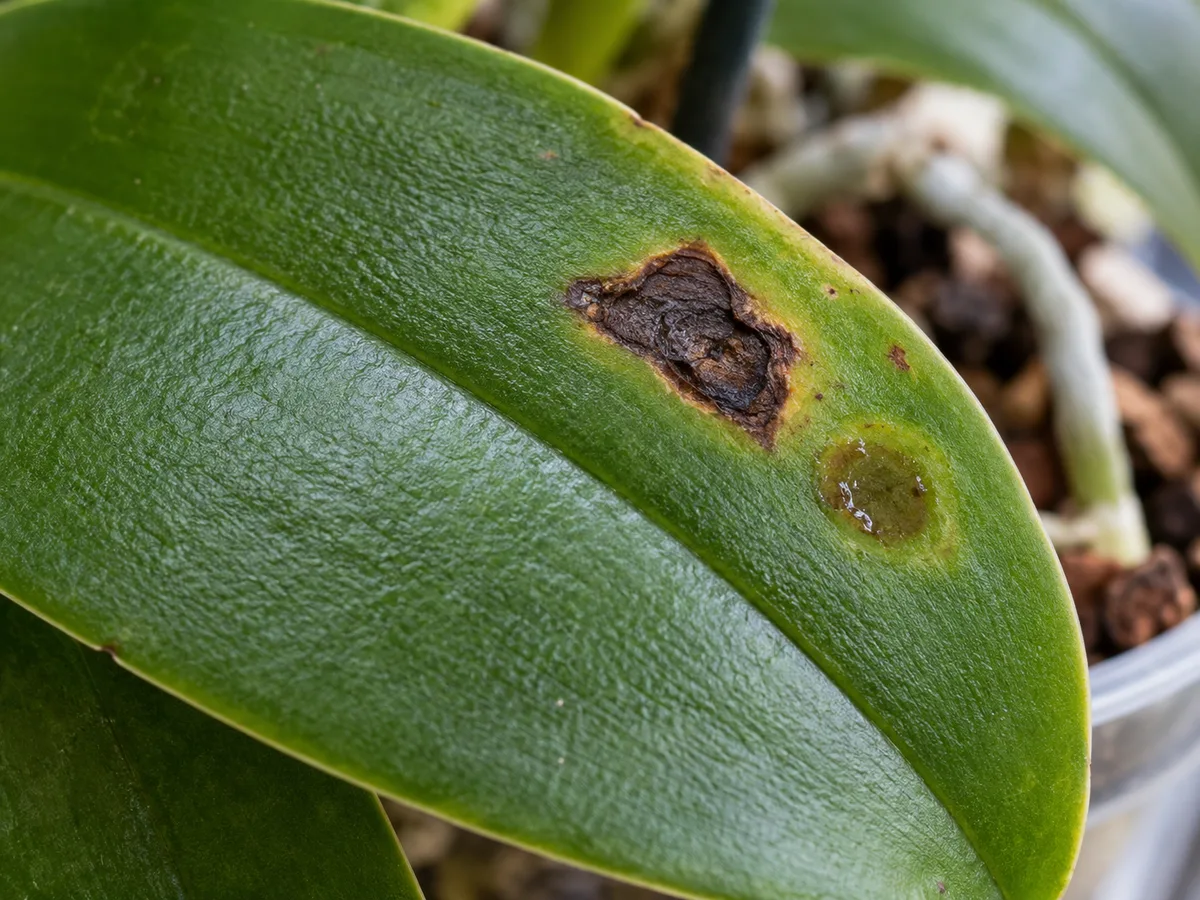
A dark spot that is soft or water-soaked and still expanding calls for isolation and closer inspection; a dry, unchanged mark may be old damage.
The American Orchid Society’s orchid disease guide describes bacterial lesions that start water-soaked and may turn brown or black, with some infections producing soft tissue and fluid. Its black rot reference describes dark lesions that can enlarge and threaten the crown. These patterns overlap, so a photograph or a color match cannot reliably identify the organism by itself.
Look beyond the center of the spot. A growing translucent edge, new marks on another leaf, or a lesion moving toward the stem raises concern. A dry, corky margin that has not changed for days points more toward old injury, although a damaged leaf can still be infected later. When in doubt, maintain isolation while you monitor rather than placing the orchid back in the collection after one reassuring glance.
Three infections that can darken orchid leaves
“Black spots” is a broad description. The disease name matters because bacteria, water molds, and leaf-spot fungi do not respond to the same products, and some infections can move much faster than others. The clues below help you choose the urgency of your next step; they are not a substitute for a lab diagnosis.
Bacterial brown spot
Bacterial brown spot can begin as a small, soft, water-soaked blister. In Phalaenopsis, the American Orchid Society describes spots that may start dirty green, enlarge, and become brown or black, sunken, and sometimes wet at the edge. Older references may call the bacterium Pseudomonas cattleyae; the society notes the current genus name is Acidovorax.
This pattern is more concerning when the lesion feels soft, grows outward, or releases fluid. Warm, humid conditions and water moving between plants can favor spread, so isolate the orchid and keep the leaf surface dry. A yellow halo can occur, but it is not proof of bacterial infection; several kinds of injury produce a pale border.
Bacterial soft rot
Soft rot is the fastest-moving warning sign in this group. The affected area becomes water-soaked and mushy rather than simply dark and dry, and badly infected tissue may have a distinctly foul odor. The American Orchid Society notes that Phalaenopsis can be severely affected within a few days, so do not wait a week to see whether a soft, wet patch near the crown settles down.
If the leaf or crown is collapsing, isolate the plant, stop overhead watering, and remove actively rotting tissue with a sterile blade if you can do so without cutting through the crown. Bag the removed material; do not compost it or rinse it into a sink used for other plants. If the growing center itself is soft or foul-smelling, the prognosis is poor, and a plant clinic or experienced orchid grower can help determine whether any healthy tissue remains.
Black rot
Orchid black rot is associated with Pythium and Phytophthora. It can appear as water-soaked spots that turn brown or black and expand across leaves, roots, or other plant tissue. In a Phalaenopsis, the crown is especially important: this monopodial orchid has a single main growing point, so rot that reaches and destroys it can kill the plant.
These pathogens are often called fungi in older orchid references, although they are oomycetes, or water molds. That distinction is useful when selecting a product: do not assume a generic fungicide controls every organism grouped under the word “rot.” Blooming Expert’s orchid disease overview also separates black rot, bacterial soft rot, and leaf spot, but its symptom comparisons should be treated as clues rather than a lab diagnosis.
The name “black rot” is sometimes used loosely for any black orchid lesion. Do not assume that every dark spot is this disease or that a fungicide will solve it. The American Orchid Society’s black rot guidance describes spread through contaminated water, splashes, unclean tools, and plant material; isolation, sanitation, and prompt removal of infected tissue are central to limiting risk.
Could the mark be something other than an infection?
Phalaenopsis leaves can show patterned color, and some plants have mottled or variegated foliage. NC State Extension lists Phalaenopsis schilleriana among orchids with variegated leaves. A repeating, orderly pattern that is part of the leaf rather than a new lesion is not the same as a spot that becomes wet, soft, or larger. If the plant is new to you, compare the unaffected leaves and cultivar information before treating natural markings as disease.
Sun scorch usually follows exposure: the leaf facing strong direct light may first look bleached or yellowed, then develop a dry tan or dark patch. Chilling injury can also follow a cold window, draft, or contact with a cold surface; affected tissue may look water-soaked at first, but the damage should stop spreading once the exposure is corrected. A bruise, crease, or torn edge tends to stay localized and dry.
Mineral residue is different again: it may sit on the leaf surface and sometimes wipe away with a damp, soft cloth. Fertilizer or chemical injury is more likely to affect leaf tips or areas contacted by the spray than to create a progressively enlarging, mushy lesion. If a spot wipes off completely, it was residue, not dead leaf tissue. If the green leaf underneath remains intact, there is no lesion to cut out.
Diagnose with four clues: texture, speed, position, and odor
Use several clues together instead of trying to identify a pathogen from a single symptom. A yellow rim or black center can appear in more than one disease, and different orchid species do not always show textbook symptoms. This quick comparison helps you decide how cautious to be while avoiding a false sense of certainty.
| Clue | More consistent with active rot or bacterial disease | More consistent with old or noninfectious damage |
|---|---|---|
| Texture | Wet, translucent, soft, or sunken | Dry, firm, corky, or flat |
| Change over time | Enlarges, darkens, or creates new spots | Stays the same after the original exposure ends |
| Position | Crown, leaf base, wound, or wet area; may spread | Faces the window, follows a crease, or matches a patterned leaf |
| Odor | Foul odor increases concern for bacterial soft rot | No odor is reassuring but does not rule out disease |
| Other signs | Yellow margin, fluid, collapsing tissue, nearby lesions | No new damage and normal firm tissue around the mark |
The table is a triage aid, not a diagnosis. The Royal Horticultural Society’s indoor orchid guidance and NC State Extension’s Phalaenopsis profile describe moth orchids as warm-growing plants that need drainage and should not sit in water. Those growing conditions can help you assess care, but they cannot tell you which microbe caused a particular lesion.
How to remove infected orchid tissue safely
Prune only when the lesion is active, extensive, or in a position where waiting could let it reach the crown. For a small spot well out on a leaf, a clean cut around the damaged area may preserve most of the leaf. If you cannot leave a safe margin of healthy tissue, or the lesion is near the leaf base, removing the entire leaf may be the cleaner choice.
Use a new disposable blade or a tool disinfected before the cut and again between cuts. Make a clean cut through the leaf tissue without sawing, crushing, or dragging the blade across the lesion. If you trim around a small lesion, include a modest margin of apparently healthy tissue because the visible edge may not exactly match the damaged area beneath it. Avoid cutting into the crown or stem while trying to save a leaf.
Put the removed tissue directly into a bag and discard it with household waste. Clean sap or debris from the tool and work surface; wash your hands before touching another plant. The cut edge needs air circulation and time to dry. Do not immediately seal it under a wet paste, spray it with several products, or water the crown to “rinse” the cut.
Should you cut off the entire leaf?
No—not for every spot. If a single lesion is small, dry, and well away from the leaf base, monitoring may be safer than sacrificing a mostly healthy leaf. A mark from sun scorch, a crease, or an old wound will not turn green again, but that alone does not mean the remaining leaf is a source of infection.
Remove the whole leaf when active rot occupies much of it, multiple lesions are merging, the leaf is collapsing, or a wet lesion is approaching the stem. Use a sterile blade and cut at the leaf base without injuring the crown. If the crown is already affected, do not keep cutting deeper in an attempt to reach a perfect-looking center; stop and reassess the plant’s viability.
After pruning, expect the cut leaf to remain visibly shortened or the scar to remain dark. Success means the lesion stops advancing and the crown, roots, and new growth stay firm—not that the old spot disappears. Keep the plant in quarantine until you have observed stable tissue and no new lesions.
Treat the cause without making the damage worse
Do not reach first for a “fungicide” just because the mark is black. A fungicide will not treat bacterial soft rot, and a general-purpose product may not be labeled for the orchid or the suspected pathogen. If you use a pesticide, follow the label exactly, including the listed plant/site, target disease, dilution, protective equipment, and re-entry instructions. When the diagnosis is uncertain, ask a local extension service or plant clinic before applying chemicals indoors.
Home remedies deserve the same skepticism. Cinnamon is mentioned in orchid care as a possible covering for a fresh cut, but it is not a reliable way to identify or cure a spreading lesion; applying powders or pastes over wet tissue can also obscure whether the problem is advancing. Hydrogen peroxide, household cleaners, oils, and leftover garden sprays can injure orchid leaves or roots. Keep treatment simple until the likely cause is clearer: isolate, keep foliage dry, remove actively diseased tissue with a clean tool, and improve airflow.
Repotting is not automatically useful for a leaf-only spot. It makes sense to inspect roots and replace medium if the bark is broken down, roots are mushy, standing water is trapped, or rot is at the stem base. Otherwise, disturbing healthy roots adds stress without removing a pathogen already inside the leaf. If repotting is needed, use a clean pot with drainage and fresh orchid bark rather than garden soil or a water-retentive decorative container.
Check the crown and roots for spread
The crown is the tight center where the Phalaenopsis leaves emerge. Look for new discoloration, soft tissue, a leaf that detaches unusually easily, or water trapped between leaves. A dry, firm crown is a useful sign that the main growing point remains intact, though it does not prove the leaf lesion is harmless.
Inspect visible roots through the pot or around its edge without pulling the plant out just to investigate one dry spot. Firm roots and bark that drains freely are reassuring. Mushy roots, a sour smell from the medium, or a crown lesion together with blackening leaves point to a more serious whole-plant problem and justify a careful root inspection or expert help.
Keep water out of the crown while the orchid recovers. If water collects there accidentally, gently wick it away with clean tissue rather than shaking or squeezing the leaf bases. Do not leave the pot standing in drainage water, and do not share runoff between plants.
Can a Phalaenopsis recover from black spots?
Often, yes—especially when the mark is limited to one leaf and the crown and roots remain firm. A dry old scar may simply remain as a blemish while the plant continues to grow. After an infectious lesion is removed, the leaf will not repair itself, so watch for stability and healthy new growth rather than a return to spotless foliage.
Recovery is less likely when rot reaches the crown, several leaves are collapsing, or soft foul-smelling tissue is moving through the plant. Phalaenopsis has one main growing point; if that center is destroyed, there may be no way for the original plant to resume normal growth. A healthy root system can sometimes support a remaining basal shoot, but do not count on this as a guaranteed rescue.
For the next few weeks, keep the orchid isolated and check the same leaves every day or two. Record whether the edge is stable, whether any new spots appear, and whether the newest leaf stays firm. Avoid changing watering, fertilizer, light, potting medium, and pesticide treatment all at once; if the plant improves, you will know which correction mattered and avoid adding unnecessary stress.
Protect the rest of your orchid collection
Set an affected plant far enough away that water cannot splash between leaves or pots. A separate room is ideal if you have space; otherwise use a different shelf and a dedicated tray. Water it last, pour drainage away from other plants, and avoid using the same soaking vessel unless it has been washed and disinfected between plants.
Clean pruners and work surfaces after handling a suspect plant. Do not use one blade to cut several orchids without disinfecting it between plants, and do not place a removed leaf on the potting bench. If you grow orchids outdoors during warm weather, raise pots above the ground and keep them clear of runoff from other containers; splash is one route for pathogens to move.
New plants deserve a short observation period before they join a collection. Keep them apart long enough to inspect leaf undersides, crowns, and roots during normal watering. If an orchid develops a fresh, expanding lesion during that period, maintain separation rather than assuming it arrived with a cosmetic scar.
Prevent new spots with drier leaves and cleaner tools
The practical prevention goal is not to make an orchid dry all the time; it is to avoid leaving water sitting on leaves or in the crown, especially overnight. Water the bark in the morning when possible, let the pot drain completely, and empty the outer cachepot. The American Orchid Society recommends avoiding overhead watering and misting as a way to limit bacterial disease spread, while the RHS gives general indoor orchid advice that includes misting. For a Phalaenopsis with a history of leaf spots, the lower-risk choice is to keep the crown and leaves dry and improve room humidity without spraying water onto the plant.
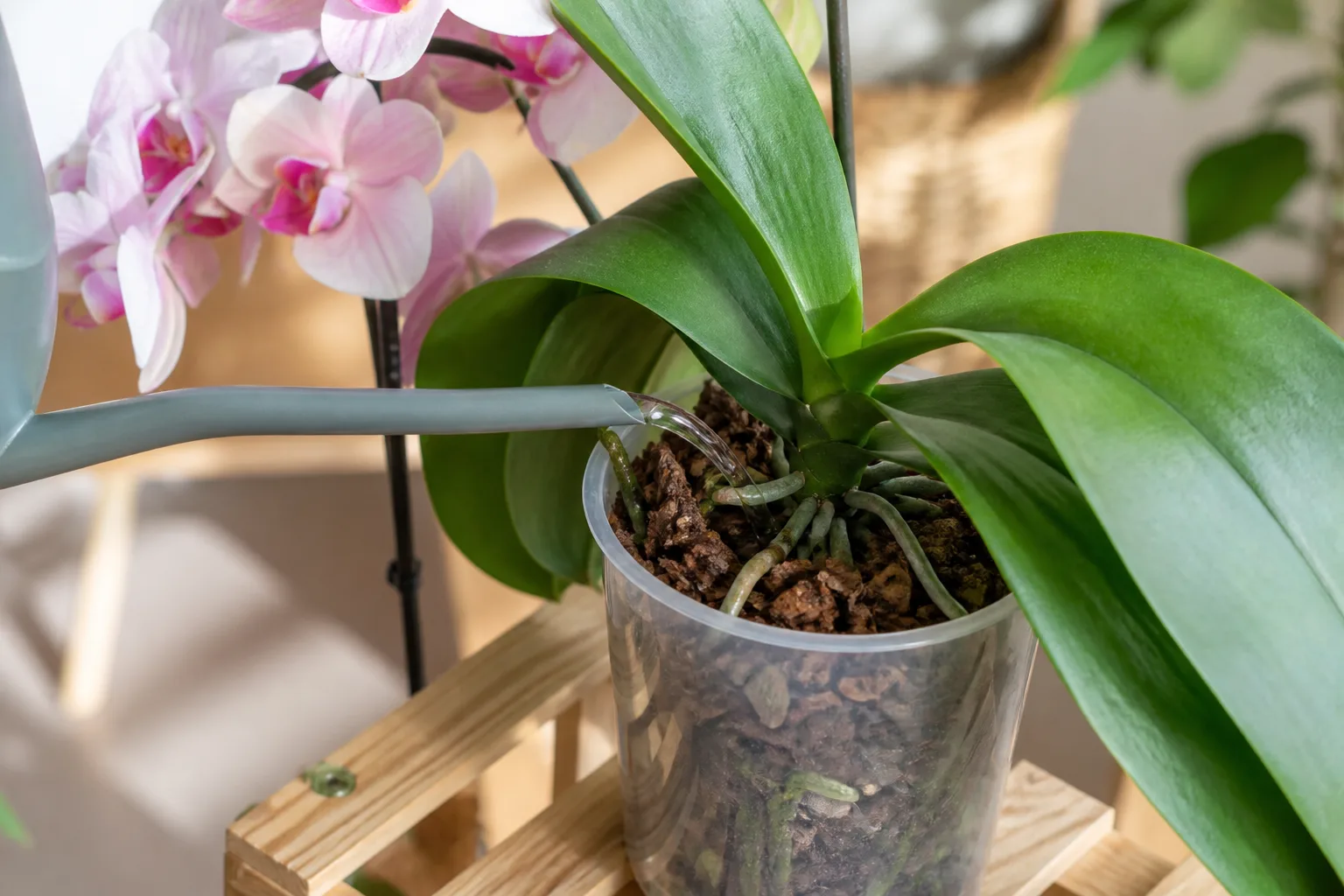
Water the growing medium rather than filling the leaf crown, then allow the pot to drain fully.
Air should move gently through the growing area so leaves dry after accidental splashes. That does not mean pointing a strong fan directly at the orchid; the aim is to prevent stagnant, wet pockets among crowded plants. Give leaves room to dry, remove dead plant debris, and avoid setting pots where condensation repeatedly drips onto them.
Keep a clean blade ready for routine pruning, and disinfect it before and after any cut through suspect tissue. Do not reuse old bark or a dirty pot when the roots have rotted. The NC State Extension Phalaenopsis profile describes a bark-based medium with drainage and notes that moth orchids should not stand in water; these basics reduce the persistently wet conditions associated with root and crown trouble.
For a broader reset of light, water, potting medium, and routine care after the lesion is stable, see our basic indoor orchid care guide.
When to ask a plant diagnostic clinic for help
Get expert help if spots keep appearing after isolation, the plant has several different symptoms, the crown is soft, or you need to protect a valuable orchid collection. A county extension office or university plant diagnostic lab can sometimes identify a pathogen from a sample, which is more dependable than matching a phone photo to a disease chart. Ask first about sampling instructions; labs may want a fresh leaf section sealed in a bag rather than a dry, old spot.
Seek help before using a pesticide when you do not know whether the problem is bacterial, fungal, or a water mold. These categories require different approaches, and product labels vary by location and approved use. If the lesion is rapidly spreading and the crown is collapsing, isolate immediately even while you arrange diagnosis.
Conclusion
The most useful first distinction is whether the spot is dry and stable or wet, soft, and advancing. A stable mark can be an old injury or natural pattern; a growing translucent lesion, foul odor, or darkening at the crown calls for isolation and prompt action.
Keep the orchid separate, document the lesion, avoid wetting the leaves, and prune only active damage with a clean blade. Then monitor the crown and new growth instead of treating every black mark with the same spray. When symptoms overlap or continue to spread, a plant diagnostic service can help identify the cause before you risk healthy leaves or neighboring orchids.