Aglaonema Red Siam Light Requirements: A Complete Care Guide
Aglaonema Red Siam Light Requirements: A Complete Care Guide
Aglaonema Red Siam Light Requirements: A Complete Care Guide
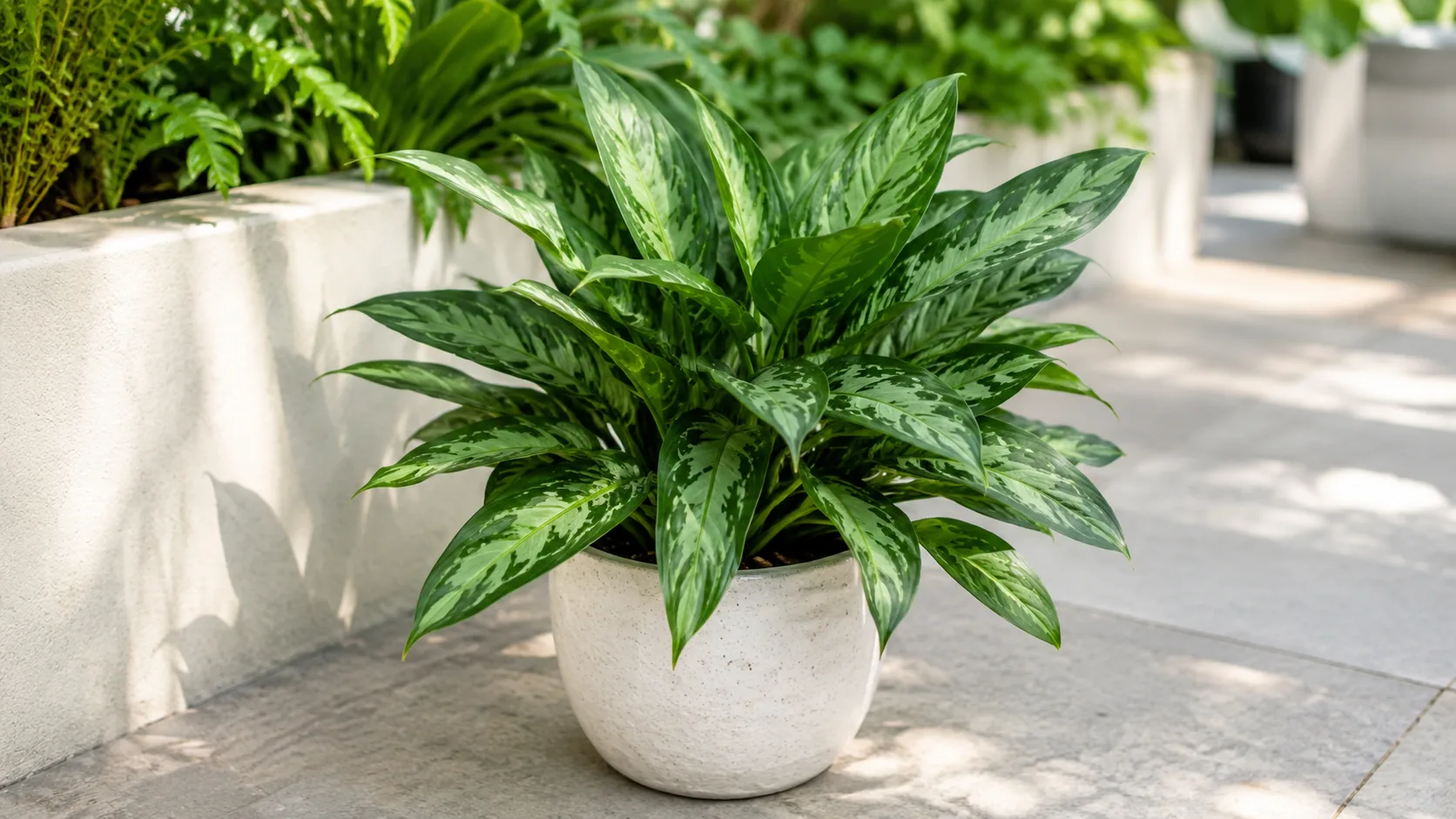
Aglaonema ‘Red Siam’ is sold as an easy Chinese evergreen, then loses its signature pink within a season when parked in a dim hallway. The genus is famously low-light tolerant, but Red Siam’s broad rosy-pink leaf centers carry far less chlorophyll than green cultivars like Aglaonema Maria. Your placement goal is bright, filtered indirect light — enough photons to drive anthocyanin in new leaves, never sustained direct sun on the foliage. NC State Extension describes Aglaonema as needing bright indirect light and intolerant of direct sunlight, which matches the rainforest-floor biology behind Red Siam’s pigment response.
What Makes Red Siam Different from Other Chinese Evergreens
The Cultivar’s Background and Anthocyanin Science
Aglaonema Red Siam is a tissue-cultured cultivar of Aglaonema commutatum, the species commonly called Chinese Evergreen. It emerged from Southeast Asian breeding programs, particularly in Thailand, that crossed silver- and green-leafed Aglaonema species with red-veined ancestors to push pink and red pigment onto the leaf blades. Costa Farms popularized it in North America alongside cultivars like ‘Siam Aurora’, ‘Pink Dalmatian’, and ‘Red Emerald’. The defining trait is broad, glossy leaves with deep green margins framing a generous center of rosy-pink, cherry-red, or hot-pink variegation.
That is what separates Red Siam from a green-leafed Aglaonema like ‘Silver Bay’ or ‘Maria’. A green cultivar can survive in a dim hallway for years because every cell is loaded with chlorophyll. Red Siam has large patches of leaf tissue that lack chlorophyll entirely. Those pink cells cannot photosynthesize efficiently, which means the plant has to push harder on the cells that can — and it has to be placed where the photons actually reach.
The red and pink in Red Siam is anthocyanin, a flavonoid pigment that absorbs green and blue light and reflects red wavelengths. Research on A. commutatum red-leaf cultivars shows light intensity strongly upregulates anthocyanin biosynthesis genes (PAL, DFR, ANS) while dark-grown leaves turn pale pink. The same MDPI Genes study found anthocyanin content under moderate intensity was 1.14 to 3.72 times higher than under the highest intensity — excess light can suppress pigment. The takeaway is a sweet spot: too dim and chlorophyll floods the pink cells; too bright and the pigment system breaks down.
Light Intensity in Numbers: Foot-Candles, Lux, and PPFD
Growers use three units for the same physical quantity. Foot-candles (fc) measure illuminance as perceived by the human eye. Lux is the metric equivalent (1 fc ≈ 10.76 lux). PPFD counts photosynthetically active photons in µmol·m⁻²·s⁻¹. For white LED and natural light, the rough conversion is PPFD ≈ 0.2 × fc, so 200 fc at the leaf ≈ 40 µmol·m⁻²·s⁻¹.
Clemson Extension classifies medium light as a minimum of 100 to 150 foot-candles, with 200 to 500 preferred for good growth, and notes the interior of a well-lighted home is often less than 100 foot-candles. Clemson HGIC’s Chinese evergreen factsheet places solid green cultivars in low light and variegated types in low to moderate indirect light — never direct sun on the foliage.
A practical framework for Red Siam:
- Compensation / survival floor: ~10 fc (~110 lux / ~2 µmol·m⁻²·s⁻¹). The University of Arkansas Extension Service places Aglaonema’s light compensation point — where photosynthesis just matches respiration — at about 10 fc. Below this, the plant stops growing and slowly draws down reserves.
- Clemson genus floor (medium/low-light tolerant): 100–150 fc (~1,100–1,600 lux / ~20–30 µmol·m⁻²·s⁻¹). This is the minimum band Clemson cites for medium-light foliage plants and the practical floor for keeping a Chinese evergreen in acceptable condition indoors. Red Siam may hold on here, but pink will dull on new growth.
- Healthy growth and strong pink: 150–300 fc (~1,600–3,200 lux / ~30–60 µmol·m⁻²·s⁻¹). This is the color target. Aglaonema should be grown in 75% to 90% shade (3,000 to 1,250 foot candles) in commercial production; red-leaf cultivars need the higher end of any indoor range to keep anthocyanin dominant in new leaves.
- Upper comfort: 300–500 fc (~3,200–5,400 lux / ~60–100 µmol·m⁻²·s⁻¹). Achievable in a well-lit east window or with supplemental LED for a well-acclimated plant.
- Stress threshold: 1,000+ fc sustained (~10,800 lux / ~200+ µmol·m⁻²·s⁻¹). Bleaching, leaf curl, and tip burn appear, especially on the sun-facing side.
Most homes deliver 50–300 fc a few feet back from a window. Right at south-facing glass on a sunny afternoon, readings can spike past 2,000 fc — burn territory for any Aglaonema. The relationship between brightness and pink is a curve, not a line.
How Light Affects Pink Coloration in Red Siam
The Chlorophyll Compensation Trap
The pink sections of a Red Siam leaf have very little chlorophyll. In low light, the plant is not getting enough energy from the few green cells it has, so it starts producing more chlorophyll in every cell it can — including the pink ones. Slowly, leaf by leaf, the pink zones turn green as chloroplasts flood back into areas that were once anthocyanin-dominated. This is not a disease; it is a survival response. The plant is choosing calories over color.
Reverse the conditions, and the same process runs backward. New leaves that emerge after a move to brighter light will produce more anthocyanin and less chlorophyll, pushing the pink back. Most growers misjudge Red Siam’s color response because they look at the wrong leaves. Wait for the next flush of new growth. The real color shift usually shows up on the third or fourth new leaf, once the plant has fully committed to the new light environment. Use new growth as your instrument panel.
Can Faded Pink Come Back?
No, not on the same leaf. Once a leaf has lost its anthocyanin dominance and gone green, that leaf will never revert. The plant will usually keep pushing new leaves from the central crown, and each new leaf is a fresh chance to express the cultivar’s true color. Some growers prune back heavily after a long low-light stretch to force a clean flush — optional, not required for plant health.
Best Window Direction and Placement
East- and North-Facing Windows (Best)
An east-facing window delivers the gentlest direct light of the day, with peak morning intensities in the 200–600 fc range. For Red Siam, this is the sweet spot: enough photon energy to drive anthocyanin production without the heat load that scorches leaf tissue. Place the plant within 2–4 feet of an east window, or on the sill behind a sheer curtain during summer. Morning sun matches the tropical understory rhythm — usable light in the first half of the day before afternoon heat builds.
A north-facing window (Northern Hemisphere) delivers roughly 50–150 fc year-round. That sits at the Clemson’s 100–150 foot-candle genus floor — enough to keep the plant alive but on the low edge for pink color, especially in winter above 40°N latitude. If your brightest natural light is north, add a full-spectrum LED on a timer for 4–6 hours during the darkest months.
South- and West-Facing Windows, Glass, and Sheer Curtains
A south-facing window in summer delivers 800–3,000+ fc at the glass. Even with a sheer curtain reducing intensity by 65–75%, the plant can land in a useful range; without filtering, it burns. West-facing afternoon sun combines intensity with heat — leaf surface temperatures can climb 8–12°F above ambient. South in summer: 3–5 feet back, or behind a sheer curtain cutting at least 60% of direct rays. South in winter: 2–3 feet back. West: 4–6 feet back, or thermal blind plus sheer layer. The Royal Horticultural Society warns that low-light tolerant houseplants are often the first to scorch from sudden direct exposure.
Window glass raises leaf-surface temperatures 3–5°F above room readings on sunny days — why the same plant burns on a sill but thrives 3 feet back. Reassess placement at the solstices; a March-perfect spot can be a July burn zone as sun angle climbs.
Sunburn Signs and Treatment
Stages, Symptoms, and Sun Stress vs. underwatering on Aglaonema Red Siam
Sun damage on Red Siam follows a recognizable progression:
- Stage 1 — Subtle bleaching: Pink sections turn pale; cherry-red loses saturation.
- Stage 2 — Leaf curl and cupping: Margins curl to reduce exposed surface — stress, not thirst.
- Stage 3 — Tan or white papery patches: Dead tissue on tips, edges, or window-facing sections.
- Stage 4 — Brown, crispy margins and holes: Brittle burned areas; fungal entry risk.
- Stage 5 — Premature leaf drop: Plant sheds the worst leaves to protect the canopy.
| Clue | Sun stress | Underwatering |
|---|---|---|
| Location of damage | Tips, edges, sun-facing patches | Margins inward, often symmetric |
| Texture | Papery, bleached, crispy | Dry, brittle, sometimes leathery |
| Leaf posture | Cupped upward | Drooping, soft, limp |
| Soil | May be wet or dry | Dry, pulling from pot edge |
| Timing | Hours to days after sun event | Builds over a week |
If both are present, fix the sun first.
How to Treat a Sunburned Red Siam
- Relocate immediately to bright, indirect light only.
- Hold off on fertilizer for 4–6 weeks.
- Maintain even soil moisture — transpiration is lower; reduce watering ~20%.
- Trim only the most damaged tissue — keep leaves under 50% scorched if they still photosynthesize.
- Boost humidity to 55–65% if possible.
- Wait for new growth before further changes.
Grow Lights: Spectrum, Intensity, Distance, and Schedule
Choosing the Right Spectrum, Hanging Height, and Photoperiod
Red Siam responds best to full-spectrum white LEDs at 3,000K–4,000K with CRI above 90. Clemson HGIC notes variegated Aglaonema types need low to moderate indirect light, while peer-reviewed work on A. commutatum anthocyanin genes links light intensity to PAL, DFR, and ANS expression in red-leaf cultivars. Balanced white LEDs supply the blue and red wavelengths that drive pigment synthesis; cool-white fluorescents (5,000K+) lack red wavelengths and produce leggy, pale growth on variegated cultivars.
For 20–40 watt panels, hang 12–18 inches above the canopy — roughly 200–300 fc at 12 inches, 100–200 fc at 18 inches. A 9–15W A19 bulb needs 18–24 inches. Run 10–12 hours daily on a timer; Aglaonema does not need a 16–18 hour photoperiod.
Practical Setup and Best Grow Light Picks
A practical setup: one 20–30W full-spectrum panel 12–18 inches above the plant on a 10–12 hour timer, hygrometer nearby, and a smartphone lux meter for spot checks. Budget options include Sansi 12W (4,000K) at ~200–250 fc from 18 inches, GE GrowLED A19 9W for north-window winter supplement, Soltech Aspect (20W/40W) for visible living spaces, and Mars Hydro TS 600 for mixed tropical shelves. Replace bulbs annually — LED output degrades ~25% per year.
Acclimating Red Siam to Brighter Light
Acclimation Schedule and Risks of Sudden Light Increases
Shade-adapted plants build photosynthetic machinery for low light. Sudden bright exposure overwhelms protective systems, damaging Photosystem II and producing the bleaching you see in early sunburn. Over 10–14 days the plant upregulates protective pigments and thicker cuticles.
Day 1–3: New spot for 2–3 hours of morning light, then return to original location. Day 4–6: Extend to 5–6 hours in the gentler morning window. Day 7–10: Full day in the new location; check daily for bleaching or curl. Day 11–14: Full-time residence if leaves stay clean. Downward light transitions are far more forgiving — just water less as transpiration drops.
Common Light Mistakes and How to Avoid Them
- South-facing sill in summer — pull back 3–5 feet or move to east for July and August.
- Cool-white-only bulbs — switch to full-spectrum 3,000K–4,000K.
- Judging color after one new leaf — wait for the third leaf after a move.
- Treating Red Siam like green ‘Silver Bay’ — pink cultivars need the brighter end of the genus range.
- Skipping rotation — quarter turn every 2–3 weeks prevents lopsided green reversion.
- Ignoring seasonal shift — reassess at each solstice.
- 24/7 grow lights — 10–12 hours beats 18 hours of dim light.
- Expecting faded leaves to re-pigment — only new growth tells you if placement is right.
Conclusion
Red Siam’s light needs sit in a well-defined band: bright, indirect, 150–300 foot-candles at the leaf surface for strong pink, built on the Clemson’s 100–150 foot-candle minimum for medium/low-light tolerant foliage plants. Achieve that through an east-facing window, a filtered south window, or a full-spectrum LED on a 10–12 hour timer. Below the Clemson floor, the plant survives but pink dulls as chlorophyll floods variegated cells. Above 1,000 foot-candles of sustained direct exposure, leaves bleach, curl, and burn, and the pigment system starts to break down.
Judge success by new growth, not old faded leaves. Rotate the plant, adjust with the seasons, and treat Red Siam as a medium-light cultivar — not a dim-hallway survivor like Maria.
When to use this page vs other Aglaonema Red Siam guides
- Aglaonema Red Siam overview — Start here for whole-plant context before deep-diving this topic.
- Aglaonema Red Siam problems hub — Jump to symptom-specific fix guides when this care topic does not resolve the issue.
- Not Enough Light on Aglaonema Red Siam — Escalate here when light adjustments are not enough.
- Leggy Growth on Aglaonema Red Siam — Escalate here when stretch persists after brighter placement.