Brown Tips on Aglaonema Red Siam: Pink-Tissue Checks
Quick answer
Brown tips on Aglaonema Red Siam usually mean dry, papery margins—often on rose-pink tissue—from fluoride in tap water, low winter humidity, or direct sun on pale variegation. First step: switch the next watering to filtered or 24-hour rested tap water and hold fertilizer until new growth opens clean.
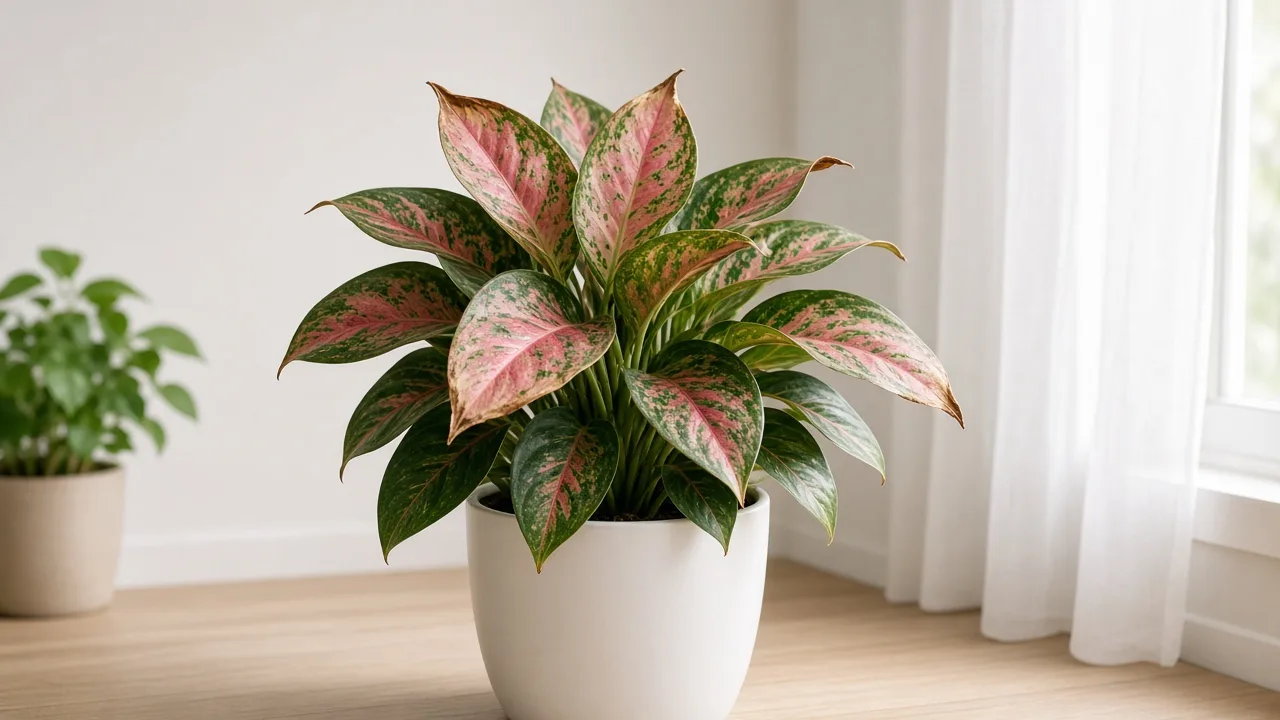
Brown Tips on Aglaonema Red Siam: Causes, Checks & Fixes
This guide covers brown tips on Aglaonema Red Siam. See also the general Brown Tips guide, watering, and light pages for this plant.
Brown Tips on Aglaonema Red Siam: Causes, Checks & Fixes
Quick answer
Brown tips on Aglaonema ‘Red Siam’ almost always mean dry, papery margins at the leaf apex—often starting on pale rose-pink or cherry-red zones where the tissue has less chlorophyll—not a sudden whole-leaf collapse. Red Siam is a tissue-cultured Thai hybrid with broad glossy leaves splashed pink and green; those pale zones lose water and accumulate fluoride faster than the dark green base.
For how dry margins and salt stress develop on houseplants in general, see our brown tips hub. On Red Siam, read water quality, winter humidity, and direct sun on pink tissue before assuming underwatering.
First step: switch the next watering to filtered, rain, or tap water rested 24 hours—and hold fertilizer until the next pink flush opens with clean tips. That single change isolates fluoride and salt tip burn, the most common trigger on Aglaonemas, before you stack repotting, misting, and light moves.
When to use this page vs other Red Siam guides
This page is the symptom-first entry for crispy leaf tips on a pink Chinese evergreen.
| Pattern | Read next |
|---|---|
| Dry crispy tips on pale pink zones; firm petioles; mix not soggy | Stay here—fluoride, humidity, or salt |
| Tan bleached patches across whole leaf faces after south-window sun | Not enough light placement correction (too much direct sun on variegation) |
| Crisp tips plus light dry pot and curled margins | Underwatering |
| Mushy tips, sour mix, soft crown on wet peat | Overwatering or root rot |
| Tips plus uniform lower yellowing on heavy pot | Wet-root stress—overwatering before feed |
| Winter-only tip crisp with tight central heating | Low humidity |
| Whole blades turning brown, not just margins | Brown leaves |
| Long-term water rhythm after tips stabilize | Watering guide |
| Filtered placement for pink color without scorch | Light guide |
What brown tips look like on Aglaonema Red Siam
Healthy Red Siam holds broad glossy leaves with rose-pink, cherry-red, and green variegation on short upright petioles. Brown tips change that pattern in predictable ways.
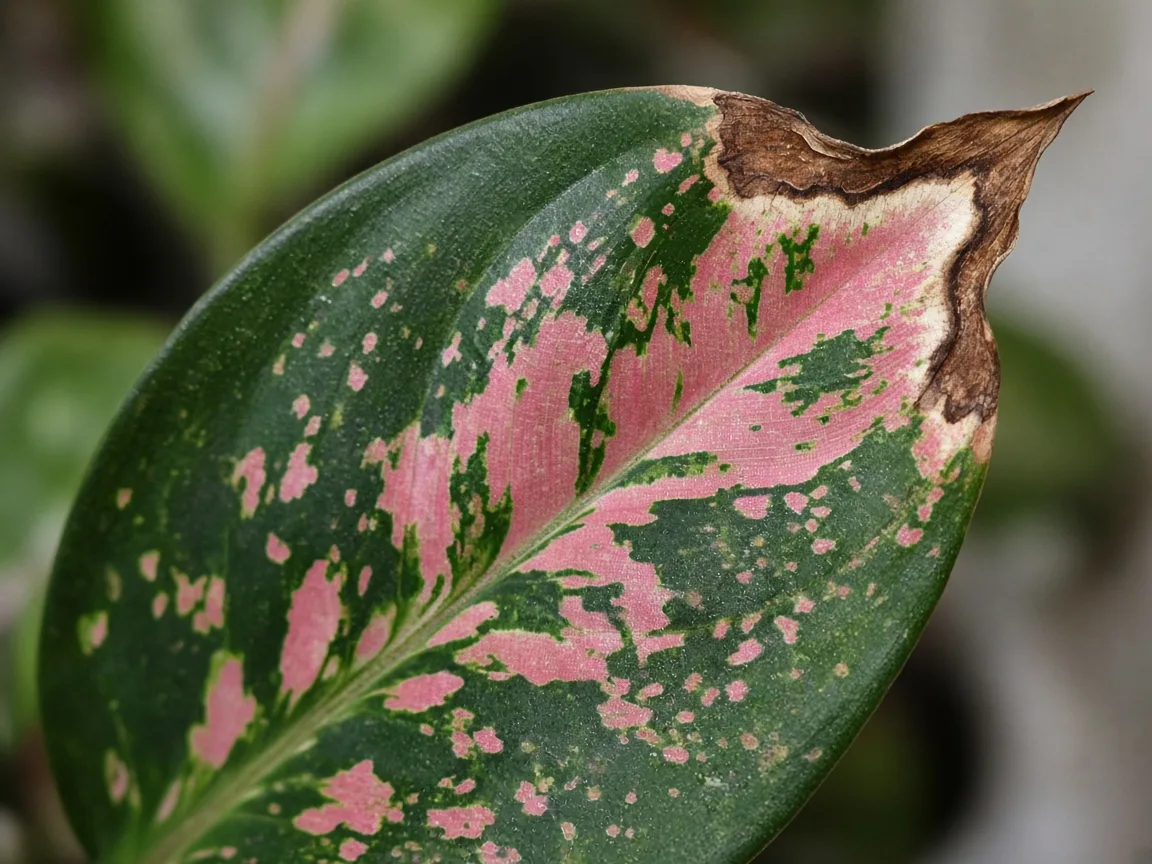
Dry papery brown tip on pale pink tissue—compare with the green-pink base still firm on the same blade.
Typical tip-burn signs:
- Dry, papery brown at the apex—sometimes with a narrow pale band between brown and healthy tissue
- Browning starts on pale pink or cherry-red zones before the dark green base
- Rest of the blade stays firm—not limp or translucent
- Oldest leaves show tips first when fluoride or salt has built up over months
- New pink flush still opens while older blades carry cosmetic margins—low urgency if spread stops
Not simple brown tips:
- Tan bleached patches across the whole leaf face after direct sun—sun scorch on variegated tissue, not classic tip burn
- Yellow lower leaves with wet heavy pot—overwatering or yellow leaves
- Mushy brown tips on saturated mix—root-zone failure, not dry margin stress
- Fine stippling with webbing at petiole bases—spider mites
- Sticky residue on young pink blades—aphids, mealybugs, or scale
Because Red Siam grows slowly in an upright clump, a few crisp tips on lower leaves while new pink growth stays clean is often past water quality or winter dryness—not a dying plant.
Cherry-red margin scorch vs fluoride tip burn
This split would be nonsense on a snake plant or a fern—Red Siam’s anthocyanin pink zones tell you which environmental stress you are fighting:
| What you see | Likely cause | First action |
|---|---|---|
| Dry crispy tip only, pale band optional, firm leaf | Fluoride or salt in tap water / fertilizer | Filtered or rested water; hold feed |
| Tan patch on pink zone mid-leaf after moving to direct sun | Sun scorch on chlorophyll-poor tissue | Sheer curtain or step back from glass |
| Tips on many leaves at once in heated dry winter | Low humidity margin desiccation | Humidifier or pebble tray; not more water |
| Tips plus white crust on soil surface | Salt buildup from heavy feeding | Flush soil; skip fertilizer 8–12 weeks |
| One or two oldest tips only; clean new pink flush | Past stress or normal aging | Trim dead tips; fix water going forward |
Fluoride damage creeps inward from the apex over weeks. Sun scorch appears as flat bleached tan on the pink face within days of a bad window move.
Reading crisp tips on the newest pink flush
On Red Siam, where browning lands on the crown matters more than counting total damaged leaves:
- Tips on the brand-new unfurling pink blade — Active fluoride, salt, or humidity stress; fix water source and hold fertilizer immediately.
- Tips only on lowest outer leaves; firm crown; clean newest flush — Often resolved by switching to filtered water; trim old tips for appearance.
- Tips plus washed-out plain green new growth — Pair water quality checks with light—variegated pink tissue needs brighter filtered light than green ‘Maria’ or ‘Silver Bay’.
- Tips plus limp petioles on wet mix — Not a tip-burn diagnosis; see overwatering before changing water type.
Always judge urgency by the youngest leaf, not the largest older blade at the soil line.
Brighter-light dry-down on variegated pink tissue
Red Siam is not a deep-shade office Aglaonema. The rose-pink zones lack chlorophyll, so this cultivar needs bright filtered indirect light (roughly 150–300 fc) to hold color and use water at a steady rate. Owners who keep it in dim corners often overwater while tips still crisp from fluoride—two problems stacked.
Variegated Aglaonema cultivars need higher light than solid green types, yet direct sunlight scorches foliage. Pale pink tissue near a south window can tan in an afternoon while green bases look fine—mistaken for underwatering. Match watering to how fast the top 2–3 cm of peat-perlite mix dries in this room’s light, not a calendar.
Why Aglaonema Red Siam gets brown tips
Fluoride and chlorine in tap water. Aglaonemas are fluoride-sensitive; fluoride travels with transpiration and accumulates at leaf tips where water exits. Municipal tap water applied for months produces slow crispy margins—often first on pale pink tissue. Resting water overnight reduces chlorine but not fluoride; filtered or rain water is the reliable fix.
Low humidity in heated winter rooms. Chinese evergreen tolerates low humidity but prefers moderate levels. When indoor air drops below 30–35% beside a radiator, margin tissue can desiccate even when mix moisture is adequate—especially on exposed pink zones.
Fertilizer salt and leaf-edge burn. Excessive fertilizer can cause leaf edge burn that mimics fluoride damage. Heavy spring feeding on stressed roots, or granules on the soil surface, draws moisture from margins. Cross-check the fertilizer guide only after water quality is corrected.
Direct sun on pale variegation. Red Siam needs brighter light than green cultivars—but direct beams on pink tissue bleach and tan the surface. This is scorch, not fluoride tip burn, and moving the pot fixes it faster than more water.
Underwatering extremes. Chronic drought can crisp tips after repeated dry cycles—usually with curled, thin-feeling leaves and very light pot weight. See underwatering when the whole blade feels papery, not just the apex.
Normal aging. One or two oldest lower leaves may show tan tips as the clump sheds outer tissue while the crown pushes pink flush—cosmetic if new growth stays clean.
How to confirm the cause
- Review water source — Has the plant received straight tap water for months? Any white crust on the soil rim?
- Read the newest pink flush — Tips on brand-new leaves mean active stress; tips on lowers only suggest past or cosmetic damage.
- Check window placement — Did browning start within a week of moving to direct south or west sun on pale zones?
- Probe the top 2–3 cm of mix — Allow the top 1–2 inches to dry before watering again. Wet heavy pot with crisp tips points away from drought.
- Note season and humidity — Winter heating without humidity often matches symmetric tip crisp on many leaves.
- Review last fertilizer — Recent heavy feed plus crusty soil surface suggests salt, not fluoride alone.
- Inspect petiole bases — Webbing or stippling means pests, not environmental tips.
First fix for Aglaonema Red Siam
Switch the next watering to filtered, rain, or tap water rested 24 hours—and skip the next fertilizer dose.
Use room-temperature water, soak until a little drains from the bottom, and empty cachepots within 30 minutes. That single correction tests fluoride and salt tip burn—the dominant cause on Aglaonemas—without repotting, misting, or moving the plant on the same day.
If you already use filtered water and tips appeared after a window move, pull the pot back from direct sun instead—that is your one change for scorch.
Step-by-step recovery
If margins keep crisping after two weeks on better water:
- Raise humidity modestly — Target 40–60% with a humidifier or pebble tray; avoid soaking foliage nightly, which can invite fungal spots on broad Aglaonema leaves.
- Flush salt-heavy soil — Run lukewarm water through the pot until drain runs clear; let the top 2–3 cm dry fully before the next drink. Hold all fertilizer 8–12 weeks.
- Adjust light without scorch — Move toward bright filtered light per the light guide if pink is fading, but keep pale tissue off direct glass.
- Trim dead tips only — Cut just the dry brown tissue with clean shears for appearance; leave partly green blades in place.
- Repot in spring if mix is exhausted — Chronic tip burn on old peat plus sour smell may need fresh well-draining mix at repotting—not an emergency unless roots are mushy.
Recovery timeline
- Week 1–2: No new browning on the youngest pink flush after water change
- Weeks 3–6: New leaves open with clean margins; old crisp tips remain cosmetic until trimmed
- Ongoing: Occasional lower-leaf tip on months-old blades may still appear until fluoride clears from soil—expect gradual improvement, not overnight reversal
Worsening signs: tips on every new leaf within two weeks, mushy margins on wet mix, or crown softening. Switch to root rot diagnosis.
Lookalike symptoms
| Symptom | Often confused with brown tips | Confirm by |
|---|---|---|
| Tan bleached patch on pink face | Tip burn | Appeared after direct sun; tip may still be green |
| Yellow whole lower leaf | Tip burn | Blade yellows from base up; see yellow leaves |
| Brown mushy apex on wet pot | Dry tip burn | Mix smells sour; stem soft at soil line |
| Crisp tip + webbing at base | Humidity | Stippling under leaf; see spider mites |
| Margins crisp + pot very light | Overwatering | Soil pulls from pot edge; see underwatering |
What not to do
- Pour more fertilizer on a tip-burning plant—leaf edge burn from excess feed worsens margins
- Mist heavily twice daily—wet broad leaves in dim corners invite leaf spot; raise ambient humidity instead
- Repot, prune half the plant, and change water on the same day—you will not know which fix worked
- Move directly into hot south-window sun to “help pink color”—pale zones scorch first
- Assume underwatering and soak a heavy damp pot—root rot follows chronic wet mix in low light
How to prevent brown tips next time
- Use filtered or rested tap water as the default for Red Siam—not straight municipal water for years on end
- Water when the top 2–3 cm of mix dries; keep soil moist but not saturated with a real dry-down between drinks
- Place in bright filtered light without direct beams on pink tissue
- Maintain 40–60% humidity in winter heating season
- Feed lightly during active growth per the fertilizer guide; flush soil in early spring if you fed heavily last year
- Scout weekly—spider mites and mealybugs stress margins on young pink growth
When to worry
Low urgency: a few crisp tips on older leaves while new pink flush opens clean after switching water.
Escalate same-day when:
- Every new leaf shows tips within two weeks despite filtered water
- Margins turn mushy on wet, sour-smelling mix
- Crown softens at the soil line or several leaves collapse together
- Tip browning spreads with yellowing lowers and heavy pot—wet-root failure, not dry margins
Use the Plant Problem Diagnosis Tool to narrow causes before changing multiple variables at once.
Related Aglaonema Red Siam guides
- Overview — placement, pink color stability, and healthy crown flush
- Watering — top-layer dry-down after tips stabilize
- Light — filtered brightness without scorching pale tissue
- Low humidity — winter margin desiccation
- Underwatering — when the whole blade crisps, not just the apex
- Problems hub — full symptom index for this cultivar
Conclusion
Brown tips on Aglaonema Red Siam are a margin and water-quality signal on pink-variegated Chinese evergreen tissue—not a reason to repot, feed, and mist on the same afternoon. Switch to filtered or rested water first, read whether damage hits the newest pink flush or only older blades, and split fluoride tip burn from sun scorch on pale zones, winter dryness, and salt-heavy feeding. Crispy tips already on the leaf will not re-green; clean margins on the next unfurling pink blade are the recovery marker you want.
Related tool
Use the Plant Problem Diagnosis Tool to narrow causes for brown tips on this plant before changing multiple variables at once.