Alocasia Melo Watering: How Often, How Much, and How to Fix
Alocasia Melo Watering: How Often, How Much, and How to Fix Mistakes
Alocasia Melo Watering: How Often, How Much, and How to Fix Mistakes
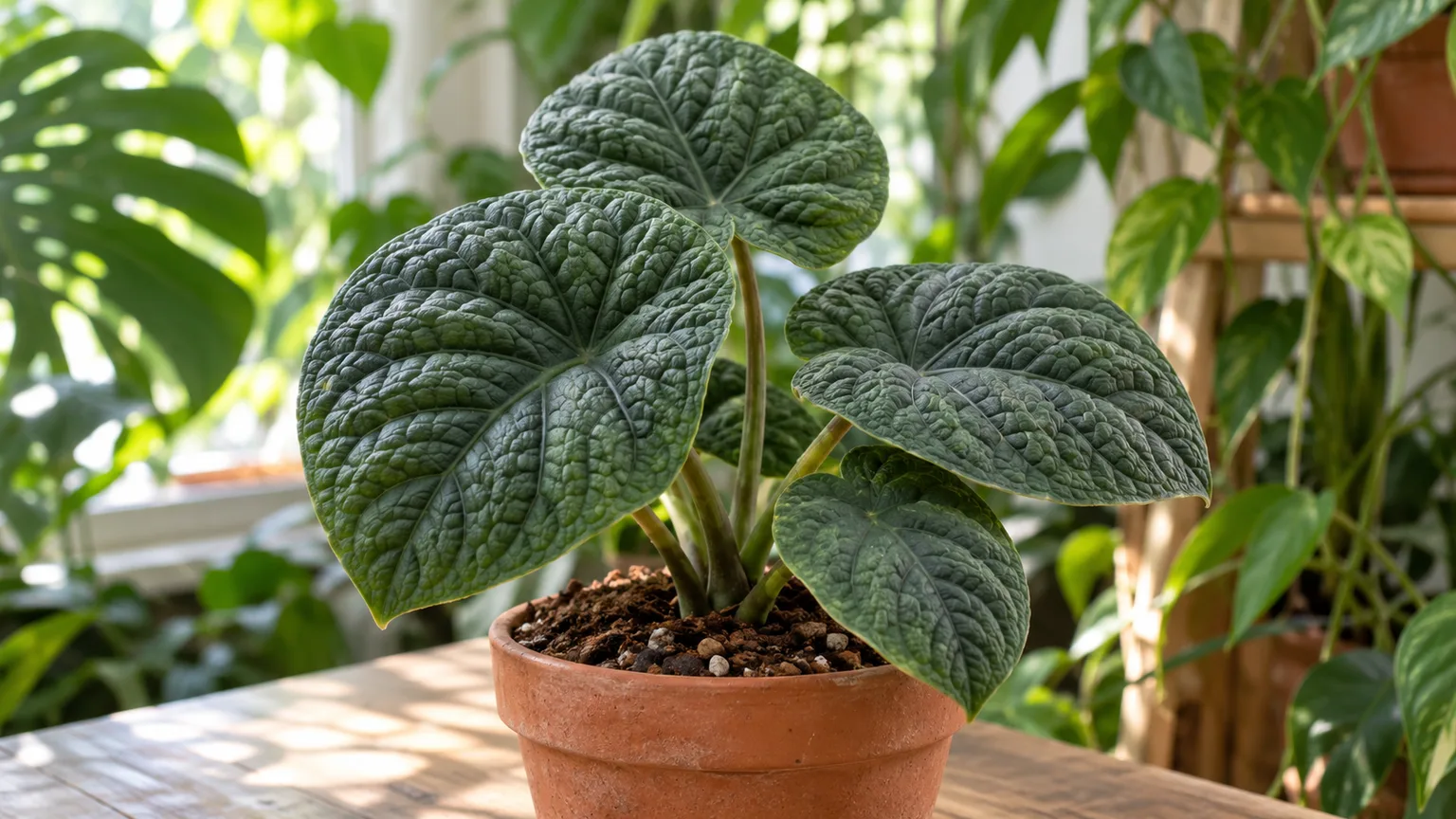
Alocasia Melo watering is less about a fixed calendar and more about reading a corm that evolved on Borneo’s fast-draining forest floor. Alocasia melo — also sold as Alocasia rugosa or Jewel Alocasia Melo — stores energy in an underground corm and pushes thick, bullate leaves slowly. Water when the top 2–3 cm of mix feel dry, soak until runoff exits the drainage holes, then let the root zone breathe again before the next drink. Get that rhythm right and new spears unfurl with metallic veins. Miss it and you get yellow leaves, mushy petioles, and root rot on Alocasia Melo while the soil still feels damp.
This guide covers how often to water Alocasia Melo, the moisture checks that beat any app reminder, water quality, bottom versus top watering, seasonal and dormancy cuts, over- and underwatering on Alocasia Melo diagnosis, and recovery when the corm has stayed too wet. For whole-plant context, start at the Alocasia Melo overview. Light and watering move together on this species — see the light guide when dry-down speed changes after a move.
Why Watering Alocasia Melo Is Harder Than It Looks
Generic advice — “water when the top inch is dry” — is directionally correct but too coarse for a slow jewel alocasia whose corm rots in days if the mix stays anaerobic. Melo is not a heartleaf philodendron: philodendron roots rebuild quickly after a dry spell; Melo’s corm and thick feeder roots punish both chronic saturation and repeated drought stress.
Borneo understory biology and the corm
Alocasia melo was described from cultivated material linked to eastern Kalimantan, Indonesian Borneo, among equatorial lowland humid forest alocasias (Kurniawan & Boyce 2011). In that habitat, rain arrives often but leaf litter and mineral debris drain within hours — consistently moist, never logged (Kew Plants of the World Online). Indoors, replicate that moist-then-aerated rhythm, not “always wet.”
The corm — a swollen underground stem — stores starch and survives leaf drop. Fine feeder roots pull moisture and oxygen; they fail fast in saturated, compacted mix. The corm tolerates brief dry-down; the roots do not tolerate long wet spells. That asymmetry is the whole puzzle.
Fine roots vs corm storage
NC State Extension notes that alocasias want moist, well-drained, humus-rich soil and that root rot and leaf spots occur from overwatering, with yellowing from too much or too little water. For Melo, the failure mode is almost always too much water in too little light — the mix never dries at the root zone even when the surface looks acceptable.
Quick Answer: Check the Pot, Not the Calendar
For most indoor Melo plants in a 10–15 cm pot with chunky aroid mix and bright indirect light:
| Moisture at top 2–3 cm | Pot weight | Action |
|---|---|---|
| Dry to touch / chopstick | Noticeably lighter | Water thoroughly; empty saucer |
| Cool but not wet | Medium | Wait 1–2 days; recheck |
| Damp or clingy | Heavy | Do not water; check light and mix |
| Wet or sour smell | Heavy, stagnant | Pause water; inspect roots |
The RHS Alocasia growing guide recommends watering when the top 5 cm (2 in) of compost has become dry from April to October, then giving cooler, drier winter conditions for dormancy. Use that as genus-level confirmation; Melo’s slow growth often sits at the longer end of the dry-down window.
How Often to Water Alocasia Melo
There is no honest universal schedule. What changes the interval is pot size, mix chunkiness, light, humidity, and season — not a blog’s “every Tuesday” rule.
The top 2–3 cm dry rule
Target a narrow band: top 2–3 cm dry, lower root zone slightly moist. In active growth with warm, bright conditions, that often means every 5–10 days in a 10–15 cm pot. Terracotta dries faster than glazed ceramic; larger pots hold water longer. The number that matters is substrate dryness at depth, not days elapsed.
Starting intervals by season
Use these as check reminders, not automatic watering days:
- Spring–summer (active growth): Check every 3–4 days; water when top 2–3 cm dry — often 5–10 days between soaks
- Fall (slowdown): Cut frequency roughly in half from October onward
- Winter (dormancy likely): Every 2–4 weeks, sometimes less if the plant drops all leaves — see dormancy section below
Continuing a summer schedule through December in a dim, cool room is the most reliable path to corm rot.
The Three Moisture Checks That Actually Work
If you only learn one skill for this plant, learn how to read moisture below the surface crust.
Chopstick, pot weight, and moisture meter
Chopstick or finger test: Push a clean skewer to the second knuckle. Dark damp tip — wait. Mostly dry with a hint of moisture — water. Surface color lies; depth sampling does not.
Pot weight: Lift the pot right after a thorough watering and again when the top 2–3 cm are dry. The weight drop between “saturated” and “ready” becomes obvious after two cycles. University of Maryland Extension emphasizes checking soil moisture before watering rather than following a fixed schedule.
Moisture meter: Insert at root depth in the pot center, not the edge. Treat readings as a second opinion in bark-heavy mixes — a chopstick still wins for chunky aroid substrates.
What Kind of Water to Use on Alocasia Melo
Water chemistry is the second most common long-term killer after overwatering on Alocasia Melo, and the two often overlap when brown tips get blamed on humidity alone.
Tap water, rainwater, and fluoride damage
Rainwater is ideal — soft, chlorine-free, and slightly acidic. Distilled or reverse-osmosis water is the safest default for a small collection. Tap water works if you let it sit 24 hours to off-gas chlorine and bring it to room temperature; note that sitting does not remove fluoride. University of Maryland Extension notes that sensitive houseplants can develop brown leaf tips from fluoride in municipal water — the same symptom Melo shows when humidity is already adequate.
If margins stay crispy despite humidity above 60%, switch water before changing anything else. Cold tap water in winter can shock roots and trigger dormancy — always use room-temperature water.
Bottom vs Top Watering
Both methods work with a well-draining aroid mix; they solve different problems.
Bottom as default, top flush for salts
Bottom watering — pot in 2–3 cm of water 15–20 minutes until the mix wicks up — saturates the root zone evenly, encourages downward roots, and keeps the surface drier, which discourages fungus gnats in persistently wet top layers.
Top watering every 4–6 weeks as a flush rinses accumulated salts from fertilizer and minerals. Water until free drainage, then empty the saucer. Default bottom, periodic top flush is the combination most experienced aroid growers use for jewel alocasias.
Humidity, Temperature, and Transpiration
Watering does not exist in isolation. Transpiration rate sets how fast the pot dries.
65–80% humidity and cold-wet risk
The RHS Alocasia growing guide places alocasias in warm, humid conditions above 16°C (60°F) during the growing season, with cooler, drier winter dormancy still above 10°C (50°F). Melo follows that same warm-humid pattern indoors at 18–26°C (65–80°F). Below 50% humidity, leaves lose moisture faster than roots replace it — papery brown edges that mimic watering errors.
Cold air plus wet substrate is the worst combination: root metabolism slows, oxygen demand drops, and pathogens like Pythium thrive. Keep Melo away from cold window glass, heating vents, and AC blasts in winter.
Overwatering Symptoms in Detail
Overwatering is the single most common cause of decline, and symptoms are not always obvious wetness.
Yellow leaves, mushy stems, and wet wilt
Classic pattern: oldest leaves yellow from the outside in, often several at once. Petioles feel soft at the base. Substrate smells sour. The plant wilts while soil is wet — wet wilt — because suffocating roots cannot move water upward (Missouri Botanical Garden overwatering guidance). That pairing is diagnostic: stop watering immediately and inspect roots.
NC State Extension lists root rot from overwatering and yellow leaves among common alocasia problems. Fungus gnats sustained in the top centimeter of wet mix are a related warning — fix dry-down interval and surface moisture, not only sticky traps.
Healthy roots are firm and white to light tan. Rotted roots are dark, mushy, and may smell. Escalate to the root rot guide if trimming and dry-back are not enough.
Underwatering Symptoms in Detail
Underwatering is less common and more forgiving on Melo than saturation.
Inward leaf curl (taco or canoe shape) is the earliest sign. Brown crispy edges from drought look more uniform than fluoride tip burn and often feel papery across the blade. Drooping that resolves within hours of a thorough soak, with dry mix pulling slightly from the pot sides, confirms thirst.
Water until runoff, then resume the top 2–3 cm dry rule. If the plant does not perk up, previous overwatering may have damaged roots — treat as recovery, not “add more water daily.”
Dormancy and Winter Watering
Melo can stay evergreen above ~21°C (70°F) with strong light and humidity. In most temperate homes, shorter days and cooler rooms trigger slowdown or full dormancy — all leaves drop while the corm survives. That is not death.
Cutting volume 60–70% and spring ramp-up
The RHS advises cooler, drier winter conditions so alocasias can dormancy-rest; foliage loss is normal. For Melo:
- Cut total irrigation volume 60–70%
- Extend interval to every 3–4 weeks; let top 3–4 cm dry fully
- Goal: keep the corm from desiccating, not push new growth
When a growth tip emerges in late winter, water lightly at half volume until the first full leaf unfurls — then return to the normal dry-down band over 4–6 weeks. Rushing the spring ramp is a common re-rot trigger.
Emergency Recovery for a Soggy Alocasia Melo
If yellowing, soft petioles, or sour mix appear but the corm still feels firm:
- Unpot — support the corm; do not yank the stem
- Rinse roots under lukewarm water; remove old mix
- Trim rot — cut dark mushy roots to firm white tissue with sterilized shears; trim mushy corm back to firm white interior if needed
- Dilute hydrogen peroxide soak — 1 part 3% H₂O₂ to 3–4 parts water, 5–10 minutes
- Repot in fresh, dry chunky aroid mix per the soil guide; clean pot with drainage holes
- Hold water 5–7 days, then resume light watering on the top 2–3 cm dry rule; no fertilizer for 4–6 weeks
- Keep warm and humid (~70% RH, 22–25°C) in bright indirect light — not direct sun
Leafless corm with firm tissue can resprout; new growth from the corm is the best recovery signal.
A Simple Weekly Watering Routine
Default for a 10–15 cm terracotta pot, chunky mix, bright warm room, active growth:
- Day 1: Water thoroughly; note heavy pot weight
- Day 3: Chopstick top 2 cm — if damp, wait
- Day 5–6: Recheck chopstick and weight; water when top 2–3 cm dry
- Every 4–6 weeks: Top-water flush for salt rinse
- Winter: Multiply intervals by 2–3; reduce volume; if all leaves drop, pause 2–3 weeks then tiny sips every 3–4 weeks
Adjust using the repotting guide when roots circle or mix collapses — old substrate that stays wet too long overrides any schedule.
Conclusion
Watering Alocasia Melo is a connected system: chunky mix, pot drainage, water quality, humidity, temperature, and season all feed one decision — top 2–3 cm dry, then soak and drain. Build the habit of chopstick checks and pot-weight reads, watch for wet wilt and dormancy cues, and protect the corm through winter with sharp volume cuts. The corm is the plant’s insurance policy; keep it firm and dry enough between drinks, and Melo comes back even from ugly months.
When to use this page vs other Alocasia Melo guides
- Alocasia Melo overview — Whole-plant context, toxicity, and baseline care.
- Alocasia Melo problems hub — Symptom-specific fixes when watering alone does not resolve the issue.
- Overwatering on Alocasia Melo — When chronic wet mix persists despite schedule changes.
- Root rot on Alocasia Melo — When roots are mushy and recovery steps are urgent.
- Alocasia Melo soil — When the mix—not the calendar—is the bottleneck.
Related Alocasia Melo guides
- Alocasia Melo overview
- Alocasia Melo light
- Alocasia Melo soil
- Alocasia Melo fertilizer
- Alocasia Melo repotting
- Alocasia Melo propagation
- Overwatering on Alocasia Melo
- Underwatering on Alocasia Melo
- Root rot on Alocasia Melo
- Wilting on Alocasia Melo
- Drooping leaves on Alocasia Melo
- Mold on soil on Alocasia Melo