Distorted Leaves on Anacharis / Elodea: Causes, Checks &
Quick answer
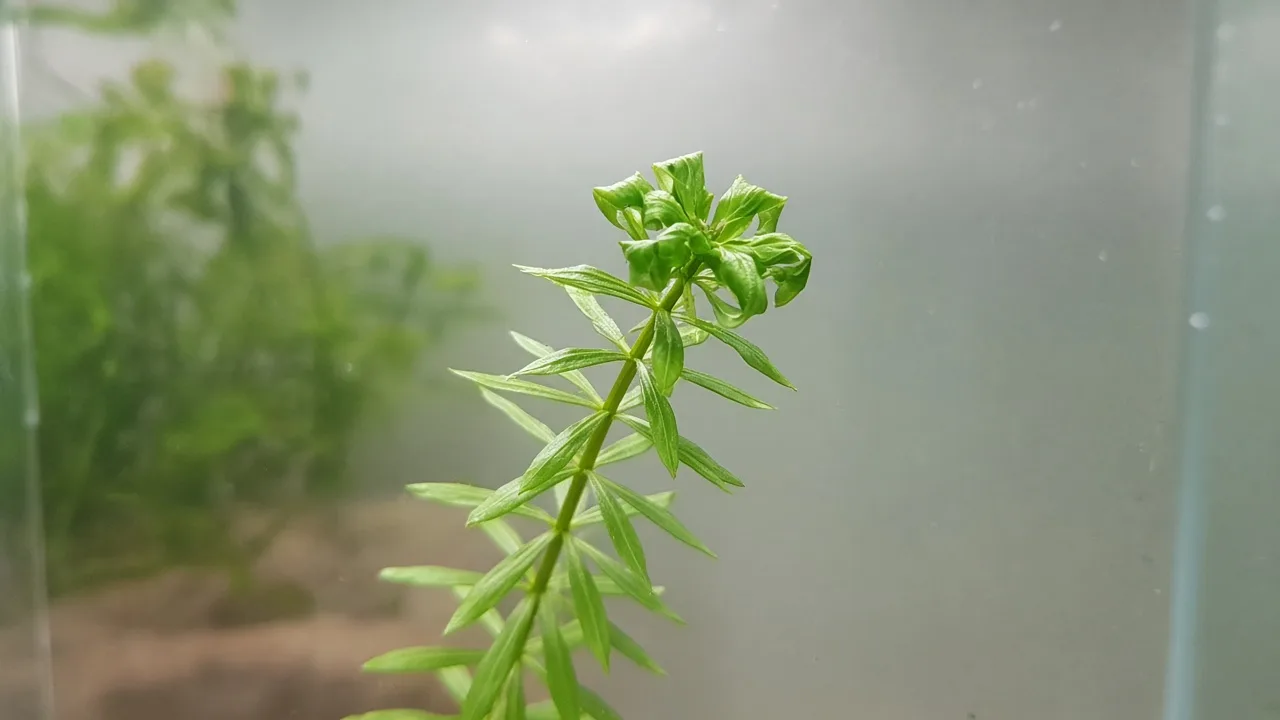
Distorted leaves on Anacharis / Elodea show as twisted, cupped, crinkled, or uneven new whorls at submerged stem tips while lower whorls may stay normal green. First step: inspect the freshest whorl on each firm stem underwater and test general hardness (GH)—especially in RO, shrimp-only, or high-light tanks.
Distorted Leaves on Anacharis / Elodea: Causes, Checks & Fixes
This guide covers distorted leaves on Anacharis / Elodea. See also the general Distorted Leaves guide, watering, and light pages for this plant.
Distorted Leaves on Anacharis / Elodea: Causes, Checks & Fixes
Quick answer
Distorted leaves on Anacharis (Egeria densa) show as twisted, cupped, crinkled, or uneven new whorls at submerged stem tips—leaves in the same ring different sizes or bent out of the usual flat strap shape. Lower whorls on firm green stems often look normal for days while only the apex warps. For general distortion mechanics on houseplants, see our distorted leaves guide. On Anacharis, diagnosis starts at the topmost whorl underwater—not potting mix, humidity trays, or emersed stems above the tank rim.
First step: inspect the freshest whorl on each firm submerged stem and test general hardness (GH). Anacharis absorbs calcium through its water-column leaves, not gravel tabs. Very soft tap water, pure RO or RODI without remineralizer, or GH below about 2 dGH commonly cup new tips in shrimp-only and high-light planted tanks. Turtle setups on average municipal tap distort less often—test before you change minerals for a grazing tank.
This guide covers submerged aquarium and pond culture only. For baseline feeding, see the Anacharis fertilizer guide. For pale new tips with green veins instead of warped shape, see iron deficiency. For simple leaf roll without whorl warp, see curling leaves.
When to use this page vs other Anacharis guides
| Pattern | Read next |
|---|---|
| Twisted, cupped, or crinkled new whorls at stem tips | Distorted leaves (this page) |
| Pale new tips with dark green veins, normal leaf shape | Iron deficiency |
| Yellow oldest whorls first, green tips | Nitrogen deficiency |
| Leaves roll inward/outward but whorl stays symmetrical | Curling leaves |
| Pinholes or scorched margins on older leaves | Potassium deficiency |
| Whole stem fades within 7–14 days after purchase | Transition melt |
| Mushy translucent stems after Excel or copper | Chemical damage |
| Long internodes reaching for light | Not enough light |
What distorted leaves look like on Anacharis
Healthy Anacharis whorls are bright emerald green, evenly spaced, with four to six strap-shaped leaves per ring on firm submerged stems. Distortion changes shape at the growing apex because calcium supports cell-wall formation in expanding tissue and cannot be redistributed from older leaves.
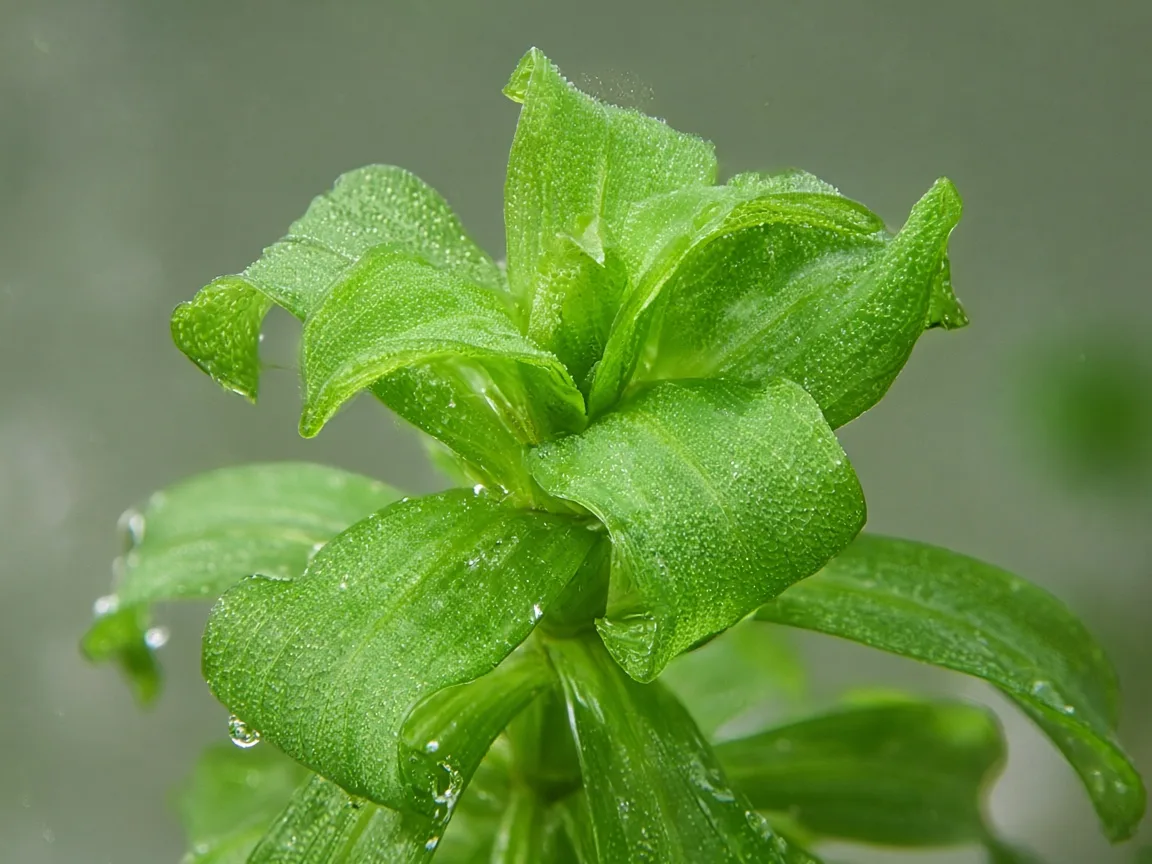
Twisted or cupped newest whorl at an Anacharis stem apex—compare with normal green whorls lower on the same submerged stem.
Classic distortion pattern (confirm this before stacking fixes):
- Newest whorl at the stem tip emerges twisted, cupped inward, crinkled, or smaller than the whorl below it
- Leaves within one whorl vary in size or angle—not the uniform ring healthy Anacharis shows
- Older whorls down the stem stay green and relatively normal in shape for days or weeks
- Stems stay firm—not the translucent mush of melt or chemical burn
- Multiple stems show the same tip pattern in soft-water or high-light tanks, not one random damaged shoot
What it is not:
- Pale new tips with green veins, normal shape → iron deficiency, not distortion-first diagnosis
- Yellow bottom whorls with healthy green tips → nitrogen deficiency
- Whole-plant washout after shipping in the first 7–14 days → transition melt
- Transparent mushy tissue after medication → chemical damage
- Long stretched internodes under dim PAR → insufficient light before mineral chasing
Anacharis is expressive: where on the submerged stem the warp sits matters more than a forum title saying “weird leaves.”
Why Anacharis gets distorted leaves
Anacharis is a fast column-feeding submerged stem plant in the Hydrocharitaceae family. Its thin whorled leaves pull minerals directly from the water. That design works in moderately hard tap water—but it also means distortion at the apex usually traces to water chemistry, light balance, or tank chemistry—not houseplant pests on submerged whorls.
Common distortion triggers on Anacharis:
- Low GH / calcium shortage — RO or RODI without remineralizer, very soft tap water, or GH below about 2 dGH. Aquarium calcium targets often sit around 10–15 ppm within a balanced profile. Cupped or crinkled new tips on firm stems are the hallmark—see calcium deficiency for the full GH workflow.
- High light without matching CO₂ and fertilizer — Strong PAR with no injected CO₂ and minimal dosing stalls apex expansion. Light, nutrients, and CO₂ must stay in balance; excess light alone produces stunted, oddly shaped whorls and algae pressure before lush growth returns.
- CO₂ swings in injected tanks — End-of-day CO₂ crash or inconsistent diffusion can warp new whorls while older tissue looks fine. Pair with stunted growth checks if internodes shorten across the tank.
- Extreme soft or acidic water — Very low pH can stress cell expansion; keep community turtle and planted tanks in the range Anacharis tolerates per the watering guide.
- Liquid carbon (Excel) or copper overdoses — Distorts tissue by liquefying cells—usually transparent and mushy, not merely cupped green whorls. Rule out chemical damage before remineralizing.
- Heat above ~82°F (28°C) — Fast melt can warp tips before stems go fully mushy. See heat stress if the tank ran hot after a heater failure.
- Deep planting or dense bunches — Lower nodes rot while upper tips distort from stress spreading up the stem. Compare with stem rot when the base feels soft.
Many turtle tanks on dechlorinated municipal tap already carry adequate GH. Distortion from calcium shortage is less common there than in shrimp display tanks on remineralized soft water—test before you change minerals for a grazing turtle setup.
Whorl-tip diagnosis on submerged stems
Anacharis does not have a soil root zone to inspect. Your field test is the newest whorl on each stem tip underwater.
Work stem by stem:
- Find the apex whorl — The topmost ring of leaves on a firm green stem fully submerged.
- Compare shape, not just color — Cupping, crinkling, or uneven leaf size in that ring only?
- Check the whorl two nodes down — Still normal strap-shaped leaves in a flat ring?
- Feel the stem — Firm green tissue vs translucent mush between nodes.
- Scan the tank — Same tip pattern on multiple stems points to water chemistry or system balance, not one broken cutting.
If only one stem warps while neighbors stay perfect, suspect mechanical crush at planting, a snail chewing the apex, or localized shade—not tank-wide calcium failure.
How to confirm the cause
Match the pattern before you change three variables at once.
| If you see… | Likely cause | Confirm with… |
|---|---|---|
| Cupped or crinkled new tips, firm stems, soft GH | Calcium shortage | GH test kit; review RO/remineralizer routine |
| Distortion + pale new tissue with green veins | Iron shortage (shape may look odd secondarily) | Dose trial + nitrate test; see iron deficiency |
| Distortion under strong light, slow overall growth | Light/CO₂/fert imbalance | PAR level, CO₂ chart, comprehensive fertilizer log |
| Transparent mush after Excel or copper | Chemical injury | Medication history; ammonia/nitrite safe |
| Distortion within 7–14 days of purchase | Transition melt overlap | Wait for new submerged whorls; avoid day-three mega-doses |
| Distortion only on deeply planted bunch bases | Stem rot spreading upward | Pull stem; cut to firm tissue; float until roots form |
GH test is the highest-yield single check when multiple stems show cupped green tips in shrimp-only or RO tanks. Skip straight to iron or potassium if the warp is clearly limited to new tips with normal green color and very soft GH.
The first fix to try
Inspect every submerged stem apex, then test GH if new whorls are cupped or crinkled on firm green stems.
That one action tells you whether you are in mineral territory (soft GH, multi-stem pattern) or system-balance territory (high light, CO₂ swings, recent medication). Do not dose full-strength fertilizer, remineralizer, and iron on the same afternoon.
If GH reads very low (below ~2 dGH) and tips match the calcium pattern:
- Remineralize change water only to your target GH with a balanced GH product—not a calcium-only spike.
- Perform a partial water change with remineralized water matching tank temperature.
- Wait 7–14 days and watch new whorls above the old distorted tissue.
If GH is adequate and you run high light with injected CO₂:
- Stabilize CO₂ through the full photoperiod before adding more fertilizer.
- Dose a comprehensive liquid fertilizer at half label strength once weekly after water changes per the fertilizer guide.
- Trim and replant healthy tops if lower stems are shaded—see the light guide.
If stems are mushy or transparent—not merely cupped:
Stop Excel, copper, and medication immediately, remove melted tissue, and perform partial water changes before any nutrient additions. That path is chemical damage, not a GH fix.
Recovery timeline
Distorted whorls rarely flatten once they harden—expanding tissue already locked in the warp. Judge success by new whorls:
- 7–14 days — First new whorl above a trim or the old warp should look more symmetrical if GH or dosing was the issue
- 2–4 weeks — Two clean whorls on most stems means the trigger is controlled
- After 4 weeks — Persistent cupping with stable GH, safe ammonia/nitrite, and adequate light suggests CO₂ instability or trace gaps—fix system balance before chasing more minerals
Trim warped tips with aquascaping scissors if new growth below the cut stays normal. Floating cuttings until white roots appear prevents repeat stem rot from deep planting.
Mistakes to avoid
- Dosing iron because leaves look “wrong” when the pattern is cupping with normal green color—test GH first.
- Full-strength fertilizer in a well-stocked turtle tank on tap water—can trigger overfertilization and algae without fixing shape.
- Treating submerged whorls for spider mites or thrips—those pests hit emersed stems above the waterline, not healthy underwater whorls.
- Deep planting fresh store bunches — Lower leaves rot and upper tips distort from stress; strip lower leaves and plant shallowly per the soil guide.
- Stacking remineralizer, iron, and potassium same day — Change one variable so you can read the response.
How to prevent distorted leaves next time
- Test GH monthly in shrimp-only, RO, and soft-water planted tanks.
- Remineralize change water before it enters the tank—never pour pure RO directly on established stems.
- Match light to CO₂ and fertilizer in high-tech setups; Anacharis grows fast without CO₂ in low-tech tanks but still needs balanced nutrients under strong PAR.
- Quarantine new stems through the first-week melt window before assuming mineral deficiency—see transplant shock.
- Thin dense mats weekly so lower whorls receive light—shaded pale lower leaves are often misread as nutrients.
- Never release trimmings into wild waterways—Egeria densa spreads aggressively outside tanks.
When to worry
Escalate if new tips stay cupped after four weeks of stable GH with confirmed adequate light and non-zero nitrate—consult a local fish store or planted-tank forum with photos of new vs old whorls on the same stem.
If stems turn translucent and mushy—not merely cupped—rule out chemical damage, heat stress, and overfertilization before adding more minerals.
For overview context on column feeding and legal disposal of trimmings, see the Anacharis care overview.
Related Anacharis / Elodea guides
- Anacharis / Elodea overview
- Anacharis / Elodea watering
- Anacharis / Elodea light
- Anacharis / Elodea fertilizer
- Anacharis / Elodea problems
- Calcium deficiency on Anacharis
- Iron deficiency on Anacharis
- Stunted growth on Anacharis
Related tool
Use the Plant Problem Diagnosis Tool to narrow causes for distorted leaves on this plant before changing GH, CO₂, and fertilizer on the same day.