Iron Deficiency on Anthurium: Causes, Checks & Fixes
Quick answer
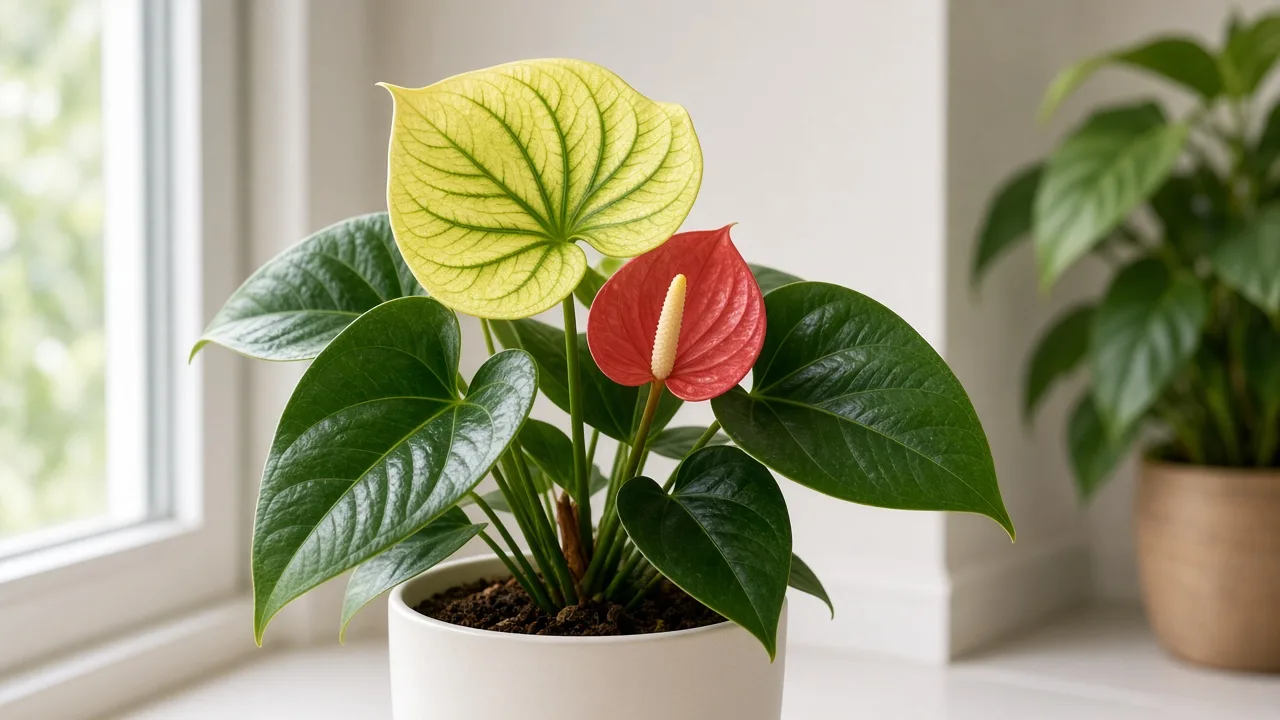
Iron deficiency on anthurium shows as pale or yellow new heart-shaped leaves with dark green veins (interveinal chlorosis) at the crown while older glossy foliage below may stay normal. First step: confirm the vein pattern is on the newest unfurling leaf—not washed-out lower leaves or interveinal yellowing on old mid-canopy blades—then check whether alkaline tap water, depleted bark mix, or wet roots block iron uptake before applying chelated iron.
Iron Deficiency on Anthurium: Causes, Checks & Fixes
This guide covers iron deficiency on Anthurium. See also the general Iron Deficiency guide, watering, and light pages for this plant.
Iron Deficiency on Anthurium: Causes, Checks & Fixes
Quick answer
Iron deficiency on anthurium (Anthurium andraeanum and related cultivars) shows as pale or yellow new heart-shaped leaves with dark green veins (interveinal chlorosis) at the crown while older glossy foliage below may stay normal. Iron is immobile in plants, so chlorosis appears on young expanding tissue first—not on the lowest old leaves the way nitrogen deficiency does.
See our iron deficiency guide for general chlorosis mechanics. On anthurium, inspect the glossy heart leaf still unfurling from the tight center crown—veins stay green while tissue between them yellows on the newest blade above mature foliage.
First step: confirm new-growth interveinal chlorosis with green veins on the crown heart leaf, then check whether alkaline tap water, depleted bark mix, or wet roots block iron uptake before applying chelated iron.
When to use this page vs other Anthurium guides
| Pattern | Read next |
|---|---|
| New crown heart leaf yellow with green veins | Iron deficiency (this page) |
| Lowest heart leaves pale uniformly; no vein pattern | Nitrogen deficiency |
| Whole plant washed-out in a dim corner | Pale leaves or not enough light |
| Interveinal yellowing on older mid-canopy leaves | Magnesium deficiency |
| New crown heart leaf cupped or margin-burned | Calcium deficiency |
| Yellow lower cluster, wet bark mix, mushy roots | Overwatering or root rot |
| Brown crispy tips after heavy feed | Brown tips from salts or water quality |
What iron deficiency looks like on anthurium
Healthy anthurium unfurls glossy heart-shaped leaves from a tight roll at the center crown. Iron stress breaks that pattern on the newest expanding blade while older canopy below often looks fine.
Typical signs:
- Pale or yellow new heart leaves at the crown with veins remaining darker green
- Successively paler new leaves if untreated—two or three chlorotic unfurls in a row during active growth
- Older glossy heart leaves lower on the stem may stay deep green while only the crown leaf looks washed out
- Smaller or thinner new blades when chlorosis is severe on a plant pushing foliage and spathes together
- Firm aerial roots and base roots if uptake is functional—soft brown roots on wet mix point to overwatering instead
Not iron deficiency:
- Uniform pale lower leaves first — nitrogen deficiency
- Washed-out green across many leaves with long weak petioles — pale leaves or not enough light
- Interveinal yellowing on oldest mid-canopy heart leaves — magnesium deficiency
- Cupped or margin-burned new crown leaf without a clear vein pattern — calcium deficiency
- All leaves yellow on persistently wet bark mix — root rot overlap
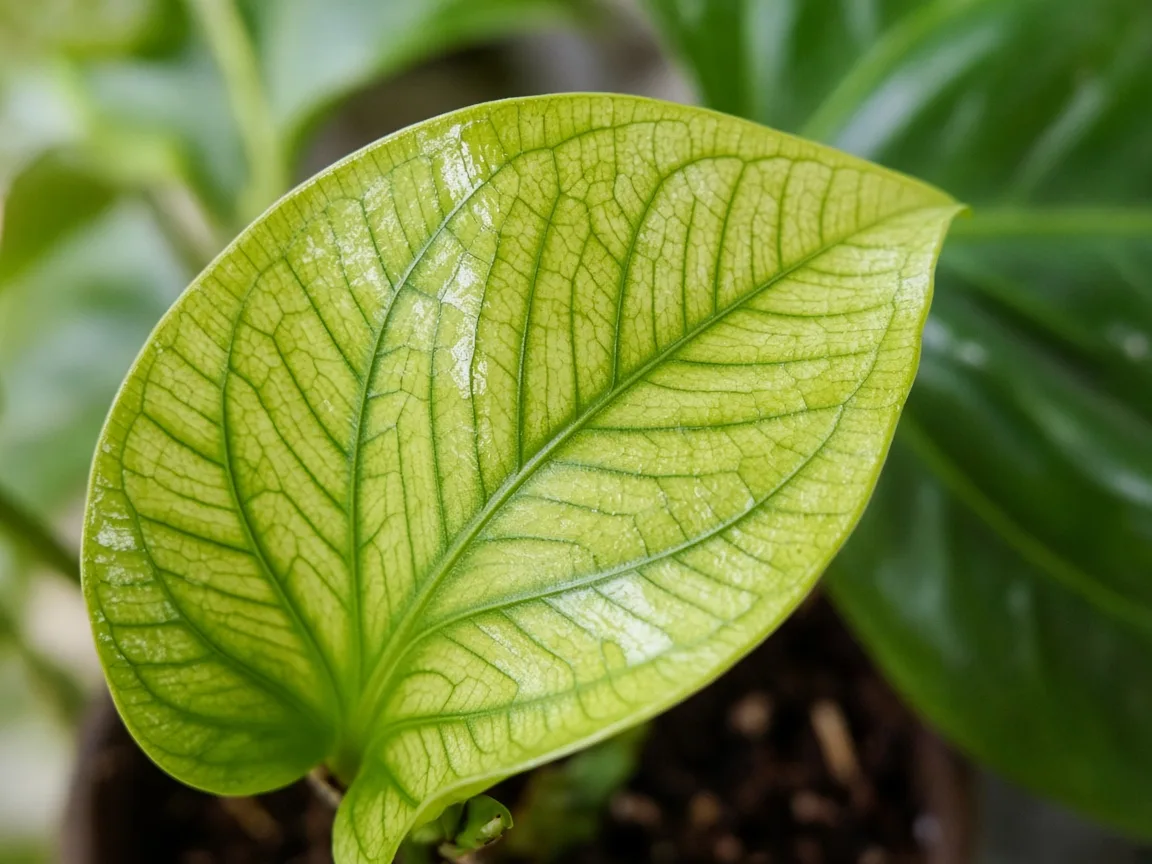
New heart-shaped leaf at the anthurium crown: pale yellow tissue between dark green veins while older glossy leaves below remain relatively normal—classic iron chlorosis on expanding aroid foliage.
The classic symptom of iron deficiency is interveinal chlorosis on new growth where leaf tissue yellows while major veins stay green. Penn State notes younger leaves show the most intense chlorosis, and severely deficient leaves may emerge almost white as they unfold. On an epiphytic aroid, that pattern is easiest to read on the heart leaf still opening at the crown—not on mature lower blades that may simply be aging.
Why anthurium gets iron deficiency
Anthurium is an epiphytic aroid grown for glossy heart foliage and waxy spathes in bright indirect light. Iron chlorosis often results when roots cannot absorb iron even when it is present in fertilizer—high pH, waterlogged bark mix, salt crust, or depleted open media block uptake while the crown keeps trying to unfurl new heart leaves.
Anthurium-specific causes:
- Alkaline tap water drifting pot pH — Anthurium prefers slightly acidic mix around pH 5.5–6.5 per the soil guide. High pH soils bind iron and cause interveinal chlorosis on new growth even when you feed occasionally.
- Bloom-only feeding without micronutrients — Owners chasing spathes with phosphorus-heavy formulas may skip chelated iron for seasons. The anthurium fertilizer guide stresses urea-free complete feeds with micronutrients during active growth.
- Depleted epiphytic bark mix — Standard bark-perlite blend that composted down over one to two seasons loses buffering capacity. Roots stay alive but iron availability drops until you refresh mix per the soil guide.
- Overwatering on open mix — Chronic overwatering limits root oxygen and micronutrient uptake. Iron-deficient roots may brown and smell differently when stress is severe—sour wet bark with yellow lower leaves is root failure first.
- Salt buildup from heavy feeding — UF/IFAS anthurium production guidance warns that soluble salts above roughly 2 dS/m stress container roots. White crust on the pot rim can lock micronutrients until you flush.
- RO or distilled water without iron in the feed — Soft water removes incidental iron tap water normally supplies unless the fertilizer label lists chelated iron.
Crown heart-leaf chlorosis on Anthurium
Anthurium allocates iron to each expanding heart-shaped leaf as it opens from the tight center roll. When uptake fails, the newest crown leaf shows bright yellow or pale tissue between dark green veins while mature glossy blades below stay relatively normal. Iron deficiency symptoms are observed on new growth as interveinal chlorosis—the opposite pattern from magnesium deficiency, which typically starts on older mid-canopy leaves.
Judge severity by successive crown unfurls: one slightly pale heart leaf after a dry spell differs from three consecutive chlorotic new leaves on stable care. A single bottom heart leaf yellowing while a green crown leaf unfurls above is often normal aging covered on yellow leaves—not iron stress.
Bark mix pH drift in epiphytic containers
Anthurium roots live in coarse orchid-like bark with perlite—not dense peat that buffers pH for years. Repeated hard tap watering, limestone in cachepot water, or top-dressing with garden compost can push mix pH above the range where iron stays soluble. WSU notes lime leaching from concrete and high pH can affect nutrient availability.
Before adding more iron:
- Check whether white mineral crust rings the pot lip—flush with plain water through open mix
- Confirm the top inch dries within a few days per the watering guide
- Review whether fertilizer lists chelated iron (Fe-EDDHA or Fe-DTPA) rather than only N-P-K macros
Pouring iron into alkaline bark without addressing pH often fails—the plant keeps pushing pale crown leaves while lower foliage still looks fine.
Spathe push vs foliage iron demand
When anthurium pushes a waxy spathe alongside new crown foliage, the plant partitions resources between inflorescence and leaf growth. A plant that bloomed heavily through spring and summer without micronutrient feeding may show the next foliage heart leaf chlorotic even though mature leaves still look glossy. That is not a reason to heavy-feed during bloom—wait until active leaf growth resumes, then feed lightly at quarter to half label strength per the fertilizer guide.
Iron correction belongs after firm roots and appropriate moisture—not stacked with repotting, pruning, and pesticide on the same day on a stressed epiphytic plant.
Aerial roots and iron uptake in open mix
Anthurium produces aerial roots along the stem that absorb moisture from humid air. In a chunky bark-perlite blend, iron must move through both substrate roots and healthy stem tissue to reach the crown meristem. Before feeding for iron deficiency, confirm:
- Aerial roots and base roots are firm and green or white—not brown and mushy
- Mix is open and drains within days—not waterlogged for a week after one drink
- No heavy salt crust rings the pot—flush before chelated iron if white deposits are present
Feeding iron into waterlogged epiphytic roots burns tissue and worsens chlorosis. Fix drainage per the watering rhythm first, then apply one dilute chelated iron drench at quarter to half strength.
Lookalike symptoms
| Pattern | Likely cause | Key difference on Anthurium |
|---|---|---|
| New crown heart leaf yellow with green veins | Iron deficiency (this page) | Interveinal chlorosis on newest expanding leaf; older leaves normal |
| Old heart leaves pale uniformly | Nitrogen deficiency | Progressive lower-leaf washout; no vein banding on new growth |
| Yellow between veins on older mid-canopy leaves | Magnesium deficiency | Interveinal banding on mature foliage, not crown-first |
| New crown heart leaf cupped or margin-burned | Calcium deficiency | Distortion on newest expanding leaf; not vein chlorosis |
| Mushy roots, wet bark mix | Overwatering | Root rot smell; yellowing may be sudden |
| Tips brown on flat green leaves | Brown tips | Tip-only damage; new crown leaves unfurl flat |
How to confirm
- Leaf age pattern — Newest crown heart leaf first; older foliage below often normal.
- Vein pattern — Yellow or pale tissue between darker green veins on the expanding blade.
- Feeding history — Bloom-only fertilizer, alkaline tap water, or seasons without micronutrient feed.
- Root check — Firm white and green epiphytic roots vs brown mush on wet mix.
- Mix moisture — Appropriate open bark dry-down vs chronic wetness.
- pH and salts — White crust on pot rim; hard tap water history; depleted bark age.
- Successive unfurls — Two or more chlorotic new crown leaves on stable care strengthens the iron diagnosis.
First fix for Anthurium
One dilute chelated iron drench at quarter to half label strength—after confirming firm roots, appropriate moisture on open (not waterlogged) bark mix, and interveinal chlorosis on the newest crown heart leaf only.
Per the anthurium fertilizer guide. Anthurium prefers light feeds—one measured dose of urea-free complete formula with listed chelated iron, not full-strength doubling on epiphytic roots. If white salt crust is visible, flush once with plain water through the open mix before the iron drench.
Step-by-step recovery
- Flush salts with plain water if white crust rings the pot—then wait one week before feeding.
- Apply one chelated iron drench at quarter to half label strength on firm roots—not bloom-only formula alone.
- Stabilize watering rhythm so iron can move to the crown tip on each drink per watering guide.
- Repot into fresh coarse epiphytic mix if roots fill the pot and chlorotic crown leaves persist after two light feeds.
- Maintain bright indirect light without hot direct sun on pale new foliage.
- Correct overwatering if roots are mushy—iron uptake requires healthy epiphytic roots.
- Monitor the next two crown heart leaves for greener unfurls over three to six weeks.
Recovery timeline
Judge recovery on new crown heart leaves, not the currently chlorotic blade:
- 2–3 weeks: Next unfurling leaf should show less interveinal yellowing
- 3–6 weeks: Two greener heart leaves from the crown—main success signal
- 6+ weeks: Consistent glossy green unfurls confirm iron is adequate
The currently pale heart leaf rarely re-green once hardened. Success means the next one or two crown leaves open with normal glossy texture and dark green veins on green tissue.
Mistakes to avoid
- Chasing blooms with phosphorus-only feed while new leaves chlorose. Complete micronutrient nutrition first, then light bloom optimization.
- Confusing overwatering with iron chlorosis. Mushy roots on wet bark mix is root failure, not immobile-iron pattern on firm roots.
- Full-strength rescue feeding on epiphytic roots. Quarter to half strength matches anthurium metabolism.
- Expecting the chlorotic crown leaf to re-green. Judge the next unfurl, not the hardened one.
- Adding iron without flushing salt crust first. Salts can block uptake and burn fine roots.
- Heavy feeding on waterlogged orchid-like mix. Fix drainage before repeated iron drenches.
Prevention
- Feed lightly during active growth with complete urea-free fertilizer including chelated iron per fertilizer guide
- Refresh coarse bark-perlite mix at repotting every two to three years
- Flush salts monthly if you feed regularly in a closed cachepot
- Maintain open mix dry-down per watering guide
- If using hard alkaline tap water, choose fertilizer with chelated iron and monitor crown new growth
- Track feeding dates on long-held container plants pushing spathes and foliage together
Related Anthurium guides
- Anthurium overview
- Anthurium fertilizer
- Anthurium watering
- Anthurium soil
- Magnesium deficiency
- Nitrogen deficiency
- Calcium deficiency
- Anthurium problems hub
Conclusion
Pale new heart leaves with green veins at the crown signal iron uptake failure on an epiphytic aroid—confirm firm roots rule out overwatering, check alkaline tap water and fertilizer completeness, apply one measured chelated iron drench, and monitor the next two crown unfurls over three to six weeks.
Related tool
Use the Fertilizer Dilution Calculator to narrow causes for iron deficiency on this plant before changing multiple variables at once.