Calcium Deficiency on Anthurium: Causes, Checks & Fixes
Quick answer
Calcium deficiency on anthurium shows as distorted, cupped, or margin-burned newest heart-shaped leaves at the crown while older foliage below may look normal. First step: confirm damage is on the newest expanding leaf—not silver-streaked thrips scarring—and check whether reverse-osmosis water and incomplete fertilizer have limited calcium uptake on firm epiphytic roots.
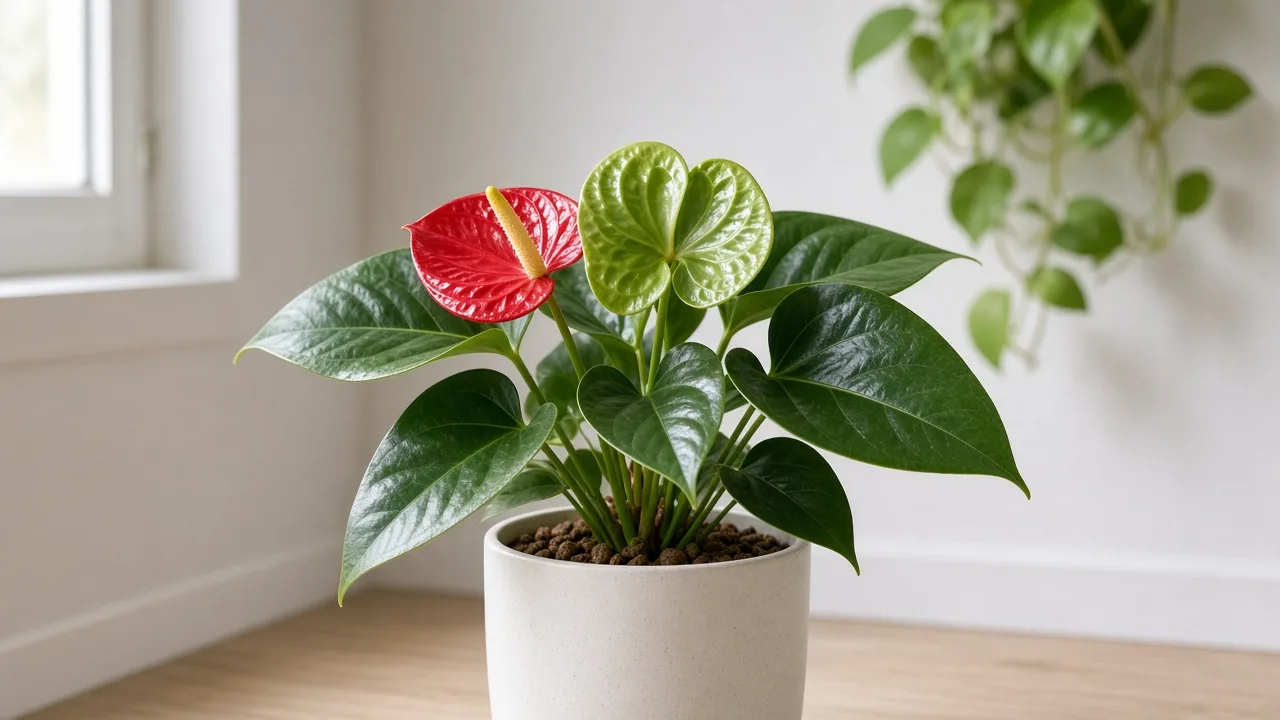
Calcium Deficiency on Anthurium: Causes, Checks & Fixes
This guide covers calcium deficiency on Anthurium. See also the general Calcium Deficiency guide, watering, and light pages for this plant.
Calcium Deficiency on Anthurium: Causes, Checks & Fixes
Quick answer
Calcium deficiency on anthurium (Anthurium andraeanum and related cultivars) shows as distorted, cupped, or margin-burned new heart-shaped leaves unfurling from the crown while older glossy foliage below may remain normal. Calcium is plant-immobile, so deficiency appears on young expanding tissue first—not on mature lower foliage the way nitrogen deficiency does.
See our calcium deficiency guide for general new-tissue distortion mechanics. On anthurium, inspect the newest heart leaf still opening at the crown—crinkling, uneven margins, or necrotic edges there point to calcium before magnesium deficiency, which shows interveinal yellowing on older leaves with green veins.
First step: confirm distorted or margin-burned tissue on the newest unfurling heart leaf, not silver-streaked thrips damage inside the rolled leaf.
When to use this page vs other Anthurium guides
| Pattern | Read next |
|---|---|
| New crown heart leaf distorted or margin-burned | Calcium deficiency (this page) |
| New leaf silver-streaked, black specks inside roll | Thrips or distorted leaves |
| Old lower heart leaves pale uniformly | Nitrogen deficiency |
| New leaves yellow with green veins | Iron deficiency |
| Yellow between veins on older leaves | Magnesium deficiency |
| Brown scorched margins on old leaves | Potassium deficiency |
| Brown tips only, no cupping on new crown leaves | Brown tips |
| Mushy roots on wet orchid-like mix | Overwatering |
What calcium deficiency looks like on anthurium
Healthy anthurium unfurls glossy heart-shaped leaves from tight rolls at the center crown. Calcium supports cell wall formation in expanding tissue, so when uptake fails, the newest leaf still opening shows damage while older canopy below often looks fine.
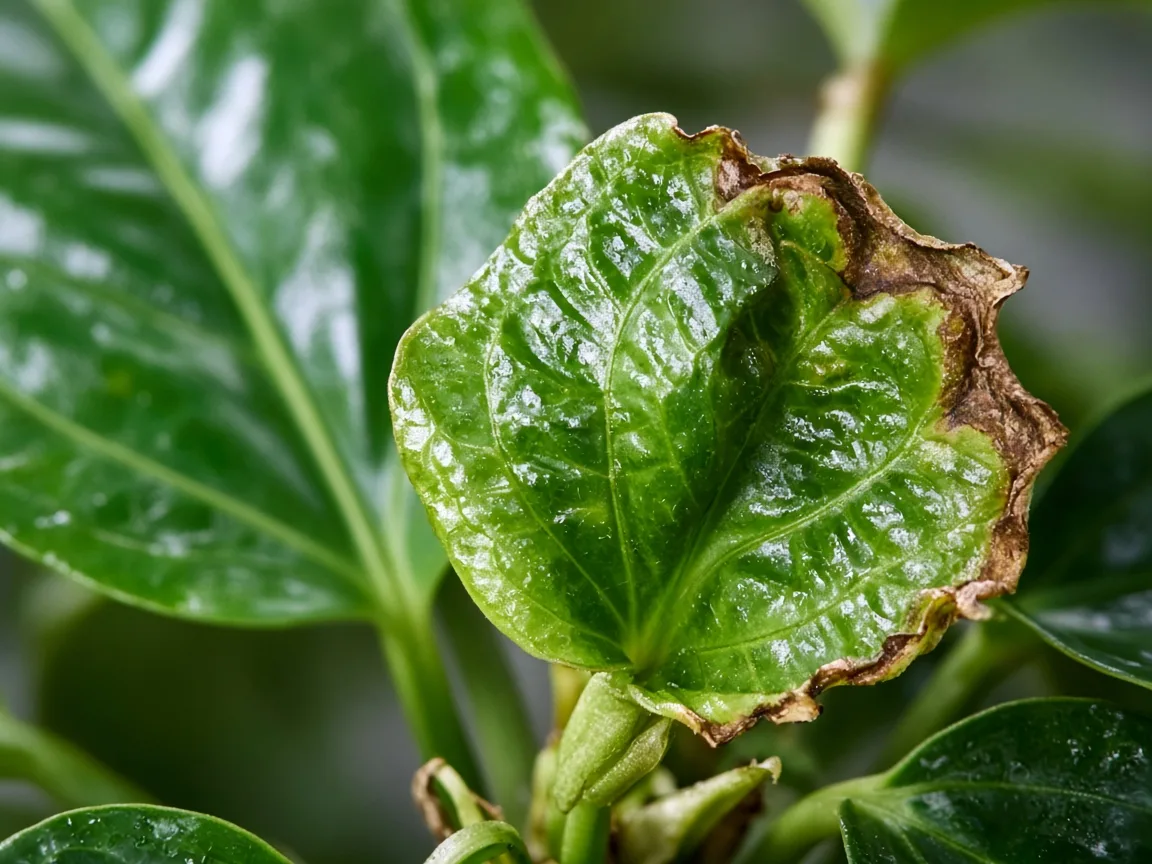
Cupped, uneven margin on the newest anthurium heart leaf still expanding from the crown—older glossy leaves below remain relatively normal.
Typical signs:
- Crinkled, cupped, or uneven edges on the newest unfurling heart leaf at the crown
- Brown or necrotic spots along the margin of the expanding leaf before it fully hardens
- Stunted or narrower new blades compared with prior leaves on the same plant
- Wrinkled tissue that opens asymmetrically—center expands while margins stay tight
- Older mature heart leaves lower on the stem may look completely normal
- Firm aerial roots and base roots if roots are healthy; soft base suggests rot instead
Not calcium deficiency:
- Silver streaks and black specks inside the rolled new leaf—thrips (distorted leaves covers unfurling pest scarring)
- Pale lower old heart leaves without tip distortion—nitrogen deficiency
- New leaves yellow with dark green veins—iron deficiency
- Interveinal yellowing on older mid-canopy leaves—magnesium deficiency
- All leaves yellow on persistently wet bark mix—overwatering or root rot
- Tip-only brown scorch on otherwise flat new leaves—brown tips from salts or water quality
Why anthurium gets calcium deficiency
Anthurium is an epiphytic aroid grown for glossy heart foliage and waxy spathes in bright indirect light. Each unfurling heart leaf demands calcium for rigid cell walls. Very soft water, incomplete fertilizer, acidic depleted bark mix, or inconsistent watering that interrupts transport to the growing tip shows up as distorted new crown leaves while lower mature blades still look healthy.
Anthurium-specific causes:
- Reverse-osmosis or very soft water only — Many owners switch to RO water chasing salt-sensitive brown tips. That removes the small calcium contribution tap water normally supplies unless fertilizer replaces it.
- Incomplete micronutrient fertilizer — The anthurium fertilizer guide stresses urea-free complete feeds with calcium and magnesium. Nitrogen-heavy products used sparingly can still expand leaf area without calcium for cell wall integrity in those new heart blades.
- Dry-down swings on open bark mix — Anthurium sits in coarse orchid-like media that dries quickly. Calcium moves with water through the xylem to the crown tip. Repeated drought-to-flood swings starve the apical growth even when lower roots absorbed enough for mature leaves.
- Depleted epiphytic mix — Standard bark-perlite blend that composted down over one to two seasons in a slightly pot-bound plant. Roots stay alive but calcium availability drops until you refresh mix per the anthurium soil guide.
- Root stress blocking uptake — Chronic overwatering limits calcium transport regardless of what is in the fertilizer bottle. Sour-smelling wet mix and yellow lower leaves point to root-zone failure first.
- Thrips confusion — Thrips rasp unfurling tissue and leave permanent ripples on new heart leaves. Magnify the rolled leaf interior before assuming a nutrient gap.
Crown heart-leaf unfurl damage on Anthurium
Anthurium allocates calcium to each expanding heart-shaped leaf as it opens from the tight center roll. When uptake fails, the center of the new leaf may expand while margins stay stunted—producing cupping, hood-like curling, or cracked edges along the unfurling margin. Calcium is extremely immobile in plants, and NC State calcium deficiency work notes marginal curling on new expanding leaves before older tissue is affected.
That pattern differs from magnesium deficiency, which shows interveinal yellowing on older foliage with green veins. It also differs from one bottom heart leaf senescing while a green crown leaf unfurls above—a normal aging pattern covered on yellow leaves.
Judge severity by successive new crown leaves: one slightly wrinkled unfurl after a dry spell differs from three consecutive cupped new leaves on stable care.
Aerial roots and calcium transport in open mix
Anthurium produces aerial roots along the stem that absorb moisture and nutrients from humid air. In a chunky bark-perlite blend, calcium must move through both substrate roots and stem tissue to reach the crown meristem. Before feeding for calcium deficiency, confirm:
- Aerial roots and base roots are firm and green or white—not brown and mushy
- Mix is open and drains within days—not waterlogged for a week after one drink
- No heavy salt crust rings the pot—flush before feeding if white deposits are present
Feeding calcium into waterlogged epiphytic roots burns tissue and worsens distortion. Fix drainage per the watering guide and soil rhythm first, then apply one dilute complete fertilizer at quarter to half strength.
Spathe push vs foliage calcium demand
When an anthurium pushes a waxy spathe alongside new foliage, the plant partitions resources between inflorescence and leaf crown. A plant that bloomed heavily through spring and summer without any feeding may show the next foliage heart leaf cupped or margin-burned even though mature leaves still look fine. That is not a reason to heavy-feed during bloom—UF/IFAS anthurium production guidance warns that soluble salts above roughly 2 dS/m stress container roots—but it explains why distortion can follow a productive flowering season on an otherwise healthy-looking plant.
Wait until active leaf growth resumes, then feed lightly at quarter to half label strength during the growing season per the fertilizer guide.
Lookalike symptoms
| Pattern | Likely cause | Key difference on Anthurium |
|---|---|---|
| New crown heart leaf cupped or margin-burned | Calcium deficiency (this page) | Distortion on newest expanding leaf; older leaves normal |
| New leaf silver-streaked inside roll | Thrips | Pest scarring inside rolled leaf; not uniform margin cupping |
| Old heart leaves pale, small spathes | Nitrogen deficiency | Progressive lower-leaf washout; firm roots |
| New leaves yellow with green veins | Iron deficiency | Interveinal chlorosis on new growth, not margin cupping |
| Yellow between veins on old leaves | Magnesium deficiency | Interveinal banding on older canopy |
| Mushy roots, wet bark mix | Overwatering | Root rot smell; yellowing may be sudden |
| Tips brown on flat green leaves | Brown tips | Tip-only damage; new crown leaves unfurl flat |
How to confirm
- Leaf age pattern — Newest crown heart leaf first; older foliage below normal.
- Unfurl stage — Damage visible while the leaf is still expanding, not only after hardening.
- Feeding history — Bloom-only fertilizer, RO water without complete feed, or years without calcium-containing fertilizer.
- Root check — Firm white and green epiphytic roots vs brown mush.
- Mix moisture — Appropriate open bark dry-down vs chronic wetness.
- Pest check — Magnify inside the rolled new leaf for thrips before treating nutrients.
- Successive spears — Two or more cupped new leaves on stable care strengthens the calcium diagnosis.
First fix for Anthurium
One dilute complete liquid fertilizer at quarter to half label strength that lists calcium and magnesium—after confirming firm roots and appropriate moisture on open, not waterlogged, bark mix.
Per the anthurium fertilizer guide. Anthurium prefers light feeds—one measured dose of urea-free complete formula such as Dyna-Gro Foliage Pro or MSU Orchid Fertilizer, not full-strength doubling on epiphytic roots.
Step-by-step recovery
- Feed lightly once with complete calcium-containing fertilizer—not bloom-only all season per fertilizer guide.
- Stabilize watering rhythm so calcium can move to the crown tip on each drink per watering guide.
- Repot into fresh coarse epiphytic mix if roots fill the pot and cupped leaves persist after two light feeds.
- Maintain bright indirect light without hot direct sun on distorted new foliage.
- Correct overwatering if roots are mushy—calcium uptake requires healthy epiphytic roots.
- Monitor the next two crown heart leaves for cleaner unfurls over four to eight weeks.
Recovery timeline
Judge recovery on new crown heart leaves, not the currently distorted blade:
- 2–4 weeks: Next unfurling leaf should show less margin cupping
- 4–8 weeks: Two cleaner heart leaves from the crown—main success signal
- 8+ weeks: Consistent flat unfurls confirm calcium is adequate
The currently cupped heart leaf rarely straightens once hardened. Success means the next one or two crown leaves open with even margins and normal glossy texture.
Mistakes to avoid
- Chasing blooms with phosphorus-only feed while new leaves cup. Balanced complete nutrition first, then light optimization.
- Confusing overwatering with calcium cupping. Mushy roots on wet bark mix is root failure, not immobile-calcium distortion on firm roots.
- Full-strength rescue feeding on epiphytic roots. Quarter to half strength matches anthurium metabolism.
- Expecting the distorted crown leaf to flatten. Judge the next unfurl, not the hardened one.
- Ignoring RO water without calcium in the feed. Soft water removes incidental calcium unless the fertilizer replaces it.
- Heavy feeding on waterlogged orchid-like mix. Fix drainage before repeated fertilizer.
Prevention
- Feed lightly during active growth with complete urea-free fertilizer per fertilizer guide
- Refresh coarse bark-perlite mix at repotting every two to three years
- If using RO or distilled water, choose fertilizer with listed calcium and magnesium
- Maintain open mix dry-down per watering guide
- Flush salts monthly if you feed regularly in a closed cachepot
- Track feeding dates on long-held container plants pushing spathes and foliage together
Related Anthurium guides
- Anthurium overview
- Anthurium fertilizer
- Anthurium watering
- Anthurium soil
- Magnesium deficiency
- Iron deficiency
- Distorted leaves
- Anthurium problems hub
Conclusion
Cupped or margin-burned new heart leaves at the crown signal calcium transport failure on an epiphytic aroid—confirm firm roots rule out overwatering, check RO water and fertilizer completeness, feed one measured complete dose, and monitor the next two crown unfurls over four to eight weeks.
Related tool
Use the Fertilizer Dilution Calculator to narrow causes for calcium deficiency on this plant before changing multiple variables at once.