Curling Leaves on Anubias: Causes, Checks & Fixes
Quick answer
Curling leaves on Anubias usually show as cupped, hooked, or ruffled margins on slow submersed foliage—often low GH calcium or magnesium, buried rhizome stress, or too much light on shade-adapted leaves. First step: squeeze the rhizome for firm green tissue, then test general hardness before changing fertilizer.
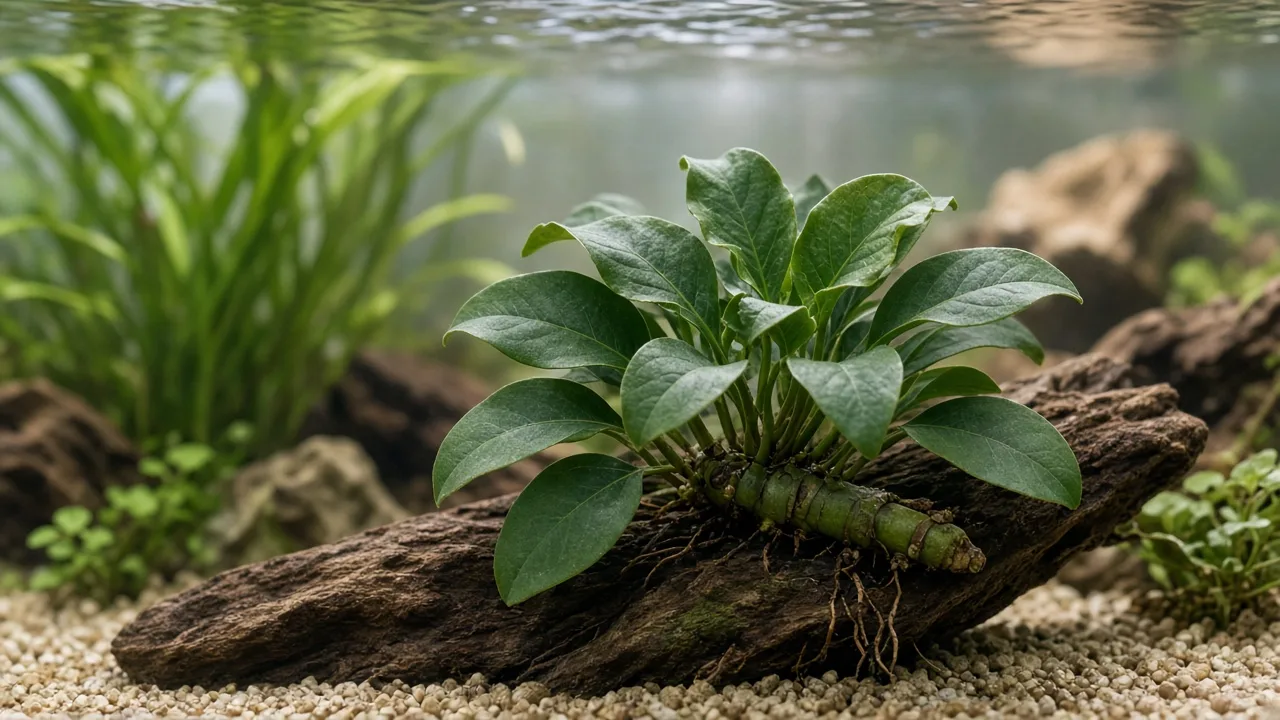
Curling Leaves on Anubias: Causes, Checks & Fixes
This guide covers curling leaves on Anubias. See also the general Curling Leaves guide, watering, and light pages for this plant.
Curling Leaves on Anubias: Causes, Checks & Fixes
Quick answer
Curling leaves on Anubias (Anubias barteri and cultivars such as nana and petite) show as cupped, hooked, or ruffled leaf margins on thick submersed foliage—not the dry inward roll you see on terrestrial houseplants. On this slow rhizome epiphyte, curl usually traces to low general hardness (GH) limiting calcium or magnesium on new leaves, a buried or damaged rhizome, photoinhibition from bright fixture light, or benign cultivar texture on older barteri leaves.
For how leaf curl works as a stress response in general, see our curling leaves guide. On Anubias, read new-leaf shape at the rhizome tip and test GH before you mist leaves or chase humidity.
First step: squeeze the rhizome where leaves attach. Firm, green rhizome tissue with cupped new leaves often means soft-water mineral stress or light imbalance—not rot. Mushy, jelly-like, or foul-smelling rhizome tissue means stop curl troubleshooting and treat rot per our root rot on Anubias workflow.
This guide covers submerged aquarium, turtle tank, and pond culture only. For cupped or twisted growth with severe warping, see distorted leaves on Anubias. For yellow melt after purchase, see yellow leaves. For baseline mounting rules, see the Anubias overview and watering guide.
When to use this page vs other Anubias guides
| Pattern | Read next |
|---|---|
| Margins cup or hook on new submersed leaves; rhizome firm | Curling leaves (this page) |
| Whole newest leaf warped, crinkled, or stunted | Distorted leaves |
| Yellow or translucent melt on nursery leaves | Yellow leaves |
| Pale new tips with dark green veins | Iron deficiency |
| Scalloped curl plus very low GH in soft tap water | Calcium deficiency / Magnesium deficiency |
| Curl with algae film under strong light | Not enough light (placement) + photoperiod reduction |
| Mushy rhizome, goo at petiole bases | Root rot |
What curling leaves look like on Anubias
Anubias is a horizontal rhizome epiphyte, not a potted rosette. Leaves emerge from a thick green stem in a line; curl changes blade shape while the rhizome may still look healthy for weeks.
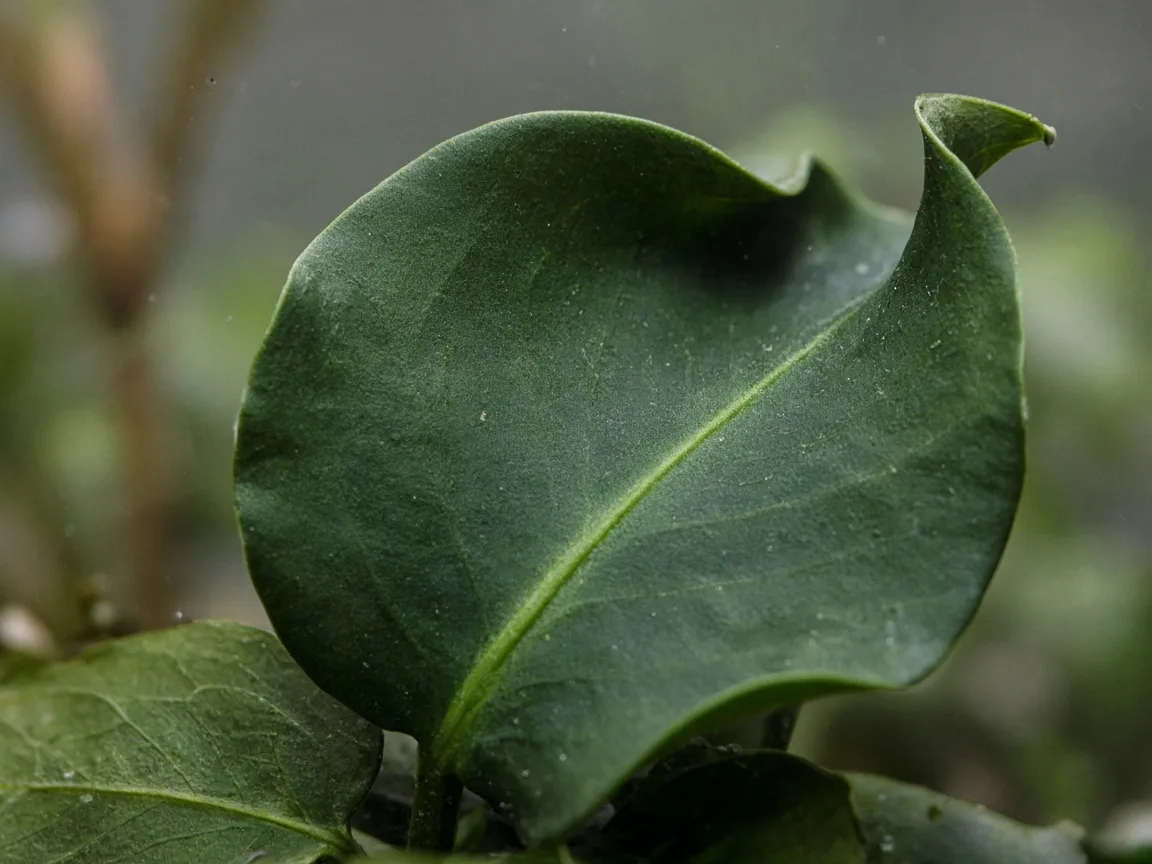
Cupped margins and hooked tips on new Anubias submersed leaves—compare with flat older tissue on the same rhizome.
Patterns that fit mineral or light stress:
- Upward cupping or downward cupping on newest leaves at the growing tip while older leaves stay flat and dark green
- Hooked leaf tips and scalloped margins on fresh submersed foliage in soft-water tanks (GH often under 4 dGH)
- Bleached, curled blades under bright direct fixture light or photoperiods longer than eight to ten hours, sometimes with green spot algae on slow leaves
- Gradual ruffling on mature barteri leaves in low-tech tanks with steady growth—often normal texture, not emergency curl
Patterns that fit rhizome or water-quality problems:
- New leaves small and twisted while the rhizome softens or smells—rot or burial damage, not simple cupping
- Sudden curl across many leaves after an ammonia or nitrite spike in an uncycled tank—chemical stress before nutrient guessing
- Curl on emersed leaves floating above the waterline in turtle setups—tissue drying out; re-submerge per underwatering on Anubias
What is not classic Anubias curl:
- Inward dry roll from calendar “underwatering” of potting mix—this plant lives in aquarium water, not soil moisture schedules
- Spider mite stippling on terrestrial houseplants—uncommon on fully submerged Anubias; see spider mites only if leaves are kept emersed
Because Anubias produces one new leaf every two to three weeks in good conditions, a single cupped blade can persist for months. Judge the next leaf, not the oldest ruffle.
Soft-water cupping on new Anubias leaves
West African stream-margin Anubias evolved in mineral-bearing freshwater, but many hobby tanks run on very soft tap water. Calcium is immobile in plant tissue—when GH drops too low, the deficiency shows on new leaves first as twisted or pale new growth, which on thick Anubias blades reads as cupping, hooked tips, or scalloped edges.
Magnesium supports chlorophyll and pairs with calcium in cell walls. Recommended aquarium ranges sit around 10–15 ppm calcium and 5–10 ppm magnesium, usually covered when GH stays above about 2 dGH—but soft-water cities can run lower while liquid fertilizer alone does not replace hardness minerals.
Soft-water curl checklist:
- New leaves at the rhizome tip cup or hook; oldest leaves still flat
- GH test reads under 4 dGH (or calcium-heavy imbalance from crushed coral without magnesium)
- Plant receives liquid fertilizer yet new deformities continue
- Other slow epiphytes in the same tank show similar new-leaf twist
Cross-check dedicated pages for calcium deficiency on Anubias and magnesium deficiency on Anubias before stacking micro-nutrient doses.
Rhizome exposure and curl on slow epiphytes
Anubias feeds primarily from the water column through leaves and roots, but the rhizome must stay exposed to oxygenated water. Burying the horizontal stem in gravel or sand creates anaerobic decay that starves new leaf development—cupped, stunted, or failing petioles even when older blades look fine.
Rhizome-related curl signals:
- Thread or glue tied too tightly, crushing the cambium
- Rhizome sitting under substrate to “anchor” the plant
- Softening near the growing tip with curl on the newest leaf only
- Recent turtle rearrangement that pushed the stem into detritus-heavy corners
If the rhizome is firm and fully exposed, curl is more likely GH, light, or cultivar texture than burial. If texture turns jelly-like, switch to root rot on Anubias immediately.
Photoinhibition on shade-adapted Anubias foliage
Native Anubias colonizes shaded riverbanks with a thick waxy cuticle. In home tanks, excess PAR or long photoperiods trigger a self-shading response—bleached, curled foliage on leaves that persist for years because the species turns over slowly. Light intensity also drops with depth and dirty glass, so a rhizome placed under a bare bulb can curl while a shaded section on the same plant stays flat.
Light-stress curl vs mineral cupping:
| Clue | Light stress | Soft-water minerals |
|---|---|---|
| Affected leaves | Often sun-facing or top-of-tank | Newest at rhizome tip |
| Algae | Green spot or beard on old leaves | Usually clean blade |
| GH test | Any | Often low |
| Fixture change | Recent bulb upgrade or longer timer | No recent change |
| Fix priority | Shade + shorten photoperiod | Balance GH during water changes |
See Anubias light guide for placement before doubling fertilizer on curled shade leaves.
How to confirm the cause
Work through these checks in order before buying new hardware.
Rhizome firmness and mounting
Remove the plant gently from hardscape if needed. Press the rhizome along its length:
- Firm and green → mineral, light, cultivar texture, or aging are more likely
- Soft, jelly-like, brown, black, or foul-smelling → rot; see root rot on Anubias
Confirm the horizontal stem sits above substrate with only thin roots trailing down—matching our Anubias watering mounting rules.
Which leaves are curling
| Pattern | Likely cause |
|---|---|
| Newest leaves cup or hook; firm rhizome; low GH | Calcium or magnesium availability |
| Bleached curl under bright light; algae on old leaves | Photoinhibition / excess light |
| Gentle edge ruffle on old barteri leaves; steady buds | Cultivar texture or benign aging |
| Curl plus mushy petiole bases | Rhizome rot or burial |
| Curl only on emersed portions above waterline | Drying tissue—re-submerge |
Tank history checklist
Note:
- GH and KH readings from your tap or tank
- Days since purchase—emersed transition can odd-shape first submersed leaves
- Recent light or photoperiod change
- Fertilizer product and dose—especially in soft water
- Ammonia or nitrite in cycling tanks
- Rhizome buried, crushed, or moved during aquascaping or turtle activity
Confirmed benign curl: firm rhizome, predictable pattern (new-leaf cupping in soft water or old-leaf ruffle only), and flatter new leaf within two to four weeks after one targeted correction.
First fix for Anubias
Verify rhizome firmness, expose any buried stem, and test general hardness—then adjust GH or light once, not both on day one.
If GH is low in a soft-water setup, raise hardness with a balanced calcium-magnesium aquarium product at label rates during weekly water changes—avoid crushed-coral-only fixes that skew the Ca:Mg ratio and can lock out iron on slow leaves. If the rhizome was buried, reattach it above substrate on rock or wood per Anubias soil guide.
If the plant sits directly under a strong LED or runs more than eight to ten hours of light, move it to filtered mid-tank shade and shorten the photoperiod before adding fertilizer.
Do not bury the rhizome deeper to stop cupping. Do not dose heavy liquid fertilizer in a dark or uncycled tank—unused nutrients feed algae on slow Anubias leaves.
Step-by-step recovery
After the first rhizome-and-GH-or-light fix, continue in this order:
- Confirm exposure - Rhizome fully visible; only thin roots may enter substrate.
- Stabilize water - Partial water change if organics built up; keep ammonia and nitrite at zero.
- Wait two to four weeks - Realistic first-response window for this slow species.
- Watch the next leaf - Flatter tip and normal margin mean success; persistent hook on new leaves after four weeks favors retesting GH.
- Dose fertilizer only if needed - If new leaves stay pale in a lit zone with firm rhizome, test nitrates and review Anubias fertilizer at label rates.
- Treat rot if texture changes - Any softening rhizome overrides curl patience.
Hold CO₂, copper algae treatments, and major light upgrades until the rhizome is firm and you know whether new submersed growth is flattening.
Recovery timeline
Two to four weeks after corrected GH or light, watch for a new leaf opening with flatter margins—that is the primary success marker.
Four to eight weeks may be needed in very soft water after starting balanced hardness dosing during water changes.
Curled old blades rarely flatten once the cuticle hardens. Judge recovery by the shape of the next leaf from the growing tip, not by saving every cupped frond.
Worsening signs during the wait: rhizome softening, spreading black tissue, foul odor, or every leaf cupping within days while chemistry tests fail—escalate to rot or water-quality emergency.
Lookalike symptoms
Cultivar ruffle - Gentle wave on mature barteri leaves; firm rhizome; normal bud pace.
Soft-water mineral cupping - Hooked new tips in low GH; see calcium deficiency and magnesium deficiency.
Photoinhibition - Bleached curl under strong light with algae on persistent old leaves; fix light placement.
Rhizome rot - Mushy stem, goo at stalk bases; often from buried rhizome—root rot guide.
Emersed drying - Curl on leaves above the waterline in turtle tubs—underwatering.
Distorted new growth - Severe twist or crinkle beyond simple cupping—distorted leaves.
What not to do
Do not check potting-soil moisture or humidity trays—submerged Anubias does not use that care model.
Do not bury the rhizome to flatten cupped leaves—that invites rot.
Do not assume every curl needs iron—confirm firm rhizome, GH, and light first.
Do not add crushed coral alone in soft water without balancing magnesium—new-leaf deformities can persist.
Do not stack fertilizer, CO₂, and brighter lights on day one—fix rhizome exposure and one environmental variable at a time.
Do not tear curled leaves mid-blade—cut at the rhizome so the plant redirects energy cleanly.
How to prevent curling leaves
- Mount on hardscape with rhizome exposed; follow Anubias watering rules
- Test and maintain GH in soft-water regions during regular partial water changes
- Run aquarium lights six to eight hours with the growing tip in filtered, not bare-bulb, brightness—see Anubias light
- Quarantine new plants under moderate light during emersed-to-submersed transition
- Dose fertilizer conservatively in low-tech tanks per Anubias fertilizer
- Trim algae-coated old leaves so slow foliage does not sit under photoinhibition plus fouling
Stable clean water, an exposed rhizome, balanced GH in soft setups, and realistic slow growth prevent most repeat curl scares.
When to worry
Escalate beyond watchful waiting when:
- The rhizome turns soft, smells rotten, or shows spreading jelly-like discoloration
- Ammonia or nitrite stays above zero while leaves cup rapidly in a new tank
- Every new leaf hooks or cups for six to eight weeks despite firm rhizome, corrected GH, and shaded placement—retest minerals and inspect for hidden buried sections
- Bleaching and curl spread under algae treatments containing copper—remove the plant from treated water if species-sensitive
For a firm rhizome with mild cupping on one new leaf in soft water, balanced GH correction and patience usually suffice—the Anubias overview recovers slowly but reliably when the stem stays healthy.
Conclusion
Curling leaves on Anubias are usually new-leaf mineral stress, light imbalance, or harmless cultivar texture—not a houseplant humidity crisis. Squeeze the rhizome first, test GH in soft water, keep the stem exposed, and judge success by the next submersed leaf opening flatter, not by uncurling old tissue. Tie cupping to this slow epiphyte’s water-column feeding and shade biology, and curl becomes a readable signal instead of a panic search for soil moisture advice.