Magnesium Deficiency on Anubias: Causes, Checks & Fixes
Quick answer
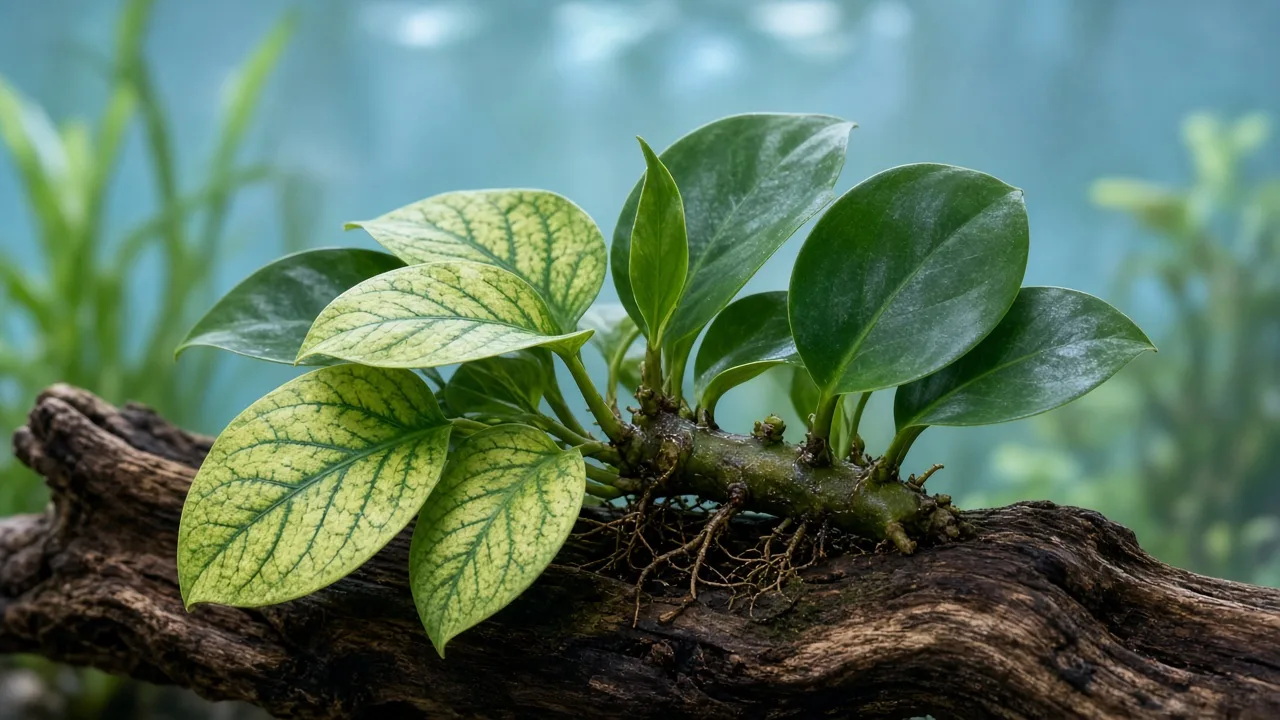
Magnesium deficiency on Anubias shows as pale or yellow tissue between dark green veins on the oldest thick leaves along the rhizome while newer rhizome tips stay dark green. First step: confirm the pattern is on lower mature blades—not pale new tips with green veins—and test general hardness (GH) in soft-water or RO tanks.
Magnesium Deficiency on Anubias: Causes, Checks & Fixes
This guide covers magnesium deficiency on Anubias. See also the general Magnesium Deficiency guide, watering, and light pages for this plant.
Magnesium Deficiency on Anubias: Causes, Checks & Fixes
Quick answer
Magnesium deficiency on Anubias shows as pale or yellow tissue between dark green veins on the oldest thick leaves along the horizontal rhizome while newer rhizome tips and unfurling blades usually stay dark green. Magnesium is mobile within plant tissues—the plant pulls it from mature foliage to fund new growth—so chlorosis concentrates on lower, longest-held blades, not on the softest new leaf at the tip.
See our magnesium deficiency guide for general interveinal chlorosis mechanics. On Anubias, read the leaf-age gradient along one rhizome—mature glossy leaves closest to the attachment point yellow between veins first while the newest spear above them stays normal. That pattern differs from iron deficiency, which bleaches new tips with green veins.
First step: confirm interveinal chlorosis on older lower leaves and test general hardness (GH). Anubias pulls magnesium through its water-column leaves and rhizome, not buried gravel. Very soft tap water, pure RO or RODI water without balanced remineralizer, or GH below about 2 dGH is the most common trigger in shrimp-only and high-light planted tanks—not routine community setups on average municipal tap.
This guide covers submerged aquarium culture only. For baseline feeding cadence, see the Anubias fertilizer guide. For twisted new tips instead of old-leaf vein yellowing, see calcium deficiency. For pinholes on older leaves, see potassium deficiency.
When to use this page vs other Anubias guides
| Pattern | Read next |
|---|---|
| Yellow between veins on oldest lower blades, green rhizome tips | Magnesium deficiency (this page) |
| Pale new tips with dark green veins, normal leaf shape | Iron deficiency |
| Twisted, cupped, or crinkled new leaf at rhizome tip | Calcium deficiency |
| Yellow oldest leaves first, uniform wash without green veins | Nitrogen deficiency |
| Pinholes or scorched margins on older leaves | Potassium deficiency |
| Whole-plant fade within 7–14 days after purchase | Slow growth or acclimation melt |
| Mushy black rhizome buried in gravel | Root rot |
| Uniform pale wash on many open leaves | Pale leaves or Not enough light |
What magnesium deficiency looks like on Anubias
Healthy Anubias leaves are thick, dark green, and leathery, emerging slowly from a firm horizontal rhizome attached to rock or driftwood. Magnesium shortage targets chlorophyll in older tissue because magnesium forms the central atom in chlorophyll and the plant redistributes magnesium upward when supply is limited.
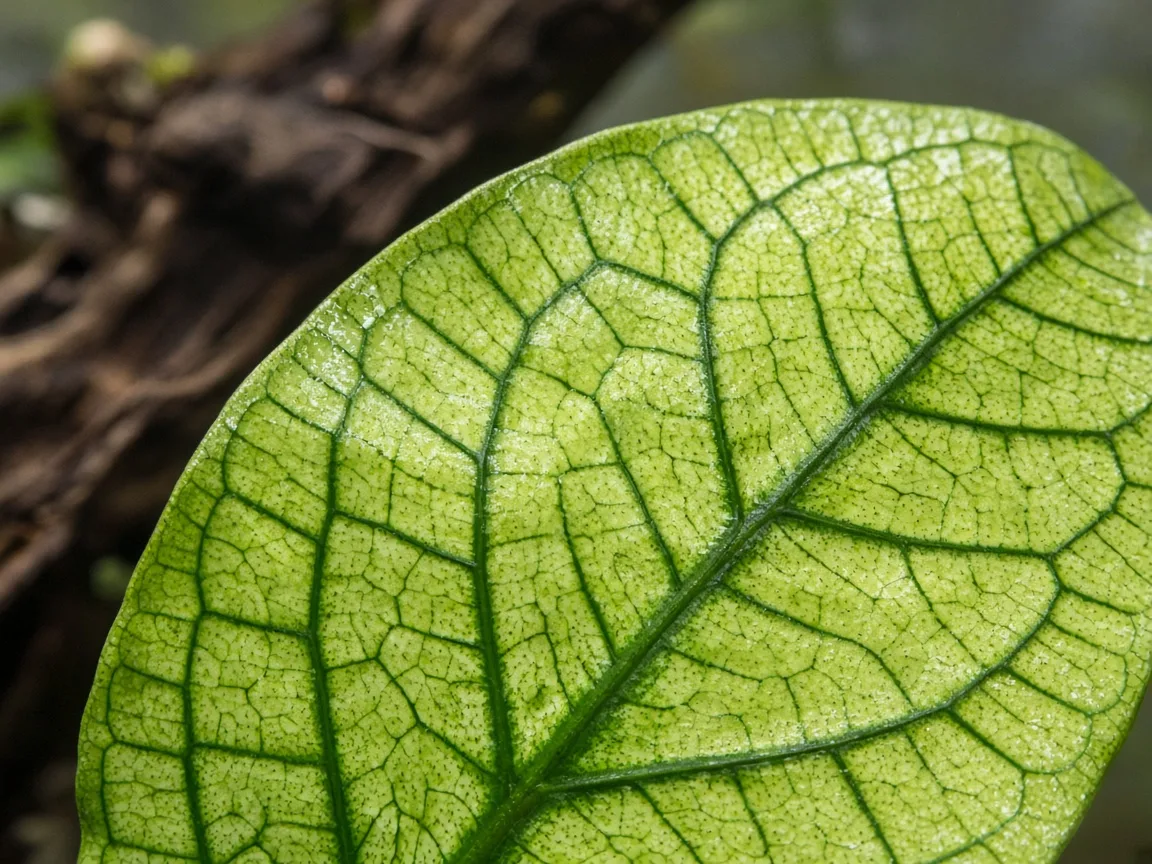
Interveinal chlorosis on an older Anubias blade—the tissue between dark green veins turns pale or yellow while the rhizome tip above stays dark green.
Classic magnesium pattern (confirm this before dosing minerals):
- Oldest lower leaves on the same rhizome show yellow or pale green between dark green veins (interveinal chlorosis)
- Newest rhizome leaf and tip stay dark green with normal vein contrast for weeks
- Rhizome stays firm and green—not the black mush of a buried crown
- Symptoms creep slowly up the rhizome as magnesium is scavenged from lower blades—Anubias already holds each leaf for months in low-tech tanks
- Leaf edges may droop slightly on affected blades in advanced cases (Aquarium Co-Op notes this pattern on aquarium plants)
What it is not:
- Pale new tips with green veins, normal shape → iron deficiency, not magnesium
- Twisted or cupped newest leaf at rhizome tip → calcium deficiency
- Small round pinholes ringed with yellow on older leaves → potassium deficiency
- Whole-leaf yellow or translucent old leaves without green vein islands → nitrogen deficiency
- Whole-plant melt within days of shipping → acclimation stress—see yellow leaves and slow growth
- Black soft rhizome under substrate → root rot from burying the crown—see the soil guide
Anubias is slow to signal problems: which leaves along the rhizome show vein islands matters more than one random pale splotch on a single blade.
Why Anubias runs short on magnesium
Anubias is a slow-growing rhizomatous epiphyte that feeds from the water column. Each thick leaf still demands magnesium for chlorophyll, but uptake fails quietly on mature lower blades while the rhizome keeps pushing new tissue. Very soft water, incomplete remineralization, aggressive water changes, or a lean fertilizer routine in a low-bioload tank can limit supply—and shows on oldest foliage first while newer glossy leaves stay healthy.
Anubias-specific causes:
- RO, RODI, or very soft tap water — Magnesium must be dissolved in the water bathing the rhizome. Aquarium Co-Op notes that magnesium deficiency resembles iron chlorosis but affects older leaves instead of new ones. Shrimp-only and crystal-shrimp tanks are frequent trouble spots.
- GH boosters heavy on calcium, light on magnesium — Some remineralizers rebuild calcium hardness without matching magnesium, leaving total GH readable but magnesium lean (Gensou Aquascaping describes this in soft-water planted tanks).
- Large water changes with pure RO — Frequent 50 percent or larger changes with un-remineralized water strip magnesium faster than a slow Anubias can tolerate, even when comprehensive liquid fertilizer is dosed.
- Micronutrient-only or iron-heavy dosing in a lean tank — Iron supplements do not replace magnesium. Green Leaf Aquariums notes magnesium is moderately mobile and deficiency appears on older leaves first.
- Low-bioload turtle or quarantine tanks — Fish waste normally buffers minerals in community tanks. A sparsely stocked turtle display with heavy filtration and large water changes can run leaner than owners expect—test before assuming magnesium is fine.
- Competition from fast growers in high-tech scapes — Stems and carpets in CO₂-injected tanks can strip the water column before dissolved minerals reach an Anubias tied to the back wall. Interveinal yellow on one slow epiphyte’s oldest leaves while Ludwigia thrives is a classic soft-water or dosing-balance clue.
Rhizome leaf-age gradient and slow leaf-cycle check
Anubias holds each leathery blade for months along a horizontal rhizome. When magnesium runs low, the lowest, oldest petioles lose chlorophyll between veins first as the plant translocates magnesium to younger tissue. The pattern climbs slowly toward the rhizome tip—one yellowed lower blade differs from three consecutive older leaves showing vein islands while the newest spear stays dark green.
That gradient differs from iron deficiency, which bleaches the softest unfurling tip while mature blades below look fine. It also differs from nitrogen deficiency, which yellows whole old leaves uniformly rather than leaving dark green vein tracks.
Judge severity by successive rhizome leaves: one slightly pale lower blade after a large RO change differs from steady upward spread over two leaf cycles. Because Tropica lists Anubias as a slow grower, you may need to wait a full leaf cycle (four to eight weeks in low-tech tanks) to confirm the next blade opens without interveinal yellowing.
Water-column feeding vs buried rhizome placement
Anubias evolved on stream margins with the rhizome exposed and roots anchoring to rock—not buried in rich soil. In your tank, magnesium reaches older leaves only when it is dissolved in the water bathing the rhizome and every attached blade. A root tab buried under gravel near the plant does not reliably feed the rhizome meristem, and burying the crown is the fastest way to trigger root rot instead of fixing minerals.
Practical placement check:
- Rhizome sits on driftwood, rock, or open gravel with roots in water—not under substrate
- Flow from the filter passes the rhizome occasionally without blasting it with a powerhead
- No terrestrial fertilizer, potting soil, or copper-treated products in the water column
- Liquid comprehensive fertilizer dosed into the water after water changes per the fertilizer guide
If the rhizome is firm and green but oldest leaves show interveinal yellow, the problem is almost certainly water chemistry, not placement. If the rhizome is soft, black, or smells foul, fix crown health before any mineral dosing.
Turtle tank and low-bioload GH stripping
Many Anubias keepers grow the plant in turtle aquariums or lightly stocked displays where fish waste does not supply the minerals a community tank would. Turtle keepers also run strong filtration and large water changes to manage waste—both of which can lower GH and magnesium if change water is very soft or un-remineralized RO.
Turtle-tank cross-check:
- Test GH and KH on tank water and tap or RO source used for changes
- Confirm mineral targets match your turtle species’ husbandry range before raising hardness
- Do not add terrestrial Epsom salts, garden gypsum, or unlabeled pond products directly to turtle water without dissolving into change water first
- If oldest Anubias leaves show interveinal yellow but GH reads moderate, rule out not enough light and excess fertilizer driving algae before another mineral tweak
Anubias in turtle tanks is often healthy on municipal tap alone. Magnesium deficiency is more likely when the setup is deliberately soft for shrimp, discus, or specific turtle species—or when RO change water never gets remineralized with balanced calcium and magnesium.
How to confirm magnesium deficiency on Anubias
Work through this order before buying supplements:
- Pattern check — Is chlorosis between veins on the oldest lower leaves with normal dark green rhizome tips? If yes, magnesium stays on the list. If the newest leaf is pale with green veins, pivot to iron deficiency.
- GH test — Use a liquid drop kit on tank water. Below 2 dGH strongly suggests insufficient dissolved magnesium and calcium for column feeders. Moderate GH (4–8 dGH) makes pure magnesium shortage less likely—look at iron on new tips or potassium pinholes next.
- Water source review — RO, RODI, rainwater collection, or very soft municipal water are red flags. Note whether large water changes happen without balanced remineralizer.
- Fertilizer label — Confirm you dose a comprehensive liquid, not iron-only products. Check whether change water includes magnesium—not just trace micronutrients in the bottle.
- Rhizome firmness — Green, firm rhizome with interveinal yellow on lower blades supports nutrient diagnosis. Soft black tissue means root rot first.
- Lookalike minerals — Calcium deficiency distorts new tips; potassium deficiency punches pinholes in old leaves without classic green-vein islands.
The first fix to try
Test GH and remineralize change water with balanced calcium and magnesium if readings are below about 4 dGH—before stacking iron supplements or Epsom salt dumps.
That single step addresses the most common Anubias magnesium trigger without overdosing a slow grower. Use a balanced aquarium GH booster or remineralizer rated for planted tanks and invertebrates, mixed into change water only, then add gradually through partial water changes over one to two weeks. Target roughly 4–8 dGH unless shrimp or turtle species require a narrower band.
If GH is already adequate but oldest leaves still show interveinal yellow, dissolve Epsom salt (magnesium sulfate) into the next water change at a conservative dose—roughly 1 gram per 40 liters raises magnesium by about 2.5 ppm per aquarium magnesium guidance—rather than dumping crystals into the display.
Do not dose iron for old-leaf vein yellowing. Do not bury the rhizome deeper to “reach” minerals. Do not double comprehensive fertilizer on the same day you raise GH—adjust one variable, then watch the next rhizome leaf.
Step-by-step recovery
After GH and magnesium are stable:
- Resume conservative liquid feeding — Half label dose of comprehensive fertilizer once weekly after water changes per the Anubias fertilizer guide. Anubias is a light feeder; excess nutrients often feed algae on slow leaves.
- Expose the rhizome — Re-tie or wedge the crown above substrate if any section was buried. Trim only fully melted leaves at the petiole; leave firm chlorotic blades until replacements harden.
- Stabilize light — Six to eight hours of moderate aquarium light supports steady new growth without pushing the plant faster than its magnesium supply can follow. See the light guide.
- Wait one leaf cycle — Judge the next rhizome leaf, not the currently yellowed lower blade. Recovery means a cleaner unfurl within four to eight weeks in low-tech tanks.
- Escalate only if lower-leaf chlorosis keeps climbing — With stable GH, firm rhizome, and conservative dosing, persistent spread may indicate calcium-magnesium imbalance or trace gaps—post photos showing old vs new leaves before mineral chasing.
Recovery timeline
| Stage | What you should see |
|---|---|
| Week 1–2 | GH stable; no further spread of interveinal yellow to additional lower blades |
| Week 3–6 | Next rhizome leaf begins unfurling without yellow between veins |
| Week 6–10 | Second clean leaf confirms the fix in low-tech tanks |
| Ongoing | Older chlorotic leaves remain pale; trim cosmetically once replacements look firm |
Damaged tissue does not re-green retroactively. Magnesium is mobile, so existing yellow bands between veins stay visible on old blades. Success means new leaves open with normal thick Anubias color and the rhizome stays firm.
Mistakes to avoid
- Dosing iron for old-leaf interveinal yellow — Iron hits new tips; magnesium hits old lower blades. Read the iron deficiency page before grabbing Easy Iron.
- Treating potassium pinholes as magnesium — Pinholes on old leaves without green vein islands point to potassium deficiency, not magnesium.
- Burying the rhizome to “feed” the plant — Invites root rot and does not deliver magnesium to submerged blades.
- Assuming fish waste covers minerals in every tank — Shrimp-only, turtle, and quarantine setups often run lean.
- Large RO changes without remineralizer — Stripping GH weekly overwhelms a slow Anubias even when fertilizer is dosed.
- Treating shipping melt as magnesium on day three — Whole-plant yellowing after arrival is acclimation, not a GH problem—see yellow leaves.
- Stacking GH booster, Epsom salt, iron, and CO₂ changes same day — You cannot read which fix worked.
How to prevent magnesium deficiency next time
- Test GH monthly in soft-water, RO, shrimp, or turtle tanks
- Remineralize change water with balanced calcium and magnesium before it enters the tank—not after symptoms appear
- Keep the rhizome exposed on hardscape per the soil and watering guides
- Dose comprehensive liquid conservatively after changes; let Anubias tell you when it needs more
- Match water changes to bioload — Very large changes in low-stock tanks need mineral-aware refill water
When to worry
Escalate if interveinal chlorosis keeps climbing toward the rhizome tip after two full leaf cycles (often eight to sixteen weeks in low-tech tanks) despite stable GH, firm crown, adequate light, and conservative feeding. Chronic old-leaf yellow with moderate GH can indicate calcium-magnesium ratio imbalance in high-tech scapes—fix system stability before adding more Epsom salt.
If the rhizome turns black and mushy—not merely chlorotic lower leaves—treat as root rot urgency, not a nutrient tweak.
Related Anubias guides
- Anubias overview
- Anubias watering
- Anubias light
- Anubias fertilizer
- Anubias problems
- Iron deficiency on Anubias
- Calcium deficiency on Anubias
- Potassium deficiency on Anubias
- Nitrogen deficiency on Anubias
- Pale leaves on Anubias
Related tool
Use the Fertilizer Dilution Calculator to check dose rates for comprehensive aquarium fertilizers after GH is stable—without stacking magnesium, iron, and GH changes on the same day.