Nitrogen Deficiency on Anubias: Causes, Checks & Fixes
Quick answer
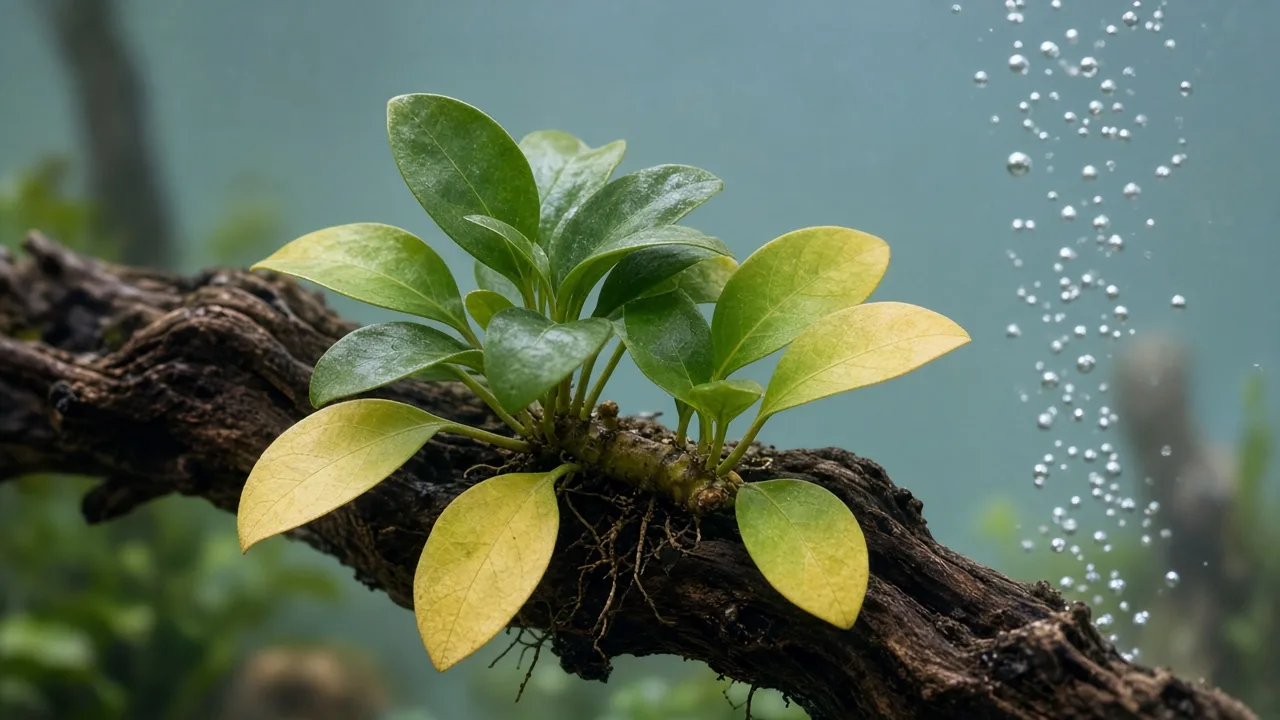
Nitrogen deficiency on Anubias shows as uniform pale yellow-green on the oldest leaves along the rhizome—often starting at the leaf tips and turning translucent—while newer leaves at the rhizome tip stay greener but may emerge smaller. First step: test aquarium nitrate (NO3) levels; if they read 0 ppm in a shrimp-only or heavily filtered tank, address nitrogen before adding micronutrient-only fertilizer.
Nitrogen Deficiency on Anubias: Causes, Checks & Fixes
This guide covers nitrogen deficiency on Anubias. See also the general Nitrogen Deficiency guide, watering, and light pages for this plant.
Nitrogen Deficiency on Anubias: Causes, Checks & Fixes
Quick answer
Nitrogen deficiency on Anubias shows as uniform pale yellow-green on the oldest leaves along the rhizome—often starting at the leaf tips and turning translucent—while newer leaves at the rhizome growing point stay greener but may emerge smaller or thinner than earlier growth. Nitrogen is mobile in plants, so the plant strips chlorophyll from mature blades to fund new tissue at the tip.
See our nitrogen deficiency guide for general mobile-nutrient mechanics. On Anubias, read yellowing from the rhizome base upward—the leaf that has been attached longest yellows first, not the soft new blade unfurling at the tip.
First step: test aquarium nitrate (NO3). If readings sit at 0 ppm in a shrimp-only, turtle-light, or heavily filtered tank while oldest leaves pale, address nitrogen before reaching for iron or potassium supplements. Anubias pulls nutrients through its water-column leaves and rhizome, not buried roots—so gravel and root tabs will not fix this pattern.
This guide covers submerged aquarium culture only. For baseline feeding cadence, see the Anubias fertilizer guide. For pale new tips with green veins instead of old-leaf washout, see iron deficiency.
When to use this page vs other Anubias guides
| Pattern | Read next |
|---|---|
| Yellow oldest leaves first, green rhizome tips | Nitrogen deficiency (this page) |
| Pale new tips with dark green veins, normal shape | Iron deficiency |
| Twisted, cupped, or crinkled new leaf at rhizome tip | Calcium deficiency |
| Pinholes or scorched margins on older leaves | Potassium deficiency |
| Interveinal yellow on older blades | Magnesium deficiency |
| Whole-plant fade within 7–14 days after purchase | Yellow leaves or acclimation melt |
| Uniform pale wash on many open leaves, dim tank | Pale leaves or Not enough light |
| Mushy black rhizome buried in gravel | Root rot |
| Stalled growth, firm rhizome, adequate NO3 | Slow growth |
What nitrogen deficiency looks on Anubias
Healthy Anubias leaves are thick, dark green, and leathery, emerging slowly from a firm horizontal rhizome on rock or driftwood. Nitrogen shortage targets mature foliage that has been on the rhizome longest because nitrogen supports chlorophyll and leafy growth and can be redistributed upward.
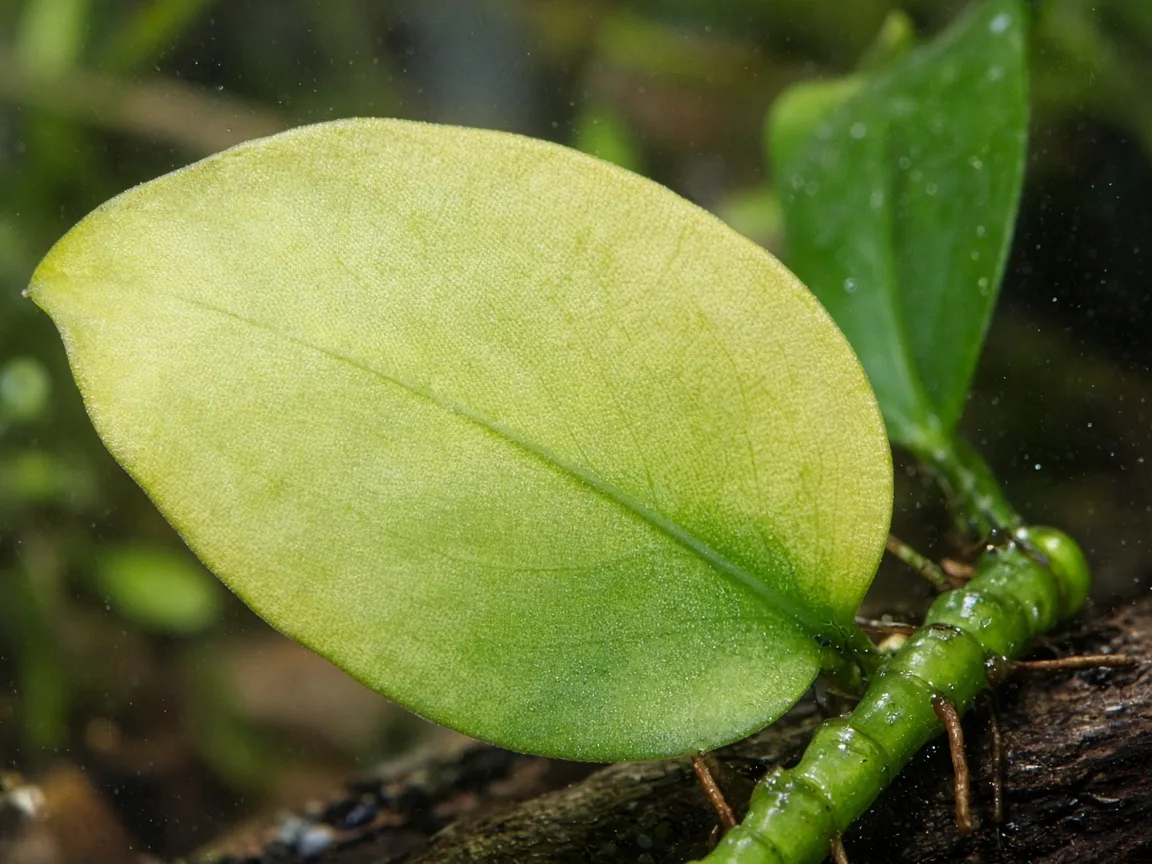
Oldest Anubias leaf along the rhizome showing uniform pale yellow-green chlorosis from the tip inward—compare with darker newer blades closer to the growing point.
Classic nitrogen pattern (confirm this before dosing macros):
- Oldest leaf on each rhizome section turns pale yellow-green, often starting at the tip and moving toward the petiole
- Leaf tissue may become translucent on heavily starved plants—not just pale
- Newer leaves at the rhizome tip stay greener but may emerge smaller or thinner than earlier blades
- Rhizome stays firm and green—not the black mush of a buried crown
- Growth interval lengthens—you wait longer than usual between new leaves (Anubias already pushes one leaf every four to eight weeks in low-tech tanks)
What it is not:
- Pale new tips with green veins, normal shape → iron deficiency, not nitrogen
- Twisted or cupped newest leaf → calcium deficiency
- Pinholes ringed with yellow on older leaves → potassium deficiency (Aquarium Co-Op describes this as the classic K pattern)
- Whole-plant melt within days of shipping → acclimation stress—see yellow leaves and slow growth
- Uniform washed-out green across all leaves in a dim tank → not enough light before assuming hunger
- Black soft rhizome under substrate → root rot from burying the crown—see the soil guide
Aquarium Co-Op notes that low nitrates often show as old leaves turning yellow and translucent, especially from the tips—the plant consumes nutrients from bottom leaves to make new growth at the top. On slow Anubias, that bottom-to-top ladder is easier to read than on fast stem plants because each leaf stays attached for months.
Why Anubias runs short on nitrogen
Anubias is a slow-growing rhizomatous epiphyte that stores energy in a horizontal rhizome and absorbs dissolved nutrients from aquarium water through leaves and exposed rhizome tissue. Even light feeders run out of nitrogen when the tank supplies none.
Anubias-specific causes:
- Zero-nitrate low-bioload tanks — Shrimp-only, nano, or turtle-light setups with few fish produce little ammonia for bacterial conversion to nitrate. Aquaponic systems rely on fish waste and bacteria to supply nitrogen; without that bioload, Anubias depends entirely on you.
- Aggressive water changes — Hobbyists trained on fish-only tanks may change 50% weekly without testing NO3, stripping nitrates Anubias was slowly consuming.
- Micronutrient-only dosing — Products like Seachem Flourish supply trace elements but limited macronutrient nitrogen. Dosing micros while NO3 reads 0 ppm can yellow oldest leaves while you chase iron or potassium instead.
- Over-filtration or nitrate-absorbing media — Phosphate or nitrate removal pads in filters starve all water-column feeders, including epiphytes on hardscape.
- Competition from fast stem plants — In high-tech scapes, Ludwigia and other stem plants can outcompete slow Anubias for dissolved nitrogen even when a test shows moderate NO3 at mid-tank.
- New-tank syndrome after cycling — Freshly cycled tanks may show 0 ppm until bioload builds; Anubias yellows slowly while owners wait for “indestructible” plant behavior.
Do not diagnose nitrogen deficiency on a black mushy rhizome buried in gravel—that is root rot until you confirm a firm green crown above the substrate line.
The nitrate test fork in low-bioload tanks
The diagnostic fork on Anubias is tank nitrate level, not pot weight or soil moisture—those checks belong on terrestrial houseplants, not submerged rhizomes.
Test NO3 before any fertilizer change:
| Reading | Likely story on Anubias |
|---|---|
| 0–5 ppm + oldest leaves yellowing | Nitrogen deficiency likely—especially in shrimp-only or heavily filtered tanks |
| 10–20 ppm + oldest leaves yellowing | Look at magnesium, potassium, or light before adding more nitrogen |
| 40+ ppm + yellow oldest leaves | Unlikely pure nitrogen hunger—check potassium limits or water-quality stress |
Penn State Extension notes nitrate-nitrogen as a critical plant nutrient in aquatic solutions. In aquarium hobby terms, 0 ppm NO3 with yellowing oldest Anubias leaves is a clearer nitrogen signal than guessing from leaf color alone.
Turtle tanks add a wrinkle: moderate bioload may supply enough nitrogen that Anubias never needs macro dosing—but large water changes for turtle hygiene can still strip nitrates. Test after your normal change routine, not only on setup day.
Reading the rhizome leaf ladder
Anubias does not drop old leaves quickly. Each thick blade can stay attached for months, which creates a visible age ladder along the rhizome:
- Rhizome tip — newest leaf bud or soft unfurling blade (should stay green unless iron- or calcium-limited)
- Mid-rhizome — mature dark green leaves in their prime
- Rhizome base / oldest petioles — first leaves to yellow when nitrogen runs low
This ladder is nonsense on a snake plant rosette or a fern crown—it is the primary diagnostic tool on Anubias. Walk the rhizome from base to tip: if yellowing concentrates at the oldest attachment points while the tip still pushes green blades, mobile nitrogen shortage fits. If only the tip is pale, pivot to iron or calcium guides.
Because RHS guidance notes older leaves are affected first in nitrogen deficiency, one random yellow leaf on an otherwise green rhizome may be normal senescence—see yellow leaves. Nitrogen starvation shows progressive yellowing up the age ladder on multiple rhizome sections over weeks.
The macro-only fertilizer trap
A common Anubias mistake is dosing micronutrient blends without macronutrient nitrogen in a tank that already reads 0 ppm NO3.
Anubias is marketed as a plant that “does not need fertilizer,” which is true in stocked community tanks where fish food and waste supply ammonia. In planted shrimp cubes, quarantine tanks, or hardscape-only scapes, that advice leaves Anubias on trace elements alone while macros stay at zero.
Signs you are in the trap:
- You dose Seachem Flourish or similar micro blends weekly
- NO3 test still reads 0 ppm
- Oldest Anubias leaves yellow while you add iron for “pale plants”
- Fast stem plants in the same tank look fine—they grabbed nitrogen first
Fix the macro gap before stacking micros. See the Anubias fertilizer guide for when to use all-in-one liquid versus conservative half-dose macros—and never bury the rhizome to “feed the roots.”
How to confirm nitrogen deficiency on Anubias
Work through this order before changing multiple variables:
- Rhizome firmness — Green and firm above substrate? If black and mushy, treat root rot first.
- Leaf age pattern — Yellow oldest leaves with greener rhizome tips? Mobile nitrogen pattern. Pale new tips only? Not nitrogen.
- Nitrate test — Liquid test kit or calibrated strip; target context 10–20 ppm for planted growth, note if 0 ppm.
- Bioload review — Fish count, feeding volume, shrimp-only status, recent large water changes.
- Fertilizer label — Are you dosing macros (N-P-K) or micronutrients only?
- Tank age — New setup under four weeks may simply need time for nitrogen cycle to stabilize.
- Purchase timing — Brand-new plant yellowing all leaves at once within days is melt, not chronic nitrogen deficiency (Aquarium Co-Op distinguishes melt from nitrogen deficiency on new plants).
Confirmed nitrogen deficiency requires old-leaf uniform yellowing + low NO3 + firm rhizome + exclusion of melt timing—not yellow leaves alone.
The first fix to try
Test nitrate. If NO3 reads 0–5 ppm and oldest Anubias leaves match the pattern above, add nitrogen once through a measured macro source—not a micronutrient-only dose.
Practical options:
- All-in-one liquid fertilizer with macronutrients at half label dose after a water change (per Anubias fertilizer conservative rhythm)
- Increase bioload-appropriate feeding in understocked tanks—more fish food means more ammonia conversion to nitrate over time
- Reduce nitrate-stripping filter media if you run phosphate or nitrate removal pads unnecessarily
Do not bury root tabs, dump dry salts, or stack iron and potassium on the same day you first add nitrogen. One macro adjustment, then wait four to six weeks for Anubias to push a new leaf before re-testing.
Step-by-step recovery
After the first measured nitrogen addition:
- Remove fully translucent leaves at the rhizome with sharp scissors— they will not recover and can harbor algae
- Maintain stable light — do not blast high PAR to “force green” without matching nutrients
- Resume conservative weekly testing of NO3 until readings stabilize in the 10–20 ppm range for planted tanks
- Keep rhizome exposed on rock or wood per the watering guide — buried crowns fail regardless of nitrogen
- Trim algae from remaining leaves gently; nitrogen-starved slow leaves collect green spot algae when photosynthesis stalls
- Re-test before second dose — Anubias responds slowly; doubling fertilizer because you saw no change in three days often causes algae, not faster greening
If NO3 rises but oldest leaves keep yellowing, pivot to magnesium or potassium differentiation—not more nitrogen blindly.
Recovery timeline
Anubias is slow. Expect:
- 2–4 weeks — NO3 readings stabilize after first measured dose; yellowing stops spreading up the rhizome ladder
- 4–8 weeks — Next new leaf at rhizome tip emerges darker and slightly larger in low-tech tanks
- Months — Multiple new leaves needed before the rhizome looks full again; old yellow blades do not re-green
Judge success by new leaf color and size at the rhizome tip, not old tissue recovering. Tropica lists Anubias as a slow grower—one new leaf every four to eight weeks is normal even after correction.
Mistakes to avoid
- Dosing iron for old-leaf yellowing — Iron targets new-tip chlorosis, not mobile nitrogen loss on mature blades
- Burying rhizome to “feed roots” — Causes rot; Anubias feeds from the water column
- Large water changes without retesting NO3 — Can undo weeks of slow nitrogen buildup
- Assuming fish waste is enough — Shrimp-only and nano tanks often prove otherwise
- Feeding nitrogen to a melting new plant — Wait for acclimation to finish before diagnosing chronic deficiency
- Chasing high PAR — Bright light without nitrogen increases algae on slow leaves, not faster Anubias growth
How to prevent nitrogen deficiency next time
- Test NO3 monthly in low-bioload planted tanks—not only when leaves yellow
- Dose all-in-one liquid at half strength after water changes when stock is light; see Anubias fertilizer
- Match water-change volume to bioload — Large changes in shrimp cubes need macro-aware refill
- Remove nitrate-absorbing filter media unless you deliberately run ultra-low-nutrient systems and accept slower growth
- Quarantine new rhizomes on clean hardscape until acclimation melt passes—do not confuse melt with hunger on day three
- Keep rhizome above substrate per the Anubias overview attachment method
When to worry
Escalate if yellowing climbs through most rhizome leaves, two successive new leaves at the tip stay undersized and pale-green despite NO3 at 10–20 ppm for six weeks, and the rhizome remains firm. That pattern may indicate competition from faster plants, CO₂ instability in high-tech scapes, or a different nutrient limit—re-check iron, magnesium, and system stability before adding more nitrogen.
If the rhizome turns black and mushy—not merely pale oldest leaves—treat as root rot urgency.
Related Anubias guides
- Anubias overview
- Anubias watering
- Anubias light
- Anubias fertilizer
- Anubias problems
- Iron deficiency on Anubias
- Magnesium deficiency on Anubias
- Potassium deficiency on Anubias
- Calcium deficiency on Anubias
- Pale leaves on Anubias
- Yellow leaves on Anubias
Related tool
Use the Fertilizer Dilution Calculator to check half-strength macro dose rates for all-in-one aquarium fertilizers after NO3 testing—without stacking nitrogen, iron, and potassium changes on the same day.