Iron Deficiency on Anubias: Causes, Checks & Fixes
Quick answer
Iron deficiency on Anubias shows as pale or yellow new leaves emerging from the rhizome tip with dark green veins (interveinal chlorosis) while older tough leaves on the same plant stay dark green. First step: confirm the vein pattern is on the newest unfurling blade—not uniform yellow on old leaves, algae-coated slow growth, or a buried rotting rhizome—then dose chelated iron or a comprehensive liquid aquarium fertilizer.
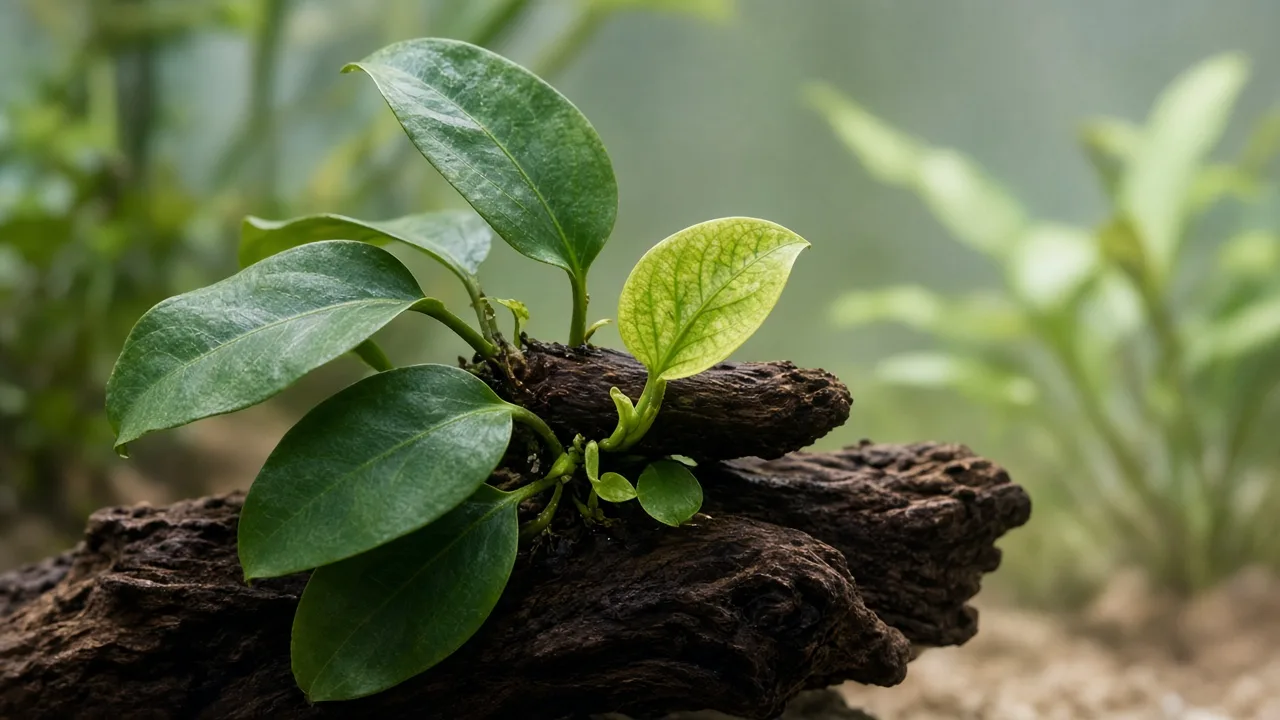
Iron Deficiency on Anubias: Causes, Checks & Fixes
This guide covers iron deficiency on Anubias. See also the general Iron Deficiency guide, watering, and light pages for this plant.
Iron Deficiency on Anubias: Causes, Checks & Fixes
Quick answer
Iron deficiency on Anubias shows as pale or yellow new leaves with dark green veins (interveinal chlorosis) at the rhizome growing tip, while older tough leaves on the same plant usually stay dark green. Iron is immobile in plants—the plant cannot move stored iron from mature blades to feed new tissue—so chlorosis appears on the newest unfurling leaf first, not on the lowest old foliage the way nitrogen deficiency does.
See our iron deficiency guide for general chlorosis mechanics. On Anubias, inspect the softest new blade still opening from the horizontal rhizome—mature glossy leaves behind it can look fine for weeks while only the freshest tip shows green-vein yellowing.
First step: confirm interveinal chlorosis on the newest rhizome-tip leaf, then dose chelated iron or a comprehensive liquid aquarium fertilizer at label strength. Anubias pulls micronutrients through its water-column leaves and rhizome, not gravel or potting soil. In low-bioload, shrimp-only, or lightly stocked turtle tanks with moderate light, low dissolved iron is a common trigger—fish waste supplies nitrogen but little iron.
This guide covers submerged aquarium culture only. For baseline product choice and weekly cadence, see the Anubias fertilizer guide. For twisted or cupped new tips instead of vein-pattern yellowing, see calcium deficiency. For bottom-up uniform yellowing, see nitrogen deficiency.
When to use this page vs other Anubias guides
| Pattern | Read next |
|---|---|
| Pale new tips with dark green veins, normal leaf shape | Iron deficiency (this page) |
| Yellow oldest leaves first, green rhizome tips | Nitrogen deficiency |
| Interveinal yellow on older blades | Magnesium deficiency |
| Twisted, cupped, or crinkled new leaf at rhizome tip | Calcium deficiency |
| Pinholes or scorched margins on older leaves | Potassium deficiency |
| Uniform pale wash on many open leaves | Pale leaves or not enough light |
| Whole-plant yellowing with mushy buried rhizome | Root rot or overwatering |
| Whole-plant fade within 7–14 days after purchase | Slow growth or acclimation melt |
| Green spot algae coating slow leaves | Algae stress — see light guide |
What iron deficiency looks like on Anubias
Healthy Anubias leaves are thick, dark green, and leathery, emerging slowly—often one or two per month—from a firm horizontal rhizome attached to rock or driftwood. Iron shortage targets color on the newest tissue because the plant cannot redistribute stored iron from older blades.
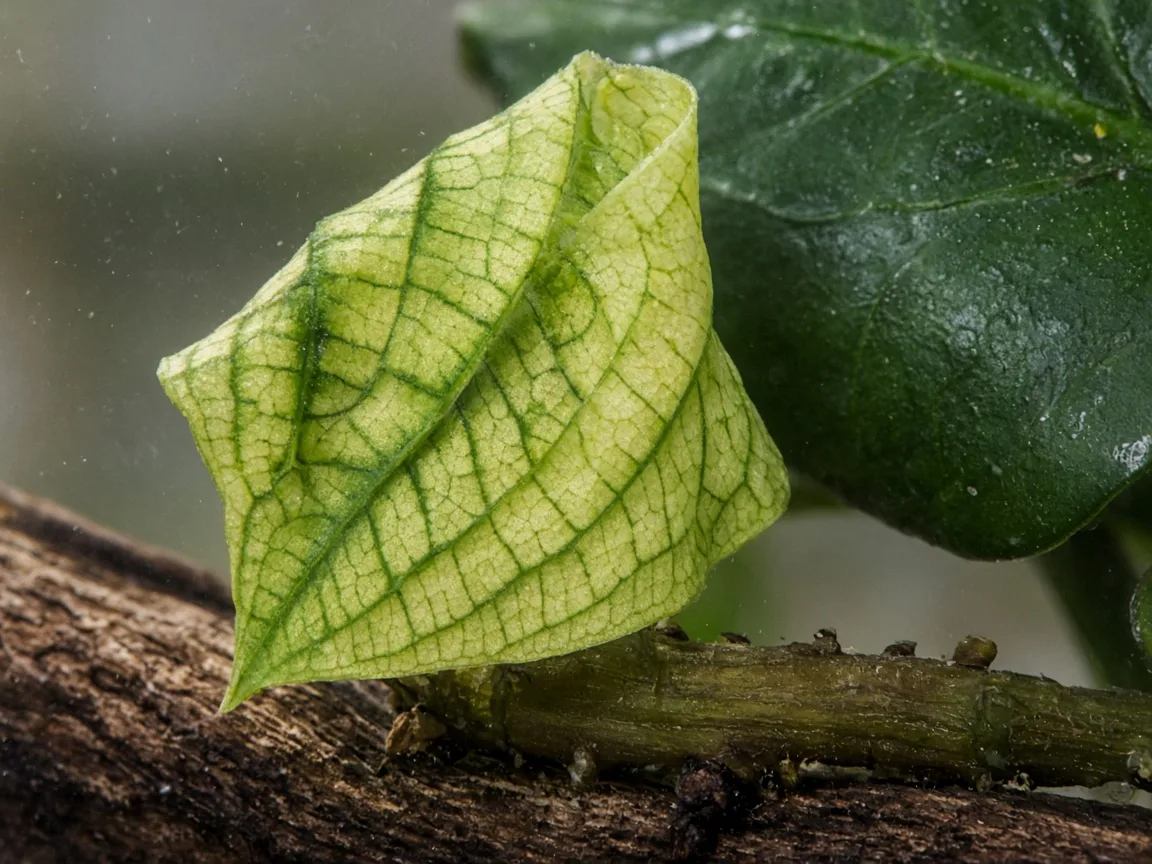
Newest Anubias leaf unfurling from the rhizome: pale yellow tissue between dark green veins while older leathery blades behind it stay normal green—classic iron chlorosis on slow epiphyte growth.
Classic iron pattern (confirm this before dosing):
- Newest leaf at the rhizome tip emerges pale yellow, lime green, or washed-out green
- Veins remain darker green against lighter tissue between them—interveinal chlorosis
- Older leathery leaves on the same rhizome stay dark green for weeks or months while only the fresh tip looks sick
- Rhizome stays firm and green-brown—not the black mush of a buried stem
- Growth may slow further—the opening leaf looks thin or smaller when iron stays low through multiple leaf cycles
What it is not:
- Yellow oldest leaves first with green tips → nitrogen deficiency, not iron
- Interveinal yellow on mature lower blades while the tip stays green → magnesium deficiency
- Twisted or cupped new tips without clear vein contrast → calcium deficiency
- Whole-plant washout within the first 7–14 days after purchase → acclimation melt on slow growth, not a call for iron on day three
- Uniform dull green everywhere in a dim tank → not enough light before micronutrient tweaks
- Widespread yellowing with soft black rhizome buried in gravel → root rot, not nutrient deficiency
Anubias is a slow diagnostician: the position of pale tissue on the rhizome matters more than the word “yellow” in a forum title. Iron deficiency in aquarium plants often presents as chlorosis where new leaves turn yellow while veins remain green.
Why Anubias runs short on iron
Anubias is a slow-growing rhizomatous epiphyte from shaded West African streams. Its thick leaves and exposed rhizome absorb dissolved iron, manganese, and other trace elements directly from the water column—not from substrate buried under gravel. That design makes it forgiving in community tanks, but it also means micronutrients must be dissolved in the tank water when bioload is low.
Common iron-deficiency triggers on Anubias:
- Shrimp-only, betta-only, or lightly stocked turtle tanks — Minimal fish bioload supplies some nitrogen through waste but does not replace chelated iron that comprehensive fertilizers provide.
- Trace-only dosing in low-stock tanks — Products like Seachem Flourish add iron but assume fish supply macronutrients; in sparse tanks you may need a fuller formula such as Tropica Specialised Nutrition that includes nitrogen, phosphorus, potassium, and the full trace package per the fertilizer guide.
- Months without liquid fertilizer in a planted display — Anubias is a light feeder, not a zero feeder. Skipping all supplementation for a year in a tank with stem plants and moss can still leave the slowest grower iron-starved at the rhizome tip.
- Heavy water changes with RO or very soft water — Dilutes trace elements unless you remineralize or redose after changes.
- Strong light on a low-tech tank without matching micros — Faster photosynthesis on neighboring plants can deplete dissolved iron before slow Anubias shows stress—but the symptom still appears on the newest Anubias leaf, not old tissue.
Fish waste helps nitrogen. It does not reliably supply chelated iron at the levels a pale new Anubias tip needs in a planted low-bioload aquarium.
Rhizome-tip chlorosis: reading slow new leaves on an epiphyte
Anubias barteri shows iron stress on the single soft blade still unfurling from the horizontal rhizome—a pattern that would be nonsense on a fast stem plant whorl or a terrestrial rosette. Veins stay green while the expanding tissue between them yellows before the leaf hardens into its typical leathery gloss.
That tip-only chlorosis distinguishes iron from nitrogen, which starts on the lowest oldest leaf attached to the rhizome. It also differs from normal juvenile color: a brand-new Anubias blade is briefly lighter green for a few days, then deepens. Worry when two or three consecutive new leaves from the same rhizome stay yellow-green with dark veins for weeks after hardening.
Because Anubias may produce only one leaf per month in low light, iron deficiency develops slowly. Compare the last two leaves that opened from the growing point:
- One pale opener after a big water change — may be transient dilution; redose and wait
- Two or three pale openers in a row with green veins — strong iron signal during stable light and firm rhizome
This rhizome-tip timeline is specific to slow epiphyte growth and does not apply to stem plants or terrestrial houseplants.
Water-column feeding: why root tabs miss Anubias iron needs
Unlike rooted swords or crypts, Anubias does not pull meaningful iron through anchor roots in gravel. Tropica lists Anubias as an epiphyte that should have its rhizome above substrate—roots attach to hardscape; the rhizome and leaves process nutrients from flowing tank water.
Practical consequences for iron correction:
- Liquid chelated iron reaches the newest expanding leaf immediately through the water column
- Root tabs placed under the rhizome do not fix chlorosis and can encourage burying, which leads to root rot
- Terrestrial houseplant iron drenches are wrong chemistry for submerged culture—use aquarium-labeled products only
If you keep Anubias in a mixed tank with heavy root feeders, stem plants may look fine while the epiphyte on driftwood shows tip chlorosis. That split diagnosis—healthy rooted neighbors, sick rhizome tip—is a classic Anubias iron pattern.
Turtle tanks and low-bioload setups: the micronutrient gap
Anubias is popular in turtle aquariums because tough leaves resist casual grazing and the rhizome ties securely to rock. Turtle setups often run lower fish stocking than community planted tanks, which means less nitrogen and phosphorus from waste—and essentially no dissolved iron unless you dose it.
The iron call is safest when:
- The rhizome is firm and exposed on wood or stone per soil and attachment guidance
- Only the newest leaf shows green-vein yellowing
- Nitrate is not zero—if nitrate is very low with old-leaf yellowing, fix nitrogen first
Dose conservatively. Anubias is a light feeder; overdosing iron in a turtle tank can fuel algae on slow leaves and complicate water chemistry. One label-strength dose of aquarium-safe liquid fertilizer with chelated iron after a partial water change is the usual first correction—not a daily iron stack.
Algae-coated slow leaves vs true iron chlorosis
Anubias grows slowly, so green spot algae on older leaves is common when light runs long or intense. A thick algal film blocks light to chloroplasts and can make mature blades look yellow or dull without the green-vein interveinal pattern iron produces on new tissue.
Before treating for iron:
- Gently wipe one older leaf with a soft sponge—if green returns underneath, algae was masking color
- Inspect the unfurling tip leaf separately—iron chlorosis shows there first even when algae coats months-old blades
- Reduce photoperiod or move the plant to shade if algae returns within days
True iron deficiency and algae stress can coexist in high-light tanks. Fix algae shading on old leaves and dose iron if the newest tip still opens chlorotic.
How to confirm iron deficiency before you dose
Work through this order on a firm rhizome attached above substrate:
- Locate the symptom — Is pale tissue on the newest leaf at the rhizome tip with green veins? If yes, iron moves to the top of the list. If oldest leaves yellow first, see nitrogen deficiency.
- Feel the rhizome — Firm and green-brown is healthy. Soft black mush with buried rhizome is root rot—fix attachment before any fertilizer.
- Check nitrate — Very low nitrate with bottom-up yellowing suggests nitrogen, not iron. Adequate nitrate with pale new tips supports iron.
- Review recent changes — Large RO water change, new inert substrate, or months without any liquid feed all increase iron-deficiency risk.
- Count consecutive new leaves — Two or three chlorotic openers in a row on the same rhizome during stable care is stronger evidence than one pale leaf after shipping.
| Pattern | Affected tissue | Vein color | Rhizome feel | Likely cause | First check |
|---|---|---|---|---|---|
| Iron chlorosis | Newest rhizome-tip leaf | Dark green veins on pale blade | Firm | Low dissolved iron | Dose chelated iron; confirm nitrate not zero |
| Nitrogen shortage | Oldest leaves first | Uniform pale, weak vein contrast | Firm | Low nitrate | Test nitrate; adjust feeding |
| Magnesium shortage | Older mid-rhizome leaves | Green veins on yellow older blades | Firm | Low Mg in soft water | Test GH; balanced fertilizer |
| Burying / rot | Many leaves, whole plant | Mottled or uniform yellow | Soft black sections | Buried rhizome | Expose rhizome on hardscape |
| Acclimation melt | Random leaves first 2 weeks | No clear vein pattern | Firm | Shipping stress | Wait; do not dose iron day three |
| Low light | Many leaves dull | No interveinal pattern | Firm | Insufficient PAR | Review light guide |
The first fix to try
Dose one label-strength application of chelated iron or a comprehensive liquid aquarium fertilizer immediately after your next partial water change—then wait four to eight weeks for the next rhizome leaf to judge.
Anubias grows too slowly to read a response in days. Seachem labels Flourish Iron at 1 mL per 10 US gallons to maintain roughly 0.10 mg/L iron—use a syringe for small tanks. In a stocked community tank that already receives trace fertilizer, a single iron top-up may be enough. In a shrimp-only or turtle tank with no routine dosing, start with a conservative half-strength comprehensive liquid feed per the fertilizer guide rather than daily iron alone.
Do not dose iron if:
- The rhizome is buried or soft—expose and trim rot first
- Nitrate tests near zero with old-leaf yellowing—address nitrogen first
- The plant arrived within the last two weeks—allow acclimation melt to finish
- You are running copper medication—iron and copper interact; finish treatment first
Recovery timeline and what improvement looks like
Anubias will not green up overnight. Expect four to eight weeks before a fully dark green new leaf opens from the rhizome—sometimes longer in cool water or dim light.
Signs you are winning:
- The next leaf after dosing opens noticeably greener than the last chlorotic one
- Vein contrast fades—tissue between veins matches the rest of the blade
- Rhizome stays firm and may push a second healthy leaf within two months
- Older chlorotic leaves may stay pale permanently—that is normal; iron does not back-fill
Signs the problem is worsening or misdiagnosed:
- Three or more consecutive new leaves emerge increasingly chlorotic despite dosing
- Yellowing spreads to old leaves while nitrate is low—likely nitrogen, not iron
- Rhizome softens at the substrate line—rot overlap; see root rot
- Algae coats every leaf within days of dosing—reduce light before adding more iron
Trim a persistently pale old leaf at the petiole base only if it traps debris or algae; do not strip the rhizome bare. Each leaf photosynthesizes slowly but still supports the plant.
Mistakes to avoid
- Burying the rhizome to “feed” the plant — causes rot that mimics nutrient failure; keep the rhizome exposed on hardscape
- Using root tabs under Anubias — wrong delivery path; risks burying
- Dosing iron daily because growth is slow — accumulates iron, fuels algae; Anubias needs patience, not aggression
- Confusing shipping melt with iron deficiency — wait through the first two weeks unless the vein pattern is unmistakable on new growth
- Stacking iron with copper medications — wait until treatment ends
- Ignoring nitrate — iron will not fix nitrogen deficiency on old leaves
How to prevent iron deficiency on Anubias
- Dose a balanced liquid aquarium fertilizer at conservative strength in low-bioload tanks per the fertilizer guide
- Test nitrate monthly in shrimp-only and turtle setups so you can separate nitrogen from iron symptoms
- Redose after large water changes that use RO or very soft water
- Keep the rhizome exposed on driftwood or rock with good flow around it
- Match light to feeding — if you increase light, increase micro dosing slightly rather than assuming fish waste covers iron
- Wipe algae from slow old leaves so you can read true color on new growth
Related Anubias guides
Use this page when the newest rhizome-tip leaf shows green-vein yellow interveinal chlorosis on a firm exposed rhizome in submerged culture. For yellow old leaves first, read nitrogen deficiency. For general pale wash without vein pattern, see pale leaves. For attachment, water quality, and baseline care, start at the Anubias overview and problems hub.
Related tool
Use the Fertilizer Dilution Calculator to work out a conservative liquid iron or comprehensive fertilizer dose for your tank volume before changing multiple variables at once.