Magnesium Deficiency on Areca Palm: Causes, Checks & Fixes
Quick answer
Magnesium deficiency on areca palm shows as broad yellow bands along the margins of oldest lower fronds while each leaflet center stays distinctly green. First step: confirm marginal chlorosis on the lowest fronds—not rapid whole-frond yellowing on wet soil—and apply one half-strength palm feed or Epsom drench to already-moist mix.
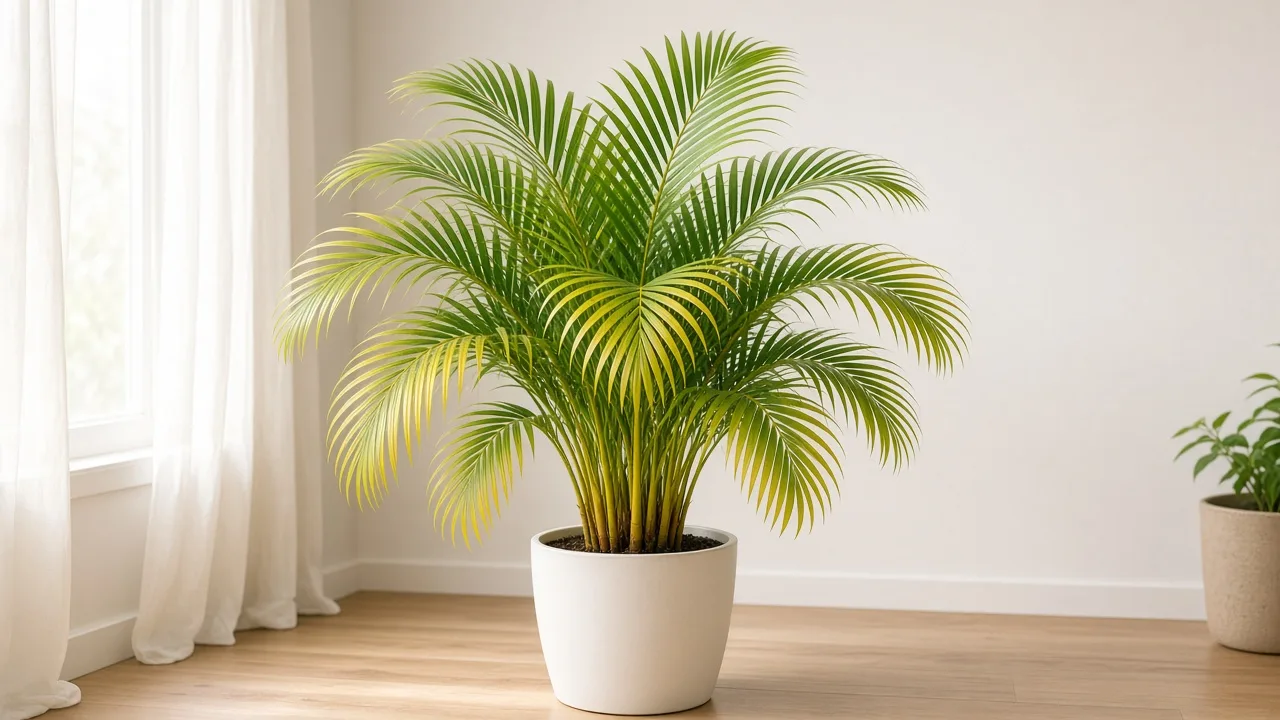
Magnesium Deficiency on Areca Palm: Causes, Checks & Fixes
This guide covers magnesium deficiency on Areca Palm. See also the general Magnesium Deficiency guide, watering, and light pages for this plant.
Magnesium Deficiency on Areca Palm: Causes, Checks & Fixes
Quick answer
Magnesium deficiency on areca palm (Dypsis lutescens) shows as broad yellow bands along the margins of individual leaflets on the oldest lower fronds, while the center of each leaflet stays distinctly green. Magnesium is mobile in plants, so deficiency symptoms appear first on the oldest leaves while new spears at the crown may still unfold normally.
See our magnesium deficiency guide for universal nutrient mechanics. On this clumping feather palm, inspect the lowest arching fronds near the pot rim first—marginal chlorosis there is classic magnesium before iron, which hits new crown spears with green veins on pale tissue.
First step: confirm broad marginal yellow bands with green leaflet centers on oldest lower fronds—not rapid whole-frond yellowing on wet soil.
What magnesium deficiency looks like on areca palm
Areca palm grows as multiple yellow-green canes topped with arching pinnate fronds—a central rachis lined with narrow leaflets. Magnesium deficiency does not yellow the whole clump overnight. It paints lemon-yellow to orange-yellow bands along the outer edges of individual leaflets on the oldest fronds attached to the lowest visible canes, while the mid-blade of each leaflet remains deep green.
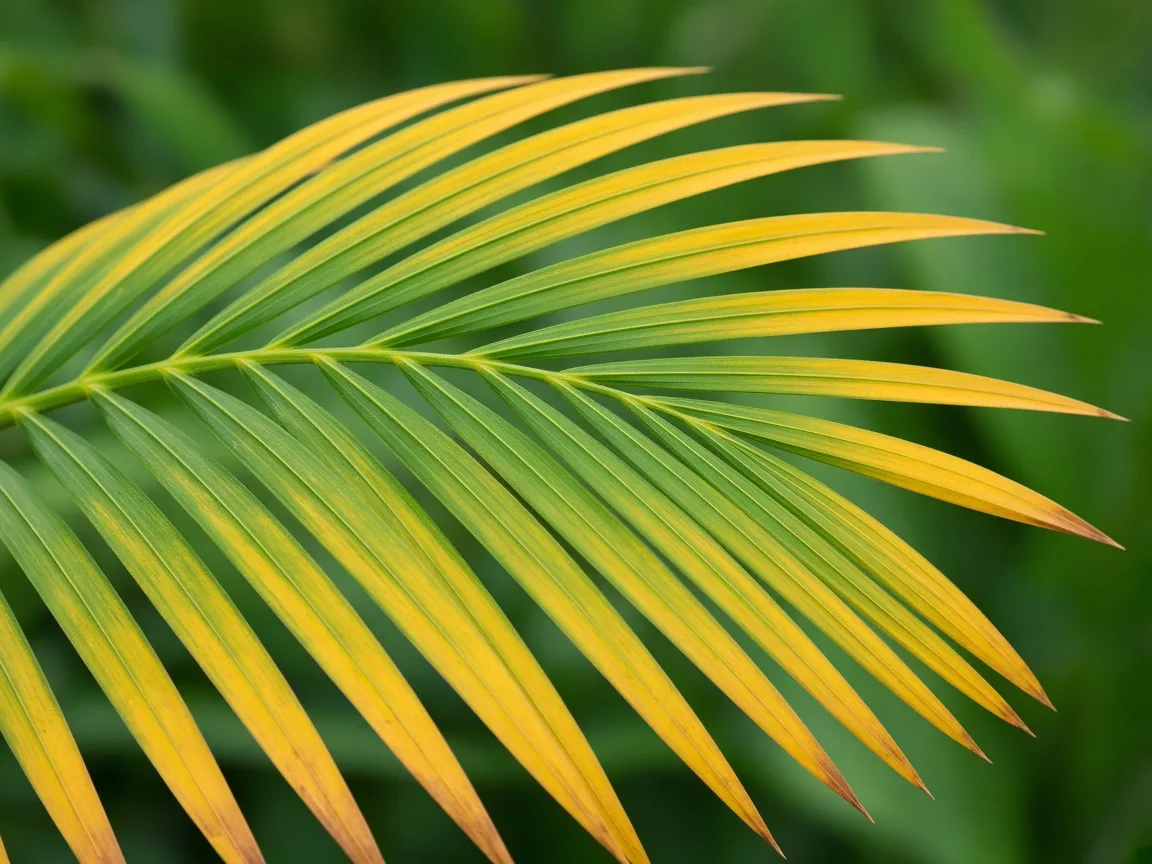
Broad yellow bands along leaflet margins on an oldest areca frond—the center of each leaflet stays green, a hallmark of magnesium deficiency.
Typical signs:
- Broad chlorotic bands along leaflet margins on oldest lower fronds
- Green centers on each leaflet—not uniform pale yellow across the whole blade
- New spears may look normal in early stages
- Firm canes unlike soft overwatered palms
- Normal soil dry-down between waterings—not permanently wet mix
- No necrotic spotting or frizzled tips alone—magnesium deficiency never causes necrosis by itself
Not magnesium deficiency:
- Even yellow across entire lowest fronds over months — often normal senescence on yellow leaves
- Multiple fronds yellow in days on wet soil — overwatering or root rot
- Orange spotting with tip necrosis — potassium deficiency
- New crown spears pale with green veins — iron deficiency
- Uniform pale lower fronds without marginal bands — nitrogen deficiency
- Brown tips only — brown tips from fluoride or dry air
Why areca palms get magnesium deficiency
Palms have distinct nutrient signatures that generic houseplant advice misses. UF/IFAS Extension documents magnesium deficiency on palms as broad chlorotic bands along margins with distinctly green centers, always most severe on oldest fronds. Magnesium is readily leached from potting mix by repeated watering, and high nitrogen or potassium in fertilizer can exacerbate magnesium limitation when the mix no longer supplies enough Mg.
Areca-specific causes:
- Six months or longer in the same container without feeding — Dolomite added to nursery mix is often exhausted after about six months, and marginal bands appear on oldest fronds.
- Nitrogen-heavy feed without micronutrients — Lower fronds show marginal chlorosis while the clump still pushes new spears from the crown.
- Blocked uptake from overwatering — Overwatering on anaerobic mix prevents roots from absorbing magnesium even when it is present in the substrate.
- Confusion with normal golden petioles — Dypsis lutescens has naturally golden-yellow leaf bases; magnesium banding sits on leaflet margins, not petiole color alone.
- Confusion with potassium deficiency — K deficiency shows orange to bronze shading and tip necrosis; Mg shows sharp green centers with yellow margins and no necrosis alone.
How to confirm magnesium deficiency
Work through this inspection on the lowest fronds first, then move up the clump:
- Leaflet pattern — Broad yellow margins with green centers on individual leaflets, not even yellow across the whole frond.
- Frond age — Symptoms on oldest lower fronds; mid-canopy fronds clean in early stages.
- Necrosis check — No translucent orange spotting or frizzled tips without marginal bands (potassium). Mg deficiency never causes necrotic spotting alone.
- Soil moisture — Top 1–2 inches dry on your normal schedule; not wet for many days after watering.
- Cane firmness — Firm tan canes at the base; soft mushy bases point to root stress, not fertilizer shortage.
- Feeding history — Same pot six months without fertilizer? Palm-specific or balanced feed with micronutrients vs nitrogen-only products.
- New spear color — Next unfolding frond still green when only oldest fronds show marginal bands.
Soil tests are not particularly useful for diagnosing palm nutrient deficiencies—visual pattern on oldest fronds plus care history is usually enough indoors.
First fix for areca palm
One half-strength dose of complete palm fertilizer or balanced liquid feed containing magnesium—or one soil drench with 1 tablespoon Epsom salt per gallon of water—applied to already-moist potting mix during active growth.
Do not drench a dry or waterlogged pot. Let the top 1–2 inches of mix reach your normal dry point per the watering guide, then apply solution until a small amount drains from the bottom and discard runoff.
Do not stack repotting, heavy pruning, and repeated Epsom drenches on the same day. One correction, then watch the next spear.
Step-by-step recovery
- Switch to half-strength palm-specific or balanced fertilizer with micronutrients through active growth per the fertilizer guide.
- Repeat one Epsom drench after three to four weeks if marginal chlorosis persists on new mid-canopy fronds—never weekly on a container clump.
- Flush accumulated salts if you feed frequently or use hard tap water—run several pot volumes of plain water through the mix and discard runoff before the next feed.
- Repot into fresh soil with perlite if roots are compacted and chlorosis persists after two careful treatments.
- Monitor new spears for clean green leaflets without marginal bands—symptomatic leaves never fully recover and must be replaced by healthy new fronds.
Recovery timeline
Fully chlorotic leaflet margins do not re-green. They may brown and drop, or you remove spent fronds once the cause is fixed. Recovery is measured by new growth, not old blade color.
Expect the next one or two spears to open with normal green margins within four to eight weeks after a correct first treatment in warm, bright conditions. Palm deficiency correction is gradual—each new frond must replace damaged older tissue, so mid-canopy improvement may take several months. Winter low light slows frond replacement; judge progress by spring spear quality.
Signs you are winning: firm canes, normal dry-down, and green new spears without marginal bands. Signs you are losing: chlorosis climbing toward the crown, new spears opening pale, or soft cane bases on wet soil despite feeding.
Marginal chlorosis on pinnate fronds
Unlike broad-leaf houseplants where interveinal yellow sits between veins on a single blade, areca palm fronds are compound—dozens of narrow leaflets line each arching rachis. Magnesium deficiency shows as yellow borders around individual leaflets on the oldest frond, while each leaflet center stays green. From across the room it can look like the whole frond is fading; up close the margin-versus-center contrast is diagnostic.
Because magnesium is mobile, the plant strips it from mature fronds to supply newer spears. The lowest frond on the shortest cane near the pot rim fails first. A clump with three cane heights may show perfect green on upper arching fronds while the bottom third displays lemon-yellow leaflet edges—a pattern that would be nonsense on a rosette succulent or single-cane dracaena.
Golden petioles vs true deficiency bands
Dypsis lutescens is sold as Golden Cane Palm for a reason: petioles and leaf bases are naturally yellow-green even on healthy plants. That normal coloration confuses owners who search for “yellow areca palm.” Magnesium deficiency is not golden petioles alone—it is progressive marginal chlorosis on leaflet tissue that spreads along oldest fronds when feeding has lapsed.
If only petioles look golden while leaflet blades stay evenly deep green and new spears emerge regularly, the plant is likely fine. If leaflet margins yellow while centers stay green on lowest fronds after months without feed, magnesium limitation is the branch to pursue—not repotting or extra water.
Clumping canes and where symptoms start
Areca palm is a multi-stem clustering palm with new spears pushing from a shared crown while oldest fronds hang from the lowest canes. Magnesium deficiency almost always appears on fronds attached to canes nearest the soil line before it climbs to mid-height arching fronds. Check the lowest one or two fronds on each short cane before assuming the whole clump is deficient.
If only upper fronds show pale new tissue with green veins, suspect iron deficiency on crown spears rather than magnesium on lower fronds. Firm canes with yellow margins on lowest fronds and green upper canopy is the classic magnesium picture on indoor butterfly palms.
Epsom salt on container clumps
Indoor areca palms are not landscape trees—you cannot broadcast pounds of magnesium sulfate under a canopy. For container culture, one tablespoon of Epsom salt per gallon of water as a single soil drench on moist mix is a reasonable first pass after confirming the marginal band pattern. Foliar Mg sprays supply very small amounts relative to palm need and are generally ineffective for correction—soil application matters.
Repeat once after three to four weeks if needed; avoid weekly drenches that stack salts without fixing uptake. If two careful treatments fail and roots are tight in old mix, fresh repotting into well-draining palm mix resets the root zone faster than chasing more magnesium in depleted peat.
Lookalike symptoms
| Pattern | Likely cause |
|---|---|
| Yellow leaflet margins, green centers, oldest fronds | Magnesium deficiency (this page) |
| Even yellow on 1–2 lowest fronds, slow fade | Normal aging — yellow leaves |
| Multiple fronds yellow fast on wet soil | Overwatering |
| Orange spotting + tip necrosis | Potassium deficiency |
| New spears pale, green veins | Iron deficiency |
| Uniform pale lower fronds | Nitrogen deficiency |
| Brown tips only | Brown tips |
What not to do
- Do not fertilize a waterlogged palm — Fix moisture first; salts on stressed roots worsen yellowing.
- Do not assume every yellow frond is magnesium — Aging and overwatering are more common indoors.
- Do not rely on foliar Epsom sprays alone — Soil drenches or complete palm feed correct container palms.
- Do not expect old fronds to re-green — Remove spent tissue after new spears look healthy.
- Do not feed a dry root ball — Apply magnesium to moist mix only.
How to prevent magnesium deficiency
- Feed during active growth — Half-strength balanced or palm-specific formula with magnesium every two to four weeks in spring and summer per the fertilizer guide; pause in winter unless strong grow lights keep new spears coming.
- Refresh mix at repotting — Areca palms prefer repotting every 2–3 years; depleted mix loses dolomite charge over time.
- Avoid nitrogen-only products — Complete micronutrient labels prevent Mg limitation when N and K are high.
- Flush salts occasionally — Hard tap water and frequent feeding build minerals; plain-water flushes reduce imbalance.
- Keep bright indirect light — Steady photosynthesis supports nutrient uptake per the light guide.
When to use this page vs other Areca Palm guides
Use this page when oldest lower fronds show broad yellow bands along leaflet margins with green centers. Use yellow leaves when you need to separate aging, watering, and multiple yellow causes. Use potassium deficiency when tip necrosis and orange spotting dominate without sharp green leaflet centers. Use iron deficiency when new crown spears chlorose with green veins. Use overwatering when wet soil and rapid multi-frond yellowing align.
Related Areca Palm guides
- Areca palm overview
- Areca palm fertilizer
- Yellow leaves
- Potassium deficiency
- Areca palm problems hub
Related tool
Use the Fertilizer Dilution Calculator to narrow causes for magnesium deficiency on this plant before changing multiple variables at once.