Nitrogen Deficiency on Bird of Paradise: Causes, Checks &
Quick answer
Nitrogen deficiency on Bird of Paradise shows as uniform pale yellow-green on the oldest large paddle leaves along the outer fan of the clump, with smaller or lighter new paddles emerging from the rhizome crown on stiff petioles. First step: confirm even chlorosis on the lowest mature leaves—not interveinal banding or new-tip green veins—then check whether rhizomes are firm and a hungry plant in bright light has gone a full growing season without complete fertilizer in leached potting mix.
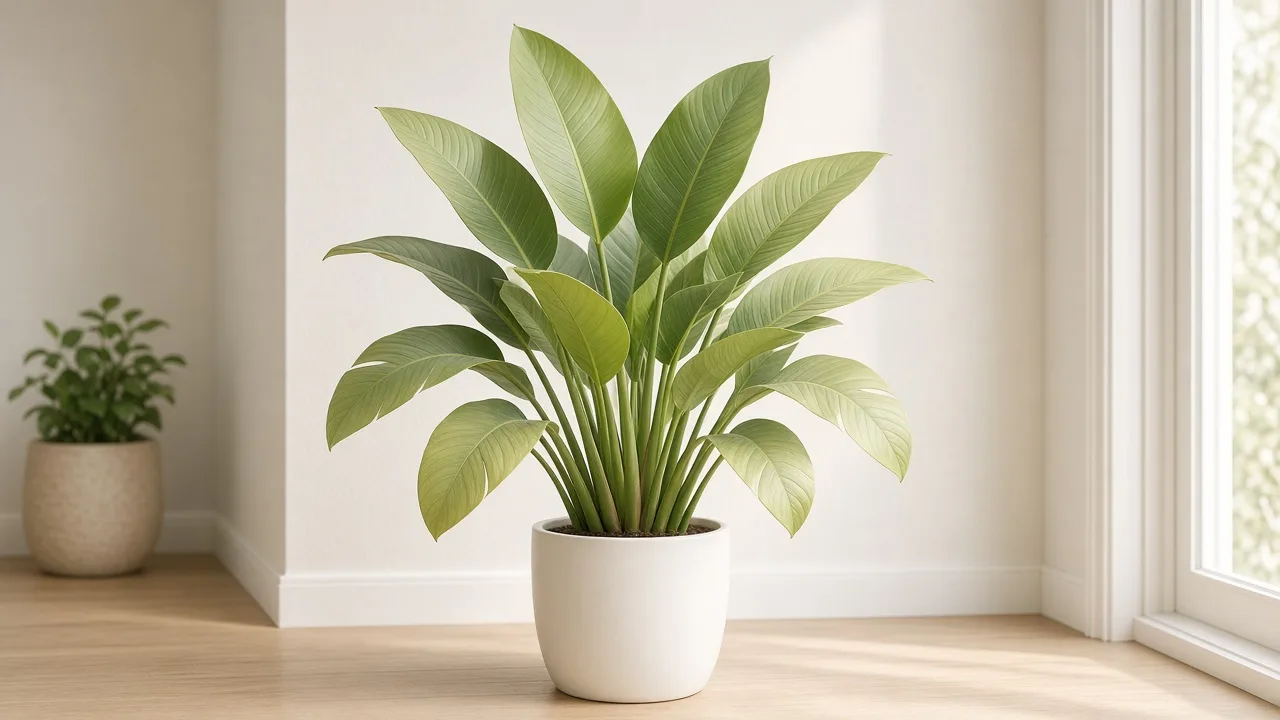
Nitrogen Deficiency on Bird of Paradise: Causes, Checks & Fixes
This guide covers nitrogen deficiency on Bird of Paradise. See also the general Nitrogen Deficiency guide, watering, and light pages for this plant.
Nitrogen Deficiency on Bird of Paradise: Causes, Checks & Fixes
Quick answer
Nitrogen deficiency on Bird of Paradise (Strelitzia reginae) shows as uniform pale yellow-green on the oldest large paddle leaves along the outer fan of the clump, with smaller or lighter new paddles emerging from the rhizome crown on stiff petioles. Nitrogen is mobile in plants, so deficiency symptoms show up first on the lower leaves as a general yellowing—veins and tissue fade together, unlike magnesium deficiency (interveinal banding on old paddles) or iron deficiency (green veins on new crown paddles).
See our nitrogen deficiency guide for general mobile-nutrient mechanics. On Bird of Paradise, inspect the lowest mature gray-green paddles nearest the pot rim—even washout there, with the rhizome crown still pushing thinner new blades, is classic nitrogen starvation before wet-root failure or low-light pale leaves.
First step: confirm uniform pale color on the oldest outer paddles—not interveinal chlorosis or new-tip green veins—then check rhizome firmness and a full growing season without complete fertilizer in leached fertile mix.
When to use this page vs other Bird of Paradise guides
| Pattern | Read next |
|---|---|
| Uniform pale oldest outer paddles, smaller new crown blades | Nitrogen deficiency (this page) |
| Yellow between veins on oldest paddles | Magnesium deficiency |
| Yellow new crown paddles with green veins | Iron deficiency |
| Brown scorched margins on old paddles | Potassium deficiency |
| Washed-out green across the whole fan, dim room | Pale leaves or not enough light |
| Yellowing with soft petiole bases on constantly wet mix | Overwatering or root rot |
| General yellowing without a clear nutrient pattern | Yellow leaves |
| Stalled paddles despite good light and moisture | Slow growth |
What nitrogen deficiency looks like on Bird of Paradise
Healthy Bird of Paradise holds large gray-green paddle-shaped leaves on stiff upright petioles arising from underground rhizomes in a fan-like clump. Nitrogen stress breaks that pattern on mature foliage on the outer, oldest portion of the fan, not with a vein-retained banding pattern.
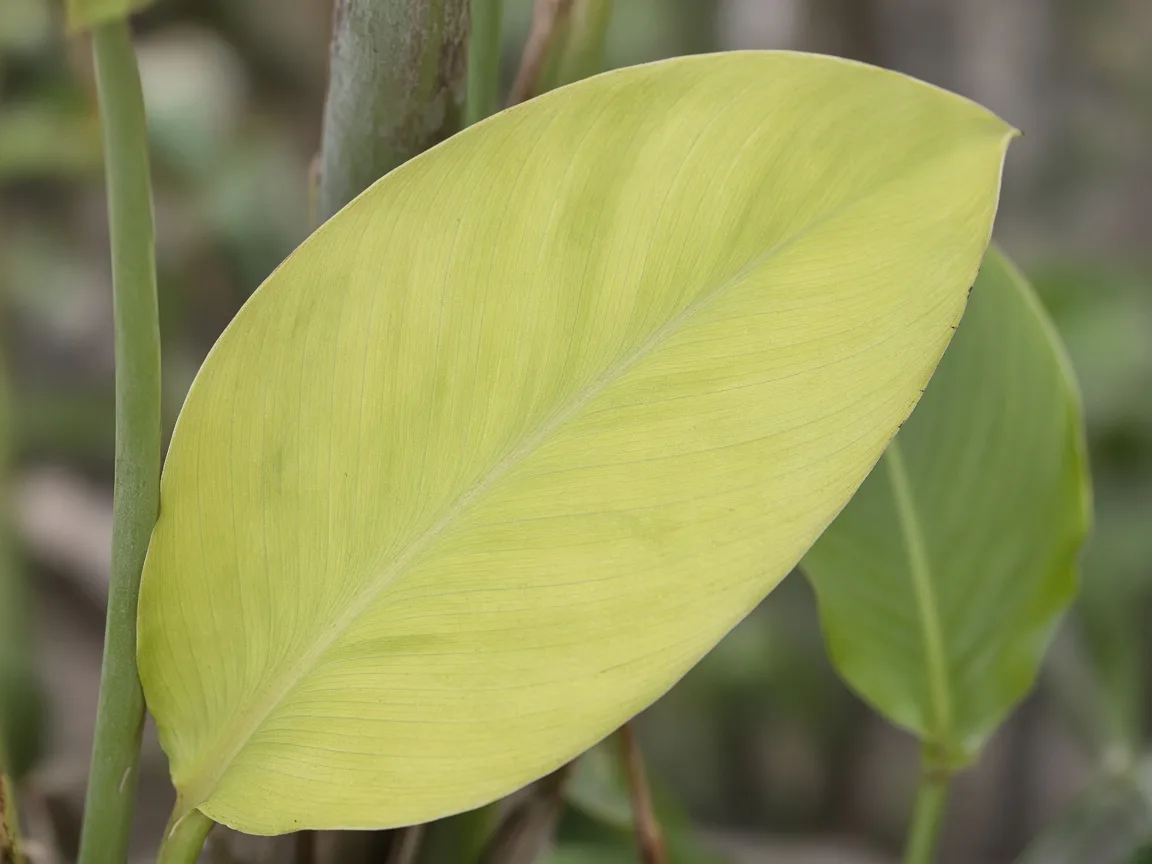
Oldest outer Bird of Paradise paddle with uniform pale yellow-green chlorosis—veins and blade tissue faded together, unlike interveinal magnesium banding.
Typical signs:
- Uniform pale yellow-green on the oldest large paddle leaves along the outer ring of the clump—veins and tissue lose color together
- Progressive climb toward younger paddles over weeks as the plant strips nitrogen from old tissue to fund crown growth
- Smaller or shorter new paddles and slower fan expansion during spring and summer when the plant should be pushing large blades
- Firm stiff petioles and upright architecture when roots are healthy; soft bases on sour wet mix suggest overwatering instead
- Reduced paddle width on the newest crown leaves compared with paddles from the prior season
Not nitrogen deficiency:
- Yellow tissue between dark green veins on oldest paddles—magnesium deficiency (magnesium deficiency initially develops on lower or older foliage with interveinal chlorosis)
- Yellow new crown paddles with dark green veins—iron deficiency
- One outer paddle only while the crown unfurls a full-size green blade—normal aging on yellow leaves
- All paddles yellow at once on persistently wet soil—overwatering or root rot
- Uniform washed-out green across the whole fan with long bare spacing—not enough light or leggy growth before assuming starvation
UC IPM notes slow growth and uniform yellowing of older leaves as the first symptoms of nitrogen deficiency. On a large-leaf Strelitzia, that older-paddle washout is easiest to read on the lowest mature blade nearest the pot edge.
Why Bird of Paradise gets nitrogen deficiency
Bird of Paradise is a clumping rhizomatous tropical that pushes expansive paddle leaves when light and warmth support active growth. Nitrogen is a core component of chlorophyll and proteins—when soil reserves run low, the plant dismantles chlorophyll in older outer paddles and redirects nitrogen to the crown and new petioles.
The Royal Horticultural Society describes strelitzias as hungry plants that need regular liquid feeding through spring and summer. Indoor growers often meet light and watering needs but skip feed on a plant that still adds multi-foot paddles each season.
Bird of Paradise–specific causes:
- Skipped spring and summer feeds — Owners keep bright placement and drainage perfect but forget dilute fertilizer while rhizomes sit in the same pot for multiple years. See the Bird of Paradise fertilizer guide for seasonal timing.
- Leached fertile mix — Each thorough soak per the Bird of Paradise watering guide flushes soluble nitrogen through drainage holes faster than owners replace it in perlite-rich soil.
- Heavy leaf biomass, modest pot — Large paddles transpire heavily in direct sun; a root-bound clump in bright light can outpace depleted mix nitrogen even when you feed occasionally.
- Winter pause without spring restart — Correct autumn and winter holds are necessary, but some growers never resume measured feed when crown paddles resume in spring.
- Blocked uptake from wet roots — Chronic saturation in a cachepot prevents absorption even when nitrogen is present; see overwatering before feeding waterlogged rhizomes.
- Bloom-only low-nitrogen formulas — Mature plants pushed with high-phosphorus bloom feeds without balanced nitrogen can show foliage starvation while you chase flowers; see no flowers for light and maturity limits first.
Do not diagnose nitrogen deficiency on sour wet soil with soft petiole bases—that is root failure until you confirm mostly firm rhizomes and appropriate dry-down.
Outer fan paddles vs crown flush
The diagnostic fork on Strelitzia is which paddles pale in the fan, not just that some leaves look yellow.
Bird of Paradise arranges leaves like a fan emerging from rhizomes—the oldest, largest paddles sit on the outer ring nearest the pot rim, while new blades unfurl from the central crown. Nitrogen starvation shows on that outer ring first: uniform pale yellow-green on massive lower paddles while the crown may still push new tissue.
Walk the clump from the outside in: if color improves steadily toward the center but the lowest outer paddle pair is uniformly lime, nitrogen is a strong suspect. If every paddle is equally washed out and petioles stretch toward the window, shift to not enough light before feeding. This outside-in fan read is meaningless on a ZZ plant arching stem—it is central on Bird of Paradise.
Spring paddle expansion vs winter slowdown
Bird of Paradise grows most actively in warm months with strong light—when crown paddles should unfurl on a regular rhythm indoors or on a summer patio. Pale outer paddles plus undersized new blades during that window support nitrogen deficiency.
In late autumn and winter, many homes slow extension even when you water on schedule. Occasional yellowing or drop on the oldest outer paddle during cool, short days is often seasonal, not starvation—even though older leaves yellow first. Nitrogen deficiency shows during active paddle flush when nights stay mild, new stiff petioles are emerging, and the plant is on your normal watering rhythm.
Feeding a cold-stalled clump in a dim room builds salts without uptake. Wait for consistent spring crown growth, then diagnose pale outer color again.
Large-leaf nitrogen budget in container mix
The trap on Bird of Paradise is the statement plant in a bright south window while nitrogen silently leaches out of fast-draining fertile mix.
Each large paddle is a nitrogen-intensive sheet of tissue. NC State Extension recommends fertilizing regularly in spring and summer on fertile, well-drained soil—container life magnifies depletion because every watering carries nitrates toward the drainage hole.
Leaching in perlite-rich pots: Top 5 cm may dry on schedule while a dense rhizome mass in two-year-old mix starves below. Even washout on lower outer paddles with firm rhizomes and normal watering rhythm often means depleted nitrogen, not thirst—compare with underwatering, which dulls the whole fan and pulls mix from the pot edge without a progressive outer-to-inner pale wave.
RHS notes nitrogen deficiency causes pale yellow leaves on older foliage first and that the nutrient is easily washed out of compost by watering—especially relevant for heavy feeders in bright light that you water thoroughly.
Lookalike symptoms
| Pattern | Check | Likely cause |
|---|---|---|
| Uniform pale oldest outer paddles | Feed history, mix age | Nitrogen deficiency (this page) |
| Interveinal yellow on oldest paddles | Vein pattern | Magnesium deficiency |
| New crown paddles yellow, green veins | Wet mix, pH | Iron deficiency |
| Edge scorch on old paddles | Feed type | Potassium deficiency |
| All yellow, wet heavy pot | Petiole softness | Overwatering |
| One outer paddle only | Crown green and full size | Normal aging—yellow leaves |
| Washed-out uniform green, dim room | Window hours | Pale leaves or not enough light |
How to confirm
- Color pattern on lowest outer paddles — Uniform pale yellow-green including veins, not interveinal banding.
- Magnesium vs nitrogen split — Green veins with yellow between them on old paddles point to magnesium; even washout points here.
- Iron vs nitrogen split — New crown green veins point to iron; oldest-outer-paddle uniform pale points here.
- New paddle size — Smaller crown blades and stalled fan expansion support starvation when outer paddles pale first.
- Season and temperature — Active spring or summer flush, not cool-season stall alone.
- Fertilizer label and timing — Complete balanced feed vs skipped growing season on a bright specimen.
- Rhizome check — Firm rhizomes and healthy roots support nitrogen fixes; brown mush needs drainage first.
- Moisture cross-check — Wet core in a sealed cachepot rules out simple starvation until roots recover.
UC IPM cautions that poor drainage, compaction, and too much irrigation can mimic nitrogen deficiency because roots cannot absorb nutrients—common on large pots that stay heavy while outer paddles pale.
First fix for Bird of Paradise
One half-strength dose of complete balanced liquid fertilizer on already-moist mix—only after confirming firm rhizomes, active growing-season flush, and uniform pale color on the oldest outer paddles.
Water normally first so roots are hydrated, then apply diluted feed until a small amount drains from the bottom per the Bird of Paradise fertilizer guide. Do not feed a clump you just soaked in an oversized pot still holding saturated mix at the rhizome level.
Do not feed a waterlogged plant, a specimen you repotted within the last four to six weeks, or a plant with active pest damage on new crown paddles. Fix the limiting stress first, then apply one measured nitrogen correction during the growing season.
Step-by-step recovery
- Apply one half-strength complete balanced feed on moist mix during active growth; bloom-only low-nitrogen formulas alone may not supply enough nitrogen for paddle recovery.
- Flush salts if white crust rings the pot rim—leach with plain water before stacking more fertilizer; scorch may overlap with brown tips from salt or dry air.
- Adjust watering so the pot dries appropriately between drinks per Bird of Paradise watering—uptake fails in chronic wet mix.
- Repeat measured feed once after four to six weeks if outer chlorosis spreads but rhizomes stay firm—do not feed weekly at full strength.
- Repot into fresh well-drained mix if rhizomes crowd the pot and pale outer paddles persist after two measured treatments—see Bird of Paradise repotting.
- Remove fully yellow outer paddles only when they pull away easily; do not strip half the fan at once on a young clump.
- Monitor the next two crown paddles for larger blade width and deeper blue-green color.
Recovery timeline
Correct nitrogen on healthy rhizomes shows larger, greener new crown paddles within four to eight weeks during active spring and summer growth—slower than a pothos runner because each Strelitzia blade is large and stiff. Older chlorotic outer paddles rarely return to full deep blue-green; the clump slowly replaces them as the fan expands.
Full outer-ring refresh on a mature specimen may take one growing season. Judge success by deeper green color and normal paddle width on fresh crown blades, not by old pale paddles darkening again. If three successive crown paddles stay small and pale after two measured treatments with firm rhizomes, reassess light, iron lockout, and overlapping slow growth causes.
Mistakes to avoid
- Fertilizer before drainage — Feeding waterlogged rhizomes worsens stress and will not fix chlorosis.
- Confusing iron, magnesium, and nitrogen — Paddle position and vein patterns tell them apart; read the lookalike table before drenches.
- Feeding during winter stall — Winter salts without uptake risk tip burn on a clump that is not growing.
- Repot + feed + hard prune same week — Stack one change at a time on a stressed fan.
- Expecting old outer paddles to re-green — Judge recovery by fresh crown paddle size and color.
- Overfeeding after pale paddles appear — Full-strength repeated doses on stressed roots cause scorch; measured half-strength once is the first fix.
- Diagnosing nitrogen on dim, washed-out clumps — Not enough light fades the whole plant uniformly; fix placement before assuming starvation.
Prevention
- Feed lightly with complete balanced liquid fertilizer every two to four weeks in spring and summer per the Bird of Paradise fertilizer guide—the RHS recommends liquid houseplant feed fortnightly through the growing season for hungry strelitzias in active growth.
- Refresh depleted mix every two to three years when rhizomes crowd the pot.
- Match feed frequency to growth rate—a clump in direct sun depletes nitrogen faster than a specimen in bright indirect light only.
- Track whether oldest outer paddles wash out uniformly before crown blades shrink; early pale outer leaves are easier to correct than a fully stunted fan.
- Pause feeding in autumn and winter when extension slows, then resume only after consistent spring crown growth.
Related Bird of Paradise guides
- Bird of Paradise overview — species baseline and care hub
- Bird of Paradise fertilizer — seasonal feed timing and dilution
- Bird of Paradise watering — moisture rhythm that pairs with nutrient uptake
- Bird of Paradise soil — fertile mix that drains without waterlogging
- Bird of Paradise light — bright light that drives growth and feed demand
- Bird of Paradise problems — full symptom index for this species
- Magnesium deficiency — when older paddles band between veins
- Iron deficiency — when new crown paddles yellow with green veins
- Pale leaves — light-first diagnosis when color shifts broadly
- Yellow leaves — moisture and aging when yellowing is widespread
Conclusion
Uniform pale yellow-green on the oldest outer Bird of Paradise paddles, with smaller new crown blades during active spring or summer flush, is a nitrogen signal—confirm the pattern is not interveinal or new-tip chlorosis, rule out soft wet rhizomes and winter stall, then apply one measured balanced feed on moist mix.
Related tool
Use the Fertilizer Dilution Calculator to narrow causes for nitrogen deficiency on this plant before changing multiple variables at once.