Magnesium Deficiency on Fiddle Leaf Fig: Causes, Checks &
Quick answer
Magnesium deficiency on fiddle leaf fig shows as yellow tissue between green veins on older lower violin-shaped leaves while new apex growth may look normal. First step: confirm interveinal chlorosis is on older leaves—not new leaves with green veins alone—and check whether complete fertilizer has been skipped for months.
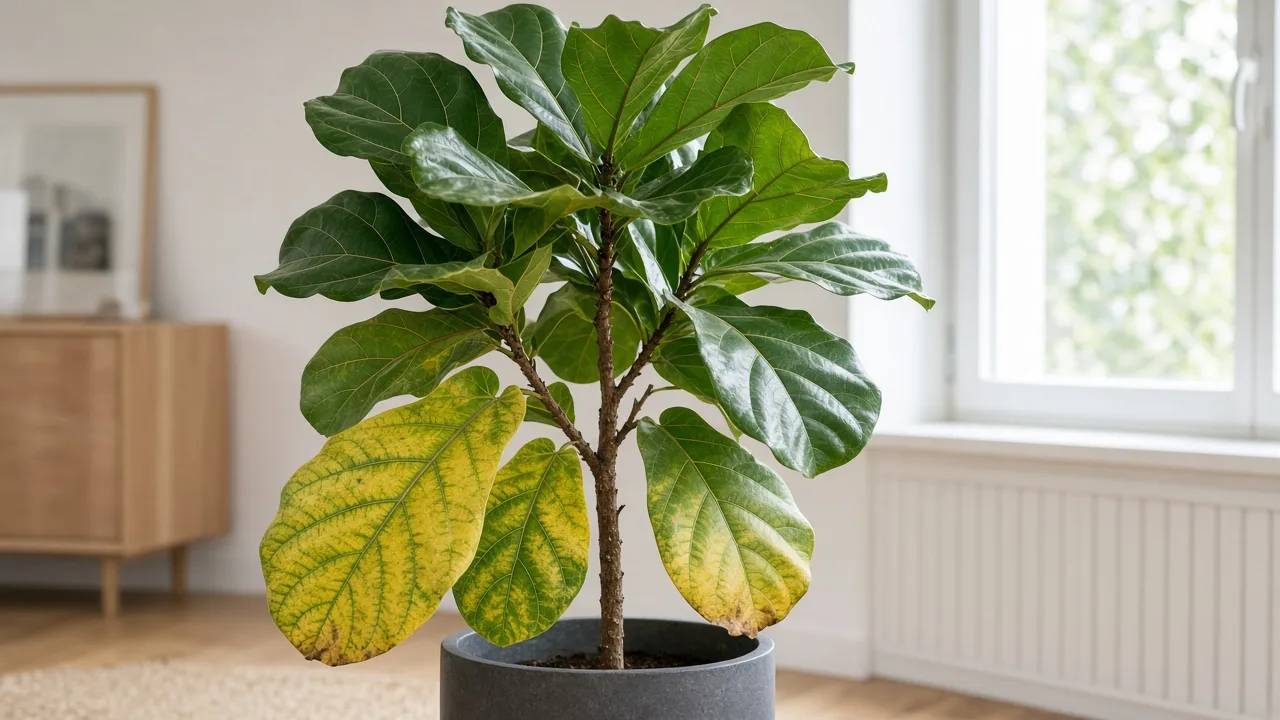
Magnesium Deficiency on Fiddle Leaf Fig: Causes, Checks & Fixes
This guide covers magnesium deficiency on Fiddle Leaf Fig. See also the general Magnesium Deficiency guide, watering, and light pages for this plant.
Magnesium Deficiency on Fiddle Leaf Fig: Causes, Checks & Fixes
Quick answer
Magnesium deficiency on fiddle leaf fig (Ficus lyrata) shows as yellow tissue between green veins on older lower violin-shaped leaves while new apex growth may look normal. Magnesium is a mobile nutrient and chlorosis appears on mature leaves first because the tree strips magnesium from older tissue to supply newer growth.
See our magnesium deficiency guide for general interveinal chlorosis mechanics. On fiddle leaf fig, inspect the oldest large violin leaves on the lower trunk—yellow bands between dark green veins there point to magnesium before iron, which hits new expanding leaves at the apex.
First step: confirm interveinal chlorosis on older lower leaves, not new apex leaves with green veins alone, and review whether complete fertilizer has replaced magnesium leached from a large floor pot.
When to use this page vs other Fiddle Leaf Fig guides
| Pattern | Read next |
|---|---|
| Old leaves yellow between green veins | Magnesium deficiency (this page) |
| New leaves yellow, green veins | Iron deficiency |
| Uniform pale old leaves, no vein pattern | Nitrogen deficiency |
| Brown scorched leaf margins on old leaves | Potassium deficiency |
| New apex leaf distorted or tip-burned | Calcium deficiency |
| Brown tips only, margins clean | Brown tips |
| Dark spots, soggy soil | Overwatering |
What magnesium deficiency looks like on fiddle leaf fig
Fiddle leaf fig’s broad violin-shaped leaves make interveinal chlorosis easy to read at a glance. Each mature blade spans six to eighteen inches on a floor tree, so the contrast between dark green veins and pale yellow tissue between them is visible from across the room—unlike smaller houseplants where the pattern hides on tiny foliage.
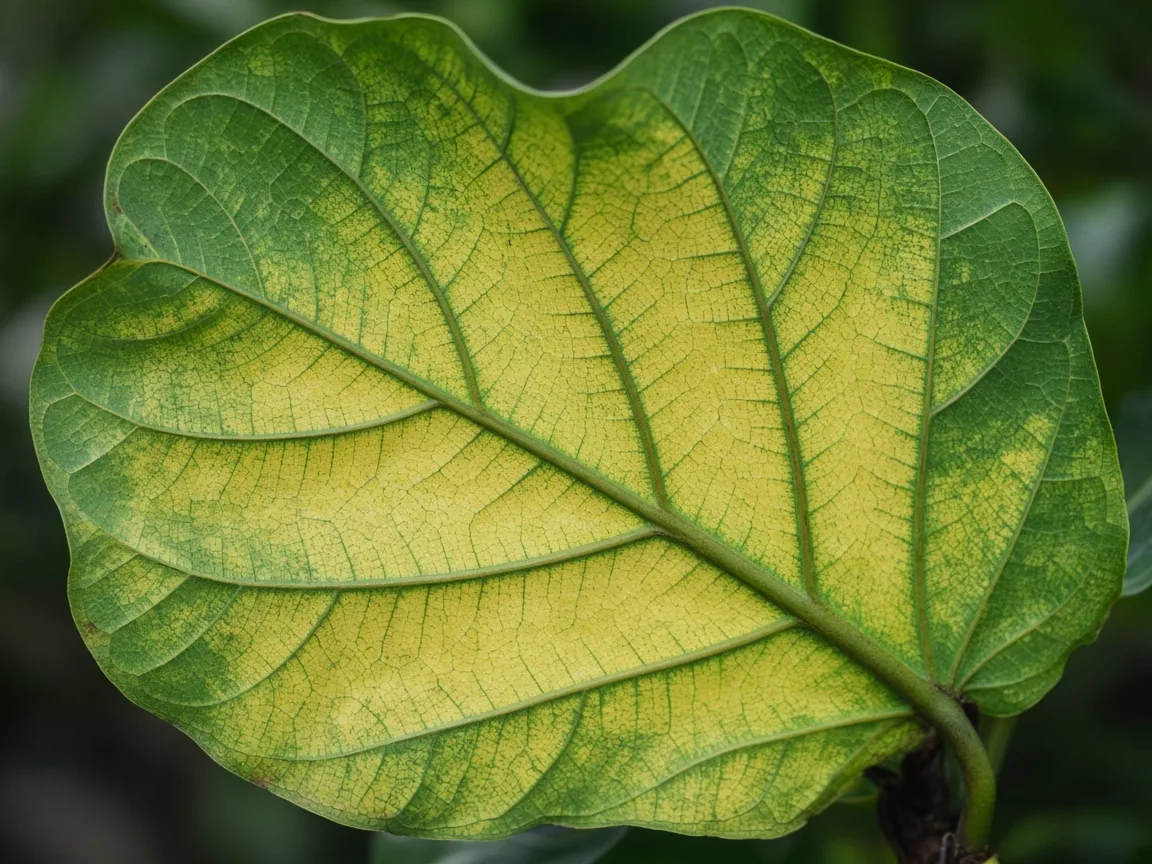
Interveinal chlorosis on an older fiddle leaf fig violin leaf—veins stay dark green while tissue between them yellows.
Typical signs:
- Yellow or pale green patches between dark green veins on older lower violin leaves (interveinal chlorosis is the hallmark magnesium pattern)
- Veins stay relatively green while interveinal tissue bleaches or yellows
- Symptoms start on lowest leaves and may move upward over weeks
- Apex new leaves may look normal in early stages
- Firm trunk unlike mushy overwatering cases
- Large leaf size unchanged—unlike nitrogen deficiency where new leaves also shrink
Not magnesium deficiency:
- New leaves yellow with green veins only — iron deficiency
- Uniform pale lower leaves without vein pattern — nitrogen deficiency
- Brown crispy leaf edges and margins — potassium deficiency or fluoride brown tips
- Dark brown spots on wet leaves — overwatering leaf spots
- New apex leaf crinkled or distorted — calcium deficiency
Why fiddle leaf fig gets magnesium deficiency
Ficus lyrata grows large leaves that demand magnesium for chlorophyll production. Each new violin blade the apex pushes requires magnesium pulled from older tissue when root-zone supplies run low. Long-term use of incomplete fertilizer, leaching from frequent deep watering without micronutrient replacement, or old depleted mix in oversized floor pots strips magnesium from the upper root zone.
Fiddle-leaf-fig-specific causes:
- Nitrogen-heavy feeding without micronutrients — Promotes large new violin leaves while magnesium stores in older foliage deplete. Container Ficus need balanced micronutrients, not nitrogen alone on a floor tree pushing monthly new growth.
- Old peat-based mix — Years in the same decorative floor pot without refresh leaves a nutrient-stripped root zone even when surface soil looks dark.
- Leaching in large containers — Thorough watering per the watering guide washes mobile magnesium downward if feeds lack micronutrients or feeding was skipped for months.
- Blocked uptake from overwatering — Anaerobic roots in wet oversized pots cannot absorb magnesium present in mix. Chlorosis persists until drainage improves.
- Salt buildup compounding stress — White crust at the pot rim from hard tap water and fertilizer limits micronutrient uptake. See salt build-up before stacking more supplements.
- Confusion with iron deficiency — Iron hits new expanding leaves with green veins at the apex. Magnesium hits older lower violin leaves first—a opposite leaf-age pattern that saves misdiagnosis.
Lookalike symptoms
| Pattern | Check | Likely cause |
|---|---|---|
| Old leaves yellow between green veins | Leaf age, vein pattern | Magnesium deficiency (this page) |
| New leaves yellow, green veins | Apex vs lower canopy | Iron deficiency |
| Uniform pale old leaves | No interveinal banding | Nitrogen deficiency |
| Brown scorched leaf margins | Margin vs between veins | Potassium deficiency |
| Brown tips only | Tip vs full margin | Brown tips / fluoride |
| Dark spots, soggy soil | Root firmness | Overwatering |
How to confirm
- Vein pattern on leaf age — Interveinal chlorosis on older lower violin leaves with green veins points to magnesium.
- Fertilizer label — Complete micronutrient mix vs nitrogen-only products used for months.
- Root health — Firm roots on dry-down schedule vs soggy chronic wetness in cachepots.
- Compare new vs old leaves — New-leaf chlorosis with green veins alone suggests iron, not magnesium.
- Soil age — Same mix three or more years in a large floor pot without repot or top-dress.
- Salt buildup — Salt build-up white crust may need flushing before magnesium supplements absorb.
- Progression direction — Magnesium moves upward from lowest leaves over weeks; iron stays on new apex tissue.
First fix for fiddle leaf fig
One foliar spray or soil drench with Epsom salt (magnesium sulfate) at 1 tablespoon per gallon of water, or one half-strength dose of complete fertilizer containing magnesium—after confirming roots are healthy and soil is not waterlogged.
Do not foliar-spray a recently relocated or sun-stressed tree in hot direct light. Apply in morning on stable plants. Per the fiddle leaf fig fertilizer guide, one measured correction—not weekly Epsom drenches on soggy soil.
If white salt crust rings the pot, flush with plain water first, let mix return to normal dry-down, then apply one Epsom drench or complete feed. Fix drainage before repeating any supplement on waterlogged roots.
Step-by-step recovery
- Switch to complete balanced fertilizer with micronutrients through the growing season per the fertilizer guide.
- Apply one Epsom salt drench at 1 tablespoon per gallon if interveinal yellowing is clear on multiple lower leaves—repeat once after two weeks only if pattern persists.
- Flush accumulated salts if white crust appears on the soil rim before the next feed.
- Maintain consistent dry-down on large floor pots—top two inches dry before deep watering.
- Repot into fresh well-draining mix if the tree has been in the same oversized pot for years and chlorosis continues after two corrections.
- Monitor new apex violin leaves for normal green color without interveinal banding over the next two flushes.
- Reduce Epsom applications in winter when Ficus lyrata growth slows—over-supplementing dormant trees risks salt injury.
Recovery timeline
Chlorotic areas on old large violin leaves rarely return to full green—the bleached interveinal tissue does not re-pigment once magnesium is corrected. Judge recovery by new apex leaves emerging with uniform green color, usually within three to six weeks after corrected feeding on healthy roots.
If interveinal yellowing spreads to new leaves despite Epsom and complete feed, inspect roots for rot and check whether chronic overwatering is blocking uptake before a third supplement application.
Large violin leaves and magnesium mobility
Fiddle leaf fig’s broad violin-shaped leaves make interveinal chlorosis easy to spot on the lower canopy—veins stay green while the wide leaf blade yellows between them. Because magnesium is mobile in plants, the tree strips it from older leaves to supply newer growth at the apex, so the lowest large leaves fail first.
That pattern differs from iron chlorosis on the newest unfurling leaf at the apex, where veins remain dark green on pale new tissue. It also differs from nitrogen deficiency, which causes uniform pale green on old leaves without the distinct vein-retention pattern, and from potassium scorch that burns outer margins rather than yellowing between veins.
Do not confuse magnesium banding with normal slight color variation on very old lower leaves that are about to drop after years of service—true magnesium chlorosis shows clear yellow between green veins across a wide area of the blade, not a faint fade on one aging leaf.
Floor pots, leaching, and the micronutrient gap
Fiddle leaf fig floor trees in oversized decorative pots are especially prone to magnesium depletion. Owners water deeply so a tall tree does not dry out, flushing mobile nutrients from the upper mix layer where feeder roots work. Months of nitrogen-heavy feeding without micronutrient replacement—or no feeding at all during spring and summer growth—leaves magnesium stripped while the tree still pushes large new violin leaves from the apex.
The visual result is a split canopy: healthy-looking new growth at the top and yellow-between-veins lower leaves that owners often misread as normal aging. When multiple lower violin leaves show the same interveinal pattern, it is deficiency, not senescence.
Closing the gap means complete balanced fertilizer with magnesium during active growth and mix refresh when the same container has held the tree for three or more years. A moderate indoor tree in bright indirect light depletes micronutrients faster than owners expect—especially when water quality and fertilizer salts compound stress on sensitive Ficus roots.
Mistakes to avoid
- Do not diagnose iron deficiency when only older lower leaves show interveinal chlorosis—iron hits new apex tissue first.
- Do not apply weekly Epsom drenches on soggy soil—fix drainage before repeated magnesium supplements.
- Do not foliar-spray a recently relocated tree in direct afternoon sun—leaf burn compounds chlorosis stress.
- Do not expect old chlorotic violin leaves to fully re-green—judge the next apex flush.
- Do not rely on nitrogen-only fertilizer on a large-leaf floor tree pushing monthly new growth.
- Do not confuse interveinal yellowing with fluoride tip burn—tips-only browning is water chemistry, not magnesium banding.
Prevention
- Feed lightly with complete balanced houseplant fertilizer including magnesium and micronutrients during active growth per the fertilizer guide.
- Flush mix occasionally with plain water during the growing season to limit salt buildup from tap water and fertilizer.
- Refresh old peat-based mix at repotting before roots circle a nutrient-stripped core in an oversized floor pot.
- Avoid months without any fertilizer during spring and summer when the apex is pushing new violin leaves.
- Match watering depth to pot size without letting the tree sit in cachepot standing water.
- Use complete feeds rather than high-nitrogen products alone on Ficus lyrata in bright indoor light.
Related Fiddle Leaf Fig guides
- Fiddle leaf fig overview
- Fiddle leaf fig fertilizer
- Fiddle leaf fig watering
- Iron deficiency
- Nitrogen deficiency
- Potassium deficiency
- Brown tips
- Fiddle leaf fig problems hub
Conclusion
Yellow tissue between green veins on older fiddle leaf fig violin leaves signals magnesium depletion or blocked uptake—confirm the old-leaf interveinal pattern differs from iron chlorosis on new apex growth, fix root health and leaching in large pots, then apply one Epsom drench or complete feed and monitor new leaves for uniform green color.
Related tool
Use the Fertilizer Dilution Calculator to measure Epsom salt or half-strength complete fertilizer for magnesium deficiency recovery on this plant before changing multiple variables at once.