Iron Deficiency on Fiddle Leaf Fig: Causes, Checks & Fixes
Quick answer
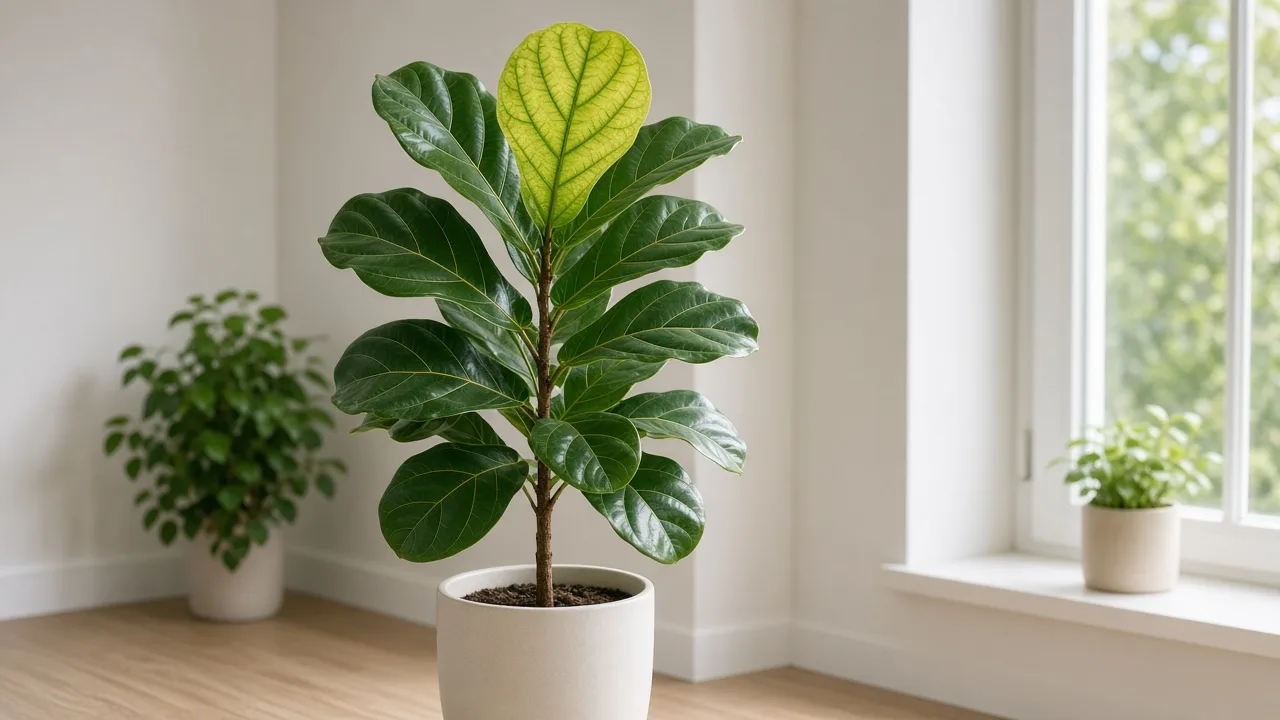
Iron deficiency on fiddle leaf fig shows as pale or yellow new violin-shaped leaves with dark green veins (interveinal chlorosis) at the apex crown while older large leaves lower on the trunk may stay normal. First step: confirm the pattern is on newest apex growth only, then check whether soil pH, chronically wet mix, or depleted potting soil is blocking iron uptake before applying chelated iron.
Iron Deficiency on Fiddle Leaf Fig: Causes, Checks & Fixes
This guide covers iron deficiency on Fiddle Leaf Fig. See also the general Iron Deficiency guide, watering, and light pages for this plant.
Iron Deficiency on Fiddle Leaf Fig: Causes, Checks & Fixes
Quick answer
Iron deficiency on fiddle leaf fig (Ficus lyrata) shows as pale or yellow new violin-shaped leaves with dark green veins (interveinal chlorosis) at the apex crown, while older large violin blades lower on the trunk may stay normal green. Iron is immobile in plants, so chlorosis appears on young expanding tissue first—not on the lowest old leaves the way nitrogen deficiency does.
See our iron deficiency guide for general chlorosis mechanics. On fiddle leaf fig, inspect the largest violin leaf still unfurling at the apex crown—veins stay green while tissue between them yellows on the newest blade.
First step: confirm new-growth interveinal chlorosis with green veins, then check soil pH, watering depth, and whether mix stays too wet or nutrient-depleted before applying chelated iron.
When to use this page vs other Fiddle Leaf Fig guides
| Pattern | Read next |
|---|---|
| New apex violin leaves yellow with green veins | Iron deficiency (this page) |
| Old leaves yellow between green veins | Magnesium deficiency |
| Uniform pale old leaves; no vein pattern | Nitrogen deficiency |
| Brown scorched leaf margins on old leaves | Potassium deficiency |
| New apex leaf distorted or tip-burned | Calcium deficiency |
| Brown tips only; margins clean | Brown tips |
| Washed-out green across many leaves in a dim corner | Pale leaves or not enough light |
| Dark spots, soggy soil, soft trunk | Overwatering or root rot |
What iron deficiency looks like on fiddle leaf fig
Healthy fiddle leaf fig pushes large lyre-shaped violin leaves from a woody upright trunk topped by an apex crown. Iron stress breaks that pattern at the active growing tip, not across every violin blade on the tree at once.
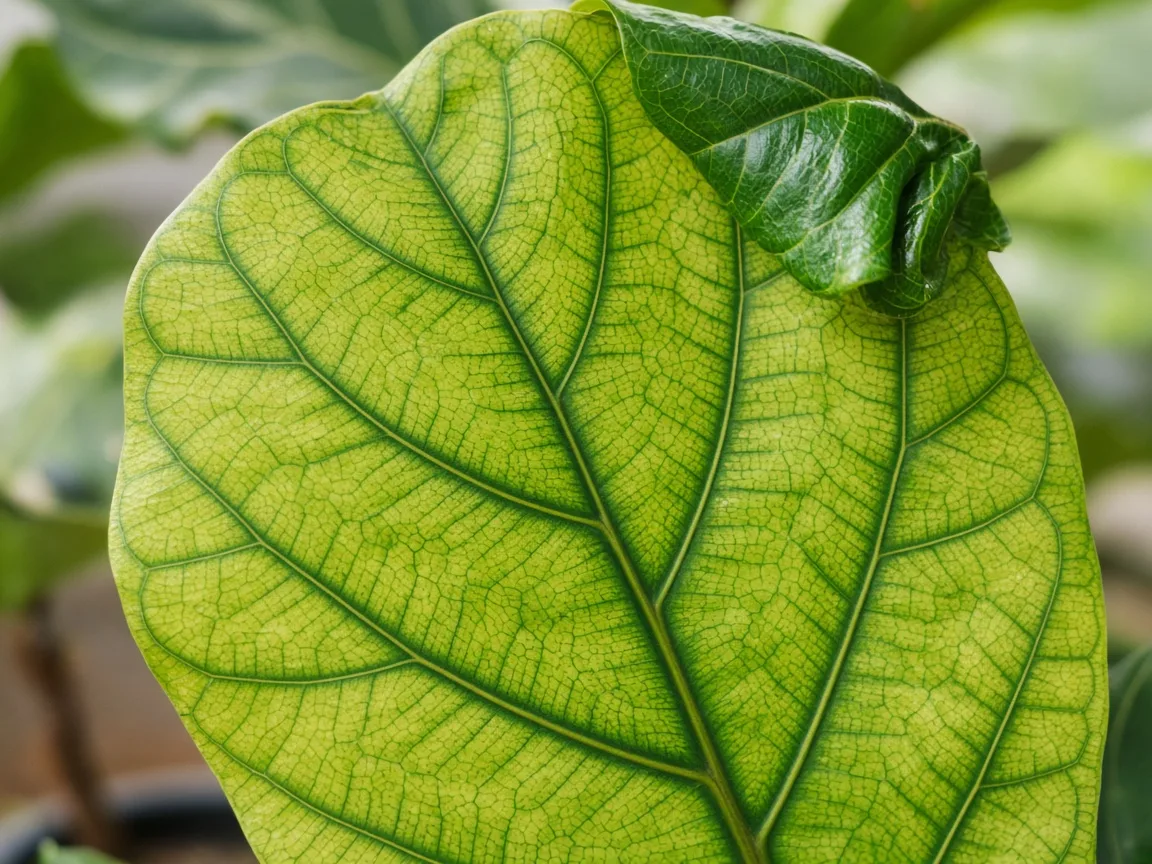
New violin leaf at a fiddle leaf fig apex crown: pale yellow tissue between dark green veins while older large blades lower on the trunk stay normal—classic iron chlorosis on expanding crown foliage.
Typical signs:
- Pale or yellow new violin leaves at the apex crown with veins remaining darker green
- Successively paler new apex leaves if untreated—noticeable on a floor tree because each new blade spans six to eighteen inches
- Older violin leaves lower on the trunk may stay green while only the newest crown blade looks chlorotic
- Smaller or thinner new violin blades when chlorosis is severe
- Firm trunk at the soil line if roots are functional—soft mushy trunk on wet mix points to overwatering instead
Not iron deficiency:
- Interveinal yellowing on older lower violin leaves — magnesium deficiency
- Uniform pale lower leaves without vein pattern — nitrogen deficiency
- Brown scorched outer margins on old leaves — potassium deficiency
- Washed-out green across many leaves with long internodes — pale leaves or not enough light
- Fine stipples with webbing on undersides — spider mites before assuming chlorosis
- All leaves yellow on persistently wet soil — root rot overlap
The classic symptom of iron deficiency is interveinal chlorosis where leaf tissue yellows while veins stay green. RHS notes iron deficiency affects the youngest leaves first, unlike manganese or magnesium problems that tend to start on older foliage. On a tall floor tree, that pattern is easiest to read on the violin leaf still opening at the crown—not on mature lower blades that may simply be aging out.
Why fiddle leaf fig gets iron deficiency
Ficus lyrata grows large leaves that demand iron for chlorophyll in every new violin blade the apex pushes. Iron chlorosis often results when roots cannot absorb iron even when it is present in fertilizer—high pH, waterlogged mix, compacted peat, or salt crust block uptake while the crown keeps trying to unfurl new foliage.
Fiddle-leaf-fig-specific causes:
- Alkaline tap water drifting pot pH upward — Repeated hard tap watering in a large floor pot raises pH over time and locks iron chemically; high pH makes iron unavailable to plants even when you feed occasionally. Fiddle leaf fig prefers slightly acidic mix near pH 6–7.
- Depleted mix in the same decorative pot for years — Large floor trees often go two or more years without repotting or micronutrient feeding; owners miss gradual apex chlorosis until the second pale violin leaf opens.
- Overwatering in oversized cachepots — Wet mix reduces root oxygen and micronutrient uptake; symptoms worsen in poorly drained soils. A tall tree in a pot that stays wet too long cannot absorb iron present in the mix.
- Skipped micronutrients during active growth — Complete fertilizer with iron was never applied during spring and summer when the apex pushes monthly new growth; see the fiddle leaf fig fertilizer guide.
- Salt buildup from hard tap water and fertilizer — White crust at the pot rim limits micronutrient uptake. See salt build-up before stacking more supplements.
- Misread magnesium deficiency — Magnesium hits older lower violin leaves with interveinal yellowing. Iron hits the newest apex blade with green veins—a opposite leaf-age pattern.
Do not diagnose iron deficiency on sour wet soil with a soft trunk at the soil line—that is root failure from chronic saturation until you confirm mostly firm wood-like trunk tissue.
Apex violin leaves: chlorosis on the newest unfurling blade
Fiddle leaf fig shows iron stress on the large violin leaf still opening at the apex crown—a pattern that would be nonsense on a pothos vine heart or snake plant rosette. Veins remain green while the expanding blade between them yellows before the leaf fully hardens and arches outward along the trunk.
That crown-only chlorosis distinguishes iron from nitrogen, which starts on the lowest oldest violin leaves with uniform pale green. It also differs from magnesium deficiency, which yellows between veins on older lower leaves while the apex may look normal early on.
Because each new fiddle leaf is enormous, compare two or three consecutive new apex violin blades on the same trunk. One briefly lighter opener after repot stress may be transient; two or three in a row with dark green veins on pale tissue is a strong iron signal.
Floor pots, alkaline water, and the pH drift problem
Fiddle leaf fig floor trees in oversized decorative pots are especially prone to iron chlorosis from pH drift. Owners water deeply so a tall tree does not dry out, but repeated alkaline tap water gradually raises pot pH above the slightly acidic range Ficus prefers. Iron may be present in old mix or fertilizer labels, yet roots cannot absorb it once pH climbs.
The visual result is a split canopy: healthy-looking lower violin leaves on the trunk and pale new growth with green veins at the apex. Owners often misread this as normal aging on the lower canopy while only the top looks sick—when the top is actually showing immobile-nutrient chlorosis on expanding tissue.
Closing the gap means complete balanced fertilizer with micronutrients during active growth, occasional flushing when white salt crust appears, and mix refresh when the same container has held the tree for three or more years. Container Ficus need balanced micronutrients, not nitrogen alone on a floor tree pushing large new leaves monthly.
Lookalike symptoms
| Pattern | Check | Likely cause |
|---|---|---|
| New apex leaves yellow with green veins | Leaf age, vein pattern | Iron deficiency (this page) |
| Old leaves yellow between green veins | Lower canopy vs apex | Magnesium deficiency |
| Uniform pale old leaves | No interveinal banding | Nitrogen deficiency |
| Brown scorched leaf margins | Margin vs between veins | Potassium deficiency |
| Brown tips only | Tip vs full margin | Brown tips |
| Dark spots, soggy soil | Root firmness | Overwatering |
How to confirm
- Vein pattern on leaf age — Interveinal chlorosis on the newest unfurling violin leaf at the apex with green veins points to iron.
- Compare apex vs lower canopy — Lower leaves green with only crown chlorosis supports iron over magnesium.
- Fertilizer label — Complete micronutrient mix vs nitrogen-only products used for months.
- Root health — Firm roots on appropriate dry-down schedule vs soggy chronic wetness in cachepots.
- Soil age — Same mix three or more years in a large floor pot without repot or top-dress.
- Salt buildup — Salt build-up white crust may need flushing before iron supplements absorb.
- Progression direction — Iron stays on new apex tissue; magnesium moves upward from lowest leaves over weeks.
First fix for fiddle leaf fig
One soil drench with chelated iron (FeEDDHA form for alkaline-prone indoor mix) at label rate for container plants—after confirming roots are firm, soil is not waterlogged, and interveinal chlorosis is clearly on new apex growth only.
Do not foliar-spray a recently relocated tree in hot direct afternoon sun. Foliar iron works best on newly developing foliage in spring; on a stable indoor tree, a single measured soil drench is usually the safer first correction. Per the fiddle leaf fig fertilizer guide, one measured correction—not weekly iron drenches on soggy soil.
If white salt crust rings the pot, flush with plain water first, let mix return to normal dry-down per the watering guide, then apply one chelated iron drench. Fix drainage before repeating any supplement on waterlogged roots.
Step-by-step recovery
- Confirm the chlorosis pattern is on new apex violin leaves with green veins—not older lower leaves alone.
- Check trunk firmness and whether the top two inches of mix dry before the next deep watering.
- Flush accumulated salts if white crust appears on the soil rim before the next feed.
- Apply one chelated iron drench at label rate for container plants; prefer FeEDDHA in alkaline-prone tap-water setups.
- Switch to complete balanced fertilizer with micronutrients through the growing season per the fertilizer guide.
- Repot into fresh well-draining mix if the tree has been in the same oversized pot for years and chlorosis continues after two corrections.
- Monitor the next two apex violin leaves for uniform green color without interveinal banding over four to eight weeks.
Recovery timeline
Chlorotic areas on the violin leaf currently unfurling rarely return to full green—the bleached interveinal tissue does not re-pigment once iron is corrected. Judge recovery by new apex leaves emerging with uniform green color between veins, usually within four to eight weeks after corrected feeding and one chelated iron drench on healthy roots.
If interveinal yellowing spreads to multiple successive new crown leaves despite iron and complete feed, inspect roots for rot and check whether chronic overwatering is blocking uptake before a third supplement application.
Mistakes to avoid
- Do not diagnose magnesium deficiency when only new apex leaves show interveinal chlorosis—magnesium hits older lower violin leaves first.
- Do not apply weekly iron drenches on soggy soil—fix drainage before repeated micronutrient supplements.
- Do not foliar-spray a recently relocated tree in direct afternoon sun—leaf burn compounds chlorosis stress.
- Do not expect old chlorotic violin leaves to fully re-green—judge the next apex flush.
- Do not rely on nitrogen-only fertilizer on a large-leaf floor tree pushing monthly new growth.
- Do not stack repotting, pruning, and iron drench on the same day after a recent move—stabilize care first.
Prevention
- Feed lightly with complete balanced houseplant fertilizer including iron and micronutrients during active growth per the fertilizer guide.
- Flush mix occasionally with plain water during the growing season to limit salt buildup from tap water and fertilizer.
- Refresh old peat-based mix at repotting before roots circle a nutrient-stripped core in an oversized floor pot.
- Maintain bright indirect light per the light guide so new violin leaves can use iron efficiently once absorbed.
- Match watering depth to pot size without letting the tree sit in cachepot standing water.
- Avoid months without any fertilizer during spring and summer when the apex is pushing new violin leaves.
Related Fiddle Leaf Fig guides
- Fiddle leaf fig overview
- Fiddle leaf fig fertilizer
- Fiddle leaf fig watering
- Magnesium deficiency
- Nitrogen deficiency
- Potassium deficiency
- Brown tips
- Fiddle leaf fig problems hub
Conclusion
Pale new violin leaves with dark green veins at the fiddle leaf fig apex signal iron chlorosis or blocked uptake—confirm the new-growth interveinal pattern differs from magnesium chlorosis on older lower leaves, fix root health and pH drift in large floor pots, then apply one chelated iron drench and monitor the next crown flush for uniform green color.
Related tool
Use the Fertilizer Dilution Calculator to measure chelated iron or half-strength complete fertilizer for iron deficiency recovery on this plant before changing multiple variables at once.