Pale Leaves on Fiddle Leaf Fig: Causes, Checks & Fixes
Quick answer
Pale leaves on fiddle leaf fig usually mean too little light for full chlorophyll, iron or nitrogen loss in a bright room without regular feed, or root stress on chronically wet soil. First step: compare the newest crown leaf to mature blades below—washed-out yellow-green with long petioles means move to bright indirect light before fertilizing.
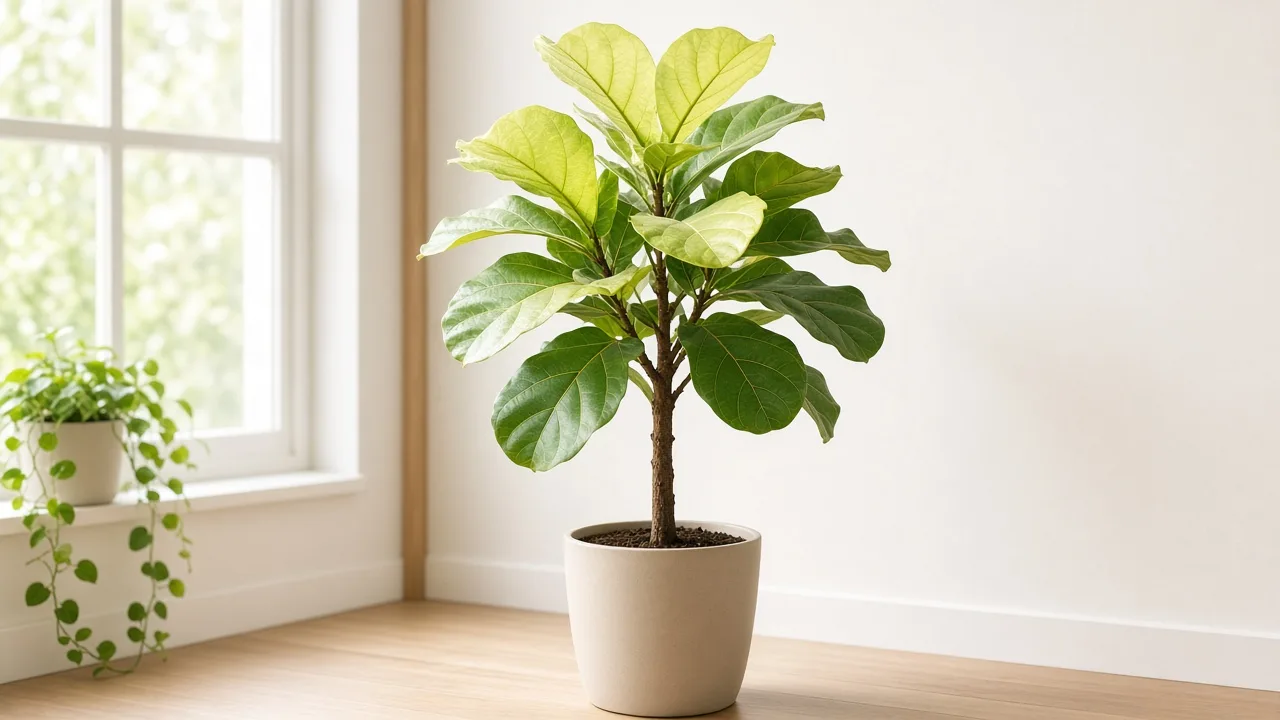
Pale Leaves on Fiddle Leaf Fig: Causes, Checks & Fixes
This guide covers pale leaves on Fiddle Leaf Fig. See also the general Pale Leaves guide, watering, and light pages for this plant.
Pale Leaves on Fiddle Leaf Fig: Causes, Checks & Fixes
Quick answer
Pale leaves on Fiddle Leaf Fig (Ficus lyrata) look washed-out, yellow-green, or dull lime instead of the deep glossy green that healthy large violin-shaped blades show in good light. For general chlorosis mechanics, see our pale leaves guide. On fiddle-leaf fig, crown-tip color on long petioles tells you more than any single lower leaf—small pale new foliage at the apex with stretched spacing means light first; interveinal yellowing with dark green veins on new growth in a bright room means iron or nutrient uptake instead.
First step: compare the newest crown leaf to the largest mature blade three nodes below. If the fresh leaf opens smaller, thinner, and lighter than older foliage while petioles lengthen, move the tree to bright indirect light before you change watering or feed. If new growth in a bright window shows yellow between veins with green veins remaining, hold fertilizer until you confirm roots are firm and soil dries normally—then see iron deficiency on Fiddle Leaf Fig.
Ficus lyrata prefers bright indirect light or partial shade with protection from afternoon sun. Insufficient light makes indoor plants spindly with fading leaf color and poor growth—on this high-light tree, that fade often appears on crown tips before widespread yellow leaves.
When to use this page vs other Fiddle Leaf Fig guides
- Not enough light — long bare stems, directional lean, very small new leaves on elongated petioles
- Yellow leaves — soft yellow on wet soil or crisp yellow-brown on dry mix
- Iron deficiency — interveinal yellowing with green veins on newest crown growth in bright light
- Nitrogen deficiency — oldest large leaves pale first during active growth with firm roots
- Overwatering — heavy pot, sour smell, pale limp lowers on saturated mix
- Spider mites — stippled pale speckling with webbing, not uniform chlorosis
- Brown leaves — necrotic tissue after pale washout progresses
What pale leaves look like on Fiddle Leaf Fig
Healthy fiddle-leaf fig holds large alternate violin-shaped leaves—often 12 to 18 inches long indoors—on an upright woody trunk with a glossy deep green upper surface and paler green undersides. Pale foliage breaks that pattern in recognizable ways depending on cause.
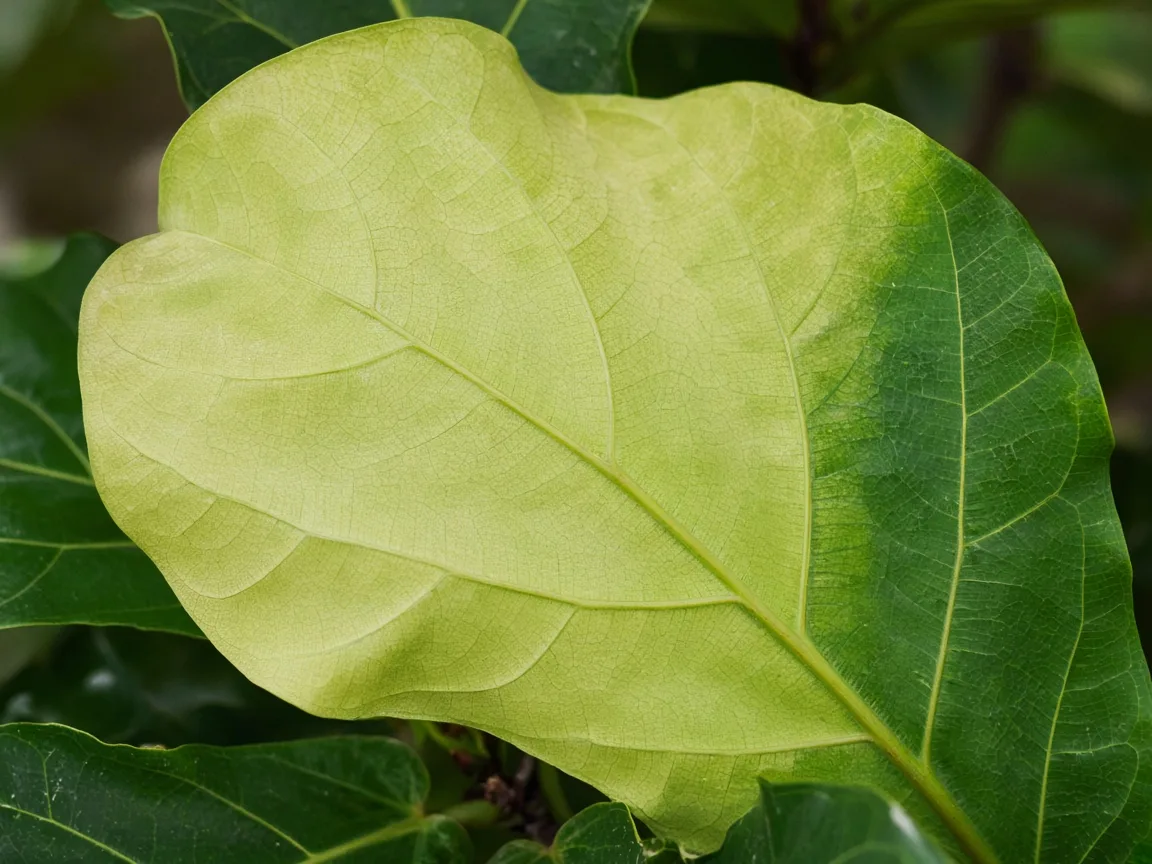
Pale leaf symptoms on Fiddle Leaf Fig—compare washed-out yellow-green tissue and visible vein pattern against healthy dark green on the same blade.
Low-light chlorosis (most common indoors)
- Uniform washed-out yellow-green across several leaves on the same stem section—not isolated spots
- New crown leaves open smaller and thinner than mature blades a few nodes back, often on longer petioles
- The upright tree leans toward the brightest wall; lower trunk leaves may stay darker while tips fade first
- Growth stalls for weeks even though old foliage still looks merely dull rather than necrotic
- Pot may stay wet 10+ days because the dim tree uses little water—setting up overwatering risk while color washes out
Iron chlorosis in bright light (second common pattern)
- Yellow between veins on newest crown leaves while veins stay dark green—interveinal chlorosis often affects youngest leaves first with iron deficiency
- Older large blades may still look acceptable while the apical bud pushes pale, thin new tissue
- Common when a tree sits in strong light but has gone months without feed or sits in alkaline, depleted mix
- Not the same as sun-bleach—vein pattern stays visible and tissue does not turn papery crisp
Root-stress pale (wet soil)
- Lower leaves fade yellow-green while mix stays damp 2 inches (5 cm) down for 10+ days
- Stems stay firm at first, but crown growth stalls; sometimes paired with yellowing
- Pot feels heavy; fungus gnats may hover when soil never dries
- Ficus lyrata is sensitive to overwatering—oxygen loss limits nutrient uptake and mimics deficiency
Sun-bleach pale (too much direct sun)
- Pale or whitish patches on leaves facing south or west glass—not uniform canopy washout
- Stiff leathery tissue may turn crisp brown at edges after sudden exposure
- Opposite side of the blade may stay darker—unlike dim-room chlorosis, which affects whole sections evenly
Pest stippling (looks pale from a distance)
- Fine yellow speckles across the large leaf surface with possible webbing on undersides
- Pattern is scattered, not evenly washed-out green
- Common in dry winter rooms—confirm with spider mites on Fiddle Leaf Fig before treating light
Reading pale on large violin-shaped Ficus lyrata leaves
Fiddle-leaf fig leaves are very large, leathery, and coriaceous with a raised midrib and prominent lateral veins. That anatomy changes how pale reads compared to smaller-leaved houseplants:
Crown-first washout: Because each blade is expensive to maintain, the newest leaves at the apical bud show chlorosis first when light or iron falls short. Pale small crown leaves on long thin petioles next to full-size dark green mature foliage below is the signature low-light pattern on this upright tree—not a random lower leaf aging out.
Interveinal pattern on new growth: When veins stay green but tissue between them turns yellow on fresh crown leaves only, think iron or manganese limitation in bright conditions—not dim corners. Iron deficiency affects the youngest leaves first, which on Ficus lyrata means the top of the tree, not the lowest trunk leaves.
Bottom-canopy holdout: On a tall fiddle tree, lower mature blades may stay relatively dark while the crown washes out in a dim room. That lollipop pattern—dark skirt, pale top—almost always means insufficient light at canopy height even if the pot sits near a window at floor level.
Underside baseline: Healthy Ficus lyrata naturally shows dull green upper surface and paler green undersides. Do not confuse normal underside color with chlorosis on the upper blade surface.
The high-light paradox on Ficus lyrata
Fiddle-leaf fig is classified among high-light houseplants that need bright indirect exposure to hold large glossy foliage. Strong light drives rapid photosynthesis on each expensive leaf—depleting iron and nitrogen faster than a dim pothos in the same room.
That creates a paradox owners miss: a tree in a bright south room can still turn pale if it has not been fed through a full growing season, while a dim north-corner tree pales from insufficient chlorophyll production for different reasons. House Plant Journal notes that strong light paired with no fertilizer can leave progressively lighter leaves and stalled growth even when placement looks correct.
Bright room + green veins on yellow new leaves → confirm roots, then address iron or balanced feed—not relocation.
Dim room + uniformly dull small crown leaves → light correction first—never fertilizer on a tree that cannot use it.
Winter semi-dormancy and the pale-wet-soil trap
Fiddle-leaf fig slows growth in fall and winter and uses less water. Many pale-leaf cases in cold months trace to chronic wet mix in dim light, not nutrient deficiency alone.
When growth is slow and days are short, the top 2 inches of mix may stay wet for weeks if you keep summer watering frequency. Lower leaves turn dull yellow-green while the pot feels heavy and crown tips stay small. NYBG recommends checking the top 2 to 3 inches before watering—the same rhythm that works in June waterlogs roots in January when low light slows uptake.
Winter fix path when pale pairs with heavy wet soil:
- Pause watering until the top 2 inches of mix dry at center depth.
- Move the tree to the brightest indirect spot available so soil does not stay cold and stagnant.
- Do not fertilize until new growth looks stable for two weeks after moisture corrects.
- Unpot only if pale spreads after a full dry-down cycle—see root rot on Fiddle Leaf Fig.
How to confirm the cause
Work through these checks in order:
- Crown-tip color and petiole length — Pale small new leaf plus elongated petiole on the apical bud = low light. Rich color with tight spacing = light is probably adequate at canopy height.
- Hand-shadow test at canopy height — On a bright day, hold your hand at the top of the tree. Soft defined shadow = usable indirect light; faint or absent shadow = too dim for healthy color on this species per extension lighting guidance.
- Vein pattern on newest leaf — Green veins with yellow tissue between them on fresh crown growth in a bright window = iron or nutrient uptake issue. Uniform dull washout without vein contrast = light or root stress.
- Soil moisture at 2 inches — Wet and heavy with pale limp lowers = root stress. Appropriately dry with pale stretch at crown = light.
- Which leaves pale — Crown tips uniformly dull = light. Lower leaves only on wet soil = moisture. Speckled pattern = pests.
- Recent moves or light changes — Sudden bleach after a window change = sun, not chlorosis. Gradual fade over months in same spot = chronic low light or depleted feed in bright rooms.
- Growth rate — No new leaf for eight or more weeks during spring or summer with directional lean confirms chronic under-lighting—see not enough light.
Check stem firmness at the base. Soft stems with sour-smelling wet soil suggest root decline, not light alone. Firm wood, appropriate moisture, and crown washout keep pale-leaf diagnosis at the top of the list.
First fix for Fiddle Leaf Fig
Run the hand-shadow test at canopy height and compare the newest crown leaf to mature foliage below—then correct light placement if the test fails before you change watering or fertilizer.
If the shadow is faint or the newest leaf is smaller and paler than mature blades on a longer petiole, move the tree to the brightest location that still qualifies as bright indirect light—within one to three feet of an east window, or three to five feet back from south or west glass with a sheer curtain. The canopy should see bright sky without leaves pressed against hot panes. Details: Fiddle Leaf Fig light guide.
If light passes the test but new crown leaves show interveinal yellowing with green veins, skip feed for 48 hours and confirm the top 2 inches of mix dry on a normal cycle with firm roots. Then use a diluted balanced liquid fertilizer at half strength during active growth, or see iron deficiency when vein contrast is strong on fresh leaves only.
Do not relocate and fertilize on the same day. Ficus lyrata reacts to change before it reacts to slow nutrient decline—stabilize one variable first.
Step-by-step recovery
After the first fix, work through secondary steps based on what you confirmed:
Low light confirmed
- Move to final bright indirect placement and stop moving the tree for at least two weeks.
- Resume normal watering only after the top 2 inches dry—dim trees drink slowly; do not let wet soil persist.
- Rotate the pot every two to three weeks once growth resumes for even crown color.
- Judge recovery by the next two crown leaves opening darker and closer together—not by old faded blades re-greening.
Iron or nutrient pale in bright light
- Confirm roots are white and firm—not brown and mushy on wet mix.
- Feed monthly at half strength during spring and summer only after moisture rhythm is stable—see fertilizer guide.
- If interveinal pattern persists on new growth after two feed cycles, test for alkaline tap water or depleted mix; repot only in spring if roots are circling and feed has not helped.
- Never use full-strength fertilizer on a tree that recently recovered from root rot.
Root-stress pale on wet soil
- Stop watering until the top 2 inches dry completely at center depth.
- Confirm drainage holes are open; empty cachepots within 30 minutes of every soak.
- Keep the tree in bright indirect light so mix does not stay cold and stagnant.
- Remove only fully limp pale lowers after two dry-down cycles if they do not firm up.
Recovery timeline
Existing faded violin-shaped blades rarely return to deep green. Judge progress by new crown growth:
- Low light corrected: Expect visibly darker, larger new leaves within three to six weeks during spring or summer. Winter corrections may take longer while growth is slow.
- Nutrient correction in bright light: Interveinal yellowing on the next one or two crown leaves should ease within four to eight weeks if roots are healthy and feed is consistent.
- Root-stress pale: After moisture corrects, crown color stabilizes in one to two watering cycles if rot has not advanced. Soft stems at the base mean escalation—not more waiting.
Signs the problem is worsening: pale spreading to every leaf including mature lowers, multiple leaves dropping in a week, soft stems at soil line, or new bud casings browning before leaves unfurl.
Lookalike symptoms
| What you see | Likely cause | Where to go |
|---|---|---|
| Small pale crown leaves on long petioles, tree leans to window | Low light | Not enough light |
| Yellow between veins, green veins on newest crown leaf | Iron chlorosis | Iron deficiency |
| Oldest trunk leaves pale first, crown still green in bright room | Nitrogen loss | Nitrogen deficiency |
| Soft yellow lowers on wet heavy pot | Root stress | Overwatering |
| Fine speckles, webbing on undersides | Spider mites | Spider mites |
| Whitish patches on window-facing side only | Sun scorch | Light guide |
| One lowest trunk leaf fading slowly, crown glossy | Normal senescence | No fix needed if new growth stays firm |
Mistakes to avoid
- Fertilizing a dim tree — Without enough light, Ficus lyrata cannot use nutrients; feed burns roots on slow metabolism.
- Moving the tree repeatedly while diagnosing pale color — relocation shock can drop leaves and mask whether light was the original issue.
- Watering on a summer calendar in winter — Wet cold mix in dim rooms causes pale lowers that look like deficiency.
- Assuming pale means more sun — Hot direct afternoon rays bleach stiff leaves; bright indirect light is the target.
- Pruning the crown to force new growth before fixing light — you remove the best diagnostic tissue and stress an already weak apical bud.
- Repotting on day one — Only unpot when roots are mushy, mix is failing, or chronic wet soil persists after dry-down corrections.
How to prevent pale leaves next time
Place the tree where bright indirect light is realistic at canopy height most of the day—not just at floor level near a window. Check the top 2 inches of mix before every watering per the watering guide. Feed at half strength monthly during active growth when light is strong enough to support new large leaves. Reduce winter watering when growth slows. Inspect crown tips weekly during the growing season—pale new leaves are an early warning before leaf drop or brown leaves follow.
Related Fiddle Leaf Fig guides
- Fiddle Leaf Fig overview — placement, stability, and growth expectations for the full cluster
- Problems hub — all symptom guides for this species
- Light — hand-shadow test, window distance, and grow-light options
- Watering — top-2-inch dry-down rhythm that prevents pale-wet-soil traps
- Soil — drainage and mix choices that keep roots oxygenated
- Fertilizer — when feed helps crown color vs when it harms stressed roots
Use this page when several leaves look uniformly washed-out or crown new growth opens lighter and smaller than mature foliage. Use sibling guides when one symptom dominates—interveinal veins for iron, heavy wet pot for overwatering, or directional stretch for not enough light.
Related tool
Use the Plant Problem Diagnosis Tool to narrow causes for pale leaves on this plant before changing multiple variables at once.