Potassium Deficiency on Fiddle Leaf Fig: Causes, Checks &
Quick answer
Potassium deficiency on fiddle leaf fig shows as brown or scorched margins and yellowing edges on older violin-shaped leaves, sometimes with weak petioles on lower branches. First step: confirm scorching is on leaf margins of older foliage—not brown tips from fluoride alone—and review whether complete fertilizer has been used.
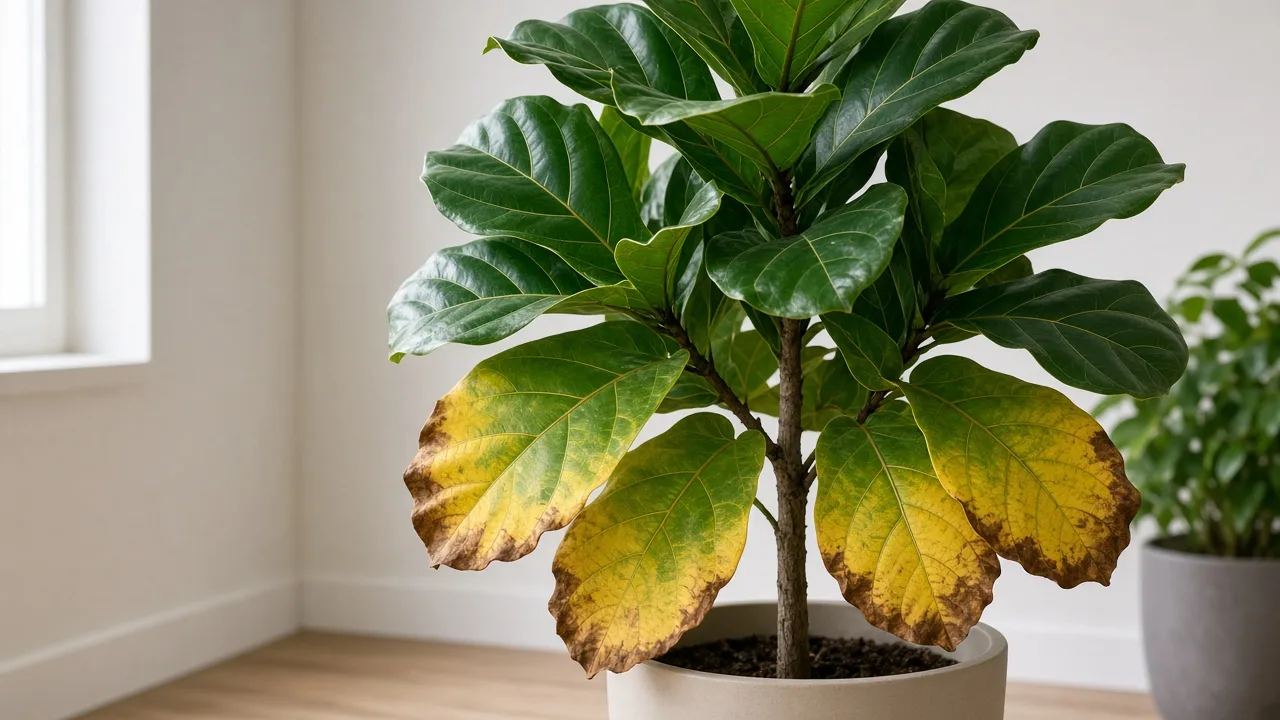
Potassium Deficiency on Fiddle Leaf Fig: Causes, Checks & Fixes
This guide covers potassium deficiency on Fiddle Leaf Fig. See also the general Potassium Deficiency guide, watering, and light pages for this plant.
Potassium Deficiency on Fiddle Leaf Fig: Causes, Checks & Fixes
Quick answer
Potassium deficiency on fiddle leaf fig (Ficus lyrata) shows as brown or scorched margins and yellowing edges on older violin-shaped leaves, sometimes with weak petioles on lower branches. Potassium regulates water movement and enzyme activity in plants, and deficiency often appears as marginal leaf scorch on mature foliage before the apex shows damage.
See our potassium deficiency guide for general scorch mechanics. On fiddle leaf fig, inspect the outer margins of large lower violin leaves—a band of yellow or brown along the leaf edge differs from fluoride brown tips that stay confined to the pointed apex.
First step: confirm marginal scorch on older leaves, not tip-only browning from fluoride or dry soil, then review whether complete balanced fertilizer has replaced potassium leached from a large floor pot.
When to use this page vs other Fiddle Leaf Fig guides
| Pattern | Read next |
|---|---|
| Old leaf margins yellow and scorched | Potassium deficiency (this page) |
| Tips brown only, margins clean | Brown tips / fluoride |
| Yellow between veins on old leaves | Magnesium deficiency |
| Uniform pale old leaves, no vein pattern | Nitrogen deficiency |
| New apex leaf distorted or tip-burned | Calcium deficiency |
| Dark mid-leaf spots, wet soil, soft stem | Overwatering |
| General yellowing, mixed causes | Yellow leaves |
What potassium deficiency looks like on fiddle leaf fig
Fiddle leaf fig carries some of the largest leaves in common indoor plant collections—each violin-shaped blade can span twelve to eighteen inches on a mature floor tree. Potassium stress shows clearly on those wide leaf margins because potassium helps regulate stomatal opening and water balance at the leaf edge. When supplies run low, the outer rim dies first while the mid-blade may stay greener for weeks.
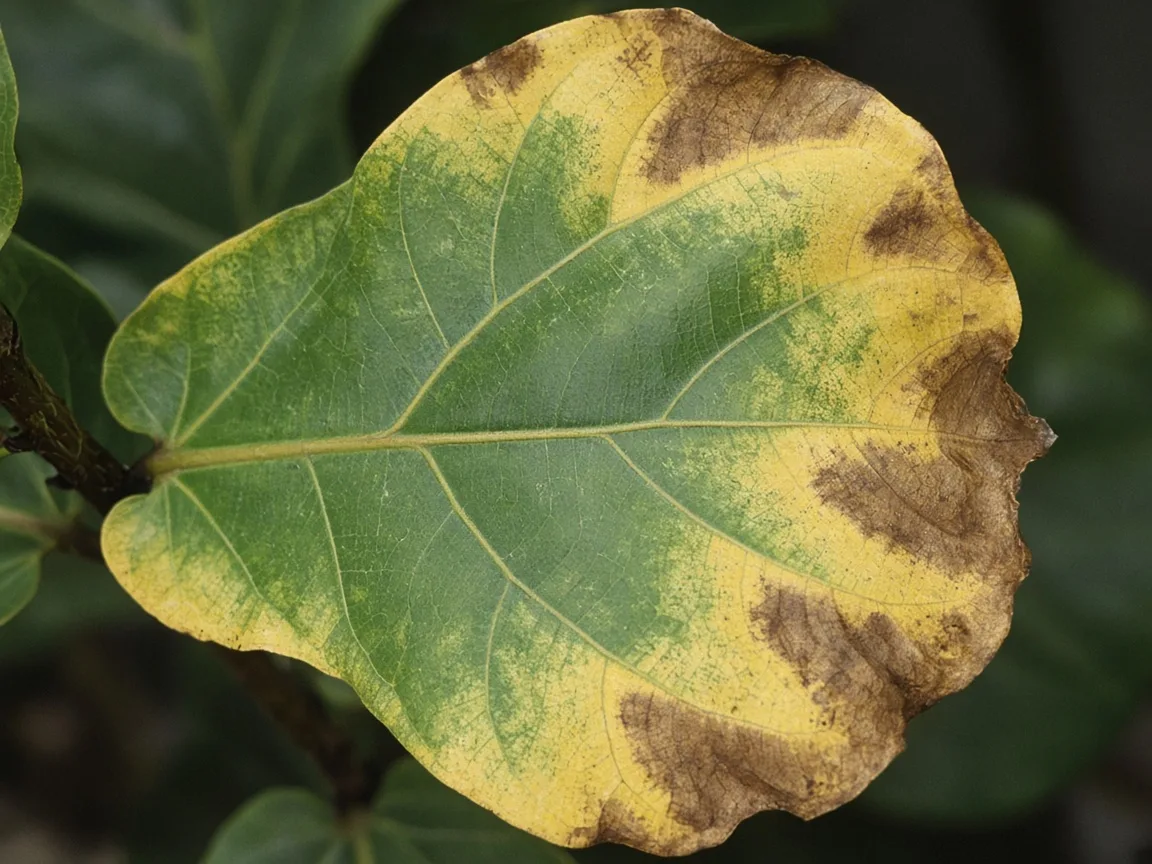
Marginal scorch on an older fiddle leaf fig violin leaf—the outer edge browns while veins and mid-blade tissue may stay greener initially.
Typical signs:
- Yellowing or browning along margins and edges of older lower violin leaves (marginal leaf scorch is a classic potassium symptom)
- Scorched or crisp brown leaf edges while mid-blade tissue stays relatively green initially
- Mottled yellow patches on mature leaves in moderate cases
- Weak or drooping petioles on affected lower leaves as scorch advances
- New apex leaves may look normal until deficiency deepens across the lower canopy
- Firm trunk and stiff upper growth if roots are still functional
Not potassium deficiency:
- Brown tips only without margin banding — brown tips or fluoride from tap water
- Yellow between veins on old leaves — magnesium deficiency
- Uniform pale old leaves without edge scorch — nitrogen deficiency
- Dark brown spots in leaf centers on wet soil — overwatering
- New leaves yellow with green veins — iron deficiency
Why fiddle leaf fig gets potassium deficiency
Ficus lyrata leaves transpire heavily in bright indoor light, and each large violin blade loses water through thousands of stomata. Potassium is the nutrient that helps regulate that water flow. When potassium runs low in the root zone, leaf margins—the farthest tissue from veins—dry out and scorch first.
Potassium deficiency on fiddle leaf fig is rarely about exotic soil chemistry. It is usually about depletion and leaching in large floor pots combined with incomplete feeding.
Fiddle-leaf-fig-specific causes:
- Leaching in oversized floor pots — Owners water deeply per the watering guide so a tall tree does not dry out, but potassium is mobile in soil and washes out of the upper root zone with each thorough flush. Without replacement through complete fertilizer, margins scorch on the oldest leaves first.
- Incomplete or nitrogen-heavy fertilizer — High-nitrogen products promote large new violin leaves without supplying enough potassium to support water regulation in existing foliage. Ficus in containers need balanced nutrition, not nitrogen alone.
- Depleted old peat-based mix — A fiddle leaf fig that has sat in the same decorative fourteen-inch pot for three or more years often has a modest root ball surrounded by exhausted mix. Potassium reserves are gone even when the owner waters on schedule.
- Root stress blocking uptake — Chronic overwatering in cachepots keeps roots anaerobic. Potassium may be present in the mix but cannot be absorbed through damaged roots.
- Salt imbalance from tap water and fertilizer — Months of hard tap water and heavy feeding without flushing can raise salt levels at the pot rim, compounding marginal burn. See salt build-up when white crust appears.
- Confusion with fluoride tip burn — Municipal tap water often browns only the pointed tip of violin leaves on Ficus lyrata. Potassium scorch bands the full outer margin on older lower leaves—a wider, edge-to-edge pattern tip burn does not produce.
Lookalike symptoms
| Pattern | Check | Likely cause |
|---|---|---|
| Old leaf margins yellow and scorched | Full edge band vs tip only | Potassium deficiency (this page) |
| Tips brown only, margins clean | Water source, leaf age | Brown tips / fluoride |
| Yellow between veins on old leaves | Vein pattern | Magnesium deficiency |
| Uniform pale old leaves | No margin scorch | Nitrogen deficiency |
| New apex leaf distorted | New vs old tissue | Calcium deficiency |
| Dark mid-leaf spots, wet soil | Root smell, stem firmness | Overwatering |
How to confirm
- Margin vs tip pattern — Full edge scorch banding the outer rim of violin leaves points to potassium. Tip-only browning without margin involvement points to fluoride or underwatering instead.
- Leaf age — Older lower violin leaves on the trunk show scorch first. New apex leaves stay clean in early stages.
- Fertilizer history — Complete balanced product with potassium listed vs nitrogen-only or skipped feeds for months during active growth.
- Water source — Fluoride-heavy tap water browns tips on multiple leaves regardless of age. Margin scorch on filtered-water trees with depleted mix points to potassium.
- Root check — Firm white roots on appropriate dry-down support feeding fixes. Brown mushy roots need drainage correction before fertilizer.
- Salt crust — White deposits at the pot rim suggest salt build-up that may need flushing before the next feed.
- Pot size vs root ball — Oversized decorative floor pot with small root mass and years-old mix strongly suggests nutrient depletion.
First fix for fiddle leaf fig
One half-strength application of complete balanced fertilizer containing potassium, after confirming roots are healthy and soil moisture is normal—not waterlogged.
Do not heavy-feed a stressed or recently relocated floor tree. Per the fiddle leaf fig fertilizer guide, one measured complete feed replaces leached potassium more safely than stacking repot, prune, and triple fertilizer the same week.
If white salt crust rings the pot, flush with plain water first, let the mix dry to normal depth, then apply one dilute feed. On a tree watered exclusively with hard tap water showing both tip burn and margin scorch, address potassium depletion through feeding while accepting that fluoride tips on old leaves will not heal.
Step-by-step recovery
- Continue monthly half-strength complete feeds through active growth; pause or reduce in winter when Ficus lyrata uptake slows.
- Flush accumulated salts if white crust rings the pot rim—then resume light feeding rather than skipping fertilizer entirely.
- Maintain consistent dry-down on large floor pots: top two inches dry before deep watering per the watering guide.
- Repot into fresh well-draining mix if roots fill an oversized floor pot and marginal scorch persists after two measured feeds.
- Trim fully scorched lower leaves only if they are mostly dead tissue—leave partial leaves that still photosynthesize.
- Monitor new apex violin leaves for clean margins without edge burn over the next two flushes.
- Switch to filtered or low-fluoride water if tip burn confuses the diagnosis, but do not rely on water changes alone when margin scorch points to potassium depletion.
Recovery timeline
Scorched margins on old large violin leaves do not heal—the burned edge tissue is dead. Judge recovery by new leaves emerging without marginal burn, usually within four to eight weeks after corrected complete feeding on healthy roots.
Severe depletion in an unchanged oversized pot may take a full growing season and a repot refresh before the lower canopy stabilizes. If new apex leaves also show edge scorch despite feeding, check for chronic overwatering or salt injury before repeating heavy fertilizer.
Margin scorch on floor-tree violin leaves
Fiddle leaf fig’s massive violin-shaped leaves make potassium stress visible in a way smaller houseplants hide. The wide leaf edge is the last tissue to receive water when potassium-regulated stomatal function fails—marginal yellowing and brown scorch appear on the oldest lower canopy while the mid-blade may stay green longer.
This pattern differs sharply from fluoride tip burn, which typically affects the pointed tip of violin leaves on trees watered with untreated municipal tap water. Fluoride damage stays at the apex point; potassium scorch bands the entire outer margin from petiole to tip. It also differs from magnesium interveinal chlorosis, which yellows tissue between veins rather than scorching the outer rim.
On oversized decorative pots, potassium leaches fastest from the upper mix layer where feeder roots actively work. Margin scorch can appear even when the owner waters on a reasonable schedule—the problem is depleted mix, not drought.
Large pot leaching and the feeding gap
Fiddle leaf fig floor trees often live in pots far larger than their root balls for stability and aesthetics. That design means a small root mass sits in a large volume of mix that gets flushed with every deep watering.
Potassium is mobile in soil solution and washes downward with each thorough drink. Nitrogen-heavy feeds without potassium replacement, or months without any fertilizer during spring and summer growth, leave the upper root zone stripped. The tree compensates by pulling potassium from older leaf margins—hence scorch on the lowest violin leaves first.
Closing the gap means complete balanced fertilizer during active growth, not more nitrogen to push larger leaves that the root zone cannot support. A moderate indoor tree in bright indirect light still needs potassium replacement every four to six weeks through the growing season if deep watering is part of the routine.
Mistakes to avoid
- Do not confuse fluoride tip burn with potassium margin scorch—tips-only damage on multiple leaf ages is usually water chemistry, not potassium alone.
- Do not heavy-feed a waterlogged floor tree in a cachepot—fix drainage and let the root zone breathe before fertilizer.
- Do not strip half the lower canopy because margins scorched—partial leaves still photosynthesize and support recovery.
- Do not expect scorched edges on old violin leaves to re-green—judge the next apex flush.
- Do not rely on nitrogen-only fertilizer on a large-leaf tree pushing new violin blades every month in bright light.
- Do not repot and feed heavily the same week on a recently relocated tree—stabilize placement first.
Prevention
- Feed lightly with complete balanced houseplant fertilizer including potassium during active growth per the fertilizer guide.
- Flush mix occasionally with plain water during the growing season to limit salt buildup from tap water and fertilizer.
- Refresh depleted peat-based mix at repotting before roots circle a nutrient-stripped core in an oversized floor pot.
- Use filtered or low-fluoride water if brown tips and margin scorch appear together—address both water quality and potassium replacement.
- Match watering depth to pot size without letting the tree sit in cachepot standing water.
- Top-dress or repot on schedule when the same decorative container has held the tree for three or more years.
Related Fiddle Leaf Fig guides
- Fiddle leaf fig overview
- Fiddle leaf fig fertilizer
- Fiddle leaf fig watering
- Brown tips
- Magnesium deficiency
- Nitrogen deficiency
- Salt build-up
- Fiddle leaf fig problems hub
Conclusion
Brown or scorched margins on older fiddle leaf fig violin leaves point to potassium depletion or leaching in large floor pots—confirm the full-margin pattern differs from fluoride tip burn, fix root health and salt balance, then apply one measured complete fertilizer feed and monitor new apex leaves for clean edges.
Related tool
Use the Fertilizer Dilution Calculator to measure half-strength complete fertilizer for potassium deficiency recovery on this plant before changing multiple variables at once.