Flame Moss Care: Light, Attachment, and Aquarium Growth
Taxiphyllum sp. 'Flame'
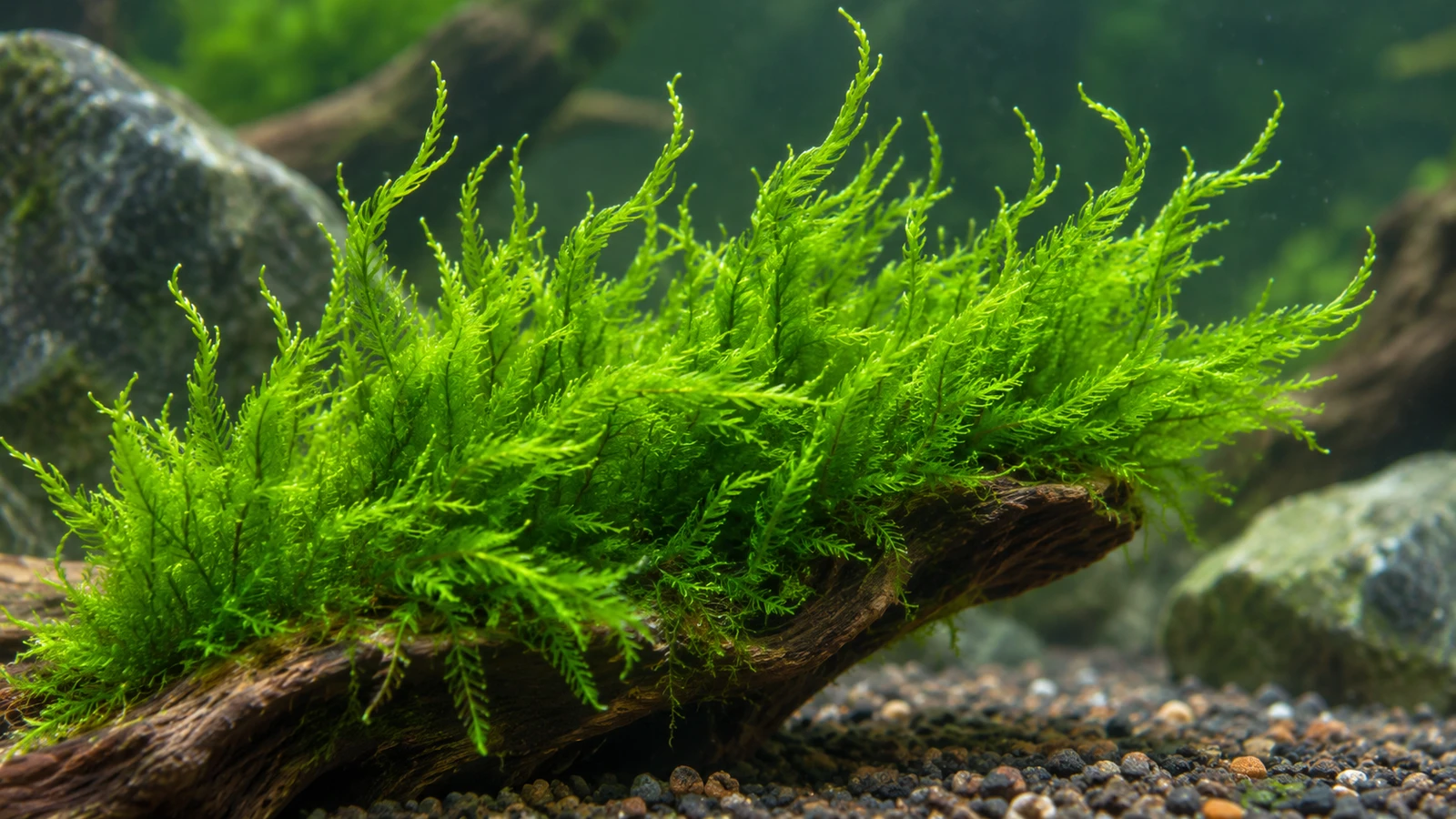
Keep Flame Moss fully submerged in a freshwater aquarium, attach small portions to rock or driftwood, and use low to medium light. Trim and remove debris when clumps become dense; do not bury it in substrate.
Flame Moss Aquarium Care
Start with wateringThe most common care mistake for Flame MossAquarium care →Flame Moss care essentials
Light
Low to medium aquarium lighting; even overhead light helps preserve upright form
Water
Keep aquarium-grown Flame Moss fully submerged in clean freshwater. It is an aquatic moss, not a terrestrial plant to water by pot or soil dryness. Attach it to rock or driftwood so the fine shoots stay in place and receive water flow.
Soil
No soil is needed. Secure a small, thin portion to aquarium-safe rock or driftwood; Flame Moss is grown for its attachment to hardscape, not as a rooted substrate plant.
Humidity
Fully submerged aquarium conditions
Temperature
22–28°C (72–82°F), the range listed by Dennerle Plants for the trade form
Fertilizer
Fertilizer is usually unnecessary when the aquarium has adequate nutrients in the water column. If a tank-wide deficiency is identified, use an aquarium plant product according to its label rather than feeding the moss separately.. Aquarium plant fertilizer only when needed for the planted tank
About Flame Moss
Flame Moss is native to Dennerle Plants lists Southeast Asia for the aquarium trade form, but its species-level identity and precise native range are not established in the sources reviewed., typically reaches Up to about 10 cm according to Dennerle Plants; height and form vary with tank conditions and trimming indoors, with slow growth. Flame Moss has a submerged freshwater moss sold under a trade name; forms slow growing, twisted, upright shoots when attached to aquarium hardscape. growth habit and part of the Taxiphyllaceae family. It is also known as Taxiphyllum sp. Flame Moss and Flame Moss Aquarium Moss.
| Detail | Information |
|---|---|
| Also known as | Taxiphyllum sp. Flame Moss, Flame Moss Aquarium Moss |
| Native region | Dennerle Plants lists Southeast Asia for the aquarium trade form, but its species-level identity and precise native range are not established in the sources reviewed. |
| Mature size | Up to about 10 cm according to Dennerle Plants; height and form vary with tank conditions and trimming |
| Growth rate | Slow |
| Growth habit | Submerged Freshwater Moss Sold Under A Trade Name; Forms Slow Growing, Twisted, Upright Shoots When Attached To Aquarium Hardscape. |
| Scientific name | Taxiphyllum sp. 'Flame' |
| Family | Taxiphyllaceae |
How to care for Flame Moss?
How much light does Flame Moss need?
Low to medium aquarium lighting; even overhead light helps preserve upright form. Low-tech freshwater aquarium lighting. Medium lighting in a balanced planted tank. low light
- Low to medium aquarium lighting - Low to medium aquarium lighting; even overhead light helps preserve upright form.
- even overhead light helps preserve upright form - Low to medium aquarium lighting; even overhead light helps preserve upright form.
- Low-tech freshwater aquarium lighting - Low-tech freshwater aquarium lighting.
- Medium lighting in a balanced planted tank - Medium lighting in a balanced planted tank.
- low light - Low to medium aquarium lighting; even overhead light helps preserve upright form.
When should you water Flame Moss?
Keep aquarium-grown Flame Moss fully submerged in clean freshwater. It is an aquatic moss, not a terrestrial plant to water by pot or soil dryness. Attach it to rock or driftwood so the fine shoots stay in place and receive water flow.
- Check that the moss remains submerged and secured - Keep aquarium-grown Flame Moss fully submerged in clean freshwater.
- and inspect for trapped debris - Attach it to rock or driftwood so the fine shoots stay in place and receive water flow.
- algae
- and decaying inner growth. Review water temperature and circulation before changing light or fertilizer - Attach it to rock or driftwood so the fine shoots stay in place and receive water flow.
- Drain excess water - Keep aquarium-grown Flame Moss fully submerged in clean freshwater.
What soil works best for Flame Moss?
No soil is needed. Secure a small, thin portion to aquarium-safe rock or driftwood; Flame Moss is grown for its attachment to hardscape, not as a rooted substrate plant.
- Attach small portions with aquarium-safe cotton thread - Secure a small, thin portion to aquarium-safe rock or driftwood; Flame Moss is grown for its attachment to hardscape, not as a rooted substrate plant.
- fishing line
- or another tank-safe method - Secure a small, thin portion to aquarium-safe rock or driftwood; Flame Moss is grown for its attachment to hardscape, not as a rooted substrate plant.
- Keep the layer loose enough for water to reach the inner shoots - Secure a small, thin portion to aquarium-safe rock or driftwood; Flame Moss is grown for its attachment to hardscape, not as a rooted substrate plant.
- dense piles can trap debris and decay
How to propagate Flame Moss?
Separate a small piece from an established clump, spread it thinly over clean rock or driftwood, and secure it until it holds. Remove loose trimmings so they do not drift into the filter or settle where they are not wanted.
- Division - Split the root ball into smaller sections, each with stems and roots attached.
- Trimming and reattaching healthy pieces - Separate a small piece from an established clump, spread it thinly over clean rock or driftwood, and secure it until it holds.
Grower notes for Flame Moss
Attach small portions to hardscape
Secure a thin layer to aquarium-safe rock or driftwood with cotton thread, fishing line, or a tank-safe adhesive. Large loose clumps are more likely to trap debris, shift in the current, or lose their shape.
Keep the flame-like shoots uncovered
Flame Moss is sold for its twisting vertical growth. Mount it where light reaches the upper fronds and water can move gently through the clump; a dense layer over the base can trap debris and shade older growth.
Start with modest light
Dennerle Plants lists medium-to-low light. Aquarium hobby guides also recommend avoiding strong light before balancing nutrients and algae control. Increase light only if the rest of the tank can support it.
Treat it as a slow grower
Dennerle Plants describes Flame Moss as slow-growing. Give an attached portion time to establish rather than repeatedly moving or replacing it when visible growth is gradual.
Thin clumps during maintenance
If the center becomes compact or collects debris, trim a little at a time and remove the loose pieces from the tank. Keeping the clump open helps water reach its inner shoots.
Do not assume aquarium use proves pet safety
Flame Moss was not individually listed in the ASPCA plant page checked for this profile. Keep the moss and aquarium treatments away from pets that might chew aquarium plants; absence from a list is not confirmation of safety.
Pet safety
Flame Moss has no species-specific toxicity assessment in the sources reviewed, and it was not named in the ASPCA plant list that was checked. That absence is not a safety clearance. Do not offer it as pet food, and keep aquarium chemicals out of reach. Rabbits, birds, turtles, and tortoises are also not assessed here.
Aquarium use is not evidence that Flame Moss is safe for pets to chew. No species-specific veterinary toxicity assessment was found in the sources reviewed; keep it and any aquarium treatments away from pets that may ingest it.
Watering Flame Moss
For Flame Moss, check that the moss remains submerged and secured, and inspect for trapped debris, algae, and decaying inner growth. Review water temperature and circulation before changing light or fertilizer. and water maintain continuous submersion and the aquarium's normal water-change routine; there is no separate watering schedule for the moss. Growth responds to aquarium temperature and lighting rather than outdoor seasons. Trim less often if growth slows in a cooler tank.
| Detail | Information |
|---|---|
| How often | Maintain continuous submersion and the aquarium's normal water-change routine; there is no separate watering schedule for the moss. |
| How to check | Check that the moss remains submerged and secured, and inspect for trapped debris, algae, and decaying inner growth. Review water temperature and circulation before changing light or fertilizer. |
| Seasonal changes | Growth responds to aquarium temperature and lighting rather than outdoor seasons. Trim less often if growth slows in a cooler tank. |
Signs of overwatering
- Not applicable to submerged aquarium culture; investigate stagnant flow, debris, or water quality instead.
Signs of underwatering
- Exposed or dried shoots can desiccate; do not let aquarium-grown clumps dry out.
Soil & potting for Flame Moss
Use a mix of Attach small portions with aquarium-safe cotton thread, fishing line, or another tank-safe method., Keep the layer loose enough for water to reach the inner shoots; dense piles can trap debris and decay. for Flame Moss. Not applicable to submerged culture. Aim for gentle, consistent circulation that keeps debris from collecting in the moss. Target soil pH around Dennerle Plants lists pH 5–8 for its Taxiphyllum sp. 'Flame' trade form; keep conditions stable and suitable for the other aquarium inhabitants. Repot no potting or repotting; reposition or thin the hardscape clump when needed, ideally in reposition during routine aquarium maintenance when tank conditions are stable.
| Detail | Information |
|---|---|
| Recommended mix | Attach small portions with aquarium-safe cotton thread, fishing line, or another tank-safe method., Keep the layer loose enough for water to reach the inner shoots; dense piles can trap debris and decay. |
| Drainage | Not applicable to submerged culture. Aim for gentle, consistent circulation that keeps debris from collecting in the moss. |
| Soil pH | Dennerle Plants lists pH 5–8 for its Taxiphyllum sp. 'Flame' trade form; keep conditions stable and suitable for the other aquarium inhabitants. |
| Repotting frequency | No potting or repotting; reposition or thin the hardscape clump when needed |
| Best season to repot | Reposition during routine aquarium maintenance when tank conditions are stable |
Signs it needs repotting
- A thick clump traps debris or develops decaying growth inside.
- Fronds shade the base or spread beyond the intended hardscape area.
Humidity & temperature for Flame Moss
Flame Moss prefers fully submerged aquarium conditions. Keep temperatures around 22–28°C (72–82°F), the range listed by Dennerle Plants for the trade form. Avoid letting Flame Moss sit below No verified cold-hardiness limit found; avoid abrupt temperature swings. Dennerle Plants lists 22–28°C. Other aquarium guides give wider ranges, so treat their extremes as tolerance claims rather than an ideal target.
| Detail | Information |
|---|---|
| Humidity | Fully submerged aquarium conditions |
| Ideal temperature | 22–28°C (72–82°F), the range listed by Dennerle Plants for the trade form |
| Minimum temperature | No verified cold-hardiness limit found; avoid abrupt temperature swings |
| Temperature notes | Dennerle Plants lists 22–28°C. Other aquarium guides give wider ranges, so treat their extremes as tolerance claims rather than an ideal target. |
Humidity tips
- Keep aquarium-grown Flame Moss underwater; ordinary room humidity is not a substitute for submersion.
Fertilizer & pruning for Flame Moss
Feed Flame Moss fertilizer is usually unnecessary when the aquarium has adequate nutrients in the water column. If a tank-wide deficiency is identified, use an aquarium plant product according to its label rather than feeding the moss separately. using aquarium plant fertilizer only when needed for the planted tank. The best feeding window is adjust aquarium dosing to actual tank growth and livestock needs, not an outdoor calendar. Avoid unmeasured dosing to force faster moss growth; excess light or nutrients can encourage algae to coat slow-growing fronds.
| Detail | Information |
|---|---|
| Fertilizer schedule | Fertilizer is usually unnecessary when the aquarium has adequate nutrients in the water column. If a tank-wide deficiency is identified, use an aquarium plant product according to its label rather than feeding the moss separately. |
| Best season | Adjust aquarium dosing to actual tank growth and livestock needs, not an outdoor calendar. |
| Fertilizer type | Aquarium plant fertilizer only when needed for the planted tank |
| What to avoid | Avoid unmeasured dosing to force faster moss growth; excess light or nutrients can encourage algae to coat slow-growing fronds. |
Pruning (optional)
Trim only to control shape or thin a dense clump. Remove cut pieces from the aquarium and keep the remaining shoots loosely attached so water can circulate.