Powdery Mildew on Mogra: Signs and First Fix
Quick answer
If Mogra has spreading, flour-like white patches on its leaves or shoots, isolate the pot first. Check both leaf surfaces and the newest growth before trimming; do not treat a white flower, mineral mark, or cottony pest cluster as mildew without checking the texture and pattern.
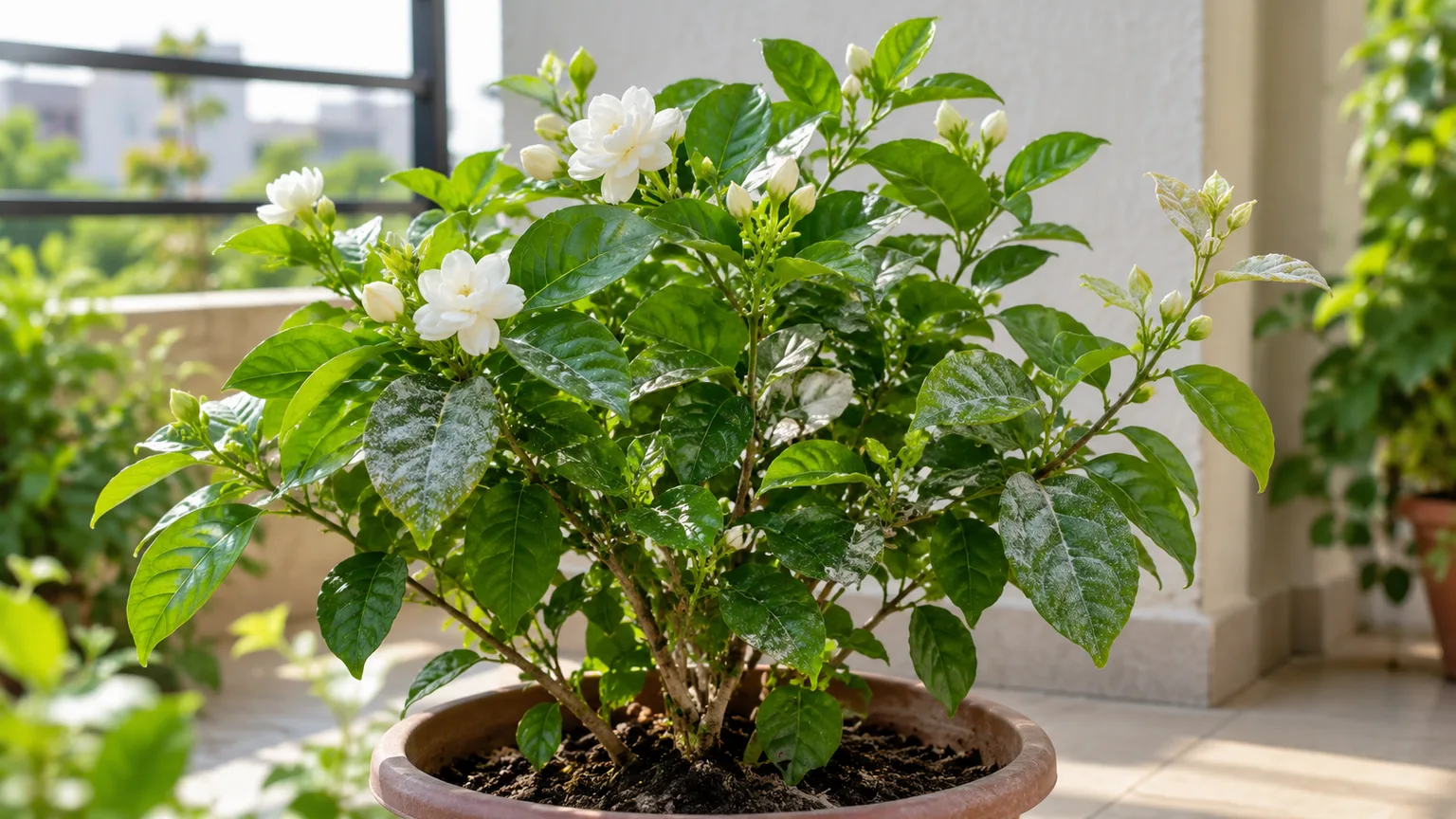
Powdery Mildew on Mogra: How to Confirm It and Stop the Spread
This guide covers powdery mildew on Mogra. See also the general Powdery Mildew guide, watering, and light pages for this plant.
Powdery Mildew on Mogra: How to Confirm It and Stop the Spread
Quick answer
Related: powdery-mildew guides If you see spreading, flour-like white patches on a Mogra leaf or tender shoot, isolate the pot first. Powdery mildew usually shows as surface growth that enlarges or merges across foliage, stems, or flowers, as the RHS symptom guide describes; it may rub partly away, but rubbing alone does not remove the infection, according to the Missouri Botanical Garden. Check both sides of the leaves, the newest tips, and any buds before pruning. Mogra’s normally white flowers, dust, dried-droplet residue, or localized pest signs can confuse a quick glance, so use the pattern and texture rather than color alone.
This is a foliage problem, not a reason to dig through Mogra’s roots or repot it on day one. Keep the plant’s usual moist-but-well-drained root routine steady while you confirm the leaf diagnosis. If other plants are close enough to touch or share still air, move Mogra aside before you handle it.
What powdery mildew looks like on Mogra
The clearest clue is a matte white to gray coating made of small powdery patches. It can start as separate marks on the upper surface, underside, petiole, or tender shoot, then broaden until the leaf looks dusty. The growth may also reach buds or flowers. The Royal Horticultural Society describes powdery mildews as fungi that form a dusty surface coating on leaves, stems, and flowers; heavier infections can discolor and distort young leaves in its symptom overview.
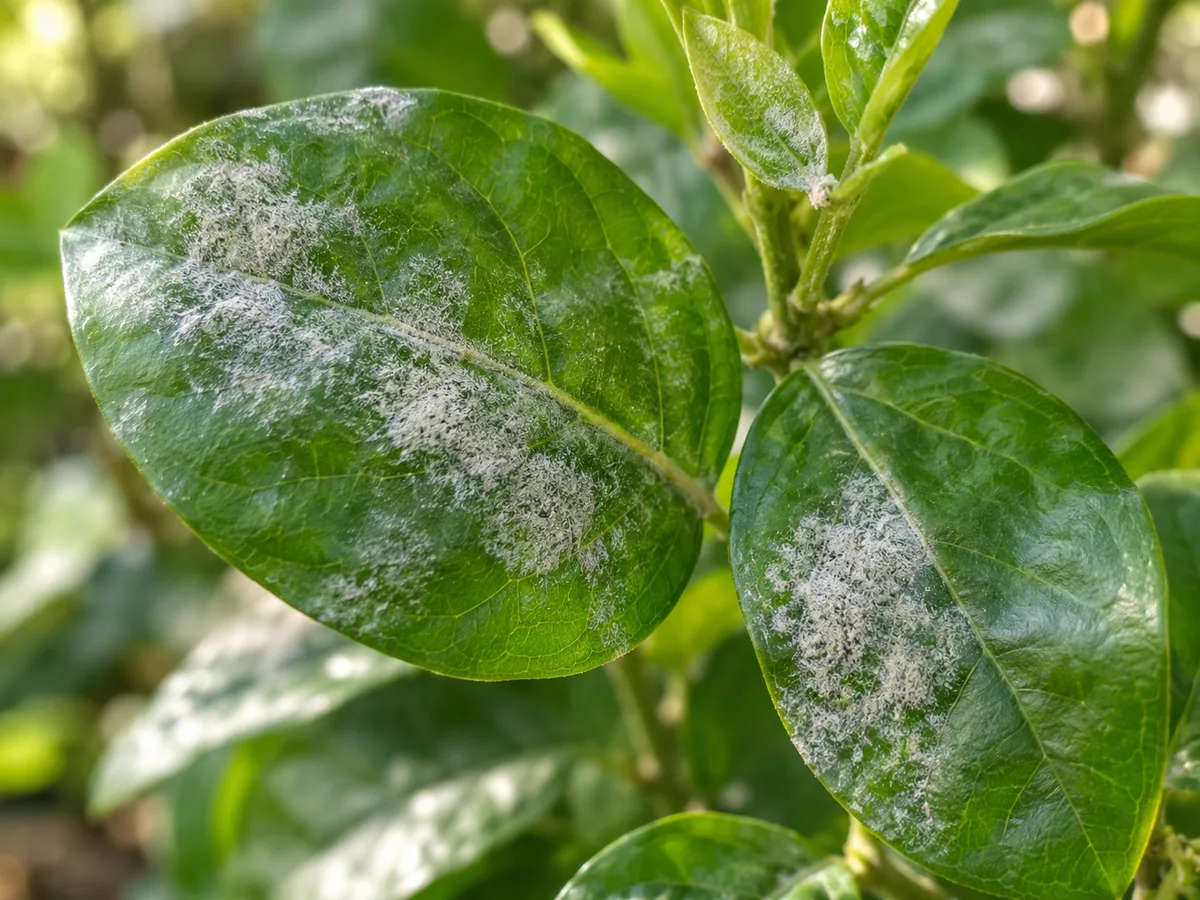
White-gray powdery patches on Mogra leaves need to be checked on both sides; appearance alone does not identify the host-specific fungus.
On Mogra, inspect a few leaves at different heights rather than judging the whole plant from a distance. Turn leaves over, look where petioles join the stem, and check the soft tips that grew most recently. A convincing pattern is several expanding patches on living tissue, not one old white fleck on a leaf that has not changed for weeks. If only one section is affected, photograph it today and again after a few days so you can tell whether the edge is spreading.
Mogra’s flowers add a species-specific trap: Arabian jasmine’s petals are naturally white, so a white bloom is not itself evidence of disease; The Spruce’s Arabian jasmine profile describes the flowers as white. The useful question is whether there is a dusty or thread-like film sitting on the petal or nearby leaf, rather than the normal clean surface of the flower. Mogra is Jasminum sambac, an evergreen, quick-growing shrub or vine with glossy green leaves; it grows best with full to partial sun and moist, well-drained soil, according to the same profile.
A light fingertip or damp cotton swab test can help, but it is not a stand-alone diagnosis. Powdery growth may come away in part when rubbed, while the fungus remains on the tissue and the coating returns if the conditions still suit it. Missouri Botanical Garden describes indoor powdery mildew as a white-to-gray dusty coating that starts in discrete spots and can spread over the leaf; rubbing does not eliminate it. Its indoor powdery mildew guide
Why Mogra’s setting matters
Whether you prune Mogra into a compact pot shrub, train it around a support, or keep it close to a doorway where its fragrance can be enjoyed, inspect the center of the canopy as well as the outer leaves. Closely overlapping shoots can create a sheltered pocket, so new leaves, buds, and petioles tucked inside may be affected before the whole plant looks dusty. A balcony can be bright yet still have poor movement of air behind a screen, wall, or neighboring pots. This is a practical inference from Mogra’s growth form and the airflow conditions associated with powdery mildew, not evidence that the species is unusually susceptible.
Powdery mildew is not simply a consequence of wet leaves. UC IPM explains that many powdery mildew fungi are host-specialized and that their spores can travel through air; they do not need free water on a leaf to germinate. Shade, low light, high humidity, and still greenhouse air can favor disease development, though the exact pattern varies by fungus and host. UC IPM ornamental mildew guidance
That distinction matters for Mogra care. An outbreak does not prove that you watered incorrectly, and spraying or misting the leaves is not a reliable fix. The plant still needs a suitable amount of light and moisture at its roots, but a dense, stagnant pocket around foliage is a separate issue from how damp the potting mix feels. Think about crowding, a newly moved indoor pot, or several warm days followed by cooler humid nights before changing the watering routine.
Do not assume the mildew on a nearby plant has spread to Mogra just because both have white patches. Related fungi often have narrow host ranges; an infection on one plant may not be able to infect a different genus. Mogra still needs its own inspection and, if the diagnosis is unclear, a local diagnostic service rather than a guess based on the neighbor’s disease.
Confirm the diagnosis before trimming
Use a small inspection sequence before you cut a healthy Mogra shoot.
- Choose two or three leaves with the clearest white patches and check the top and underside under bright light.
- Note whether the material is flat and powdery, raised and cottony, gritty like dried droplets, or part of the leaf tissue itself.
- Look at the patch edge and nearby new growth. A fungal coating is more convincing when separate spots enlarge or merge and the plant develops fresh patches.
- Check petiole joints and the undersides for visible pest signs. If you find insects or damage that does not form a surface film, use the relevant diagnosis instead of applying a mildew treatment.
- Photograph one affected leaf and the whole Mogra. A dated photo makes spread easier to judge and is useful if you ask a nursery or extension service to identify it.
| What you find on Mogra | More likely explanation | What to do next |
|---|---|---|
| Several flour-like white or gray patches that expand across leaf surfaces or shoots | Powdery mildew is plausible | Isolate Mogra and compare the next inspection with today’s photo. |
| A white mark stays localized at a leaf joint instead of spreading as a surface film | A pest lookalike is possible | Check the Mogra mealybug guide before treating. |
| A sharply edged mark matches a dried droplet and wipes away without rebuilding | A surface residue lookalike is possible | Clean one leaf gently and see whether the mark returns. |
| Yellowing, drooping, or leaf drop without a spreading white coating | A watering or root-zone problem may fit better | Compare the plant with Mogra’s watering guide and inspect the pot’s dry-down. |
Do not decide that Mogra has powdery mildew because a leaf is pale, yellow, or dropping. The fungal diagnosis rests on the characteristic surface growth and its changing pattern. If the material appears only on a bloom, wipe away a small amount and look at a nearby leaf or shoot before treating the whole plant; Mogra’s white petals can make a photograph look more dramatic than the foliage actually is.
The first fix: isolate the Mogra pot
Move the Mogra away from nearby plants before you handle or prune it. Leave a clear air gap, and avoid carrying it through a crowded collection while rubbing against other leaves. This is the safest first step when the white coating looks like active powdery mildew because it reduces contact with plants that might share the same susceptible host group. Missouri Botanical Garden recommends that growers isolate indoor plants at the first sign of infection, then remove and dispose of infected parts.
Keep the isolated plant in a bright, stable place rather than putting it into a dark corner or exposing it abruptly to harsh afternoon sun. Mogra can grow in full or partial sun, but a plant that has been indoors should be acclimated gradually if you move it outdoors. The useful goal is a bright position with air moving around the canopy, not a sudden change to every part of its care at once.
Once isolated, recheck the leaves and mark only the visibly affected tissue. Remove the most heavily coated leaves or a badly affected short shoot with clean scissors, especially when it touches healthy growth. Do not strip every leaf that has a faint mark: Mogra needs healthy foliage to keep growing, and broad pruning can remove buds or a flowering flush that you otherwise could retain. Collect fallen leaves rather than leaving them on the potting mix.
Preserve Mogra’s flowering shoots while you prune
A Mogra plant may carry fragrant white buds at the same time that a few leaves develop powdery patches. Treat the leaf disease and the flower flush as two related but separate decisions. If a single leaf is coated and its stem is otherwise clean, remove that leaf rather than cutting the entire flowering tip. If a whole shoot has repeated patches, cut that shoot back to healthy tissue and accept that its current buds may be lost.
Do not use flowering as proof that the plant is healthy enough to ignore a spreading infection. New leaves and buds are still worth checking because young, soft growth can be vulnerable to powdery mildew. Gardening Know How notes that fresh growth can be especially vulnerable and recommends watching for new white patches after cleanup; for Mogra, that means inspecting the newest tips instead of repeatedly pruning old leaves that already carry cosmetic marks. Gardening Know How guide
Mogra is often shaped after flowering rather than cut back at random. The Spruce’s Arabian jasmine guide describes pruning after flowering to maintain the plant’s preferred shape. Use that timing for ordinary shaping, but do not leave actively coated tissue in place merely to preserve a flower. First remove infected growth selectively; after the flush, reassess the shrub’s shape and thin crowded stems so leaves do not press together.
Correct the Mogra conditions that can let it return
Once the immediate infection is contained, open the canopy modestly. Separate touching pots, move an indoor Mogra away from a still corner, and remove a small number of crossing or inward-facing shoots if they block air movement. Do not hollow out the plant or prune it into a bare framework; the aim is to give leaves room, not to make a hard haircut the treatment. Keep the pot away from a wall or dense group of plants if that is where leaves stay shaded and still.
Check Mogra’s light before changing its water. Arabian jasmine grows best in full to partial sun, but a plant moved from a protected indoor position needs gradual acclimation to stronger outdoor exposure. Use the Mogra light guide if the pot has been moved repeatedly or if new growth is stretched and sparse. Brightness supports the plant’s normal growth; it is not a fungicide, and sudden direct sun can create a second leaf problem that makes the original diagnosis harder.
Keep watering tied to the pot’s dry-down, not the presence of white leaves. Feel the upper mix and note whether the pot is drying normally for its season before changing the watering interval. Water the soil rather than misting the canopy as a routine, and let leaves dry promptly if they have been splashed during cleaning. The Mogra watering guide explains the plant’s root-zone routine; the Mogra soil guide helps if the mix remains wet and heavy for too long.
Hold extra fertilizer while active patches are still appearing. Powdery mildew is associated with vulnerable, succulent growth; the RHS cautions that excess nitrogen can make growth susceptible, so a strong push can add tender leaves before the plant has stabilized. Resume Mogra’s normal seasonal feeding only after you see the disease stop spreading and new growth develop cleanly. Do not repot just to treat a surface disease; consider a soil change only if the mix itself is failing, water is not draining, or the roots show a separate problem.
The exact climate pattern that favors powdery mildew differs among its fungi. Some horticulture guidance describes humid nights and drier days, while extension guidance emphasizes that these fungi can infect without free water and are favored by still, shaded conditions. That is why a wet-leaf rule alone is not enough. The practical prevention for Mogra is a bright, open canopy, stable root moisture, and fewer places where leaves sit crowded in stagnant air.
What recovery looks like on Mogra
Do not expect an infected leaf to become glossy and spotless after you remove the fungus. Powdery growth can leave discoloration or distortion, and damaged tissue may stay marked even after the outbreak is controlled. The better sign is that no new dusty patches form on adjacent leaves or fresh Mogra tips. Keep the dated photos so you can distinguish a stable old mark from an active edge that is spreading.
There is no dependable single recovery calendar for every Mogra pot. Progress depends on how much foliage was affected, how quickly the plant grows in the current season, and whether the air movement and light improved. Check the same areas every few days during the first stretch after isolation, then continue checking new leaves as they open. A clean new leaf is more useful than an old leaf that still carries a faint stain.
If mildew keeps returning, look for the condition that was not changed: a crowded canopy, a sheltered indoor corner, nearby infected debris, or a plant that is repeatedly moved between humid and dry positions. If the white growth continues across several shoots after cleanup, take clear photographs and ask a local extension office, horticultural society, or plant clinic to confirm the diagnosis. For a persistent case, use only a locally permitted product whose label specifically covers ornamental plants and powdery mildew, and follow that label exactly. Avoid improvised kitchen sprays; the RHS cautions against homemade treatments because they are unregulated and untested, while Missouri Botanical Garden notes that baking soda may damage some plants and should be tested on a few leaves first.
Escalate promptly if a large portion of the plant is losing leaves, the growing tips are repeatedly distorted, or the white material does not fit the powdery pattern. That may still be a disease, but a photo-based comparison cannot identify the pathogen species with certainty. If stems become soft or the potting mix remains saturated, check the separate root-zone problem instead of increasing mildew treatments.
Prevent another outbreak without overcorrecting
Before returning Mogra to its usual spot, make sure the leaves are no longer brushing against another plant. Clean the scissors used for pruning and remove fallen infected material from the pot surface. Keep a small amount of space around the central shoots so you can see leaf undersides and buds; in a flowering shrub, inspection is easier when new growth is not buried in a dense knot.
Give Mogra the bright placement and well-drained, moisture-retaining mix it can use, then adjust only when your observations support a change. Do not keep the soil wet to raise humidity, and do not let it dry severely just because mildew appeared. Avoid repeated misting as a substitute for air movement. A fan is not essential for every home, but if the foliage sits motionless in a sheltered nook, moving the pot into a room with ordinary gentle circulation may help.
During a humid spell or a heavy new flush, check the tender tips and overlapping leaves before the coating becomes widespread. Remove a newly infected leaf early, but save healthy shoots and flowers wherever you can. Feed lightly according to Mogra’s active growth and seasonal rhythm; do not use fertilizer to push a stressed plant into rapid soft growth. Use the Mogra pruning guide when the flowering flush has finished and the shrub needs a more open shape.
When to use this page vs other Mogra guides
Use this page when the main clue is a growing white-gray powder on Mogra’s leaf or shoot surface. If the material is cottony and clustered around joints, compare it with Mogra mealybugs; if the leaves droop or yellow without a powdery film, start with the Mogra problem hub and choose the symptom that matches what you can actually see. The Mogra overview is useful when you need to reset the plant’s normal growing conditions rather than treat a confirmed leaf disease.
For general powdery mildew biology and common houseplant lookalikes, see the broader powdery mildew guide. Return here for the Mogra-specific decisions: how to protect a white flower flush, where to inspect a bushy jasmine canopy, and how to keep its root-zone care steady while you improve airflow.
Related Mogra guides
Use Mogra light when the plant is in a dark or still position and you need to judge a gradual move. Use the Mogra watering guide and Mogra soil if the pot stays wet, drains poorly, or dries unpredictably. If the problem is not a dusty surface coating, the Mogra problems hub routes you to the appropriate diagnosis instead of treating every pale or dropping leaf as mildew.
Related tool
Use the Plant Problem Diagnosis Tool to compare powdery mildew with other visible symptoms before changing several care conditions at once.