N'Joy Pothos Repotting Guide: When and How
N'Joy Pothos Repotting Guide: When and How
N'Joy Pothos Repotting Guide: When and How
N’Joy Pothos (Epipremnum aureum ‘N’Joy’) looks small and tidy on a shelf, which makes it easy to forget that even compact cultivars still outgrow their pots. The RHS describes N’Joy as a trailing foliage houseplant with slightly puckered green-and-cream leaves that typically reaches 1–1.5 m over several years — not the metre-a-month pace of golden pothos, but enough root development to exhaust a nursery pot within a season or two. Repotting is how you restore drainage, refresh depleted mix, and give roots room to support the white variegation that makes this cultivar worth keeping.
Done at the right moment, an N’Joy pothos repot is quiet work: a modest pot upgrade, fresh airy soil, and a week of gentle watering checks. Done at the wrong time — oversized container, heavy peat mix, or repotting the day you bring the plant home — the same operation can trigger weeks of wilt, yellow leaves, or green reversion on new growth. This guide covers when to repot, how to do it step by step, and the mistakes that matter most on this slow-growing, variegated pothos.
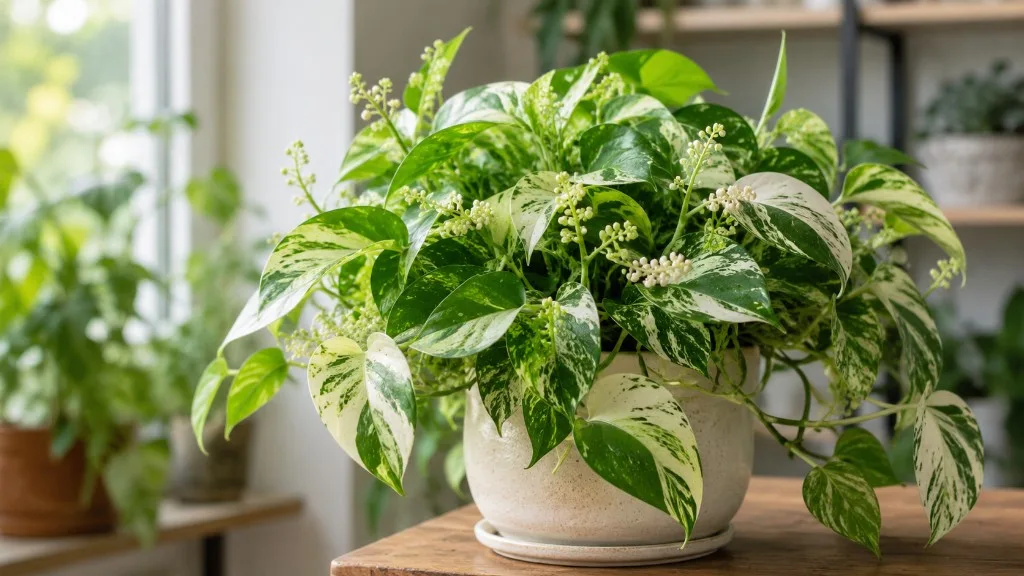
Cultivar note: N’Joy Pothos (Epipremnum aureum ‘N’Joy’) — green leaf edges with cream-to-white centers; compact leaves revert to plain green in low light. Place in bright indirect light; water when top 3–5 cm dry; slower growth means the pot dries more slowly than golden pothos.
Why Repotting Matters for N’Joy Pothos
Repotting fixes three problems that show up as leaf symptoms if you ignore them. First, roots eventually circle the pot and compress into a dense mat that absorbs water unevenly. Second, even good potting mix breaks down — peat and coir compact, perlite crumbles, and the air pockets aroid roots need disappear. Third, salts from tap water and fertilizer accumulate at the root zone, which can burn fine roots and produce brown tips or pale new leaves despite careful watering.
N’Joy pothos belongs to Araceae, the aroid family. Aroids tolerate brief dryness but struggle when roots sit in stagnant, airless wet soil for days. That biology matters because the most common repotting failure — jumping to a pot much too large — creates exactly that environment. N’Joy looks forgiving above ground, but below ground it behaves like a tropical understory climber that wants moist but well-drained mix, not a wet sponge. Repotting is your chance to rebuild that balance before decline shows up as lost variegation or soft stems.
What fresh soil and extra root room actually fix
Fresh mix restores structure: air pockets, organic matter, and drainage speed that compacted old soil lost months ago. Extra root room lets white root tips spread outward instead of spiraling, which improves water and nutrient uptake after each watering cycle. You will notice the difference in how the pot behaves. A root-bound N’Joy pothos may dry very fast on the surface while the core stays wet, or water may run straight through channels without wetting the whole root mass — a pattern that looks like underwatering on N’Joy Pothos but often starts in the root zone.
A repot is also the easiest moment to inspect roots for rot — brown, mushy, sour-smelling tissue that needs trimming before it spreads. NC State Extension notes that root rot and blackening leaf margins commonly follow overwatering on pothos. Catching rot during repotting is simpler than diagnosing from yellow leaves alone, especially when lower foliage naturally ages on a trailing vine. If roots are mostly white and firm, you are upgrading space and soil. If they are not, treat the repot as a rescue with lighter watering afterward.
How slow growth changes your repot timeline
N’Joy Pothos grows slow to moderate compared with golden pothos. Smaller leaves, a bushier habit, and less aggressive vining mean the root system expands more gradually — and the pot dries more slowly between waterings. That slower timeline is why repotting advice written for fast golden pothos can mislead you here. A vigorous golden pothos in a 10 cm nursery pot may need annual upgrades in bright light; an N’Joy in the same pot might sit comfortably for 18–24 months if growth is steady and watering remains predictable.
As a working baseline, plan a full repot every 1–2 years, checking roots rather than following a calendar. Clemson HGIC recommends repotting pothos when roots show through drainage holes or the plant becomes overcrowded, noting that most specimens need repotting every one to two years depending on growth rate. For N’Joy, lean toward the longer end unless you see multiple root-bound signals together. The calendar is a reminder to lift the pot and look, not a command to repot a plant that still has open mix around healthy white roots.
Signs Your N’Joy Pothos Needs Repotting
The clearest sign is visual: roots emerging from drainage holes or circling the surface when you slip the plant partway out of the pot. Equally reliable signals include water that runs straight through without absorbing, wilting hours after a thorough watering, and growth that stalls even though N’Joy Pothos light and feeding have not changed. When two or more of these appear during the active growing season, repotting is usually the right move.
Do not repot simply because one leaf yellowed. Yellowing can mean overwatering, underwatering, cold drafts, low light, or natural aging of lower leaves on a trailing stem. Repotting a plant already stressed for unrelated reasons adds another variable and often makes diagnosis harder. Confirm that the root zone is the bottleneck before you commit. If tips keep producing small green leaves while lower stems go bare, the issue may be light or pruning need rather than roots alone.
Root-bound and drainage signals
Lift the pot and inspect the bottom first. Roots peeking through holes mean the plant has used the volume it was given. Slide the plant out gently — if the root ball holds a perfect pot-shaped mold with little visible mix on the sides, you have a classic root-bound situation. Circling roots at the bottom are not always an emergency, but they tell you the plant has been asking for space. On N’Joy pothos, the root mass can look dense relative to the compact foliage above, which is why checking the bottom matters more than judging by vine length alone.
Fast drainage after watering sounds healthy until you realize water is bypassing a hydrophobic core. If the pot feels light again within an hour of a thorough soak, the mix may be spent. Slow drainage combined with sour smell or mushy stems points to rot that requires immediate attention. RHS repotting guidance warns that roots spiralling at the bottom can prevent water draining properly and lead to root rot — the same risk applies indoors when old mix collapses around a slow-growing aroid.
Leaf and variegation clues tied to root stress
Stunted new growth is a late root-bound signal. N’Joy pothos normally pushes fresh leaves regularly in bright indirect light, though not as quickly as golden pothos. When new leaves arrive smaller, thinner, or mostly green while older leaves still show cream centers, depleted or compacted soil is a prime suspect — but so is insufficient light. NC State Extension notes that low light can cause loss of variegation on pothos cultivars. Before you repot for colour loss alone, confirm light is adequate; repotting without fixing dim placement often produces more solid-green new growth.
Top-heavy wobble — where the compact foliage mass outweighs the root anchor — is another clue, especially on small shelf pots. Brown, crispy leaf tips can reflect salt buildup in old mix; flushing helps short term, but a full repot with fresh N’Joy Pothos soil is the durable fix. Pale or yellow lower leaves may indicate nutrient exhaustion in spent mix if moisture checks look normal and you have been fertilizing on schedule.
Best Time of Year to Repot N’Joy Pothos
Timing matters because N’Joy recovers fastest when it is already geared for growth. Spring through early summer is the safest window for most indoor growers. Rising temperatures and lengthening days trigger root and shoot development, so the plant can colonize fresh mix before winter slowdown. RHS recommends spring, as plants start into growth, as the best time to repot and prune roots — advice that fits N’Joy well if indoor temperatures stay in the 18–29°C (65–85°F) range the species prefers.
Avoid repotting immediately after purchase. N’Joy Pothos needs two to four weeks to adjust to your home’s light and watering rhythm before you disturb roots unless the mix is clearly failing or pests are active. Quarantine, learn how fast the pot dries, then repot if roots warrant it — not because a calendar says so.
Spring and early summer windows
During active growth, N’Joy can show new firm leaves within two to four weeks after a careful repot. Roots begin exploring fresh mix when temperatures are warm and the soil stays evenly moist but not soggy. Spring is also the best time to combine repotting with N’Joy Pothos pruning if you want a bushier plant, because the vine has energy to branch from nodes near the soil after the move. If you missed spring, early summer still works; avoid repotting during the hottest week if your home lacks air conditioning.
Place the plant in bright, indirect light after spring repotting — not direct sun, which can scorch cream sectors. Variegated pothos needs stronger light than golden pothos to hold white patterning; post-repot dim placement is a common reason new leaves revert to solid green even when roots are healthy.
When winter repotting is still justified
Winter repotting is a backup plan. Growth slows, days are short, and a disturbed root system sits in wet mix longer because N’Joy is not pulling water actively. That combination increases rot risk for any aroid. Skip winter repotting if the plant is merely slightly tight but still producing occasional new leaves and watering on a normal schedule.
Repot in winter only when delay would clearly harm the plant: severe root-binding with repeated wilting, active root rot requiring trimming and fresh mix, or a broken pot. If you must repot then, use a modest size increase, keep temperatures above roughly 18°C, provide bright indirect light, and let the top of the mix dry slightly further between waterings until new growth returns in spring. Clemson HGIC notes pothos prefer warm rooms between 70–85°F during the day — stable warmth supports winter recovery more than extra fertilizer does.
Choosing the Right Pot Size and Material
The most important decision is diameter, not aesthetics. N’Joy wants one step up, not a mansion. Jumping from a 12 cm pot to a 20 cm pot feels generous, but unused soil volume stays wet for days while the compact root system catches up. On this slow-growing cultivar, that wet zone is where aroid roots struggle most — and where yellow lower leaves appear that look like feeding problems but are really oxygen problems at the root level.
Measure the current inner diameter and choose a new pot 2–5 cm (about 1–2 inches) wider, with drainage holes. For N’Joy in a 10 cm nursery pot, 12–13 cm is appropriate. From 12 cm, move to 14–15 cm. Smaller decorative pots suit this cultivar’s compact habit on shelves and hanging baskets; resist the urge to skip sizes because growth is slow — excess soil is still excess water-holding capacity.
The one-size-up rule for compact cultivars
The one-size-up principle matches root biology: roots grow into soil progressively, and until they do, extra mix is a water reservoir with little uptake. Clemson HGIC recommends choosing a pot only 1–2 inches wider than the current container with drainage holes. That rule is especially important for N’Joy because slower growth means roots fill new volume slowly — the bottom of an oversized pot can stay saturated for a week while the surface looks dry, encouraging you to water again too soon.
The one-size-up rule also keeps N’Joy Pothos watering predictable after repotting. A modest soil-volume increase means you water slightly less often than before, but not so much less that the mix stays saturated at the bottom indefinitely. If you repot and find yourself waiting ten days before the top half dries, the pot is probably too large or the mix too heavy.
Drainage holes and pot materials compared
Every N’Joy pothos pot needs drainage holes for long-term indoor care. Decorative cache pots without holes work only if the plant stays in a nursery pot that drains freely into a saucer you empty after every watering. Clemson HGIC notes that plastic pots hold moisture longer than terracotta — relevant when you choose material after repotting a plant that already dries slowly.
Terracotta dries faster, which can help if you tend to overwater. Plastic retains moisture longer, useful in dry, bright rooms but risky in low light where N’Joy already uses water slowly. Glazed ceramic sits between the two; weight adds stability for small top-heavy pots on shelves. Hanging baskets suit trailing N’Joy but dry quickly at the edges until roots fill the new volume — watch moisture more closely the first month after repotting.
Best Soil Mix for Repotting N’Joy Pothos
N’Joy pothos wants well-draining standard potting mix that stays airy after repeated watering. The Missouri Botanical Garden describes Epipremnum species as preferring moist, well-drained soils — the same balance every good houseplant mix targets. Target pH 6.0–6.5; quality peat- or coir-based indoor mixes land close enough for most homes.
A reliable DIY blend for repotting:
- 60% quality peat- or coir-based potting mix
- 20% perlite or pumice for aeration
- 20% orchid bark or coarse coco chips for chunk and long-term structure
That ratio drains within seconds of watering while holding enough moisture that N’Joy does not wilt hourly. Clemson HGIC recommends an airy, well-draining soil mix with perlite or orchid bark for pothos. Add extra perlite if your home is cool or you water heavily; add bark if the plant dries too fast in bright, dry air. See the full N’Joy Pothos soil guide for home-specific tweaks.
DIY blend ratios that stay airy indoors
Mix ingredients in a tub before repotting rather than layering them in the pot. Dry blending distributes perlite and bark evenly and prevents putting all drainage material at the bottom — water moves through the whole column according to pore structure, not distinct layers. Avoid garden soil, which compacts and introduces pathogens. Avoid pure cactus mix unless you amend heavily with potting mix and bark; N’Joy is not a desert plant.
Full repot — removing the plant, loosening outer roots, and replacing essentially all old mix — fits root-bound plants, compacted or sour mix, or rot correction. Top-dressing — replacing the top 3–5 cm without disturbing roots — is a gentler mid-season option when drainage is still acceptable but salts have built up. Top-dressing in early spring can buy a few months if the plant is not yet root-bound, but it will not fix circling roots at the bottom. Never reuse old mix from a rot case; fresh mix is simpler and safer.
Step-by-Step: How to Repot N’Joy Pothos Without Shock
Repotting N’Joy pothos is straightforward if you prepare materials first and minimize root exposure time. Gather the new pot, pre-mixed soil, clean scissors, a chopstick or pencil, and a watering can. Work on a surface you can wipe clean. Compact plants in small pots are easier to handle on a table than dangling from a high hook — lay vines carefully rather than snapping brittle stems.
Step 1: Water the plant 24 hours before repotting. A lightly moist root ball holds together and slips out more cleanly than a bone-dry or soggy one.
Step 2: Add a small mound of fresh mix to the bottom of the new pot. Do not create a thick gravel drainage layer; it does not improve drainage and can create a perched water table.
Step 3: Turn the N’Joy pothos on its side and slide it out, supporting the base of stems with your hand. Squeeze flexible nursery pots or run a knife around rigid pots if it resists.
Step 4: Inspect roots. Trim brown, mushy tissue with clean scissors. Tease circling roots at the bottom and sides gently so they point outward.
Step 5: Set the plant so the previous soil line sits about 1–2 cm below the rim. Do not bury stems deeper than they were growing; buried nodes invite stem rot on pothos.
Step 6: Backfill with fresh mix, working soil between roots with a chopstick while holding the plant centered. Firm lightly — enough to remove large air gaps, not enough to compress the mix.
Step 7: Water thoroughly until excess runs from drainage holes. Empty the saucer. Place in bright, indirect light, out of direct sun, for 7–10 days.
Step 8: Hold fertilizer for at least four to six weeks while roots settle. Resume normal watering checks rather than a calendar schedule.
Preparing the plant and teasing circling roots
The goal of root teasing is to redirect growth, not destroy the root ball. Pothos relies on fine root hairs for uptake; bare-rooting by washing every particle away strips those hairs and extends recovery unnecessarily. Keep most of the original root mass intact while freeing the outer circling layer. If you are repotting a pot with multiple stems, you can divide the plant with a clean knife, provided each division has roots and at least one growing tip — useful when you want a fuller pot from N’Joy Pothos propagation cuttings rooted together.
If roots are densely matted, you may slice 1–2 cm off the bottom to stimulate new white tips. Avoid removing more than one-third of total root mass unless rescuing rot. N’Joy’s slower growth means recovery from aggressive trimming takes longer than on golden pothos — trim conservatively unless rot forces your hand.
Placement, backfill, and the first watering
Center the plant so it stands without wobbling. Add mix beneath the root ball, not just around the sides, until the plant sits firmly. If you install a moss pole, set it during backfill so the base is stable and soft ties hold the main stem without cutting into it — optional on N’Joy, which many growers keep as a compact trailer.
The first watering settles mix and closes small air pockets. For the first week, water when the top half of the mix feels dry — similar to normal N’Joy care, but expect the interval to lengthen slightly as soil volume increases. Clemson HGIC recommends letting soil dry between waterings and watering thoroughly so moisture reaches all roots. Wilting in the first 48 hours is common; recoverable wilting improves after a careful drink. Wilting that worsens daily despite careful moisture usually means rot, oversized pot, or buried stems.
Common N’Joy Pothos Repotting Mistakes and Recovery
Oversized pots top the list for compact, slow-growing cultivars. More soil without more roots means chronic bottom wetness — especially dangerous when N’Joy already dries slowly. Stick to one size up even if you imagine future growth; roots fill volume over weeks, not overnight.
Repotting on day one after purchase stacks transplant shock on top of environmental change. Wait until you know how fast the pot dries in your light unless roots are clearly rotting.
Bare-rooting or over-washing removes fine hairs that absorb water. Tease, do not scrub. Aroids recover from gentle disturbance; they struggle after aggressive stripping.
Immediate fertilizing after repot burns tender new root tips in fresh, already nutrient-rich mix. Wait until you see new growth with normal cream variegation, then resume diluted feeding per the N’Joy Pothos fertilizer guide.
Dim light after repot produces solid-green new leaves even when roots are fine. RHS notes N’Joy is tolerant of shade but variegation becomes less pronounced — post-repot placement in bright filtered light protects the cultivar’s main appeal.
Ignoring pet safety during messy work: the ASPCA lists pothos as toxic to cats and dogs because of calcium oxalate crystals, which cause oral irritation, drooling, and vomiting if chewed. Keep repotting debris and trimmings out of reach while you work.
Mild transplant shock on N’Joy usually shows as slight wilting, a pause in new leaves, or one or two dropped lower leaves for one to two weeks. Full root re-establishment typically takes four to six weeks in warm, bright conditions. New growth with restored cream patterning is the clearest success signal. If wilting persists beyond three weeks, inspect for rot, buried stems, or a pot that is too large.
Conclusion
N’Joy Pothos repotting comes down to reading the roots, choosing spring or early summer when you can, moving the plant one pot size up with fresh, well-draining aroid mix, and placing it in bright indirect light while roots settle. This compact cultivar grows slowly enough that checking every 12–24 months beats repotting on autopilot — but never wait so long that circling roots and spent mix steal variegation and vigor from new leaves.
Get pot size and soil right and N’Joy rewards you with steady recovery and clean cream-and-green new growth. Oversize the container, repot into dim corners, or fertilize too soon and the same plant will look punished for weeks despite its tough reputation. Watch roots, protect variegation with light, and treat repotting as a targeted fix — not a reflex — and you will rarely lose a healthy N’Joy pothos to a routine upgrade.
When to use this page vs other N’Joy Pothos guides
- N’Joy Pothos overview — Start here for whole-plant context, toxicity, and cultivar basics before deep-diving repotting.
- N’Joy Pothos soil — Use when mix composition and drainage are the main question, not timing or technique.
- N’Joy Pothos watering — Escalate here when moisture checks after repot still do not explain yellowing or wilt.
- N’Joy Pothos light — Use when new leaves revert to green after repot despite healthy roots.