N'Joy Pothos Soil Guide: Mix, Drainage & pH
N'Joy Pothos Soil Guide: Mix, Drainage & pH
N'Joy Pothos Soil Guide: Mix, Drainage & pH
N’Joy pothos soil decides whether this compact variegated cultivar looks crisp and cream-splashed — or slowly yellows on a shelf while the mix underneath stays soggy for weeks. Epipremnum aureum ‘N’Joy’ shares golden pothos’ famous tolerance, but its smaller leaves, slower growth, and tighter root mass change how fast a pot dries. A mix that works for a fast-growing golden vine in a large hanging basket can stay wet too long in a 4-inch N’Joy pot on a dim bookcase, producing the slow-motion failures growers blame on “overwatering on N’Joy Pothos” when the real problem is substrate that never breathes.
The practical target is a chunky, well-draining aroid blend: indoor potting mix amended with perlite and orchid bark, in a pot with drainage holes, refreshed before peat collapses. A reliable starting recipe is 2 parts potting mix, 1 part perlite, and 1 part orchid bark by volume, targeting pH 6.0–6.5. Pair that with the N’Joy Pothos watering guide rhythm — water when the top half of the mix dries — and adjust chunkiness upward if your plant lives in low light where transpiration slows further.
This guide covers why aroid structure matters for N’Joy specifically, how its compact habit changes mix decisions versus golden pothos, exact DIY ratios, environmental tweaks, commercial options, repot timing, propagation substrates, and the soil mistakes that damage variegated pothos before the vine looks seriously ill.
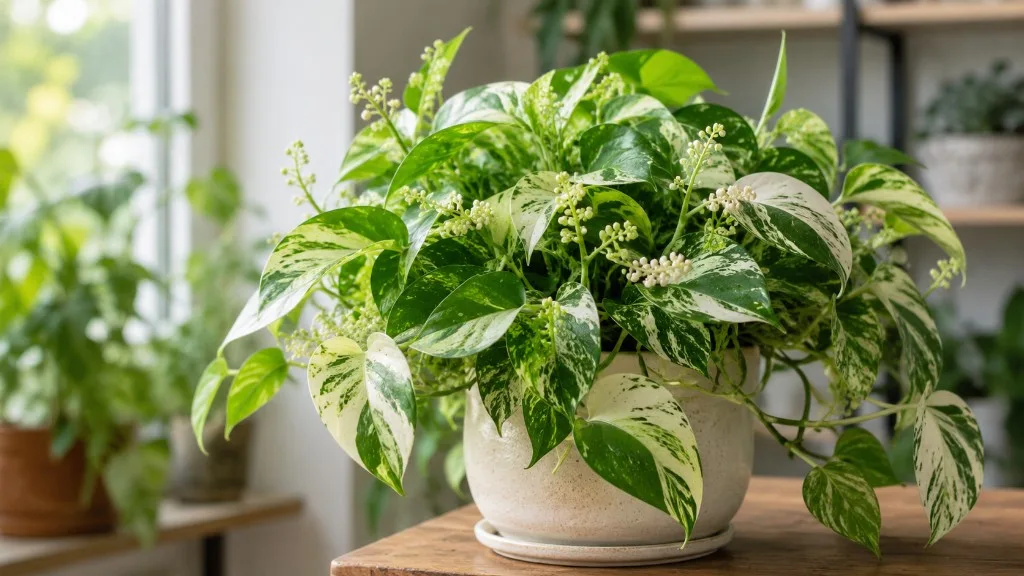
Cultivar note: N’Joy Pothos (Epipremnum aureum ‘N’Joy’) — green leaf edges with cream-to-white centers; compact leaves revert to plain green in low light. Place in bright indirect light; water when top 3–5 cm dry; slower growth means the pot dries more slowly than golden pothos.
Why N’Joy Pothos Roots Need Airy, Fast-Draining Mix
N’Joy Pothos belongs to the Araceae family. In forest habitats across Southeast Asia and the western Pacific — including Mo’orea in French Polynesia where pothos is native — the species climbs trees and sends roots into loose leaf litter, bark debris, and open organic material rather than dense ground soil. Those roots are semi-epiphytic: they cling to surfaces, breathe between rain events, and rarely sit in stagnant water for days. Indoors, the closest analogue is not “more peat” but more structure — visible perlite flecks and bark chips that keep the root zone from going anaerobic between waterings.
Clemson Cooperative Extension recommends potting pothos in an airy, well-draining soil mix and notes that root rot follows overwatering or poorly draining soil. (Clemson HGIC) Wisconsin’s Division of Extension advises a well-aerated growing medium and warns that root rots develop when plants stay too wet. (Wisconsin Horticulture) NC State Extension lists good drainage and occasionally dry conditions among cultural requirements for Epipremnum aureum, including the Beautifall® ‘Njoy’ cultivar. (NC State Extension)
The forgiving reputation of pothos cuts both ways for N’Joy. Because the plant keeps hanging on with damaged roots, soil problems stay invisible until they are advanced. A compact N’Joy in heavy mix under low light may look merely “slow” for months before a single extra watering triggers sudden yellowing. Building the right N’Joy pothos soil mix upfront is cheaper than diagnosing root rot on N’Joy Pothos after half the stems collapse.
Semi-Epiphytic Aroid Biology Indoors
Semi-epiphytic roots absorb oxygen from air spaces between particles. When water fills every pore for extended periods, root tips die back and rot pathogens gain an edge. Orchid bark and perlite create stable macropores that resist collapse better than fine peat alone. The Royal Horticultural Society describes epipremnums as climbers that use aerial roots gripping bark in native forests, and recommends an open, moisture-retentive but well-drained, slightly acidic compost for container culture. (RHS Growing Guide)
Indoors, N’Joy rarely produces the large fenestrated adult leaves seen on wild climbs — but the juvenile root system still expects the same oxygen cycle: thorough watering followed by partial dry-down, not permanently damp mix.
How N’Joy Differs from Golden Pothos in the Pot
Species-level aroid soil rules apply to all Epipremnum aureum cultivars, but N’Joy Pothos is not golden pothos in a smaller pot. Proven Winners describes N’Joy as a sport of ‘Marble Queen’ with smaller, thinner leaves and more intense variegation — green margins and large irregular cream-white sectors. (Proven Winners) That compact morphology changes how quickly the root zone cycles between wet and dry.
Golden pothos often grows fast, filling larger baskets and pulling water through a bigger leaf surface. N’Joy grows slow to moderate, typically reaching about 1.5 m trailing with a bushier habit and smaller foliage. Less biomass means less daily transpiration, so the same 2:1:1 mix in the same room may stay wet two to four days longer in an N’Joy pot than in a golden pothos hanging basket. Growers who copy golden pothos soil without adjusting for N’Joy’s slower metabolism often end up with chronic wet feet — especially when the plant lives on a shelf where N’Joy Pothos light is merely adequate for survival rather than strong growth.
Slower Growth and Longer Wet Dwell Times
Slower growth is not a license to use heavier soil. It is the opposite: less water demand per day extends the time mix stays saturated after each watering. Wisconsin Extension notes that Pearls and Jade®, another compact variegated cultivar, tends to be slower growing with smaller leaves than most pothos varieties — a pattern N’Joy shares. (Wisconsin Horticulture) When growth slows in winter or dim rooms, wet dwell lengthens further while the plant drinks even less.
The operational rule for N’Joy: if the bottom of the pot feels wet when the top half looks ready, lean drainage-heavy — increase perlite toward 35–40% of total volume — rather than watering less while leaving dense peat in place. Fixing the substrate addresses the root environment; skipping water on chronically soggy mix only stresses an already oxygen-starved plant.
Smaller Pots on Shelves and Hanging Baskets
N’Joy Pothos is commonly sold in 4-inch to 6-inch pots for desks, shelves, and small hangers. Small pots dry faster in theory — but only when mix structure and light cooperate. A 4-inch plastic pot of unamended peat under a north-facing shelf can hold moisture ten to fourteen days while the plant barely grows. Oversized pots are equally dangerous: extra wet mix around a small root ball is the most common soil mistake for compact cultivars.
Choose containers close to root-ball size at repot — one size up, not three — with drainage holes non-negotiable. Cachepots work only if the inner pot drains freely and you empty standing water after every watering.
What Makes a Good Aroid Mix for N’Joy
A good soil for N’Joy Pothos balances three forces: drainage (water exits quickly), aeration (roots access oxygen), and moisture retention (the plant does not desiccate between drinks). Pure drainage — unamended cactus mix in a bright room — dries so fast you chase wilt every few days. Pure retention — dense peat with no amendments — holds water so long that roots starve for air even when you water “correctly” on a calendar.
The mix should feel loose in your hand, not like wet clay. When you squeeze a moist handful, it should hold together briefly then crumble. You should see white perlite flecks and bark chips distributed evenly, not clustered on top after N’Joy Pothos repotting. When you water thoroughly, excess should exit drainage holes within minutes.
| Property | What N’Joy Pothos needs | What goes wrong when missing |
|---|---|---|
| Drainage | Water exits freely after each watering | Root rot, sour smell, chronic yellow leaves |
| Aeration | Visible air pockets, chunky texture | Weak roots, stalled variegation, sudden collapse |
| Moisture retention | Mix dries top-down over several days | Daily wilt, crispy margins, repeated drought stress |
Drainage, Aeration, and Moisture Retention
Drainage depends on particle size, pot depth, and hole count — not a layer of gravel at the bottom, which does not improve physics and can shorten the effective root zone. Aeration comes from perlite and bark macropores. Moisture retention comes from peat or coco coir in the base mix — enough to bridge a normal watering interval in typical indoor light, not enough to stay wet at the core when the surface looks dry.
For N’Joy specifically, prioritize even top-down drying over maximum water storage. Variegated leaves photosynthesize less efficiently in white sectors; the plant already runs closer to its energy margin in low light. Soggy roots on top of that margin produce fading cream variegation and soft yellow leaves that look like a light problem but start in the pot.
The Best DIY N’Joy Pothos Soil Recipe
The best soil for N’Joy Pothos in most homes is a DIY aroid blend mixed in a bucket in five minutes:
- 2 parts indoor potting mix — nutrient base and fine-root anchoring
- 1 part perlite — drainage and resistance to compaction
- 1 part orchid bark — chunky air pockets mimicking forest debris
That 2:1:1 ratio (by volume, not weight) produces mix that dries evenly from the top down — the pattern that matches moisture-check watering. Some growers express a similar blend as 50% potting mix, 30% perlite, 20% orchid bark; both land in the same functional range. If you change only one thing about store-bought soil, add at least 25–30% perlite; even that single amendment noticeably shortens wet dwell time.
The RHS recommends a tailor-made epipremnum blend of three parts ericaceous peat-free compost, one part grit, and one part medium orchid bark — structurally similar to the 2:1:1 recipe above with grit substituting for part of the perlite fraction. (RHS Growing Guide)
Optional additions in small amounts:
- 5–10% worm castings — mild slow nutrition at repot; skip if you fertilize N’Joy Pothos regularly
- Small handful of horticultural charcoal per gallon — odor control in humid rooms; not required
Mix dry ingredients thoroughly before potting. Uneven distribution — bark on top, peat at the bottom — creates zones that dry at different speeds.
Base Ratios for Compact Variegated Cultivars
For a standard apartment with moderate humidity (30–50%), bright indirect light, and typical indoor temperatures (18–29°C / 65–85°F), the 2:1:1 blend supports watering when the top half of the mix dries — roughly every 7–10 days in brighter light and 14–21 days in lower light per LeafyPixels N’Joy care data. Clemson HGIC recommends watering pothos when the top 1.5 to 2 inches of soil have dried.
For N’Joy in dim shelves where pots stay wet two weeks, lean drainage-heavy: 1.5 parts mix, 1 part perlite, 1 part bark, or increase perlite to 40% of total volume. In bright, warm windows where small pots dry quickly, the standard 2:1:1 recipe usually suffices without extra retention additives.
Never use garden soil, topsoil, or outdoor bed soil indoors. Never pot in pure peat or pure coco coir without large fractions of perlite and bark.
Adjusting Your Mix for Light Level and Humidity
The same N’Joy pothos soil mix performs differently in a humid bathroom than in an air-conditioned office. Light is the hidden variable: low light slows transpiration and extends wet time; the mix should be chunkier to compensate. High light pulls water faster; overly gritty mix causes wilt unless you want to water every few days.
Pot material matters too. Unglazed terra-cotta pulls moisture through walls and dries faster than glazed ceramic or plastic. A terra-cotta user can run slightly more retentive mix; a plastic cachepot setup needs more drainage in the blend itself.
Bright Rooms vs Dim Shelves
N’Joy needs brighter indirect light than golden pothos to hold cream-white variegation — but bright light also increases water use. In a warm east window with strong indirect light, the standard 2:1:1 recipe usually balances well. On a north shelf or interior desk where the plant survives but grows slowly, shift toward 35–40% perlite even though light is low, because transpiration drops and wet dwell lengthens. This is the counterintuitive N’Joy soil rule: dim placement often needs chunkier mix, not richer peat.
Watch for cream sectors reverting to green on new leaves while soil stays wet — a combined signal of insufficient light and poor drainage. Fix both: improve placement per the N’Joy Pothos light guide and increase perlite in the next repot.
Dry Homes vs Humid Bathrooms
Dry homes — humidity below 35%, heavy heating or AC — lose moisture from mix quickly. Symptoms of overly drainage-heavy blend include frequent wilt and pots that feel feather-light two days after watering. Adjust by keeping perlite at 25–30% while maintaining bark at 15–20%; do not remove structure entirely.
Humid rooms — bathrooms with showers, homes above 55% humidity — slow evaporation. Increase perlite to 35–40% and bark to 25%, dropping base mix to 30–35%. Watch for sour smell, fungus gnats, and soft yellow leaves with wet stems; all point to mix staying saturated too long. Seasonal winter dimming indoors extends dry-down time; many N’Joy growers need more drainage in winter, not less.
Commercial Aroid Mixes vs DIY
Commercial aroid or jungle mixes are legitimate if the ingredient list leads with coco coir or peat, perlite, and bark. Proven Winners recommends rich, well-draining soil with perlite, vermiculite, or coco coir added to improve drainage for pothos generally. (Proven Winners) Quality varies: some “aroid” bags are still too fine for a dim-room N’Joy, while others skew so chunky that dry-home growers fight constant wilt.
Standard indoor potting mix amended at home beats most specialty products applied without inspection. Read the bag: if you see forest products, perlite, and peat in the first lines, amending with 30% perlite and 15% bark often suffices for N’Joy.
Cactus or succulent mix alone is usually too lean unless blended 50/50 with indoor potting mix and still amended with bark for structure. Moisture-control potting mixes with water-absorbing crystals are a poor fit — N’Joy does not need extended water storage, and crystals keep the root zone wet longer when growers assume they are helping busy schedules.
Key Ingredients and What Each One Does
Indoor potting mix supplies organic base, starter nutrients, and fine structure young roots grip. Avoid “outdoor” or “moisture control” variants.
Perlite is expanded volcanic glass — the highest-impact amendment for N’Joy. It increases pore space, speeds drainage, and resists compaction. Horticultural pumice substitutes at similar volume if you prefer heavier particles.
Orchid bark — usually fir or pine — adds large chunks epiphytic roots encounter in nature. Bark breaks down over 12–24 months, one reason to refresh mix periodically even if the plant is not root-bound.
Coco coir holds moisture with more open structure than fine peat. Useful in dry homes in small amounts; risky as a large fraction in humid, low-light N’Joy setups unless perlite and bark fractions rise accordingly.
Perlite, Orchid Bark, and Potting Mix
Mix perlite throughout, not as a top dressing — surface perlite does not fix a soggy core. Medium orchid bark suits pots 10–15 cm; coarse bark suits larger containers. Coco coir bricks must be fully hydrated before measuring ratios. Keep worm castings or compost under 10% of volume to avoid dense, water-holding pockets.
Soil pH for N’Joy Pothos
N’Joy Pothos prefers slightly acidic soil, with an ideal range of pH 6.0–6.5 and a tolerable window of roughly 5.5–7.0. Most quality indoor potting mixes buffer near 6.0 thanks to peat acidity balanced with limestone. The RHS notes epipremnums prefer slightly acidic compost. (RHS Growing Guide)
Obsessive pH tuning is rarely necessary. If the plant grows steadily, new leaves unfurl with normal cream-white variegation, and you repot on a 1–2 year cycle into fresh mix, pH usually takes care of itself. Consider testing when new growth stays pale despite good light and conservative watering, or reuse very old, heavily leached mix without refresh.
Hard tap water with high alkalinity can nudge pH upward over time. If crust forms on soil and new growth washes out, flush with plain water periodically and refresh mix at repot rather than chasing chemistry weekly.
Pots, Drainage Holes, and Container Size
Even perfect N’Joy pothos soil fails in a pot that traps water. Drainage holes are non-negotiable. After watering, excess must exit within minutes. The gravel layer myth persists but does not improve drainage — fill the pot uniformly with the same aroid mix from bottom to top.
N’Joy tolerates slightly root-bound conditions and often looks better in a snug pot than swimming in an oversized container. Choose a pot 2–5 cm wider than the root ball at repot. Oversized pots hold excess wet mix around roots that cannot use it, especially in low light — a compounded risk for slow-growing N’Joy.
Signs Your N’Joy Pothos Soil Is Failing
Run diagnostics on the root zone, not only the foliage:
Chronic yellow leaves on multiple stems while you water on a reasonable schedule often mean roots sit wet too long. Check the bottom drainage hole — if mix there is wet while the top is merely dry, your blend or pot size is wrong.
Sour, swampy smell signals anaerobic breakdown. Repot and trim mushy roots; do not wait for “dry out” while pathogens spread.
Fungus gnats in large numbers point to surface moisture persisting for days — see mold on soil on N’Joy Pothos when algae or mold appears on top.
Water runs down pot sides without wetting the core — hydrophobic or shrunken mix pulled away from walls. Submerge briefly to rewet, then plan refresh at repot.
Slow or stunted new growth in good light may mean compacted mix. Gently slip the plant out: white firm roots are healthy; brown mush confirms soil failure.
Cream variegation fading to solid green on new leaves while soil stays wet often combines low light and poor drainage — fix substrate at repot and improve placement together.
When to Repot or Refresh the Mix
Repot N’Joy every 1–2 years, or when roots circle heavily at drainage holes, mix has compacted and drains slowly, water channels down sides, or odor and gnats persist after watering adjustments. Avoid repotting brand-new nursery plants on day one unless mix is clearly failing — quarantine, learn drying rhythm for two to three weeks, then repot if needed per N’Joy Pothos overview.
Best timing is active growth season — spring through early fall — when roots regenerate quickly.
How to Tell Mix Has Broken Down
Peat-based mixes decompose over time. Signs include mix feeling dense and smooth instead of chunky when moist, water sitting on surface before soaking, pot weight staying heavy days after watering, bark chips soft and fragmented, and root ball a solid cylinder of fine mud when you slide the plant out. Refresh by repotting into new aroid blend, teasing away the outer third of old mix without destroying healthy roots.
Step-by-Step: Repotting into Fresh Aroid Mix
- Water lightly one to two days before if mix is bone dry; slightly moist root balls release easier.
- Choose a pot one size up with drainage holes. Mesh over holes blocks mix escape only — not for “improving drainage.”
- Mix fresh aroid blend (2:1:1 or your environment-adjusted ratio) until uniform.
- Remove the plant, loosen outer compacted mix, inspect roots — trim brown, mushy tissue; leave white, firm roots.
- Set the root ball so the stem base sits at the same depth as before — burying nodes deep invites stem rot.
- Backfill around sides, tapping lightly. Leave 1–2 cm below rim for watering space.
- Water thoroughly until drainage runs, discard saucer water, place in bright indirect light — not direct sun while recovering.
- Hold fertilizer for four to six weeks while roots establish.
Expect minor wilt for a week; new growth confirms success.
Soil for Propagation Cuttings
Propagation mix should drain slightly faster than established plant mix because small pots and few roots stay wet longer. A workable N’Joy pothos propagation blend:
- 1 part indoor potting mix
- 1 part perlite
- 1 part orchid bark (fine to medium)
Stem cuttings with nodes root in this blend, in water, or in sphagnum-perlite — all valid if you manage moisture. Clemson notes stem cuttings should have at least one node and root in soil or water. (Clemson HGIC) Soil propagations fail when growers use dense peat alone in small pots and keep them saturated. Roots need oxygen and stable moisture, not swamp conditions. Transition rooted cuttings to standard aroid mix once roots are 5–8 cm. See N’Joy Pothos propagation for timing and aftercare.
Common N’Joy Pothos Soil Mistakes
- Using unamended bagged potting soil in low light — fastest path to chronic wet roots in compact pots
- Copying golden pothos mix without adjusting for N’Joy’s slower water use
- Oversized pots “so it can grow” — excess wet mix, not faster growth
- Gravel drainage layers — uniform chunky mix works; stones do not
- Repotting on arrival while the plant adjusts — compounds shock unless roots are rotting
- Cachepots holding standing water — negates well-draining mix instantly
- Moisture-control crystals — extend wet time when N’Joy wants partial dry-down
- Ignoring breakdown — waiting until half the plant yellows before refreshing mix
- Matching summer watering to winter soil without adjusting for slower drying in cool months
- Assuming cactus mix alone is “safe” — drought stress and weak growth in typical indoor light
Pet safety note: ASPCA lists golden pothos (Epipremnum aureum) as toxic to cats and dogs due to calcium oxalate crystals, causing oral irritation, drooling, and vomiting if chewed — applicable to all cultivars including N’Joy. (ASPCA) Soil and fertilizer are not pet-safe; keep pots out of reach of animals that dig in mix.
When to use this page vs other N’Joy Pothos guides
- N’Joy Pothos overview — Start here for whole-plant context before deep-diving soil.
- N’Joy Pothos watering — Use when moisture checks and schedules are the question; soil and watering interact but solve different problems.
- N’Joy Pothos light — Use when variegation fades or growth stalls; light level dictates how fast your mix should dry.
- Root rot on N’Joy Pothos — Escalate here when soil adjustments alone are not enough.
- Mold on soil on N’Joy Pothos — Escalate when surface mold or algae persists after drainage fixes.
Related N’Joy Pothos guides
- N’Joy Pothos overview
- N’Joy Pothos watering
- N’Joy Pothos light
- N’Joy Pothos propagation
- N’Joy Pothos fertilizer
- N’Joy Pothos repotting
- Root rot on N’Joy Pothos
- Mold on soil on N’Joy Pothos
- N’Joy Pothos problems
Conclusion
The best soil for N’Joy Pothos is a well-draining aroid mix — typically 2 parts indoor potting mix, 1 part perlite, and 1 part orchid bark — in a snug pot with drainage holes, refreshed before peat collapses into anaerobic mud. Target pH 6.0–6.5, lean chunkier in dim rooms where N’Joy’s slower growth extends wet dwell, and water when the top half of the mix dries. Commercial aroid bags work when ingredients are genuinely chunky; cactus mix and garden soil need blending or avoidance.
Soil is the system that decides how much air, moisture, and recovery time roots get after every watering. When new cream-splashed leaves unfurl regularly and the pot dries on a predictable top-down rhythm, your mix is doing its job. When smell, gnats, chronic yellow leaves, or variegation loss on wet stems appear, fix the substrate before chasing fertilizer or moving the plant room to room. Get the N’Joy pothos soil mix right once, refresh on schedule, and this compact cultivar rewards you with the crisp variegation that made you choose it over plain green pothos in the first place.