N'Joy Pothos Light Needs: Bright Indirect Guide
N'Joy Pothos Light Needs: Bright Indirect Guide
N'Joy Pothos Light Needs: Bright Indirect Guide
N’Joy Pothos looks like a miniature golden pothos at the nursery, and that visual similarity sends many pots to dim shelves where golden pothos might survive for years. Epipremnum aureum ‘N’Joy’ shares the species’ general toughness, but its compact cream-and-green leaves need brighter indirect light than golden pothos to keep white centers from reverting to plain green. The Royal Horticultural Society notes N’Joy is tolerant of a shady position, although variegation becomes less pronounced — survival language, not a recommendation for display-quality foliage.
Clemson Cooperative Extension lists bright, indirect light as the indoor preference for pothos, with tolerance for lower conditions — and warns that lower light may cause variegated varieties to lose coloring. (Clemson HGIC) North Carolina State Extension describes pothos as preferring bright indirect light while surviving long periods in low light, linking low light to variegation loss. (NC State Extension) This guide covers how much light N’Joy actually needs, why it outranks golden pothos on brightness, where to place pots by window direction, when direct sun is safe, how to supplement with grow lights, and how to read warning signs before legginess or scorch becomes habit.
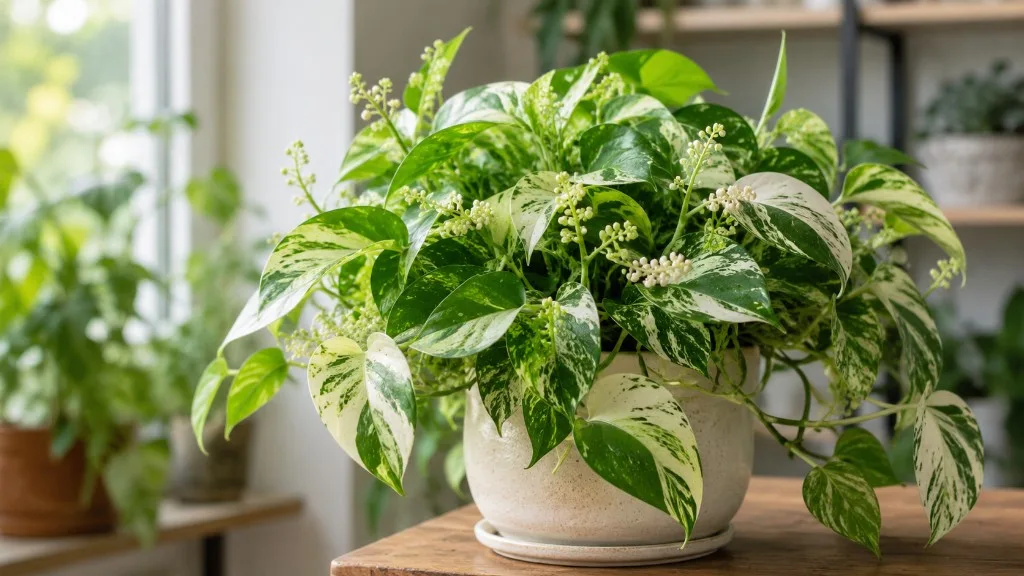
Cultivar note: N’Joy Pothos (Epipremnum aureum ‘N’Joy’) — green leaf edges with cream-to-white centers; compact leaves revert to plain green in low light. Place in bright indirect light; water when top 3–5 cm dry; slower growth means the pot dries more slowly than golden pothos.
Why N’Joy Pothos Is Not a Low-Light Plant Despite the Pothos Reputation
Pothos earned office-plant fame because Epipremnum aureum tolerates shade better than most common houseplants. N’Joy inherits that baseline flexibility but sits in a higher-variegation tier alongside Marble Queen and Pearls and Jade — cultivars Clemson notes require more light than solid-green Jade or moderately variegated golden pothos. (Clemson HGIC) Cream and white leaf sectors contain less chlorophyll than green margins, so the plant needs more total photon flux to photosynthesize enough energy to maintain decorative pigment on new leaves.
Compact Leaves and Cream Sectors Change the Light Math
N’Joy produces smaller, slightly puckered leaves on shorter internodes than golden pothos. Less leaf area means less photosynthetic surface per vine, which makes light quality at the growing tip even more important. A golden pothos in moderate indirect light may still push acceptable gold splashes; N’Joy in the same spot often shows long bare stems, tiny new leaves, and cream sectors shrinking toward solid green within weeks. University of Florida IFAS Extension reports that variegated pothos in interiors tolerate light as low as 50 foot-candles for survival, but new leaves stay small and variegated cultivars lose color; 150 foot-candles or more maintains color and leaf size. (UF IFAS Extension) Treat 150+ fc at the leaf surface as the practical floor for keeping N’Joy looking like N’Joy, not merely alive.
How Much Light N’Joy Pothos Actually Needs
N’Joy Pothos is a tropical understory climber native to Mo’orea in French Polynesia and naturalized across humid tropics, where it climbs trunks toward dappled canopy brightness rather than all-day direct sun. Indoors, the closest match is bright indirect light: strong ambient brightness on the leaves without sustained hot direct beams.
Bright Indirect as the Target Band
For most homes, place N’Joy where leaves receive bright filtered daylight most of the day — typically within 30 cm (12 inches) of an east window or 30–90 cm (1–3 feet) back from a filtered south or west exposure. The RHS Epipremnum growing guide recommends bright, indirect light such as an east- or west-facing window, or a south window protected by sheer curtains, and warns that too little light may cause foliage to lose variegation. (RHS Growing Guide) Penn State Extension recommends moderate to bright light while avoiding direct sun that yellows leaves. (Penn State Extension)
Foot-Candles and What They Mean for Home Growers
You do not need a light meter to succeed, but the ranges help calibrate expectations. 50–100 foot-candles — far from windows, dim hallways — supports survival with quality decline. 150–250 foot-candles — several feet from glass, some north rooms in summer — keeps N’Joy alive but often dulls cream patterning over time. 250–1,000 foot-candles — near east or filtered south/west windows, or under a well-placed grow light — is where N’Joy develops compact bushiness, firm leaves, and crisp cream centers on fresh growth. UF IFAS commercial production targets 63 to 80 percent shade (roughly 2,500–3,250 foot-candles) for variegated pothos in greenhouses — far brighter than most dim living rooms. (UF IFAS Extension)
The operational rule: judge new leaves every two weeks. Firm size, short internodes, and visible cream variegation on the youngest foliage mean light is working. If the newest leaf is the problem, adjust placement before changing N’Joy Pothos watering or N’Joy Pothos fertilizer.
N’Joy Pothos vs Golden Pothos: Different Light Demands
Golden pothos carries moderate yellow-green variegation and ranks among the most shade-forgiving variegated pothos types. N’Joy’s blocky cream-and-white centers behave more like Marble Queen — beautiful in bright indirect light, quick to green out in dim corners. Wisconsin Extension notes that low light can result in loss of variegation on pothos generally. (Wisconsin Horticulture) On N’Joy, that reads as new leaves approaching solid green while older shaded leaves still show cream.
Why Golden Pothos Forgives Dim Rooms More Easily
Yellow variegation still photosynthesizes more efficiently than large white sectors. Golden pothos also vines faster, producing more total green tissue to compensate in moderate light. N’Joy’s slow, compact growth means fewer new leaves to signal problems — a dim N’Joy can look “fine” for months while silently reverting. The same slow metabolism also means the pot dries slower, coupling low light with overwatering risk when growers keep a golden pothos calendar.
When N’Joy Growers Should Upgrade Placement First
Move N’Joy one brightness step brighter than wherever a thriving golden pothos sits in your home. If golden looks good on a north-facing shelf, N’Joy likely needs an east window or supplemental LED. If golden variegation fades in a hallway, N’Joy may need a grow light rather than a slightly closer window. Compare side-by-side for two weeks — the cultivar difference becomes obvious on new growth, not old leaves.
How Light Drives Cream Variegation and Leaf Size
N’Joy variegation is a stable but light-sensitive pattern of chlorophyll distribution across each leaf. In bright indirect conditions, the plant can afford generous cream sectors because green margins plus total daily light meet energy demand. In chronic low light, N’Joy edits new leaves toward green — old leaves do not re-variegate after you improve placement.
When Bright Light Keeps White Centers Crisp
Under adequate brightness, N’Joy shows bold cream-to-white centers framed by green edges, short gaps between nodes, and leaves that match or exceed the size of the previous two. Penn State Extension describes pothos as vigorous under moderate to bright light with average room temperatures — a combination most living rooms already provide if window placement is correct. (Penn State Extension) Practical signs bright light is working include firm stems, regular new leaves through spring and summer without fertilizer changes, and side shoots emerging after pinching rather than stalling for weeks.
When Low Light Fades Variegation on New Leaves
Low-light fade is gradual — easy to miss over four to eight weeks. Watch for internode length doubling, new leaves half the size of older ones, and cream sectors shrinking until fresh growth looks like plain green pothos. This is phenotypic adjustment, not permanent genetic reversion. Move to brighter filtered light and subsequent leaves usually regain pattern, though recovery speed depends on season and overall health. Do not confuse natural aging with light fade: older base leaves yellow and drop regardless; light problems show on the top of the vine first.
Best Window Placement for N’Joy Pothos Indoors
Window direction is a starting guess. What matters is hours of useful brightness on leaf surfaces and whether any hours are hot direct rays that scorch tissue formed in softer light.
Place N’Joy within 30 cm of the glass on the brightest suitable exposure when you want compact, variegated growth — not across the room where human eyes see daylight but leaves receive little flux. Rotate the pot weekly so the vine does not lean permanently toward one side, as Penn State Extension recommends for balanced foliage. (Penn State Extension)
East, South, West, and North Windows Compared
An east-facing window is the most reliable default. Morning sun is bright but cooler, delivering one to three hours of gentle direct light many acclimated pothos handle well, followed by bright indirect light the rest of the day. A south-facing window provides strong winter sun; pull N’Joy slightly back from the pane or behind sheer fabric in summer when glass intensifies heat and UV. A west-facing window delivers strong afternoon rays — highest scorch risk for unacclimated plants; treat afternoon diffusion as mandatory. A north-facing window rarely supplies enough brightness for vivid cream variegation long-term; expect stretching and green-dominated new leaves unless you add a grow light.
Hanging Baskets, Shelves, and the New-Leaf Test
Hanging baskets are often mounted too high or far from windows — the wall above a window can still be a dark zone. On shelves, the top of the cascade receives more light than shaded inner vines. Trim or rotate so growing tips stay in the brightest zone you can offer without sunburn. After any move, wait 10 to 14 days and inspect only new leaves before making another change.
Direct Sun Tolerance and Safe Acclimation
N’Joy Pothos is not a full-sun indoor plant. Penn State Extension warns that direct sun leads to leaf yellowing; Clemson lists leaf scorch and tip dieback among problems tied to intense light combined with low humidity. (Penn State Extension; Clemson HGIC) Wisconsin Extension adds that pothos does not tolerate much direct sunlight indoors. (Wisconsin Horticulture) Short periods of gentle morning direct sun through an east window often cause no damage on acclimated plants.
Morning Sun vs Afternoon Heat Load
East exposure delivers lower-angle, cooler radiation; west and south afternoon exposure combines high intensity with heat load from glass and sills. Acclimate by moving one step brighter — not from a dim shelf to full afternoon sun in one jump. Wait 7 to 14 days at each step while watching new leaves only. Increase watering slightly as brightness rises because transpiration increases. If bleaching or crisping appears, step back to the last safe position and hold until clean new growth resumes.
Low-Light Limits and Realistic Expectations
N’Joy will live in low light longer than many houseplants — which is why it appears on dim shelves — but living is not maintaining cultivar character. NC State Extension notes survival in low light while linking low light to variegation loss. (NC State Extension) Set expectations when placement options are limited: slower growth, smaller leaves, greener new foliage, higher overwatering risk, and slower recovery from stress.
Offices, Bathrooms, and Far-From-Window Spots
Office fluorescent lighting at desk height often delivers roughly 50–75 foot-candles — enough for N’Joy to persist, especially near overhead tubes, but cream variegation dulls over months. Bathrooms without windows work only with meaningful spill light from a doorway or a grow light on a timer; shower humidity does not replace photons. Far-from-window shelves — more than 2 metres from glass — usually sit below the 150 fc band N’Joy needs for crisp variegation. When low light is non-negotiable, water less often, skip heavy fertilizer, prune leggy stems, or install a small LED for 12 to 14 hours daily if cream patterning matters.
Grow Lights When Natural Light Is Not Enough
When windows cannot deliver enough brightness, a full-spectrum white LED grow light is the most reliable upgrade for offices, winter rooms, and interior shelves.
Fixture Height, Hours, and Adjustment Signals
A workable starting setup: position the fixture 25–45 cm (10–18 inches) above the canopy; run 12 to 14 hours daily on a timer; choose 5000–6500 K full-spectrum LEDs. Adjust after two weeks using new-growth signals — stretchy stems and pale shrinking leaves mean lower the fixture slightly or add one hour; bleached or curled leaves only under the lamp mean raise the fixture or reduce hours. Enclosed cabinets can overheat; check leaf-level warmth with your hand at midday. Pair winter light supplementation with reduced watering if growth slows seasonally.
Warning Signs N’Joy Pothos Has Too Much or Too Little Light
N’Joy reports light problems on new tissue first. Old bleached or stretched leaves will not revert; watch the youngest leaf and the next node after any move. Make one light change, then wait 10 to 14 days before also changing water, fertilizer, or pot size.
Too Little Light: Leggy Stems, Solid Green, Slow Growth
Long internodes and visible stretching toward the window mean the plant is escaping shade. Smaller new leaves than older ones confirm chronic deficit. Loss of cream variegation on fresh foliage indicates insufficient photon flux for the white-and-green pattern. Hard lean to one side shows directional starvation. Slow or absent new growth through spring and summer, despite adequate water, often traces to light before disease. Yellow lower leaves on soil that stays moist in dim cool rooms frequently couples low light with overwatering — fix light and N’Joy Pothos watering together.
Fixes: move closer to glass, remove obstructions, shift to a brighter exposure, add or lower a grow light, extend photoperiod, rotate weekly, and pinch vine tips after light improves so side shoots emerge compact.
Too Much Light: Bleach, Scorch, and Leaf Drop
White or tan bleached patches on sun-facing zones indicate photobleaching. Crisp, dry brown areas appearing suddenly after a move closer to glass suggest scorch, especially on leaves formed in softer light. Yellowing of multiple leaves after direct sun exposure aligns with Penn State Extension’s direct-sun warning. (Penn State Extension) Curling during peak hours can be a protective response to excess light or leaf heat. Sudden leaf drop after relocation to harsh exposure without acclimation is a common failure mode.
Fixes: pull back from glass, add sheer diffusion, shift to east or filtered exposure, acclimate gradually over 7 to 14 days, and avoid leaves pressed against hot window panes. Trim old damaged foliage once new growth under safer light looks clean.
When to use this page vs other N’Joy Pothos guides
- N’Joy Pothos overview — Start here for whole-plant context, toxicity, and cultivar identity before deep-diving light placement.
- N’Joy Pothos watering — Use when light is adequate but yellow leaves, sour soil, or wilt trace to moisture — especially in dim rooms where N’Joy dries slowly.
- N’Joy Pothos soil — Use when drainage or mix composition affects how fast the pot dries after you improve light.
- N’Joy Pothos propagation — Use when you want to restart from cuttings after leggy low-light vines, or fill out a bushier display in brighter placement.
Related N’Joy Pothos guides
- N’Joy Pothos overview
- N’Joy Pothos watering
- N’Joy Pothos soil
- N’Joy Pothos propagation
- N’Joy Pothos fertilizer
- N’Joy Pothos repotting
- N’Joy Pothos pruning
Conclusion
N’Joy Pothos light needs center on one cultivar-specific truth: cream variegation costs photons. Epipremnum aureum ‘N’Joy’ tolerates dim corners better than many houseplants, yet extension guidance consistently points to bright, indirect light as the target for vigor, leaf size, and stable cream-and-green patterning. (Clemson HGIC; NC State Extension; RHS N’Joy profile)
Place N’Joy brighter than golden pothos in the same home — close enough to the window that leaves receive real flux, default to east or filtered south and west exposures, treat hot afternoon direct sun as a risk, and use 12 to 14 hours of full-spectrum LED when natural light cannot carry the plant through winter or back-room placements. Read new leaves, not nostalgia for old ones; move exposure in steps; pair brighter light with adjusted watering on this slow-drying cultivar. Get the band right and N’Joy becomes one of the highest-return compact trailing plants available — crisp white centers, tidy growth, and none of the stringy green revert that happens when a variegated pothos is treated like an indestructible office afterthought.