Watering N'Joy Pothos: Schedule & Dry Checks
Watering N'Joy Pothos: Schedule & Dry Checks
Watering N'Joy Pothos: Schedule & Dry Checks
N’Joy Pothos (Epipremnum aureum ‘N’Joy’) looks like a miniature golden pothos, and that visual similarity causes the most common watering mistake in the cluster: treating both cultivars as if they drink on the same schedule. N’Joy carries the same drought tolerance in its thick stems, but its compact leaves, slower growth, and cream variegation mean the pot often stays wet longer than a vigorously trailing golden pothos in the same room. Water on a golden pothos calendar in a dim corner, and you get yellow leaves, sour soil, and root rot on N’Joy Pothos that arrives quietly. The fix is not watering more carefully on Sundays—it is checking whether the top 4–5 cm (roughly 1.5–2 inches) of mix has dried, giving a full soak when it has, draining completely, and stretching the interval when light is weak or winter slows growth. This guide covers the checks, realistic schedules, and cultivar-specific traps that turn a crisp variegated pothos into a limp, green-reverting shelf plant.
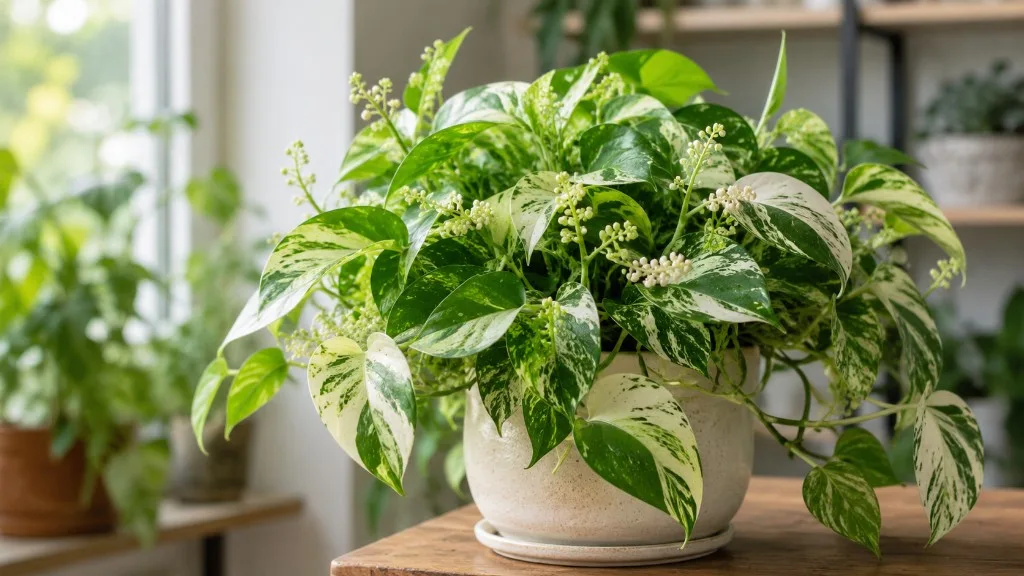
Cultivar note: N’Joy Pothos (Epipremnum aureum ‘N’Joy’) — green leaf edges with cream-to-white centers; compact leaves revert to plain green in low light. Place in bright indirect light; water when top 3–5 cm dry; slower growth means the pot dries more slowly than golden pothos.
Why N’Joy Pothos Dries Down Slower Than Golden Pothos
Golden pothos earned its reputation as nearly indestructible partly because fast vining growth pulls water through the system quickly. N’Joy Pothos shares the species’ forgiving roots but runs a slower engine. The Royal Horticultural Society describes N’Joy as a trailing houseplant with green and cream variegated, slightly puckered leaves, tolerant of shade although variegation becomes less pronounced in low light (RHS N’Joy profile). Smaller leaf surface area and slower stem extension mean less daily transpiration, so the same peat-based mix that dries in seven days under a bright east window for golden pothos may take ten to fourteen for N’Joy—and even longer in a north-facing office.
That biology creates a trap opposite to the one golden pothos faces. Golden growers sometimes underwater because the plant looks tough. N’Joy growers overwater because the plant looks small, sits in a four-inch pot on a shelf, and still looks fine while the center of the mix stays damp for weeks. Clemson Cooperative Extension notes that pothos should be watered when the top 1.5 to 2 inches of soil have dried and that soil should dry between sessions—the same depth rule applies to N’Joy, but the elapsed time between those dry points is longer. (Clemson HGIC)
The variegation–light–water triangle ties directly to watering. Cream and white sectors contain less chlorophyll than green tissue, so in low light N’Joy photosynthesizes even less and uses water slower still. NC State Extension warns that low light can cause loss of variegation on pothos (NC State Extension). If your N’Joy is fading to solid green on a dim shelf, assume the pot is drying slowly and reduce watering frequency before moving it only closer to a window. Better N’Joy Pothos light and conservative water together prevent the classic pairing: wet soil plus weak light plus yellow lower leaves.
As an aroid from tropical understory, pothos evolved with filtered light and cycles of rain followed by drying (Wisconsin Horticulture). N’Joy indoors wants that same rhythm—air around the roots between drinks—not permanently damp mix because the pot is small and cute.
How Much Water N’Joy Pothos Actually Needs
The useful principle for all N’Joy Pothos is a thorough soak that wets the full root ball, followed by a genuine dry-down before the next session. Pour slowly until water exits the drainage holes, pause thirty seconds, and add a little more if the mix absorbed the first pass unevenly. A few tablespoons every other day keeps the surface damp while the center stays dry—the plant droops, you add sips, and roots never get a coherent drink.
Volume per session matters less than completeness. For a typical four- to six-inch N’Joy pot, that often means roughly one cup once the dry-down check passes, but root mass, mix, and pot shape change the number. Watch for drainage, not a measuring cup. The RHS advises letting the top 2 cm of compost dry between waterings and warns that keeping compost too wet causes roots to rot. (RHS Growing Guide)
For N’Joy specifically, use the top 4–5 cm dry checkpoint before watering in most indoor pots—equivalent to the extension 1.5–2 inch band but emphasized here because growers often check only the surface on shallow shelf pots. In larger containers where roots fill less than half the volume, wait until the top half of the mix has dried; a wet core below a dry crust is the most common overwatering pattern on compact cultivars.
How Often to Water N’Joy Pothos Indoors
Honest frequency is always when the dry-down check passes, not a day of the week. A realistic starting range for N’Joy in bright indirect light is every 7–10 days in warm months and every 10–14 days in winter, confirmed by finger or skewer tests. In low light, stretch toward 14–21 days between sessions—and sometimes longer in a cool room—because the plant simply is not pulling moisture.
Compare that to golden pothos in the same home: the golden vine may need water three to five days sooner. If you inherited a golden pothos routine, slow down for N’Joy unless checks prove otherwise. Walk the pot twice weekly during growing season not to water by default, but to learn whether your specimen behaves like a weekly plant or a biweekly one. After fourteen days in the same spot, you will know.
Indoor humidity between 30 and 50 percent suits pothos; the RHS notes epipremnums do not need high humidity unlike many tropical houseplants (RHS Growing Guide). Dry heated air can pull moisture from small pots faster, but do not compensate with constant wet soil—low humidity plus soggy mix invites fungus gnats and mold on soil on N’Joy Pothos.
Wisconsin Extension lists an ideal temperature range of 70–90 °F (21–32 °C) for active pothos growth (Wisconsin Horticulture). N’Joy’s comfort band of 65–85 °F (18–29 °C) matches most homes; below 65 °F in winter, growth slows and soil stays wet longer. Reduce frequency when the room cools even if leaves still look green.
Finger Test, Chopstick Probe, and Pot Weight
The finger test remains the fastest check. Press into the mix 4–5 cm deep near the pot edge, not against the stem. Cool, clinging soil means wait. Dry, crumbly soil at that depth means water. Pale dry surface with damp particles on your finger below means wait—especially on peat mixes that lighten on top while the center stays moist.
A wooden chopstick or skewer inserted to mid-pot depth and withdrawn after sixty seconds catches what a surface glance misses. Damp wood clinging below means wait; dry wood plus a light pot means water.
The pot weight test is the most reliable repeat-grower signal. Lift the pot right after a thorough watering and notice the heft. Lift every few days. Dramatic lightness plus dry top 4–5 cm equals water; heavy pot plus wilted leaves equals overwatering on N’Joy Pothos, not thirst.
N’Joy shares the genus droop-and-recovery signal: genuinely dry plants soften and hang, then perk within hours after a full soak. If wilting persists into the next morning despite wet soil, roots are failing—never water again until you verify drainage and moisture at depth (Clemson indoor watering guide).
Seasonal Watering Adjustments
Spring resumes active growth as light strengthens. Water when the top 4–5 cm dries—often every 7–10 days for a bright-window N’Joy. Good season to repot root-bound plants or take cuttings when roots are healthy and N’Joy Pothos soil drains well.
Summer peak warmth increases demand slightly, but N’Joy still outpaces golden pothos on dry-down length. A bright N’Joy may need water every 7–10 days; check rather than assume weekly is enough. Heat increases evaporation; it does not suspend the need for drainage.
Fall shortens days and cools nights. Stretch intervals and verify with checks. Overwatering becomes the bigger risk as evaporation drops.
Winter in cool, dim rooms may mean water only every 14–21 days, sometimes longer. The RHS explicitly warns that overwatering, especially in winter, can rot the roots (RHS Plant Guide). A pot that dried in eight days in July may take eighteen in January. Adjust by check, not memory—and pause N’Joy Pothos fertilizer when growth stalls, the same logic as reducing water input.
Watering by Light Level and Placement
Light is the hidden dial on your N’Joy schedule. In bright indirect light—where white variegation holds best—expect the shorter end of the range: roughly 7–10 days in warm months. In medium indirect light, 10–14 days is common in winter. In low light, stretch toward 14–21 days; the risk shifts to overwatering, not drought, because variegation fades and metabolism drops together.
Clemson HGIC ties best variegation and growth to bright indirect light while noting tolerance for lower conditions (Clemson HGIC). Brighter placement increases water use modestly; dim placement decreases it sharply. Move N’Joy for better light and widen the watering interval when you move it to a shadier spot—changing both at once without thinking is how shelf plants rot.
Pot Size, Material, and Fresh Repots
Small four-inch nursery pots—the default for N’Joy at purchase—dry faster than ten-inch floor pots but still slower than an equally sized golden pothos because of lower transpiration. Terracotta breathes and shortens dry-down; plastic and glazed ceramic retain moisture longer. A plastic pot in low light is the combination most likely to stay wet too long.
After N’Joy Pothos repotting into a larger container, expect slower dry-down until roots fill the new volume. Many growers overwater freshly repotted N’Joy because they keep the old schedule. Wait for the top 4–5 cm to dry even when that takes longer than before. An oversized pot with excess wet mix around sparse roots is a common rot trigger on compact cultivars.
Soil Mix and Drainage as Hidden Watering Factors
Watering skill cannot overcome dense mix. N’Joy wants well-draining standard potting mix with enough structure for air around roots. Wisconsin Extension recommends a well-aerated medium and watering when the soil surface is dry (Wisconsin Horticulture). A practical blend adds perlite or orchid bark to bagged indoor mix; target pH around 6.0–6.5. Drainage holes are non-negotiable—decorative cachepots without drainage are the fastest path to yellow variegated leaves despite careful attention.
If mix stays wet more than ten days in a warm room, suspect too little light, an oversized pot, or dense aged mix before watering on schedule again.
Top Watering vs Bottom Watering
Both methods work when the pot has drainage holes and you drain excess afterward. Top watering flushes mineral salts—useful in small pots that accumulate fertilizer residue. Bottom watering for ten to thirty minutes helps when mix has gone hydrophobic and water runs down the sides without wetting the center (Clemson HGIC). Either way, empty the saucer within thirty minutes. Standing water re-saturates roots and produces wilted leaves in wet soil—the paradox that kills more N’Joy plants than drought.
Signs You Are Overwatering N’Joy Pothos
Overwatering is the primary killer because N’Joy looks thirsty while roots fail. Wilting despite wet soil is the hallmark—damaged roots cannot transport water, so leaves droop though moisture is present. Yellow leaves, often lower and older while soil stays damp, signal chronic overwatering. Wisconsin Extension links yellowing and blackening margins to overwatering, inadequate watering, or salt buildup (Wisconsin Horticulture). Soft stems at the soil line, mushy brown roots, sour smell, and fungus gnats round out the pattern.
If several signs align, pause watering, improve airflow, confirm drainage, and let the mix dry toward the top half before resuming conservatively. Move to brighter indirect light—not direct sun—to help dry-down. If decline continues, unpot, trim mushy roots, and repot into fresh mix sized to remaining root mass. Recovery is possible from N’Joy Pothos propagation cuttings if rot is advanced.
Signs N’Joy Pothos Is Thirsty
Underwatered N’Joy is usually clearer than overwatered. Dramatic drooping that resolves within hours after a thorough watering is classic drought stress. Dry soil pulling from the pot edge means the ball went too dry—rewater in two passes ten minutes apart, or bottom-water until the surface darkens, then drain completely. Crispy brown edges follow repeated boom-and-bust cycles. Healthy N’Joy can often go two to three weeks in summer and longer in a cool winter room without severe harm, though growth stalls—see underwatering on N’Joy Pothos if leaves crisp before recovering.
Common Watering Mistakes on Compact Variegated Pothos
Matching golden pothos frequency on a slower cultivar tops the list. Watering on a calendar without checking is mistake two—Sunday is a reminder to check, not pour. Leaving runoff in cachepots, pots without holes, misting instead of watering when soil is dry, and watering wilt without a moisture check follow close behind. Repotting into a much larger pot and keeping the old schedule traps moisture around sparse N’Joy roots for weeks.
Building a Simple Check-First Routine
Twice weekly, ask: is the top 4–5 cm dry and is the pot lighter than after the last full watering? If yes to both, water at the sink until drainage runs clear, drain five minutes, empty the saucer, return the plant. If no, walk away. Once monthly, note whether intervals are lengthening or shortening with the season. Keep one dedicated check day as a reminder, not a command—N’Joy rewards patience more than frequency.
Pair this page with light, soil, and repotting guides when the same problem repeats—yellow leaves with wet soil rarely resolve from watering alone, and bare compact vines usually want better light or N’Joy Pothos pruning, not more water.
Conclusion
Watering N’Joy Pothos well comes down to respecting slower dry-down than golden pothos. Check the top 4–5 cm of mix, soak thoroughly, drain completely, and stretch intervals in cool low-light months when variegation fades and growth stalls. Droop tells you the plant is thirsty only when soil is dry and roots are healthy—wet soil plus wilt means stop watering and fix drainage. Bright light, small terracotta pots, and summer warmth shorten the cycle; low light, large plastic pots, and winter coolness lengthen it. Trust finger, skewer, and pot weight more than any calendar, and N’Joy keeps the crisp green-and-cream leaves that distinguish it from plain green revert vines.
When to use this page vs other N’Joy Pothos guides
- N’Joy Pothos overview — Start here for whole-plant context before deep-diving this topic.
- N’Joy Pothos problems hub — Jump to symptom-specific fix guides when this care topic does not resolve the issue.
- Overwatering on N’Joy Pothos — Escalate here when watering adjustments are not enough.
- Underwatering on N’Joy Pothos — Escalate here when watering adjustments are not enough.
- Root Rot on N’Joy Pothos — Escalate here when watering adjustments are not enough.