Oleander Fertilizer Guide: Type, Timing and Dose
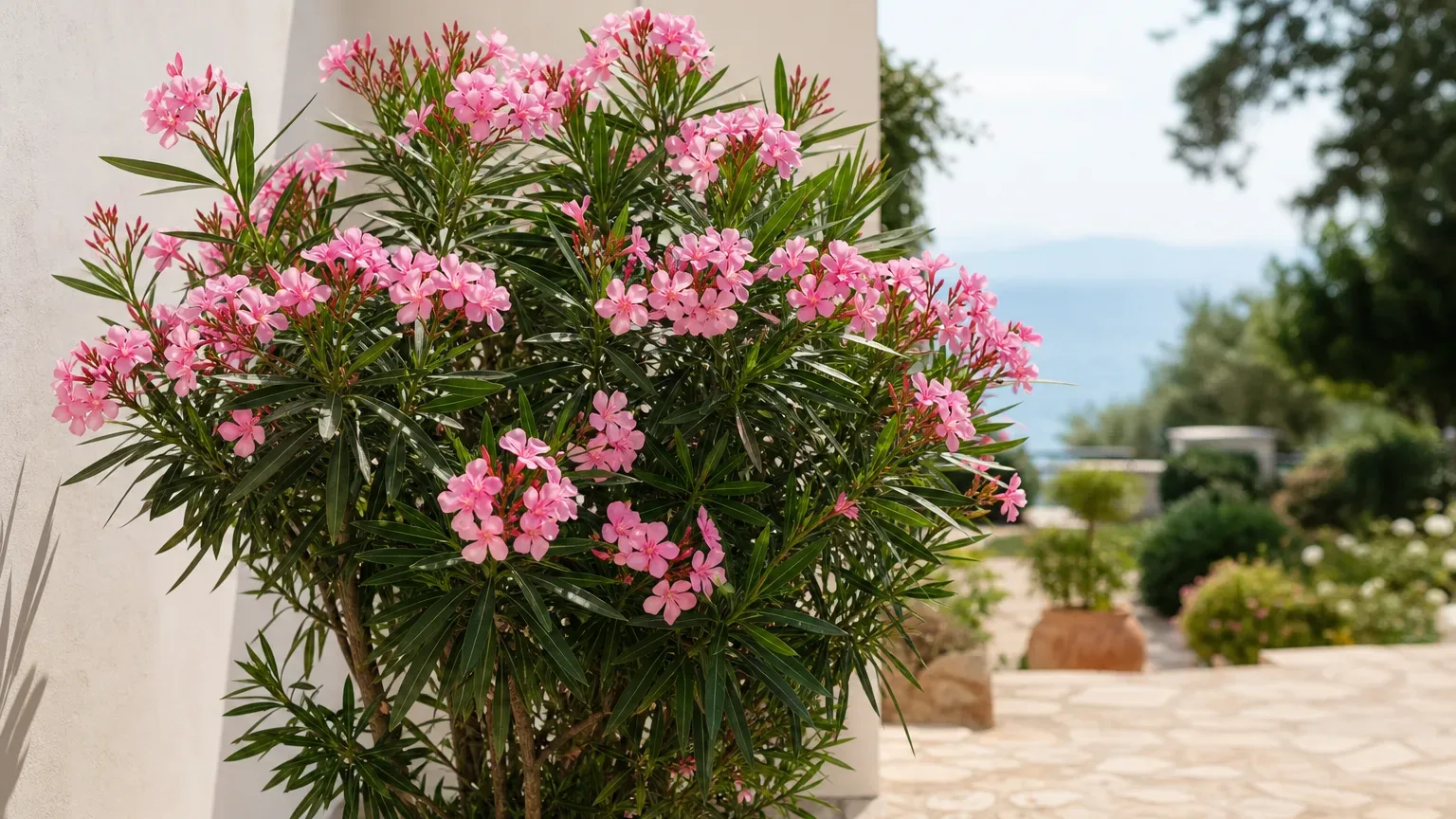
Oleander Fertilizer Guide: Type, Timing and Dose
Oleander Fertilizer Guide: Type, Timing and Dose
Oleander is a vigorous flowering shrub, but it is not a heavy feeder by default. Nerium oleander tolerates poor ground, drought, alkaline conditions, and salt exposure once established; the UF/IFAS species profile says a landscape plant can grow well with one yearly fertilization. That makes “feed more” a poor first response to every yellow leaf or flowerless stem.
The useful question is not whether fertilizer is good or bad. It is whether this oleander is actively growing, rooted in a container or the ground, and showing a need that better light, drainage, or watering will not solve. Container plants usually need more deliberate feeding because repeated watering removes nutrients, while an established garden shrub in reasonable soil may need very little.
Quick answer: the best fertilizer for oleander
For a potted oleander, use a complete fertilizer with a balanced or modest-nitrogen analysis and micronutrients. A water-soluble product applied at half the label rate every four to six weeks during strong active growth is a cautious starting point; a labelled controlled-release product applied once near the start of the main growing season is the lower-maintenance alternative. Stop or reduce feeding when growth slows, the root ball stays wet, or cold weather approaches.
For an established in-ground oleander, do not create a monthly schedule automatically. Apply one spring feeding only if growth is weak, leaves are uniformly pale, the soil is very lean, or a soil test identifies a need. Clemson Extension advises that not all landscape shrubs need fertilizer and recommends tying applications to a defined objective rather than routine.
Does oleander actually need fertilizer?
Oleander prefers fertile, well-drained soil, but preference is not dependence. The NC State Extension profile records its tolerance of poor soil along with drought, heat, wind, and coastal salt. A mature hedge growing steadily and flowering in full sun may already be getting enough nutrition from the soil, decomposing mulch, and normal nutrient cycling.
Containers are different. Roots occupy a finite volume, irrigation carries dissolved nutrients out through drainage holes, and fresh shoots and flowers draw on a limited reserve. Feed a potted oleander lightly during active growth, especially after it has occupied the same mix for a year; use the Oleander repotting guide when dense roots, rapid drying, or exhausted structure point to a root-space problem rather than a fertilizer problem.
Before feeding a struggling plant, inspect conditions. Saturated soil, drought, compacted roots, scale insects, low sun, and cold damage can all reduce growth or pale the foliage. Clemson notes that damaged roots and unsuitable soil pH can prevent nutrient uptake even when nutrients are present, so adding more fertilizer before correcting the cause can intensify stress.
Choosing a fertilizer for oleander
Choose a product by its label, not by a picture of flowers. The three prominent numbers report nitrogen, phosphate, and potash percentages; Clemson’s fertilizer-label guide explains what those N-P-K values represent. A complete product should also list micronutrients, particularly when the plant has remained in a soilless container mix for several seasons.
There is no authoritative universal “oleander NPK.” A balanced product such as 10-10-10 or 20-20-20 can work when correctly diluted, but equal numbers are not inherently superior. Where a soil test shows adequate phosphorus, adding more phosphorus provides no benefit and increases the chance of nutrient loss into runoff.
Balanced fertilizer versus high-nitrogen products
Nitrogen supports green shoot and leaf growth, but excess nitrogen can produce long, soft stems at the expense of flowers. Clemson Extension warns that too much fertilizer can cause burn and that excessive nitrogen favors leafy growth while increasing vulnerability to cold, drought, and pests. For a sunny oleander that already has dark foliage and long shoots, more nitrogen is unlikely to be the missing bloom trigger.
Avoid using a lawn fertilizer around oleander unless a soil-test recommendation specifically supports its analysis and rate. Lawn products are commonly nitrogen-heavy, and some combination products contain herbicides that do not belong in a shrub container or root zone. “Bloom booster” labels also deserve caution: a large middle number cannot compensate for insufficient sun or repeated removal of flowering wood.
Liquid versus controlled-release fertilizer
Liquid fertilizer gives you control. It suits a container whose growth changes sharply between hot bright months, monsoon cloud, and winter because you can pause immediately. Dilute it into irrigation water at no more than the label rate, and begin at half strength when the plant is newly acquired or its previous feeding history is unknown.
Controlled-release granules suit a large outdoor tub that is difficult to feed regularly. Measure for the actual pot diameter or substrate volume, distribute granules across the surface away from the trunk, and follow the product’s stated release period. Oklahoma State Extension recognizes both diluted soluble feeds and slow-release pellets for container plants, but stresses label directions and seasonal adjustment.
Compost can improve soil structure and contribute nutrients, but it is not a precisely dosed substitute for a labelled fertilizer. Use a thin layer of mature compost on in-ground soil without piling it against the stems. Do not add concentrated kitchen scraps, fresh manure, or unknown homemade liquids to a pot; their nutrient strength, salinity, and decomposition are unpredictable.
A practical oleander feeding schedule
Start feeding when warm conditions and increasing light produce visible new leaves and extending shoots. In a pot, apply diluted liquid fertilizer every four to six weeks during that active phase, or use one labelled controlled-release dose at its beginning. Treat this interval as a starting framework, not a promise: a dwarf cultivar in a small pot may exhaust nutrients sooner than a standard oleander planted in garden loam.
Pause feeding after repotting into a commercial mix that already contains fertilizer; the bag label should state how long that charge lasts. Also pause after root damage, severe wilt, pest treatment, or heat injury. Fertilizer is useful only when functioning roots can absorb it and the plant has enough light and water to turn nutrients into growth.
Timing fertilizer in India and other warm climates
Use plant growth rather than a northern-season calendar. Across much of India, the useful first feed falls in late winter or spring as temperatures rise and shoots restart. Continue light feeding while the plant is growing strongly, but skip soluble fertilizer during stretches of monsoon rain when the pot remains saturated; review the Oleander watering guide before adding nutrients to a wet root ball.
In hot, dry pre-monsoon weather, water first and feed only after the root ball is evenly moist. In cooler northern winters, stop when shoot growth slows. In a frost-free southern or coastal setting, oleander may remain active longer, but low light, heavy rain, or stalled growth still justify a pause.
Feeding established oleander in the ground
For a healthy established shrub, one measured application near the start of active growth is usually enough if feeding is needed at all. UF/IFAS specifically describes oleander as growing well with one yearly fertilization, consistent with its ability to occupy lean urban and coastal sites. Spread the product evenly over the accessible root zone according to its shrub rate, keep granules off leaves and stems, and water them into the soil if the label instructs.
Do not concentrate fertilizer in holes around the trunk. Woody roots extend beyond the stem base, and pockets of salts can injure roots without improving distribution. A soil test is the better next step when several landscape oleanders share the same pale foliage or poor growth.
How to apply fertilizer without burning roots
Check moisture first. Never pour liquid feed onto a bone-dry, heat-stressed root ball because a concentrated salt solution around dehydrated roots increases injury risk. Water lightly to moisten a very dry mix, allow it to absorb, then apply the diluted feed evenly; alternatively, feed at the next normal watering once the plant has recovered.
Measure instead of guessing. Read the product’s N-P-K analysis, mixing rate, frequency, and container or shrub instructions, then choose the lower rate when conditions are marginal. Clemson’s environmental guidance emphasizes the right source, rate, time, and place because nutrients applied beyond plant demand can move into surface water or groundwater.
Let water leave the container freely and empty any saucer. Oklahoma State explains that thorough watering helps leach excess fertilizer salts from potting mix. This does not mean flushing after every feed with wasteful volumes; it means maintaining working drainage and periodically washing accumulated salts from a healthy, free-draining pot.
Fertilizer and flowering
Fertilizer supports flowering only when nutrition is actually limiting. Oleander flowers best on strong new growth in bright exposure; UF/IFAS reports that partial shade produces a lankier plant with fewer flowers. If foliage is dark green but bloom is poor, move first to the Oleander light guide and review pruning timing rather than adding phosphorus.
Water stress can also abort buds, while saturated roots cannot support vigorous shoots. Follow the Oleander soil guide if mix remains wet, smells sour, or has compacted. Feed after correcting the root environment, not as a way to conceal it.
Signs an oleander may be short of nutrients
A genuine shortage is more plausible when older container mix has been watered heavily for many months and the plant shows uniformly pale leaves, shorter new shoots, and reduced leaf size during warm, sunny conditions. The pattern should be widespread rather than a few naturally ageing lower leaves. Confirm that roots are healthy and pests are absent before treating the symptoms as nutrition.
Yellow leaves with green veins can reflect micronutrient unavailability, often related to root-zone pH rather than a simple lack of fertilizer. A soil or substrate test is safer than repeatedly adding iron, magnesium, or Epsom salt. Epsom salt supplies magnesium and sulfur only; it is not a complete oleander fertilizer and can add unnecessary salts when magnesium deficiency has not been established.
Signs you have fed too much
Early excess often appears as white crust on the mix or pot rim, followed by browned leaf tips and margins. More serious injury brings wilting despite moist soil, sudden leaf drop, or dark damaged roots. Oklahoma State links marginal burn to excess fertilizer and recommends leaching the mix when fertilizer is the cause.
Very dark leaves, long soft shoots, and reduced flowering point more toward excess nitrogen than acute salt burn. Stop feeding rather than adding a second product to “balance” the first. If the root ball is also wet, let drainage and moisture status dictate the next step.
Recovering an overfertilized oleander
Remove visible granules from the surface if they were recently overapplied. For a pot with unobstructed drainage and otherwise healthy roots, run clean water slowly through the mix so several pot volumes drain away, then empty the saucer. Do not flush a saturated, sour-smelling mix; unpot and assess drainage and roots instead.
Withhold fertilizer until healthy new growth resumes, usually for several weeks. Move the plant out of extreme afternoon heat during acute wilt, but keep it in bright outdoor light rather than a dim room. If roots are black or soft, the issue has moved beyond feeding and needs the Oleander repotting guide.
Toxicity precautions while fertilizing
Oleander requires stricter handling than an ordinary flowering shrub. NC State rates its poison severity as high and states that bark, flowers, fruit, leaves, roots, sap, seeds, and stems are poisonous fresh or dry. Wear gloves when clearing soil around the stem or handling fallen material, cover cuts on your hands, avoid touching your face, and wash hands and tools afterward.
Keep children, pets, and livestock away from the plant, fertilizer, runoff, fallen leaves, and any roots exposed during soil work. The ASPCA identifies cardiac glycosides as the toxic principle and lists oleander as toxic to dogs, cats, and horses. Never burn oleander trimmings; UF/IFAS warns that burning them produces toxic fumes.
Do not use oleander leaves in homemade fertilizer tea, compost that animals can access, or mulch for edible beds. Treat suspected ingestion as urgent: contact the appropriate medical, veterinary, or poison-control service immediately rather than waiting for symptoms. The International Programme on Chemical Safety documents oleander as a serious cardiac-glycoside poisoning hazard; this guide does not replace emergency advice.
Common oleander fertilizer mistakes
The most common mistake is feeding a plant whose real problem is inadequate sun, wet roots, or drought. The second is using a fixed weekly schedule through monsoon or winter, when nutrient uptake and pot drying may slow. The third is stacking products—controlled-release granules, liquid feed, compost, and Epsom salt—without accounting for their combined salt load.
Do not fertilize immediately after repotting, during severe heat wilt, or while a pest infestation is actively weakening the plant. Do not assume a high-phosphorus product guarantees flowers, and do not use agricultural or lawn fertilizer in a container unless its label permits that use. A restrained, measurable application can be adjusted; root burn from an unmeasured handful cannot.
When to use this page vs other Oleander guides
- Use the Oleander overview for whole-plant placement, seasonal care, and high-severity safety context.
- Use the Oleander light guide when growth is stretched or flowering remains poor despite green foliage.
- Use the Oleander watering guide before feeding a plant that is wilted, saturated, or drying unusually fast.
- Use the Oleander soil guide when drainage, pH, compaction, or mix structure may be blocking nutrient uptake.
- Use the Oleander repotting guide when dense roots or exhausted potting mix—not fertilizer quantity—is limiting growth.
Related Oleander guides
- Oleander overview — identity, placement, routine care, and toxicity.
- Oleander light — direct sun, shade limits, and bloom response.
- Oleander watering — root-zone checks and seasonal watering.
- Oleander soil — container mixes, drainage, and pH.
- Oleander repotting — root checks, pot size, and aftercare.
- Oleander pruning — safe timing and control of vigorous shoots.
- Oleander propagation — cloning cultivars with strict handling precautions.
Conclusion
Oleander fertilizer works best as a measured correction, not a routine attempt to force flowers. Feed a container plant lightly while it is actively growing, starting with a half-strength complete liquid fertilizer every four to six weeks or one labelled controlled-release dose. For a healthy established shrub in the ground, one spring application—or none when growth is already strong—is usually more appropriate than monthly feeding.
Check sun, moisture, drainage, pests, and root space before blaming nutrition. Apply only to a functioning, moist root zone, prevent salt buildup, and stop when growth slows. Above all, plan the job around oleander’s severe toxicity: keep every plant part and all contaminated debris away from people and animals, wear gloves, wash after handling, and never burn trimmings.