Oleander Light Requirements: Sun, Shade and Placement
Oleander Light Requirements: Sun, Shade and Placement
Oleander Light Requirements: Sun, Shade and Placement
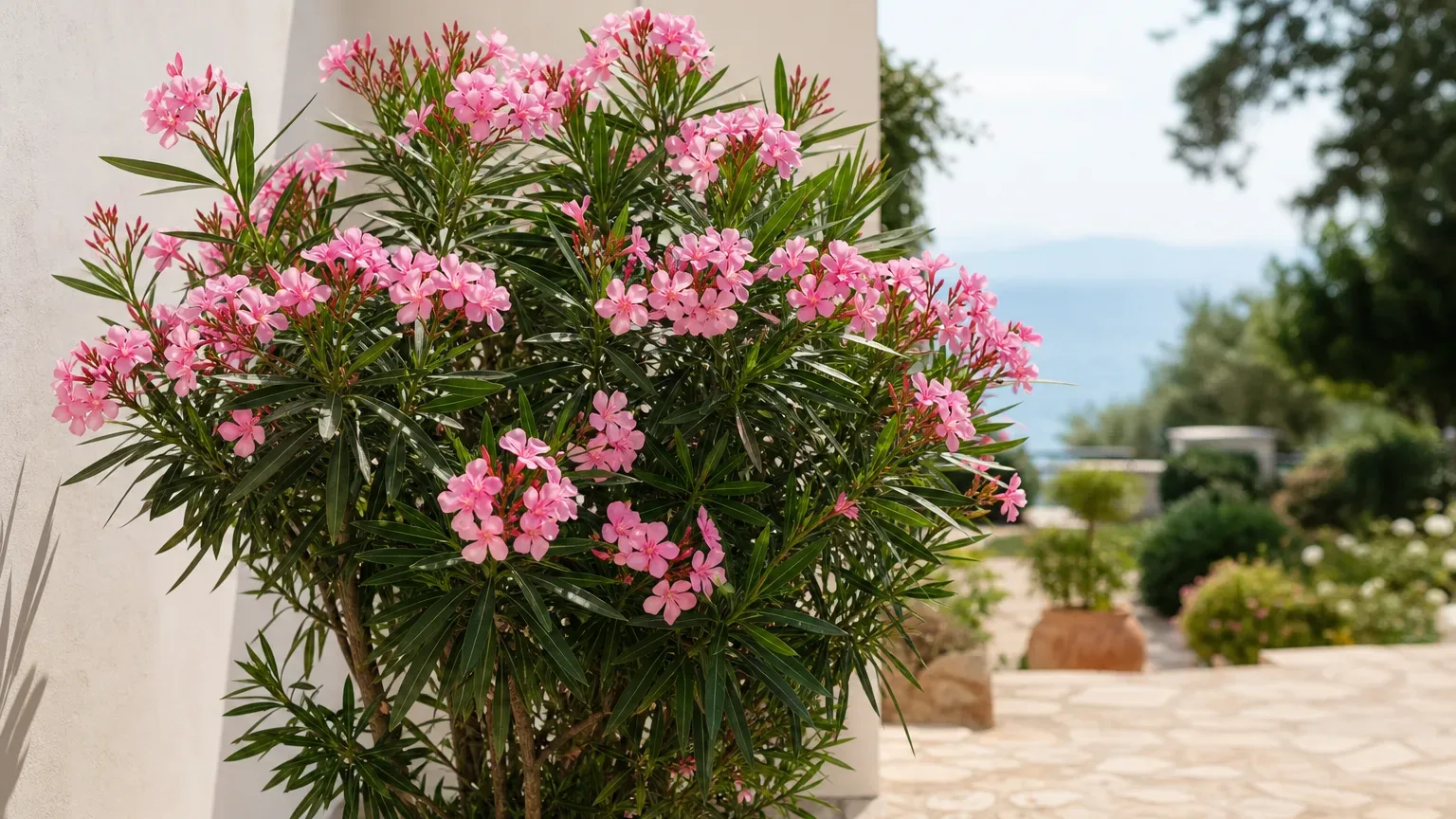
Oleander is not a foliage plant for a dim room. Nerium oleander is a sun-adapted evergreen shrub, and its light needs are easiest to meet outdoors: give it an open position where direct sun reaches the canopy for most of the day. The practical target is at least six hours of direct sun, with a longer bright day usually supporting denser growth and more reliable flowering.
That target matters because oleander can remain alive in partial shade while gradually losing the compact, flower-covered form people expect. UF/IFAS reports that oleander thrives in full sun and becomes lanky with fewer flowers in partial shade. The first response to sparse bloom or an open canopy should therefore be to measure how long sun actually reaches the leaves—not to add fertilizer automatically.
How much light oleander actually needs
Think of oleander as a full-sun landscape shrub that can tolerate some shade, not as a shade plant that happens to flower. NC State Extension lists its usable exposure as full sun to partial shade, while Clemson Extension says growth is best in full sun and that shade can produce an open shape. Those statements are compatible: partial shade may keep the plant growing, but full sun better supports the dense branching and terminal flower clusters most growers want.
Sun duration is more useful than a compass label. Watch the site on a clear day and note when direct light first and last touches the canopy. An “east balcony” blocked by a neighboring tower may deliver less sun than an open north-west terrace, so use the actual path of light rather than the direction printed on a floor plan.
Full sun is the flowering target
For practical care, aim for six or more hours of direct sunlight and bright open sky for the rest of the day. Clemson notes that oleander can even tolerate reflected heat from south- or west-facing walls, a useful clue that established plants are much more sun-tolerant than typical indoor tropicals. In a garden, an unshaded boundary, driveway edge, or open courtyard usually gives better flowering than a site under a dense tree canopy.
Light is not the only influence on bloom. Recent hard pruning, cold damage, drought in a small pot, or excessive nitrogen can also reduce flowers. Still, if long stems have wide gaps between leaves and flower clusters are scarce across the whole plant, insufficient direct sun is the most efficient variable to check first.
Best outdoor placement for oleander
Choose a place with open overhead light, good air movement, and enough room for the cultivar’s mature spread. Missouri Botanical Garden describes oleander as a subtropical to tropical shrub valued for abundant summer-to-fall flowers; the display is strongest when surrounding walls, trees, or railings do not shade most of the canopy. Avoid squeezing a standard cultivar into a narrow gap where only the top receives sun and the lower branches remain bare.
Ground-planted oleanders usually handle an exposed site once established. Containers require closer observation because a black or small pot can heat and dry much faster than the shrub’s foliage shows. Full sun remains the goal, but the Oleander watering guide should determine how you respond to faster dry-down rather than moving a healthy plant permanently into shade.
Balconies, terraces, and courtyards
On an Indian terrace, an open south or west position commonly supplies the longest direct exposure. An east-facing balcony can also work if it gets several hours of unblocked morning sun plus a bright open sky. Deep covered balconies often fail because a bright view beyond the railing does not mean direct light reaches the plant.
Place the pot where the entire canopy receives light, not with the base trapped behind an opaque parapet. Rotate a container periodically if one side consistently faces a wall, but do not move it back and forth between deep shade and hard sun each week. Stable exposure lets new foliage develop for the site.
Keep practical safety ahead of the perfect sun angle. Do not position oleander where fallen leaves and flowers land in a child’s play area, pet run, livestock pen, or food-growing bed. If the only sunny balcony is routinely accessible to children or animals, oleander is the wrong plant for that space.
Can oleander grow indoors?
Oleander can spend a limited period in a very bright protected structure, but it is a poor permanent houseplant. Its mature size, demand for strong direct light, and severe toxicity make an open outdoor site the better default. A sunny frost-free porch, conservatory, or greenhouse can protect a container in cold weather; the centre of a living room cannot replace full outdoor sun.
Kew identifies the species as a shrub or tree of a subtropical biome with a native range extending from the Mediterranean to Myanmar. This background fits its preference for bright, warm, open conditions. Indoor shelter is a climate workaround, not evidence that oleander adapts well to ordinary room light.
Window placement for temporary indoor shelter
Use the brightest unobstructed window available, generally a south-facing exposure in the northern hemisphere. Keep foliage close enough to receive direct window sun while preventing leaves from touching very cold or hot glass. A sunroom is more suitable than a bedroom because it offers stronger light and can be kept inaccessible.
Inspect for scale, aphids, or other pests before bringing a container under cover. Reduce watering as growth and light decline, but do not let the root ball become dust-dry. When outdoor conditions improve, return the plant gradually rather than moving window-grown leaves directly into a full day of intense sun.
Partial shade has limits
Oleander may stay green with several hours of sun or shifting shade, especially in a hot climate. UF/IFAS Gardening Solutions nevertheless warns that too little light reduces flowering and creates a leggy, open look. This is the key distinction between tolerance and good ornamental performance.
Partial shade can be a reasonable compromise where afternoon exposure is obstructed but morning sun is strong. It is less successful beneath dense evergreen trees, behind a deep roof, or several metres inside a room. If new stems repeatedly stretch toward the opening and lower foliage thins, move the container to a brighter site or prune the competing shade rather than trying to feed the plant into compactness.
Acclimate oleander before increasing sun
A plant raised under nursery shade cloth or kept indoors can scorch when placed abruptly in all-day sun, even though the species ultimately prefers full exposure. Start it in bright open shade with mild morning sun, then increase the direct period over roughly two weeks. Let the plant spend several days at each stage and pause if fresh leaves bleach.
Acclimation prepares existing foliage; it does not make damaged tissue green again. Move a stressed plant back one step rather than into deep shade, then wait for stable new growth. Change one major variable at a time, because simultaneous repotting, heavy pruning, and a large light jump make the cause of damage difficult to identify.
Managing intense Indian summer light
Established oleander is unusually capable in hot, exposed landscapes. Clemson describes it as very heat tolerant, and Kew records it in seasonally dry rocky watercourses in full sun. That does not mean a recently purchased plant in a small plastic nursery pot can be ignored during a May heat wave.
Preserve full light while managing the root zone: use a stable, adequately sized container, keep drainage open, and check moisture more often during hot wind. If leaves stay healthy but the pot becomes dangerously hot and dries within hours, shade the container, not the canopy, or move it so the root ball is protected while the branches remain in sun. The Oleander soil guide is the right place to correct a mix that stays waterlogged or becomes water-repellent.
Seasonal changes: monsoon, winter, and spring
During cloudy monsoon periods, oleander may receive less direct light even in the same physical position. Do not compensate with extra water or fertilizer on a calendar; slower photosynthesis and humid weather can extend drying time. Remove only actual obstructions and wait for brighter weather before judging a short flowering pause.
In mild Indian winters, keep the shrub outdoors in the brightest safe site. Where frost requires shelter, preserve as much window or greenhouse light as possible and expect slower growth. Spring is the time to increase exposure gradually, reassess watering, and use the Oleander fertilizer guide only after active new growth confirms that light and temperature support feeding.
Using grow lights for sheltered oleander
A grow light is useful for temporary winter shelter or a very bright enclosed balcony that still falls short during cloudy weeks. Choose a full-spectrum LED fixture large enough to illuminate the whole canopy, not a decorative bulb aimed at one branch. Follow the manufacturer’s plant-light distance guidance, use a timer, and check whether stems grow upright rather than leaning hard toward the fixture.
Artificial light is rarely the most practical long-term solution for a standard oleander because the shrub becomes broad and tall. A compact cultivar is easier to cover evenly, but it still needs secure separation from people and animals. If the fixture cannot deliver bright light across the canopy without creating an unsafe living-space placement, move the plant outdoors or choose a different species.
Warning signs that the light is wrong
Read patterns across the newest growth rather than diagnosing from one old leaf. Too little light changes the plant’s overall architecture over weeks or months. A sudden increase in direct sun damages the surfaces that face the source, often within days.
Yellowing alone is not a reliable light diagnosis. Wet roots, drought, pests, nutrient problems, and cold can all yellow oleander leaves. Pair colour with location, timing, soil moisture, and the direction of damage before moving the plant.
Too little light
Low-light oleander commonly develops long, thin shoots, wider gaps between leaves, a sparse lower canopy, and few flower clusters. The whole plant may lean toward the brightest opening. These are consistent with the lanky form and reduced flowering described by UF/IFAS.
Move a container to a site with a longer direct-sun window, then judge the next flush rather than expecting stretched stems to shorten. If a ground plant is shaded by a structure, relocation may be the only durable answer. Do not apply extra nitrogen to “green it up”; vigorous soft extension can make the open habit worse without solving the energy shortage.
Too much sun—or a sudden change
Oleander suited to its site usually tolerates strong sun. Scorch is more likely after an abrupt move from shade, when tender new leaves meet reflected heat, or when drought and sun stress occur together. Look for pale, tan, or crisp patches concentrated on the exposed side rather than evenly distributed yellowing.
First check the root ball. If it is dry and the whole plant is limp, restore moisture according to the Oleander watering guide and protect the container from overheating. If moisture is adequate but newly exposed leaves bleach, reduce the harshest direct period temporarily and restart acclimation more slowly.
Light changes watering and growth
Sun does not act alone. A potted oleander in full sun uses water faster than the same plant under a roof, while a shaded plant takes longer to dry. Recheck the root zone after every placement change and water according to actual dryness rather than preserving the old interval.
Brighter placement also changes what “normal growth” looks like: new stems should be sturdier, the canopy denser, and flowering more dependable in the active season. If adequate sun produces no improvement, investigate root health, pruning timing, and nutrition through the Oleander overview instead of increasing light beyond what the site safely provides.
Light placement is also a safety decision
Every part of oleander is poisonous, so placement must control access as well as sunlight. The ASPCA identifies cardiac glycosides as the toxic principle and lists oleander as toxic to dogs, cats, and horses. Kew also describes oleander as highly poisonous to humans, pets, livestock, and birds; ingestion can cause severe cardiac and gastrointestinal effects.
Use a sunny site that children, pets, and grazing animals cannot enter, and account for fallen leaves, flowers, and dry clippings—not just the living shrub. Wear gloves when moving or handling the plant, avoid sap contact, wash hands and tools afterward, and never burn trimmings because sap may cause dermatitis and smoke should not be inhaled. If ingestion may have occurred, seek urgent medical or veterinary poison guidance rather than waiting for symptoms.
When to use this page vs other Oleander guides
- Use the Oleander overview for identity, mature size, seasonal care, and whole-plant safety.
- Use the Oleander watering guide when leaves wilt, the pot dries rapidly in sun, or the mix stays wet after a move into shade.
- Use the Oleander soil guide when drainage or root-zone heat limits an otherwise sunny placement.
- Use the Oleander fertilizer guide only after the plant receives adequate light and is actively growing.
- Use the Oleander repotting guide when a sunny container dries within hours, tips over, or has a densely crowded root ball.
Related Oleander guides
- Oleander care overview — complete care and high-severity toxicity context
- Oleander watering — adjust moisture to sun, heat, pot size, and season
- Oleander soil — build a drained, stable root zone for exposed sites
- Oleander fertilizer — feed active growth without mistaking shade for hunger
- Oleander repotting — manage root crowding and unstable containers
- Oleander pruning — shape a sun-grown shrub and handle toxic cuttings safely
- Oleander propagation — root cuttings with safe handling and suitable light
Conclusion
Oleander flowers and holds a dense canopy most reliably in full sun, with at least six hours of direct exposure as a practical target. Partial shade can sustain the shrub, but repeated lanky growth and sparse bloom mean the site is too dim for good performance. Outdoors is usually better than indoors; a bright protected structure is mainly a temporary solution where cold demands shelter.
Increase sun gradually for nursery- or window-grown foliage, and protect a container’s root zone during extreme heat instead of automatically shading the canopy. Read low light as a whole-plant architecture problem and scorch as sudden, source-facing damage. Above all, choose only a sunny site that also prevents access to this severely poisonous plant, its fallen material, and its clippings.