Oleander Care Guide: Light, Water, Soil & Safety
Nerium oleander
Grow oleander in full sun and fast-draining soil, watering when the top 5 cm dries. Learn pruning, pot care, frost protection, and critical toxicity safety.
Oleander Care Guide: Light, Water, Soil & Safety
Start with wateringThe most common care mistake for OleanderWatering guide →Oleander care essentials
Light
Water
Water deeply when the top 5 cm of soil is dry. Keep newly planted and container-grown oleanders more evenly moist, but let excess water drain; established shrubs tolerate drought better than waterlogged roots.
Soil
Fertile, well-drained loam is ideal, though oleander tolerates sand, clay, rocky ground, poor soil, and coastal conditions when drainage is adequate.
Humidity
Temperature
Fertilizer
About Oleander
Oleander is native to Mediterranean region and southwestern Asia; widely cultivated in warm climates, typically reaches 1.5–6 m (5–20 ft) tall and 1.8–3 m (6–10 ft) wide outdoors; dwarf cultivars stay smaller in containers indoors, with rapid in warm, sunny conditions growth. Oleander has a shrub growth habit and part of the Apocynaceae family. It is also known as Kaner, Rosebay, Rose Laurel, and Rose Bay.
| Detail | Information |
|---|---|
| Also known as | Kaner, Rosebay, Rose Laurel, Rose Bay |
| Native region | Mediterranean region and southwestern Asia; widely cultivated in warm climates |
| Mature size | 1.5–6 m (5–20 ft) tall and 1.8–3 m (6–10 ft) wide outdoors; dwarf cultivars stay smaller in containers |
| Growth rate | Rapid in warm, sunny conditions |
| Growth habit | Shrub |
| Scientific name | Nerium oleander |
| Family | Apocynaceae |
Oleander Care Guide: Light, Water, Soil & Safety
Oleander is best treated as a sun-loving outdoor shrub with a serious safety condition attached. Give it abundant direct light, a root zone that drains promptly, and deep watering based on actual dryness rather than a fixed schedule. Before any of that, decide whether you can keep the living plant, fallen material, and prunings completely inaccessible to children, pets, livestock, and free-roaming animals.
That placement decision is not optional. Every part of Nerium oleander is poisonous, including material that has dried, and its cardiac glycosides can disrupt heart function after ingestion. If secure separation is unrealistic, choose another flowering shrub instead of trying to make oleander fit the space.
What oleander is and where it fits
Identity, origin, and appearance
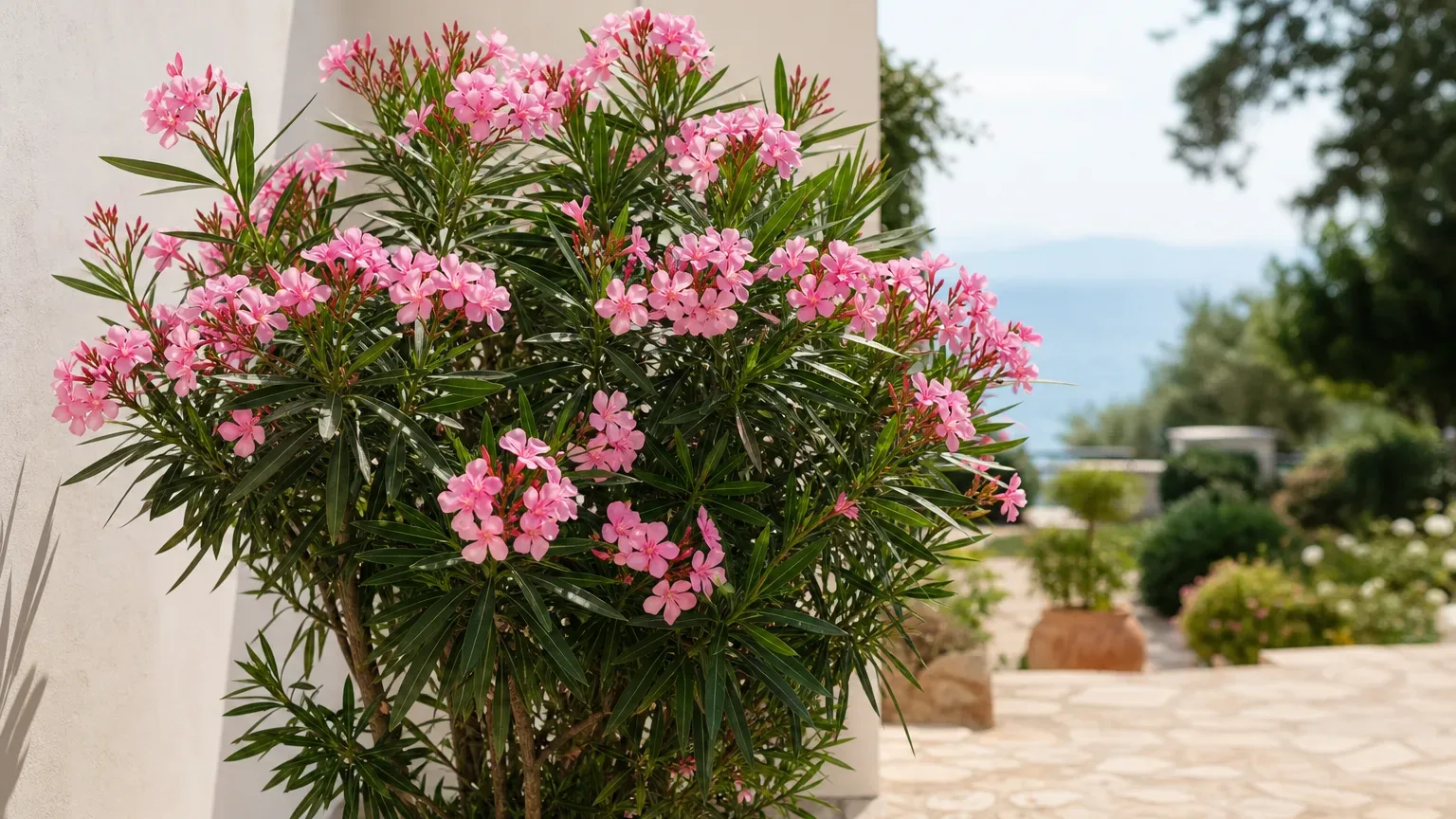
Nerium oleander is an accepted species in the dogbane family, Apocynaceae. Kew’s taxonomic record describes its native range as extending from the Mediterranean to Myanmar and identifies it as a shrub or tree of mainly subtropical environments. In India it is widely known as kaner and performs best outdoors, where heat and strong sun support dense stems and repeated flowering.
The plant carries narrow, leathery leaves and terminal clusters of pink, white, red, or cultivar-specific flowers. Kew’s species profile describes an evergreen shrub or small tree reaching about 6 m and notes its tolerance of drought, salt spray, and a wide range of soils. Those tolerances explain why oleander succeeds in exposed roadsides and coastal landscapes, but they do not mean a newly planted shrub or a small container can be neglected.
Growth habit, mature size, and containers
Standard oleanders can become broad, woody shrubs rather than compact patio plants. NC State Extension gives a mature range of roughly 5–19.5 ft tall and 6–10 ft wide, while named dwarf cultivars stay much smaller. Check the cultivar label before planting near a path, wall, or balcony edge; pruning can manage shape, but it cannot turn a vigorous standard cultivar into a naturally dwarf one.
Container culture works when the pot is broad, stable, and large enough for the cultivar’s root system. A dwarf selection is the practical choice for most terraces and balconies. Even named cultivars vary: the RHS profile for ‘Album’ lists a mature height of 2.5–4 m, so a cultivar name does not automatically mean a plant will remain tabletop-sized.
Oleander care at a glance
Oleander needs full sun, free drainage, deep but conditional watering, and room to become woody. The quickest diagnosis starts with the root zone: check light exposure and soil moisture before adding fertilizer or pruning a stressed plant.
| Care factor | Practical target | First warning sign |
|---|---|---|
| Light | At least 6 hours of direct sun; acclimate nursery plants gradually | Sparse growth or few flowers |
| Water | Soak thoroughly after the upper root zone has dried, then drain | Persistent wilt in wet soil or crisp leaves in a dry pot |
| Soil | Fertile, well-drained mix or garden soil; never stagnant | Sour mix, prolonged wetness, or weak roots |
| Temperature | Warm outdoor conditions; protect containers from freezing | Blackened or collapsed growth after cold |
| Feeding | Moderate feeding during active growth, not as a rescue for stress | Salt crust or scorched margins after overfeeding |
| Safety | Secure exclusion from people and animals; collect all debris | Any chewing, ingestion, or accessible clippings |
Placement and light for dense flowering growth
Use a sunny terrace, courtyard, balcony, or garden bed with good airflow and enough clearance for the mature canopy. The RHS species profile recommends full sun and moist but well-drained soil in sheltered, frost-free conditions. A plant moved directly from a shaded nursery bench into fierce May sun can scorch, so increase direct exposure over about a week while keeping the root ball from drying completely.
Too little light produces long internodes, a thin canopy, and disappointing bloom even when leaves remain green. Start with the detailed Oleander light guide before changing fertilizer. If the plant receives strong sun but still fails to flower, also review pruning timing and root health rather than assuming it needs more feed.
Water and soil without root stress
Water deeply enough to wet the full root ball, then wait until the upper several centimetres have dried before watering again. Missouri Botanical Garden notes that established plants tolerate some drought and poor soil, while container plants do best in fertile soil with good drainage and should dry between waterings. This distinction matters during Indian summer: a sun-heated pot can need checking every day, even though an established garden shrub may go much longer between soakings.
Do not turn a rough interval into a rigid calendar. Push a finger or wooden skewer about 5 cm into the mix, check the pot’s weight, and water only when the root zone indicates it is ready. The Oleander watering guide covers seasonal checks and stress signs, while the Oleander soil guide explains how to build a stable, draining mix for a heavy shrub.
A useful container mix combines quality potting medium with coarse bark, perlite, or pumice so water can leave freely without the plant becoming unstable. Move a root-bound young oleander up by one pot size rather than placing it in an oversized tub full of slow-drying mix. Use the Oleander repotting guide when roots circle densely, emerge from drainage holes, or the watered pot dries unusually fast.
Severe oleander toxicity: plan before planting
Oleander has high-severity whole-plant toxicity. The ASPCA identifies cardiac glycosides as the toxic principle and lists oleander as toxic to dogs, cats, and horses, with signs including drooling, abdominal pain, diarrhea, colic, depression, and death. This is not a plant to place where a curious child, pet, grazing animal, or visiting animal can reach leaves, flowers, stems, seeds, sap, roots, fallen debris, or pruning waste.
Drying does not make the material safe. Colorado State University’s veterinary Guide to Poisonous Plants states that potent cardiac glycosides occur throughout the plant and that oleander remains toxic when dry. Treat cut stems, swept leaves, and dead container plants with the same care as fresh growth.
Safer placement, handling, and disposal
Choose a location separated by a physical barrier, not merely a verbal warning. Keep oleander away from play areas, pet runs, paddocks, fodder and hay storage, edible gardens, compost accessible to animals, and balconies where fallen leaves could drop into neighbouring animal areas. If the space cannot reliably provide that separation throughout the plant’s life, removal is the safer horticultural decision.
Wear gloves for pruning and repotting, keep sap away from eyes and mouth, cover broken skin, and wash hands and tools afterward. Bag all trimmings and fallen parts promptly according to local waste rules. Never burn oleander: NC State warns that smoke from burning the plant is injurious, so burning is not an acceptable disposal method.
What to do after possible ingestion
Treat suspected human or animal ingestion as urgent even if no symptom is visible yet. Stop further access, retain a sample or clear photograph for identification without exposing anyone else, and contact the appropriate local poison-control service, emergency medical service, veterinarian, or veterinary poison service immediately. Do not induce vomiting or give food, drink, medication, or a home remedy unless a qualified professional specifically directs it.
For pets, the ASPCA advises contacting its Poison Control service or a local veterinarian as soon as possible after suspected ingestion. For people, use your local poison centre or emergency service; in India, contact the nearest emergency department or poison information centre. This guide supports prevention and plant care, not diagnosis or treatment.
Seasonal care in India and similar warm climates
In hot regions, spring through the monsoon and post-monsoon period can produce vigorous shoots, but rainfall changes the watering equation. Empty saucers, keep drainage holes open, and reduce irrigation during prolonged rain. In humid weather, prioritize airflow and inspect dense interior growth rather than reflexively increasing water because leaves look dull.
In cooler inland or hill climates, protect potted plants before freezing nights. Oleander can survive some cold, but frost may damage exposed foliage and stems; wait until the cold period has passed before deciding which wood is dead. During cool, slow growth, reduce watering and stop routine feeding rather than forcing soft growth in weak winter light.
Pruning, flowering, and pest checks
Oleander flowers on new growth, and light pruning after flowering can keep a rounded framework. NC State advises avoiding pruning after early fall because it can remove the growth that carries the next flowers. For detailed timing, clean cuts, and safe waste control, follow the Oleander pruning guide.
Check shoot tips and leaf undersides for aphids, scale, and mealybugs, especially when growth is crowded or sheltered. Sticky honeydew and sooty mould point toward sap-feeding insects, but severe yellowing or wilt in wet soil calls for a root-zone check first. Isolate a newly purchased container outdoors before placing it beside other ornamentals.
Common oleander care mistakes and first actions
Keeping it in shade: Move it toward stronger direct sun gradually and track new growth; old sparse stems will not become compact overnight. Watering by weekday: check the root zone and pot weight, because heat, rain, wind, pot size, and root density change the interval. Using dense soil: stop frequent watering, clear drainage holes, and repot only when the plant is stable enough for the disturbance.
Feeding a stressed plant: correct light, drainage, pests, or root damage before using the Oleander fertilizer guide. Pruning late to force flowers: improve sun and follow the plant’s flowering cycle instead of repeatedly removing new growth. Leaving debris accessible or burning it: secure all fresh and dried material and use local non-burning disposal; toxicity is the first priority, not tidiness.
When to use this page vs other Oleander guides
Use this overview to decide whether oleander suits your space and to establish the full care system. Use the dedicated light page for exposure and acclimation, watering for moisture decisions, soil for mixes and drainage, fertilizer for feeding, and repotting for container changes. The Oleander propagation guide covers cloning methods, but propagation also creates more toxic cut material and should only be attempted where every cutting and tool can be controlled safely.
Related Oleander guides
- Oleander light guide — direct sun, acclimation, and poor-flowering diagnosis.
- Oleander watering guide — root-zone checks for hot pots, rain, and cool seasons.
- Oleander soil guide — drainage, container ingredients, and wrong-soil signs.
- Oleander fertilizer guide — moderate feeding without masking stress.
- Oleander repotting guide — pot sizing, timing, and aftercare.
- Oleander pruning guide — flowering-aware cuts and toxic-waste precautions.
Conclusion
Successful oleander care starts with two decisions: provide a genuinely sunny, freely draining outdoor position, and maintain reliable separation from people and animals who could ingest any part. Once those conditions are met, water by root-zone dryness, choose a cultivar that fits the available space, prune with the flowering cycle, and adjust care for heat, rain, and cold rather than following a fixed calendar.
The safety threshold remains firm throughout the plant’s life. Fresh growth, dry leaves, roots, seeds, sap, and trimmings all require controlled handling and disposal, and possible ingestion requires immediate professional poison guidance. A healthy shrub is not a safe shrub unless its placement and waste are secure.
How to care for Oleander?
When should you water Oleander?
Water deeply when the top 5 cm of soil is dry. Keep newly planted and container-grown oleanders more evenly moist, but let excess water drain; established shrubs tolerate drought better than waterlogged roots.
- Check 5 cm below the surface - Water deeply when the top 5 cm of soil is dry.
- water thoroughly only when it feels dry - Water deeply when the top 5 cm of soil is dry.
- then empty saucers
- Drain excess water - Keep newly planted and container-grown oleanders more evenly moist, but let excess water drain; established shrubs tolerate drought better than waterlogged roots.
What soil works best for Oleander?
Fertile, well-drained loam is ideal, though oleander tolerates sand, clay, rocky ground, poor soil, and coastal conditions when drainage is adequate.
- 50% quality potting mix
- 25% coarse sand or fine pine bark - Fertile, well-drained loam is ideal, though oleander tolerates sand, clay, rocky ground, poor soil, and coastal conditions when drainage is adequate.
- 25% perlite or pumice - Fertile, well-drained loam is ideal, though oleander tolerates sand, clay, rocky ground, poor soil, and coastal conditions when drainage is adequate.
Grower notes for Oleander
What matters most with Oleander
Oleander is a heat-loving outdoor shrub, not a low-light houseplant. Give it at least 6 hours of direct sun for dense growth and reliable flowers, plus a container that drains freely. Established plants tolerate drought, salt spray, wind, and lean soil, but a potted root ball can still dry dangerously fast in Indian summer heat. The entire plant is highly poisonous, so placement must prevent access by children, pets, and livestock.
Best placement in a real home
Use a sunny terrace, balcony, courtyard, or garden position with good airflow and room for a broad shrub. Dwarf cultivars are easier to manage in containers. Keep the pot away from play areas, edible gardens, pet runs, grazing animals, and places where fallen leaves could be sampled. Oleander is damaged by freezing temperatures; protect containers when nights approach 0°C and prune frost-killed wood only after winter.
Before you buy this plant
Choose a named Nerium oleander cultivar with firm cane-like stems, clean leathery leaves, and no scale, mealybugs, aphids, sticky honeydew, or sooty mold. Confirm the mature size because standard forms can reach small-tree proportions while dwarf selections stay more manageable. Do not buy it for a home where secure separation from children and animals is unrealistic.
First month after bringing it home
Quarantine the shrub outdoors, place it in strong sun gradually if it came from shade, and learn how quickly its pot dries before repotting. Water deeply when the top 5 cm dries rather than following a fixed calendar. Wear gloves for handling and wash tools after pruning because the sap can irritate skin. Bag trimmings securely; never compost where animals can reach them and never burn oleander.
High-severity safety warning
Every part of oleander is highly poisonous fresh or dry. ASPCA classifies Nerium oleander as toxic to dogs, cats, and horses because it contains cardiac glycosides; reported signs include drooling, abdominal pain, diarrhea, colic, depression, and death. Treat any suspected ingestion as an emergency and contact a veterinarian or poison-control service immediately. Smoke from burning cuttings is also hazardous.
How to tell Oleander is settling in
Healthy oleander makes firm green shoots, narrow leathery leaves in opposite pairs or whorls, and terminal flower clusters from late spring through summer. Sparse bloom usually points first to insufficient sun or poorly timed pruning. Regular light pruning after flowering maintains shape, but avoid removing late-season growth that will carry future flowers. Stem cuttings are the usual way to clone a cultivar, but all cut material remains toxic.
Is oleander safe for pets?
No. ASPCA lists Nerium oleander as toxic to dogs, cats, and horses. All parts contain cardiac glycosides and poisoning can be fatal; seek urgent veterinary help after any suspected ingestion.
High-severity poison warning: every part of Nerium oleander—including leaves, flowers, stems, roots, seeds, sap, and dried material—is toxic. Cardiac glycosides can cause drooling, abdominal pain, vomiting or diarrhea, weakness, abnormal heart rhythm, collapse, and death. Do not burn trimmings because the smoke is hazardous. Treat suspected ingestion as an emergency.
Watering Oleander
For Oleander, check 5 cm below the surface; water thoroughly only when it feels dry, then empty saucers and water about every 3–5 days for sunny containers in peak summer, adjusted to pot drying; weekly or less for established landscape plants. Water more often during hot active growth and flowering; reduce sharply in cool weather when growth slows.
| Detail | Information |
|---|---|
| How often | About every 3–5 days for sunny containers in peak summer, adjusted to pot drying; weekly or less for established landscape plants |
| How to check | Check 5 cm below the surface; water thoroughly only when it feels dry, then empty saucers |
| Seasonal changes | Water more often during hot active growth and flowering; reduce sharply in cool weather when growth slows |
Signs of overwatering
- widespread yellowing leaves
- soft or darkened stem bases
- sour-smelling mix
- persistent wilt in wet soil
Signs of underwatering
- limp or inward-rolling leaves
- crisp brown leaf edges
- flower or bud drop during heat
- very slow new growth
Soil & potting for Oleander
Use a mix of 50% quality potting mix, 25% coarse sand or fine pine bark, 25% perlite or pumice for Oleander. Good drainage required; moist to occasionally dry soil is suitable, but persistent saturation invites root decline. Target soil pH around 6.0–8.0. Repot every 2–3 years for young container plants; refresh the top layer annually on large established specimens, ideally in spring, after frost risk passes and before vigorous new growth.
| Detail | Information |
|---|---|
| Recommended mix | 50% quality potting mix, 25% coarse sand or fine pine bark, 25% perlite or pumice |
| Drainage | Good drainage required; moist to occasionally dry soil is suitable, but persistent saturation invites root decline |
| Soil pH | 6.0–8.0 |
| Repotting frequency | Every 2–3 years for young container plants; refresh the top layer annually on large established specimens |
| Best season to repot | Spring, after frost risk passes and before vigorous new growth |
Signs it needs repotting
- roots circling densely or escaping drainage holes
- pot drying within a day after watering
- top-heavy shrub becoming unstable
- stalled growth despite full sun and normal feeding
Humidity & temperature for Oleander
Fertilizer & pruning for Oleander
Common problems on Oleander
Yellow Leaves
MediumLikely cause: Common on this plant type; confirm with recent watering, light, and root checks.
Quick fix: Inspect the plant and correct the most likely care stressor before stacking treatments.
Full fix guide →Brown Tips
MediumLikely cause: Common on this plant type; confirm with recent watering, light, and root checks.
Quick fix: Inspect the plant and correct the most likely care stressor before stacking treatments.
Full fix guide →Root Rot
MediumLikely cause: Common on this plant type; confirm with recent watering, light, and root checks.
Quick fix: Inspect the plant and correct the most likely care stressor before stacking treatments.
Full fix guide →Overwatering
MediumLikely cause: Common on this plant type; confirm with recent watering, light, and root checks.
Quick fix: Inspect the plant and correct the most likely care stressor before stacking treatments.
Full fix guide →Underwatering
MediumLikely cause: Common on this plant type; confirm with recent watering, light, and root checks.
Quick fix: Inspect the plant and correct the most likely care stressor before stacking treatments.
Full fix guide →Spider Mites
MediumLikely cause: Common on this plant type; confirm with recent watering, light, and root checks.
Quick fix: Inspect the plant and correct the most likely care stressor before stacking treatments.
Full fix guide →Mealybugs
MediumLikely cause: Common on this plant type; confirm with recent watering, light, and root checks.
Quick fix: Inspect the plant and correct the most likely care stressor before stacking treatments.
Full fix guide →Aphids
MediumLikely cause: Common on this plant type; confirm with recent watering, light, and root checks.
Quick fix: Inspect the plant and correct the most likely care stressor before stacking treatments.
Full fix guide →Leggy Growth
MediumLikely cause: Common on this plant type; confirm with recent watering, light, and root checks.
Quick fix: Inspect the plant and correct the most likely care stressor before stacking treatments.
Full fix guide →Slow Growth
MediumLikely cause: Common on this plant type; confirm with recent watering, light, and root checks.
Quick fix: Inspect the plant and correct the most likely care stressor before stacking treatments.
Full fix guide →Wilting
MediumLikely cause: Common on this plant type; confirm with recent watering, light, and root checks.
Quick fix: Inspect the plant and correct the most likely care stressor before stacking treatments.
Full fix guide →Drooping Leaves
MediumLikely cause: Common on this plant type; confirm with recent watering, light, and root checks.
Quick fix: Inspect the plant and correct the most likely care stressor before stacking treatments.
Full fix guide →Low Humidity
MediumLikely cause: Common on this plant type; confirm with recent watering, light, and root checks.
Quick fix: Inspect the plant and correct the most likely care stressor before stacking treatments.
Full fix guide →Not Enough Light
MediumLikely cause: Common on this plant type; confirm with recent watering, light, and root checks.
Quick fix: Inspect the plant and correct the most likely care stressor before stacking treatments.
Full fix guide →Fungus Gnats
MediumLikely cause: Common on this plant type; confirm with recent watering, light, and root checks.
Quick fix: Inspect the plant and correct the most likely care stressor before stacking treatments.
Full fix guide →Mold on Soil
MediumLikely cause: Common on this plant type; confirm with recent watering, light, and root checks.
Quick fix: Inspect the plant and correct the most likely care stressor before stacking treatments.
Full fix guide →