Seedlings Falling Over on Oxalis Triangularis: Causes
Quick answer
Seedlings and emerging petiole shoots falling over on Oxalis triangularis typically indicate damping-off fungal disease (Pythium, Rhizoctonia, Fusarium) causing a pinched, water-soaked collar at the soil line, or weak, etiolated stems flopping from inadequate light. First step: Inspect the soil-level stem collar to see if tissue is water-soaked and rotting, or merely stretched and seeking brighter light.
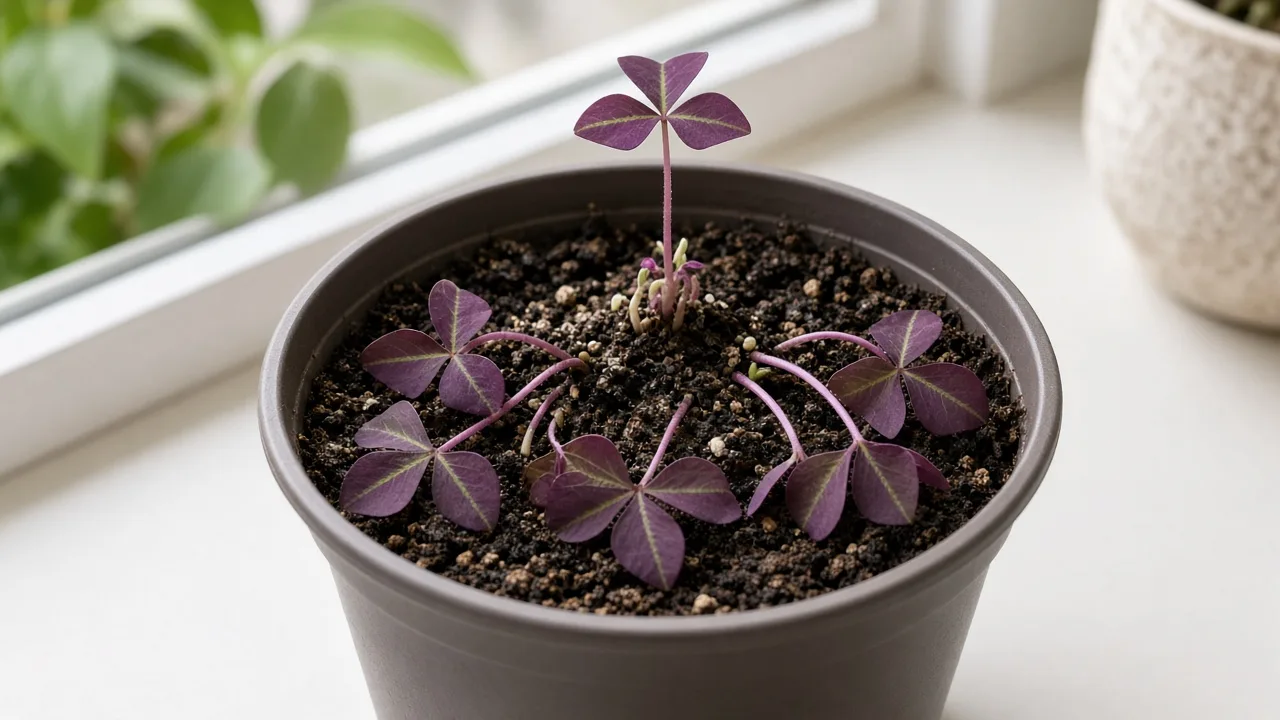
Seedlings Falling Over on Oxalis Triangularis: Causes, Checks & Fixes
This guide covers seedlings falling over on Oxalis Triangularis. See also the general Seedlings Falling Over guide, watering, and light pages for this plant.
Seedlings Falling Over on Oxalis Triangularis: Causes, Checks & Fixes
Quick answer
When seedlings or delicate young petiole sprouts collapse and fall flat on the soil in Oxalis triangularis (Purple Shamrock or False Shamrock), the issue almost always stems from one of two distinct problems: fatal damping-off disease caused by soil-borne fungal or oomycete pathogens, or etiolation, where inadequate light produces weak, stretched petioles that buckle under the weight of expanding leaves.
First step: inspect the stem base right at the soil line. If the basal stem is pinched, discolored, water-soaked, or stringy, the seedling has succumbed to damping-off and cannot be revived; cull it immediately to protect neighboring plants. If the stem is pale, firm, and physically intact but stretched and drooping under low light, the plant is salvageable—increase light levels immediately to at least 3 to 4 hours of bright, indirect light daily.
For universal seedling germination biology across all plant types, read our seedlings falling over guide. On Oxalis triangularis, however, juvenile collapse intersects with specialized underground bulb anatomy and unique leaf movements that make diagnosis distinct from standard garden seedlings.
What seedlings falling over looks like on Oxalis Triangularis
On Oxalis triangularis, true seedling collapse presents as a sudden structural failure of the delicate petiole at ground level. A young sprout that stood upright in the morning may be found sprawled completely horizontally across the substrate by late afternoon.
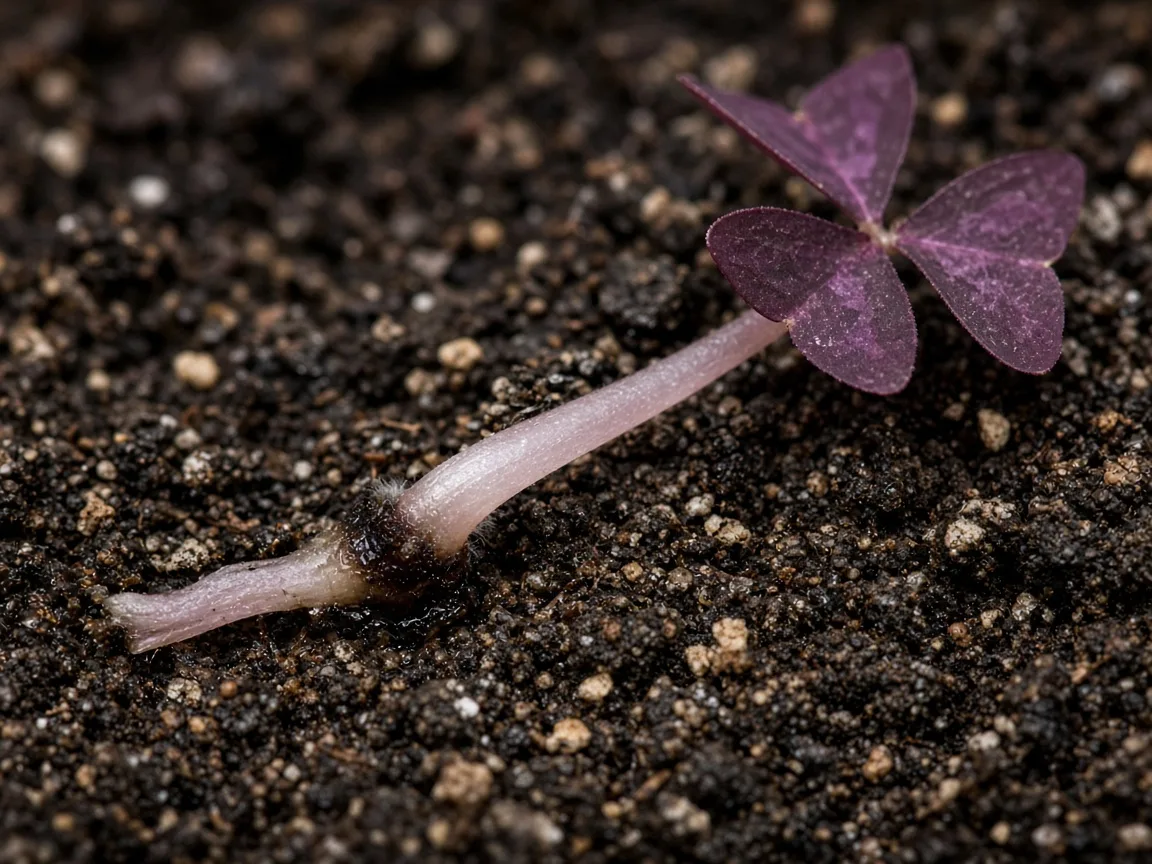
Water-soaked constriction and collapsing juvenile petiole at the soil line on Oxalis triangularis.
Key visual clues include:
- A distinct dark brown, black, or water-soaked “pinched” collar right where the stem enters the soil.
- The petiole collapses while the upper purple trifoliate leaf blade may still appear relatively vibrant and fully formed.
- In high humidity, a faint cobweb-like white mycelium or fungal fuzz may coat the collapsed stem collar.
- The collapsed petiole pulls away effortlessly from the substrate with zero root resistance when gently tugged.
- In contrast, etiolated (light-starved) seedlings show elongated, pale, translucent stems that curve or lean over without any localized collar browning or necrotic tissue thinning.
Crucial diagnostic differential: damping-off vs. nyctinasty vs. etiolation
Before discarding pots or treating with fungicides, it is vital to distinguish true pathological collapse from the normal, fascinating botanical habits of Purple Shamrock. Oxalis triangularis possesses specialized motor cells that frequently deceive indoor growers into suspecting fatal seedling diseases.
| Diagnostic Marker | True Damping-Off (Collar Rot) | Normal Nyctinasty (Sleep Movement) | Etiolation (Light Starvation) |
|---|---|---|---|
| Collar Condition | Pinched, water-soaked, dark brown or blackened, thread-like | Plump, firm, normal green or deep maroon-purple | Pale, elongated, structurally sound but thin |
| Response to Light | Remains completely flat and limp regardless of lighting | Perks upright within 30–60 minutes of morning light exposure | Stays bent or flopped; bends toward light source |
| Time of Day | Permanent daytime and nighttime collapse | Occurs consistently at dusk, nighttime, or in intense dry heat | Continuous day and night leaning or flopping |
| Foliage Texture | Limp, rapidly decaying, soft | Crisp, turgid, responsive to touch | Intact but small leaf blades on overly long stems |
| Prognosis | Fatal to infected seedling; cull immediately | Completely healthy natural biological rhythm | Fully reversible with supplemental bright indirect light |
The nyctinasty trap: sleep folding vs. pathogenic collapse
Healthy Oxalis triangularis plants are famous for nyctinasty, a circadian rhythm governed by specialized swollen motor cells at the base of each petiole and leaflet called pulvini. As noted by University of Missouri Extension on shamrock movements, shamrock leaflets fold downward like an umbrella at night or during extreme environmental heat stress, reopening briskly when exposed to morning daylight.
Novice growers often observe evening downward petiole folding in emerging sprouts and mistakenly believe their seedlings are dying of damping-off. To verify, examine the stem collar at the soil line with a magnifying glass: if the basal tissue is firm, round, and brightly colored, your plant is merely resting. If the collar is shriveled into a dark thread, it is damping-off.
Etiolation and petiole flopping
Young shamrock petioles are naturally slender and require sufficient light energy to build structural cellulose and lignin. When seedlings or newly sprouting rhizomes receive fewer than 3 to 4 hours of bright indirect light, the stems rapidly stretch toward the nearest light source. Because the distinctive three triangular leaflets act as heavy solar sails at the end of a spindly stem, the etiolated petiole simply buckles under its own crown weight. Check light intensity with our Light Meter Calculator to verify your seedling staging area provides at least 200–400 foot-candles (approx. 2,000–4,000 lux) of indirect illumination.
Rhizome sprout collapse vs. true seedling damping-off
Understanding the reproductive biology of Oxalis triangularis is essential for accurate triage. While botanical enthusiasts occasionally germinate true seeds collected from tiny pink-and-white flowers, the vast majority of Purple Shamrocks in cultivation are grown by dividing underground storage organs.
Botany confirms that Oxalis triangularis produces scaly rhizomes—often referred to casually as bulbs or corms—covered in fleshy, overlapping storage scales. When growing from true botanical seed, a collapsed seedling is a single individual: once its solitary primary taproot and hypocotyl damp off, that plant is permanently lost.
However, when emerging shoots from newly planted rhizome divisions collapse, the diagnosis is juvenile petiole collar rot. While the individual petiole dies and collapses, the underlying subterranean rhizome may remain completely healthy, provided rot has not penetrated the central corm core. As long as the rhizome remains firm and pinkish-tan, correcting your environmental conditions allows latent axillary buds along the scaly corm to push a fresh flush of upright petioles.
Why Oxalis Triangularis gets seedlings falling over
Seedling collapse on Oxalis triangularis is driven by a convergence of vulnerable juvenile plant anatomy and opportunistic environmental pathogens.
Damping-off pathogens (Pythium, Rhizoctonia, Fusarium)
Tender emergent sprouts lack the thickened cuticular wax and secondary cell wall reinforcements present on mature foliage. As detailed in NC State Extension research on damping-off pathogens, soil-borne fungi and fungus-like oomycetes—principally Pythium species, Rhizoctonia solani, and Fusarium species—actively seek out unlignified juvenile stem collars.
- Pythium spp. (Water molds): Thrives in cool, waterlogged soils. It produces microscopic motile zoospores equipped with flagella that actively swim through films of free surface water to attack petiole collars at the soil line.
- Rhizoctonia solani: Highly active across both moderate and warm potting mixes, attacking stems precisely at the air-soil interface, producing sunken, dry brown cankers that girdle the shoot.
- Fusarium spp.: Invades root tips and vascular channels, blocking water transport and triggering sudden, irreversible wilting.
Cold, saturated potting mix
Damping-off organisms multiply exponentially in stagnant, airless substrates. Overwatering seedling trays or planting in dense, unamended peat causes soil pore spaces to remain filled with water rather than air. This suffocates developing root hairs and triggers rapid cellular breakdown that invites oomycete invasion. Review our Oxalis triangularis watering guide and our dedicated soil mix guide to ensure your substrate retains adequate porosity.
Shallow bulb planting depth
When potting up scaly rhizome divisions, planting bulbs too shallowly (less than 0.5 inches deep) or leaving them partially resting on the soil surface leaves newly emerging petioles without physical lateral anchoring. As the foliage expands, the delicate connection point at the crown twists and flops onto the damp soil, where prolonged contact with wet particles induces secondary bacterial and fungal petiole decay.
How to confirm the cause
Perform this step-by-step diagnostic sequence to pinpoint why your Oxalis triangularis shoots have fallen over:
- Perform the daylight test: Observe the seedlings under bright morning daylight. If the entire shoot lifts itself upright, the collapse is normal nyctinastic movement.
- Inspect the soil collar: Using a toothpick or gentle fingers, push back a few millimeters of substrate at the stem base. A healthy seedling shows a uniform, firm cylinder. A seedling with damping-off will display a dark, water-soaked constriction that looks as though the stem was pinched with hot tweezers.
- Assess petiole length and light: Measure the height of the fallen stem. If the petiole is over 4–5 inches tall with tiny pale leaflets, etiolation from inadequate light is the primary cause.
- Inspect soil moisture and drainage: Lift the seedling container. If the pot feels heavy and waterlogged, or if the soil surface is slimy with green algae or white saprophytic mold, saturation is promoting pathogen proliferation.
- Check rhizome firmness: If growing from bulbs, gently uncover the top of the corm. Firm, pale pink or tan scales indicate salvageable stock; soft, black, foul-smelling mush indicates systemic rot that requires emergency intervention as outlined in our Oxalis triangularis root rot guide.
First fix for falling Oxalis Triangularis shoots
Your first immediate action: isolate the tray and withhold top-watering.
Never mist or spray fallen Oxalis seedlings with water, and never apply chemical fertilizers to collapsed shoots. As emphasized by the Royal Horticultural Society on damping-off control, moisture droplets sitting on the soil surface and plant foliage create the exact aquatic conduit that damping-off pathogens require to colonize adjacent stems. Moving the tray into a warm, bright location with active air circulation halts disease expansion.
Actionable rescue and correction steps
Depending on your diagnostic findings, execute the appropriate corrective protocol below:
Protocol A: Managing confirmed damping-off
Because seedlings killed by damping-off cannot be cured, quick sanitation is essential:
- Cull diseased seedlings immediately: Using clean tweezers, remove every seedling that displays a pinched collar, taking the surrounding plug of contaminated soil with it. Discard into household trash—do not compost.
- Ventilate and dry the surface: Remove plastic humidity domes or covers. Place a small oscillating fan on its lowest setting 4–5 feet away to generate gentle, indirect air movement across the soil surface.
- Switch exclusively to bottom-watering: Fill a shallow tray with 0.5 inches of clean lukewarm tap water. Set the seedling flat in the tray for 15 minutes, allowing moisture to wick upward into the root zone, then remove and drain completely. The top layer of soil will stay dry, starving surface-dwelling fungal mycelium.
- Apply a biological or copper fungicide: If uninfected seedlings remain in the tray, drench the mix with a broad-spectrum biofungicide containing Bacillus amyloliquefaciens (strain D747) or Trichoderma harzianum, which outcompete pathogenic oomycetes without damaging tender roots.
Protocol B: Correcting etiolated and floppy stems
If stems are firm and free of collar rot:
- Increase light exposure: Immediately move the container into a spot receiving bright indirect light, such as an east-facing windowsill, or position an LED grow light 6 to 8 inches above the foliage for 12 to 14 hours daily. For detailed fixture placement, consult our Oxalis triangularis light guide.
- Provide gentle physical mounding: Carefully mound a 0.25-inch layer of sterile coarse horticultural sand or perlite around the base of leaning petioles to provide mechanical upright support while new growth stabilizes.
- Do not fertilize: Avoid high-nitrogen fertilizers, which stimulate rapid, weak, watery stem elongation at the expense of structural stem strength.
Protocol C: Correcting bulb planting depth
When planting scaly rhizomes:
- Optimal depth: Plant rhizomes horizontally or at a slight 45-degree angle approximately 1 to 1.5 inches (2.5–4 cm) below the soil surface.
- Anchoring benefit: This planting depth provides a stable soil collar that grips the first inch of the emerging petiole, preventing top-heavy leaflets from tipping the shoot over during active growth cycles.
- Mix composition: Use a base of 60% high-quality peat or coco coir blended with 40% perlite and coarse pumice to maintain rapid percolation.
Scaly corm depth and petiole anchoring mechanics
The physical architecture of Oxalis triangularis makes it uniquely sensitive to planting depth. Unlike dicot seedlings that produce a branching taproot and woody hypocotyl, Purple Shamrock produces an acaulescent rosette—each petiole emerges directly from an axillary scale on the underground rhizome without an above-ground main stem.
When corms are buried less than an inch deep, emerging petioles lack the subterranean lateral friction needed to counterbalance their expanding leaf surface area. As the plant transpires and moves throughout the day, the base wobbles, creating a small conical cavity at the soil line. Water collects in this depression, creating an ideal incubation microclimate for motile water mold zoospores that swim from cell to cell. Ensuring a firm 1 to 1.5 inch planting depth in an airy mix stabilizes the petiole and eliminates standing moisture pockets at the crown.
Recovery timeline and expectations
Recovery dynamics depend entirely on whether you are working with true botanical seedlings or rhizomatous sprout divisions:
- True seedlings: Seedlings that have collapsed from collar rot will die within 24 to 48 hours and do not recover. Uninfected seedlings in the same flat that receive immediate airflow, bottom-watering, and improved light will stabilize within 3 to 5 days, showing sturdy, upright true leaf development within 10 to 14 days.
- Rhizomatous corms: If juvenile shoots flop from collar rot or etiolation, gently trim off the collapsed petioles with sterile scissors at ground level. Provided the underground corm remains firm, new upright spears will break through the soil surface within 7 to 14 days under warm (65°F–75°F / 18°C–24°C) conditions.
- Full foliage canopy: A revitalized rhizome cluster will re-establish a dense, fluttering canopy of deep purple foliage within 4 to 6 weeks.
Common mistakes to avoid
Avoid these common missteps when propagating and caring for young Oxalis triangularis:
- Overhead misting: Spraying delicate seedlings with a mister saturates the stem collar, spreads fungal spores, and causes leaf blades to stick to the wet soil.
- Reusing dirty pots and garden soil: Garden soil is teeming with wild Pythium and Rhizoctonia strains. Always use fresh, bagged, pasteurized seed-starting mix, and disinfect used pots in a 10% bleach solution for 20 minutes before planting, as recommended by university plant pathology clinics.
- Leaving humidity domes on after emergence: Humidity domes are useful during seed germination, but keeping them over newly emerged Oxalis shoots creates stagnant, saturated air that virtually guarantees damping-off. Remove domes the moment sprouts appear.
- Fertilizing collapsed shoots: Applying liquid fertilizer to stressed, decaying seedlings burns damaged root tissues and feeds saprophytic fungi.
- Confusing night folding with disease: Discarding healthy shamrock plants because their leaves fold down at dusk is an unfortunate and avoidable mistake.
Oxalis Triangularis care cross-check
To maintain robust, upright growth and protect your shamrocks from disease, cross-check your growing conditions against these species-specific baselines:
- Light: Bright, indirect light with 2–3 hours of gentle morning sun. Protect delicate juvenile shoots from harsh, scorching midday rays. See our Oxalis triangularis light guide.
- Watering: Allow the top 0.5 inches of mix to dry before bottom-watering young plants. Never allow pots to sit in stagnant runoff saucers. For mature routines, check our Oxalis triangularis watering guide.
- Substrate: A light, sterile mix containing 60% peat or coco coir and 40% coarse perlite or pumice, maintaining a slightly acidic pH of 6.0 to 6.8. Read our Oxalis triangularis soil guide.
- Temperature & Airflow: Maintain steady ambient temperatures between 60°F and 75°F (15°C–24°C) with continuous, gentle room air circulation.
- Pet Safety: Note that Oxalis triangularis contains soluble calcium oxalate content according to ASPCA animal poison control records; keep seed flats and emerging pots safely out of reach of inquisitive cats and dogs.
How to prevent seedling and shoot collapse next time
Preventing future seedling collapse is far simpler than attempting to salvage diseased flats:
- Start with strict sanitation: Wash all seed trays, tools, and plant labels with hot soapy water, followed by a disinfectant rinse with 70% isopropyl alcohol or 10% household bleach.
- Use pre-moistened, sterile soilless mix: Hydrate fresh peat-perlite seed starter with warm water before filling trays. Ensure the mix is damp like a wrung-out sponge, never waterlogged.
- Sow thinly: Space true seeds or corms at least 1.5 to 2 inches apart to allow free air movement around each developing crown.
- Provide immediate, intense indirect light: Place newly germinated pots directly under high-efficiency LED grow lights set on a 14-hour daily timer to prevent weak, etiolated stem elongation from day one.
- Practice strict sub-irrigation: Water seedling trays exclusively from below, allowing the substrate surface to remain aerated and dry.
When to use this page vs other Oxalis Triangularis guides
Use this guide specifically when dealing with germinating seeds or tender newly emerging petiole sprouts that collapse at the soil line.
If your issue involves mature foliage or different symptoms, consult our dedicated cluster guides:
- If mature, established leaves are drooping or fading gradually after flowering, refer to our drooping leaves guide or check for natural seasonal dormancy.
- If mature stems are stretching, bending, and spacing out between nodes in low-light rooms, see our Oxalis triangularis leggy growth guide.
- If entire clumps of established stems are turning yellow, mushy, and foul-smelling in soggy soil, consult our comprehensive Oxalis triangularis root rot guide.
- If you suspect excessive irrigation before stems fully collapse, review overwatering on Oxalis triangularis.
Related Oxalis Triangularis guides
- Oxalis Triangularis care overview
- Oxalis Triangularis watering guide
- Oxalis Triangularis light guide
- Oxalis Triangularis soil guide
- Oxalis Triangularis problems hub
- Root rot on Oxalis Triangularis
- Leggy growth on Oxalis Triangularis
- Drooping leaves on Oxalis Triangularis
- Global seedlings falling over guide
Related tool
Use the Light Meter Calculator to check whether your Purple Shamrock is receiving sufficient light intensity to keep emerging petioles sturdy, or check our general Seedlings Falling Over guide for universal seedling care fundamentals.