Papaya Repotting Guide: Pot, Timing and Aftercare
Papaya Repotting Guide: Pot, Timing and Aftercare
Papaya Repotting Guide: Pot, Timing and Aftercare
Repot a papaya only when the move solves a real root-zone problem. Carica papaya grows quickly, yet its speed above ground does not mean its roots tolerate repeated handling. The safest strategy is to move a young plant early into a roomy, stable container, preserve the root ball, and avoid turning repotting into routine annual root work.
If the plant is healthy and the container still drains, waiting is often safer than disturbing it. If roots have packed the pot, drainage has failed, or the plant is dangerously top-heavy, prepare the new container completely before sliding the old one away.
Why papaya repotting needs a light touch
Papaya is a giant arborescent herb rather than a woody tree; UF/IFAS describes plants that can reach 10 m while retaining a non-woody growth form. Its nursery root system includes a taproot. UF/IFAS specifically warns that in an undersized pot the taproot may circle the container and that a root-bound system may not grow properly after planting.
That evidence supports a conservative container method: do not bare-root a healthy papaya, wash off its mix, comb out fine roots, or slice a circling taproot as you might with a tougher woody ornamental. Research comparing papaya propagation systems also found meaningful differences in root density and root distribution, reinforcing that root architecture is tied to later plant performance. Preserve what is functioning and make the new environment easier for roots to enter.
Best time to repot papaya
Choose the beginning of reliably warm, active growth. UF/IFAS reports that papaya grows best around 21–32°C and that root growth slows below 15.5°C. In much of India, that means a warm spring window or another settled warm period before the heaviest monsoon rain, not a cold spell, heatwave, cyclone warning, or week of continuous rain.
Morning is preferable because the root ball and new mix are easier to keep evenly moist without working in peak heat. Do not repot simply because a calendar says six or twelve months have passed. The plant, pot, and drainage should make the decision.
Signs your papaya needs a new pot
Strong evidence includes roots emerging densely from drainage holes, a root mass that has replaced much of the mix, or a root ball that dries in a day even after thorough watering in normal warm weather. A pot that tips as the crown catches wind is also a practical reason to move, because papaya is susceptible to wind damage and toppling.
Slower growth alone is weak evidence. Cool roots, low light, poor nutrition, and waterlogging can all slow papaya without making a larger pot useful. Check the Papaya light guide, confirm drainage, and assess moisture before assuming cramped roots are responsible.
Choose a container for the plant you can actually manage
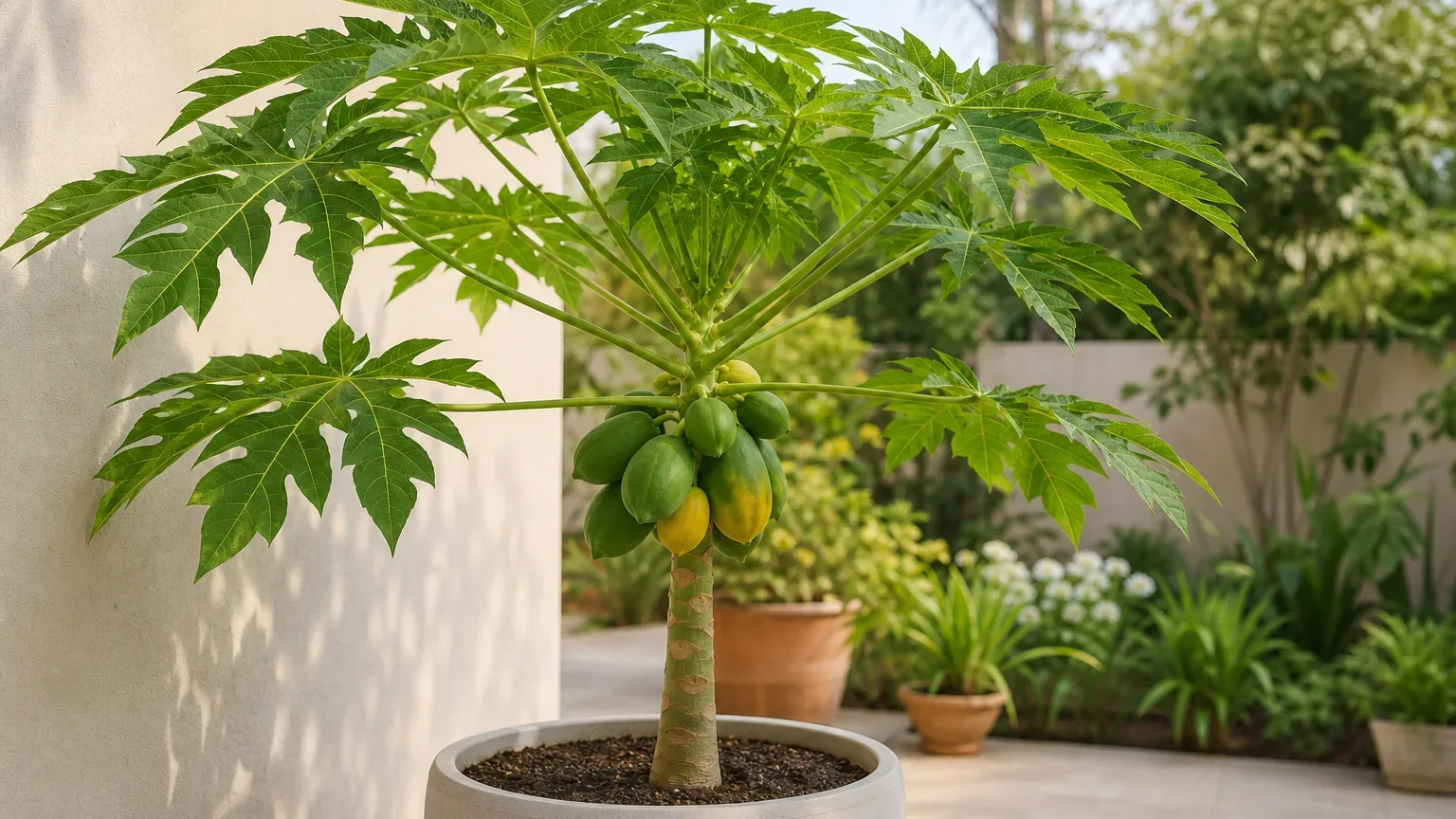
Papaya can be grown in a very large container, but a pot does not convert a potentially 10 m species into a compact houseplant. Select a compact cultivar where available, and accept that a container specimen may eventually need replacement rather than another risky move. A fruiting plant with a tall crown and heavy stem is far harder to transfer safely than a young seedling.
Prioritize a broad, stable base, rigid walls, and unobstructed drainage holes. Terracotta breathes but becomes extremely heavy and can crack; lightweight plastic is easier to move but may need a heavy outer support or sheltered position. A wheeled platform must be rated for the fully watered pot, not its empty weight.
Size, drainage and stability
For a small plant, choose a container only modestly wider and deeper than the intact root ball. If the goal is to avoid another move soon, a young vigorous papaya can go into its planned final container, but the mix must be airy and watering must be limited to the occupied root zone at first. An oversized mass of wet mix surrounding a small root ball can stay saturated long after the roots have used their available oxygen.
Multiple drainage holes at the true lowest point are essential. Do not add a “drainage layer” of stones while leaving a poorly draining mix above it, and do not allow a saucer or decorative cachepot to retain runoff. Papaya grows in varied soils only when they are well drained, and excessive irrigation is associated with root decline.
Prepare a fast-draining potting mix
Use fresh, clean mix that holds some moisture but releases surplus water promptly. A practical starting blend is 50% quality potting mix, 20% mature compost, and 30% coarse perlite, pumice, or fine bark. Adjust the coarse fraction upward if local mix collapses during the monsoon or if the container sits outdoors in frequent rain.
Do not use dense garden clay in a container, and do not pack mix hard around the root ball. UF/IFAS notes that papaya can grow across pH 4.5–8.0 in sands, loams, and rocky soils; for a pot, dependable aeration and drainage matter more than chasing one exact pH. Read the Papaya soil guide for mix adjustment beyond the transplant itself.
Latex and PPE before you begin
Papaya leaves, petioles, stem, roots, and unripe fruit can release milky latex when cut or damaged. Papain and chymopapain are papaya latex proteins, and peer-reviewed research identifies them among papaya fruit and latex proteases. This plant latex is not the same material as natural-rubber latex, but direct exposure is still unnecessary.
Wear long sleeves, eye protection if snapping tissue or splashing sap is possible, and waterproof nitrile or other non-latex gloves. This also avoids giving a person with natural-rubber latex sensitivity another latex product to handle; MedlinePlus notes that exposure can cause reactions in sensitised people. Keep hands away from the face, wash tools and exposed skin with soap and water after work, and seek medical help for breathing difficulty, facial swelling, or another serious reaction rather than trying to diagnose it as ordinary irritation.
Prepare the plant and work area
Water the papaya enough several hours before the move that its root ball is evenly moist and cohesive, not muddy. Set the new pot in its final or near-final location before filling it; once watered, a large papaya container may be unsafe to lift. Add enough mix to support the root ball at exactly the old soil height.
Have a second person support a tall plant, but neither person should lift it by the soft stem. Lay the pot on its side if practical, support the root ball with one hand, and flex or cut away the nursery pot. Sacrificing a cheap plastic pot is better than pulling until roots or stem tear.
How to repot papaya step by step
- Cover the work surface, put on PPE, and verify that the new pot drains freely.
- Add pre-moistened mix so the top of the old root ball will sit level with the new mix.
- Support the root ball and slide or cut off the old container without tugging the stem.
- Inspect only the visible surface. Note sour odour, black mushy roots, pests, or a severely circling taproot, but do not dismantle a healthy ball.
- Place the intact root ball in the centre. Keep the original soil line level with, or slightly above, the surrounding mix; UF/IFAS gives the same planting-depth principle for nursery papayas.
- Fill the gap with mix and press lightly with your fingertips. Do not ram mix under the ball or bury the stem.
- Water once, slowly and thoroughly, until runoff appears. Empty any catch tray.
- Add a loose stake only if the crown moves in wind. Use a broad, soft tie and allow slight stem movement.
Keep the taproot and root ball intact
The default is slip-potting, not root pruning. A circling taproot is a warning that the plant remained too long in a small pot, not an invitation to straighten it forcefully. Bending it back can crack the root; cutting it removes a major structural and absorptive organ.
If the root ball is rotten, healthy roots and decayed roots must be distinguished, and saving the plant may require removing dead tissue. That is rescue work with a poorer prognosis, not normal repotting. Start replacement seedlings as insurance rather than stripping every root from a declining mature papaya.
Aftercare for the first two weeks
After the settling watering, check moisture in the old root ball as well as the surrounding new mix. The two zones can dry at different rates. Water again when the upper 2–4 cm is dry and the pot feels lighter, then let runoff escape; the Papaya watering guide explains how heat and container size change that check.
Keep the plant warm, sheltered from strong wind, and in bright light. If roots were disturbed or the plant came from protected nursery conditions, give it a few days of relief from brutal afternoon sun, then return it gradually to full sun. Do not move it into a dim room for weeks, because papaya needs light to rebuild.
Wait for clear new growth before resuming normal feeding. Fertiliser cannot repair torn roots, and a concentrated dose in a recently disturbed root zone adds stress. Use the Papaya fertilizer guide when growth restarts.
Diagnose trouble after repotting
A slight pause in growth or limited lower-leaf droop can follow a move. Check whether the root ball is actually moist before adding water. Repeatedly soaking an already wet pot because leaves droop can turn a handling setback into oxygen-starved roots.
Rapid collapse, a soft dark stem base, sour mix, or persistent wilting in wet soil is more serious. UF/IFAS lists Phytophthora diseases that include damping-off, root rot, and stem rot and recommends clean potting media for new plants. Improve drainage immediately, keep water away from the stem base, and consider replacement if decay has reached the main stem.
When not to repot papaya
Do not move a papaya during cold, extreme heat, saturated monsoon conditions, or active flowering and heavy fruiting unless the existing pot is failing. Avoid moving a tall mature plant merely to refresh soil. Top-dress a small amount of mix, correct nutrition carefully, or replace the plant after harvest if the alternative is breaking a large established root system.
Also pause if the apparent problem is only yellow leaves. Diagnose moisture, light, temperature, and pests first. The Papaya overview helps separate whole-plant care problems from a true space or substrate problem.
When to use this page vs other Papaya guides
Use this page for container size, transplant timing, root-ball transfer, planting depth, and immediate recovery. Use Papaya soil to formulate or correct the substrate, Papaya watering for ongoing moisture decisions, and Papaya propagation when starting replacement plants from seed.
For symptoms that began before the move, start with the relevant care cause rather than assuming repotting is the cure. A plant in poor light or cold conditions will not improve simply because it receives more compost and pot volume.
Related Papaya guides
- Papaya plant overview — growth habit, mature scale, climate, and whole-plant priorities.
- Papaya soil guide — drainage, aeration, and practical container mixes.
- Papaya watering guide — when to water the old root ball and new surrounding mix.
- Papaya light guide — returning a transplanted plant to strong sun safely.
- Papaya fertilizer guide — restarting nutrition after visible recovery.
- Papaya propagation guide — raising replacement seedlings when a mature root system cannot be moved safely.
Conclusion
Successful papaya repotting is mostly restraint. Move a young, actively growing plant into a stable, free-draining container; wear suitable PPE around sap; keep the root ball and taproot intact; and preserve the old soil line. Then judge water by the root zone rather than the calendar and wait for new growth before feeding. If a large papaya is healthy in its present pot, avoiding another transplant may be the best care decision.