Papaya Plant Care Guide for Sun, Water and Soil
Carica papaya
Grow Carica papaya in full sun, tropical warmth, and fertile, fast-draining soil kept evenly moist. Learn papaya watering, potting, growth, pollination, and pet-safety basics.
Papaya Plant Care Guide for Sun, Water and Soil
Start with wateringThe most common care mistake for PapayaWatering guide →Papaya care essentials
Light
Water
Keep the root zone evenly moist during active growth without leaving it saturated. Water deeply when the top 2–4 cm of container mix feels dry, then let all excess drain; reduce watering during cool, slow growth.
Soil
Fertile, moisture-retentive but very freely draining potting mix. A practical container blend is 50% quality potting mix, 20% finished compost, and 30% coarse perlite, pumice, or bark. Papaya tolerates pH 4.5–8.0.
Humidity
Temperature
Fertilizer
About Papaya
Papaya is native to Tropical Central America; now cultivated throughout tropical and subtropical regions, including India, typically reaches Up to 10 m (33 ft) in the ground, though many garden and container plants are kept nearer 2–4 m (6.5–13 ft) indoors, with very fast in full sun, warm temperatures, and evenly moist soil growth. Papaya has a upright growth habit and part of the Caricaceae family. It is also known as Papita, Pawpaw, and Papaw.
| Detail | Information |
|---|---|
| Also known as | Papita, Pawpaw, Papaw |
| Native region | Tropical Central America; now cultivated throughout tropical and subtropical regions, including India |
| Mature size | Up to 10 m (33 ft) in the ground, though many garden and container plants are kept nearer 2–4 m (6.5–13 ft) |
| Growth rate | Very fast in full sun, warm temperatures, and evenly moist soil |
| Growth habit | Upright |
| Scientific name | Carica papaya |
| Family | Caricaceae |
Papaya Plant Care Guide for Sun, Water and Soil
A papaya can look lush and grow rapidly yet still fail because its roots stayed wet for one monsoon spell, its crown was battered by wind, or its flowers could not set fruit. Successful papaya plant care rests on four linked conditions: strong direct sun, tropical warmth, steady moisture and a root zone that drains quickly. Give up any one of them and extra fertilizer will not compensate.
This guide covers the whole plant, including the parts that need more caution than ripe fruit. Papaya releases milky latex when green tissue is cut, unripe fruit contains more latex than ripe fruit, and the evidence around pregnancy and pet exposure needs careful limits rather than broad “safe” or “toxic” labels.
Papaya care at a glance
Place Carica papaya in the warmest open site you can protect from persistent wind. UF/IFAS Extension reports best growth and fruiting around 21–32°C (70–90°F) and notes that root growth slows below roughly 15.5°C (60°F). In much of tropical and subtropical India, heat is suitable; drainage during monsoon and protection during cool northern winters are the harder tests.
Water deeply when the upper 2–4 cm of container mix is dry, then let runoff escape. Use a fertile, airy mix and feed in small regular amounts only while new leaves are forming. A vigorous plant should have a firm stem, an upright crown and regular new leaves; yellowing with persistently wet soil, a soft stem base or a stalled growing point calls for a root-zone check before any other treatment.
Know the plant before choosing a site
Papaya belongs to the Caricaceae family, and the accepted name is Carica papaya L.; Kew’s Plants of the World Online provides its taxonomic record. The species originated in tropical America and now grows across tropical and subtropical regions. “Papaya,” “papita,” “papaw” and “pawpaw” can overlap in everyday use, so the scientific name matters when buying seed or looking up care.
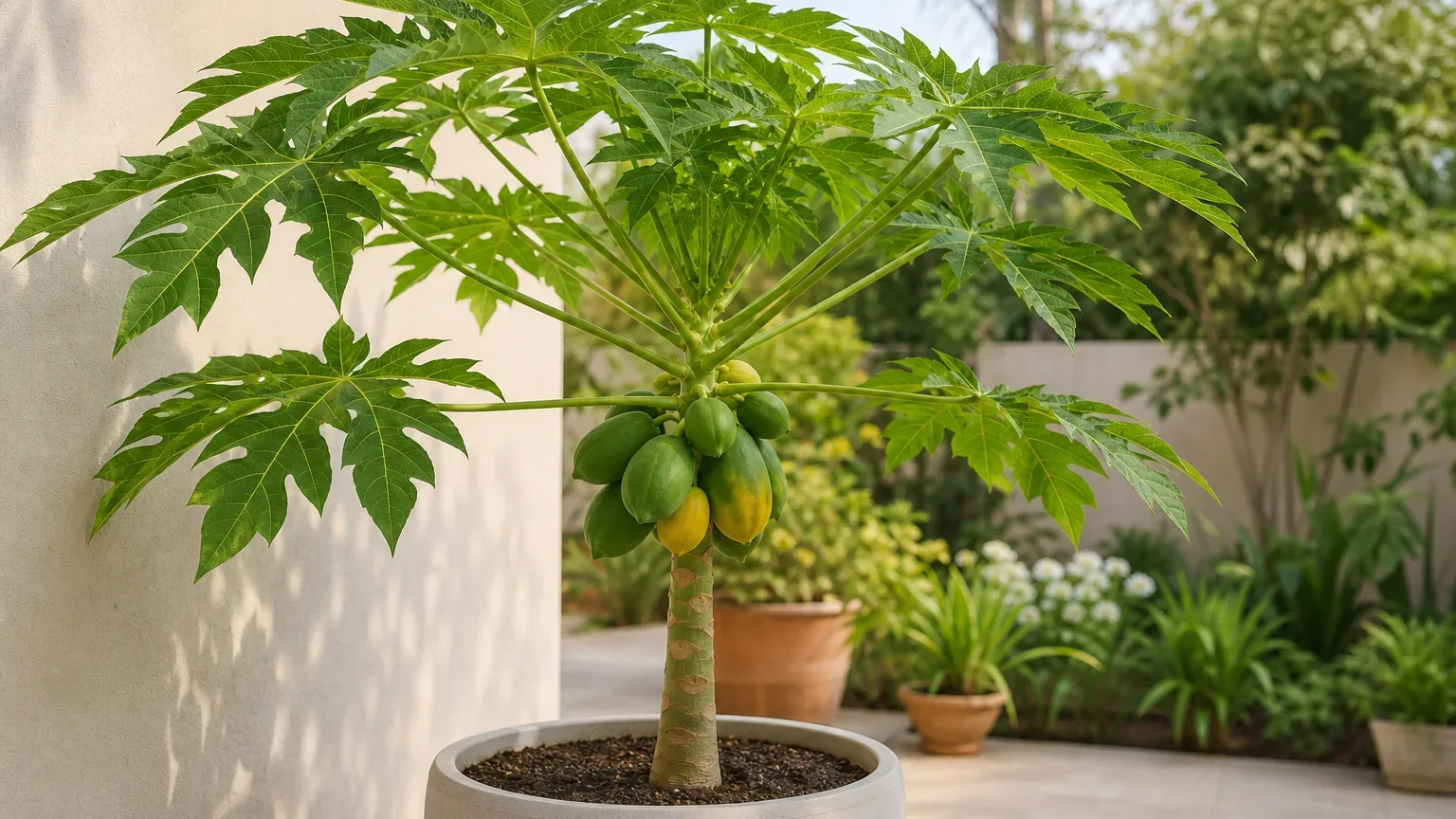
A healthy papaya usually carries one crown of large, deeply lobed leaves above a soft-looking upright stem, with flowers and fruit held close to that stem. Penn State PlantVillage describes plants ranging about 2–10 m tall, although a container, cultivar and local climate can keep a garden specimen smaller. Even a compact papaya is not a tabletop houseplant: it needs headroom, sun and a stable base.
Papaya is a giant herb, not a woody tree
Calling papaya a tree is convenient, but its structure behaves more like a giant, short-lived herb. It has a terminal growing point and does not normally build the branching woody framework of mango or citrus. This is why routine topping is a poor size-control strategy and why damage to the crown can change the whole plant.
The distinction also explains its sensitivity to rough transplanting and wind. A tall crown and developing fruit place leverage on a comparatively shallow root system, while the fleshy stem is easily injured by tight ties. The University of Hawaiʻi CTAHR describes the crop as fast-growing and short-lived, so plan for rapid change rather than treating the first pot as a permanent indoor home.
Climate sets the limits
Papaya has no useful frost tolerance. A warm courtyard, open terrace or frost-free garden suits it better than a dim room, and a south- or west-facing exposed wall can become too punishing if reflected heat combines with a dry pot. In northern India, a movable container may help a young plant survive a cool season, but moving a mature, top-heavy specimen becomes impractical.
Wind matters almost as much as temperature. UF/IFAS notes that constant wind reduces establishment and that fruit-laden plants can topple, so use a sheltered position with open sky rather than a dark corner. Stake only when needed, tie loosely with a broad soft material and allow slight movement; a wire loop can cut into the enlarging stem.
Build the core care routine
Papaya responds quickly to good conditions, which makes care errors show quickly too. Read the plant and root zone together: a drooping leaf in a light pot points toward drought, while drooping in cold, wet mix points toward root stress. If you are unsure, inspect moisture and drainage before adding water, fertilizer or a pesticide.
Give papaya full sun
Aim for at least 6–8 hours of direct sun on an established plant. Full light keeps the crown compact enough to support itself and gives flowering and fruit development a realistic energy budget. A seedling raised under shade cloth should be acclimated over several days before it receives harsh afternoon sun, because nursery leaves can scorch even though mature papaya is a full-sun crop.
Indoor light through ordinary glazing is rarely enough for a fruiting papaya, especially when the plant stands back from the window. Long petioles, leaning growth and widely spaced leaf scars are practical warnings. Use the dedicated Papaya light guide to choose placement and acclimate a plant without confusing sun scorch with heat or drought stress.
Keep moisture steady, never stagnant
Papaya grows fast and has large leaves, so a sunny plant can use water quickly. Drought may shed leaves, flowers and young fruit, while repeated saturation excludes air from roots and encourages decline; UF/IFAS specifically warns that too much water too often can lead to root rot. The right goal is even access to moisture with immediate drainage, not constantly wet soil.
In hot weather, check a pot daily rather than watering automatically every day. During monsoon, move saucers away, clear blocked holes and reduce irrigation whenever rain is doing the work. The Papaya watering guide explains pot-weight and soil-depth checks for different seasons.
Use fertile soil that drains rapidly
Papaya accepts several soil textures when drainage is good. For a container, a practical starting blend is 50% quality potting mix, 20% finished compost and 30% coarse perlite, pumice or fine bark. The exact recipe matters less than the result: water should wet the root ball evenly and then leave without the mix collapsing into mud.
Do not bury the stem or create a compost pocket beneath the roots. Keep the original soil line level with the new mix, and use the Papaya soil guide to adjust the blend for heavy monsoon humidity or a very hot, fast-drying terrace. Feeding belongs on top of a working light-water-soil system; the Papaya fertilizer guide covers timing without treating nutrition as a rescue for damaged roots.
Growing papaya in a container
Container culture is possible, but the pot is a compromise rather than a way to miniaturize any seedling indefinitely. Start a young plant in a stable container with generous drainage and move it into its intended large pot early, because root-bound nursery papayas may establish poorly. Do not tease apart or aggressively prune the root ball.
Choose a compact or dwarf cultivar where available and allow room for both crown and fruit. A large pot full of wet mix can stay saturated for days, so increasing pot size too aggressively is also risky. The Papaya repotting guide gives signs that roots need more volume and explains why a stressed or waterlogged plant should not be moved casually.
Flower type decides whether fruit develops
Papaya plants may bear male, female or bisexual flowers. Female plants need compatible pollen, bisexual plants may self-pollinate, and male plants normally do not produce useful fruit; the UF/IFAS flower guide illustrates these forms and notes that fruit normally comes from female and bisexual plants. You cannot reliably identify sex from a small seedling.
If fruit is the goal, raising two or three seed-grown plants improves the chance of retaining a productive combination once flowers reveal sex. Heat, cold, shade, drought and persistent wind can also reduce flowering or fruit set, so the absence of fruit is not automatically a pollination problem. Do not repeatedly top a healthy plant to force branching; the Papaya pruning guide explains when removal is justified around a terminal growing point.
Latex, unripe fruit and household safety
Cut leaves, stems and green fruit release a milky plant latex that contains proteolytic enzymes, including papain. That sap is useful commercially, but “natural” does not make direct skin or eye exposure harmless. Avoid touching your face while pruning or harvesting, cover broken skin and wash tools and hands after contact.
Keep the food question separate from the growing question. Ripe papaya flesh is a familiar food, while unripe or semi-ripe fruit has more latex and is sometimes cooked as a vegetable. This guide does not recommend using papaya latex, leaves, seeds or unripe fruit as a remedy; evidence about extracted plant materials cannot be converted into a safe household dose.
A careful pregnancy caution
A frequently cited study indexed by PubMed found no maternal or fetal toxicity from ripe papaya blend in its rat model, while crude latex produced uterine contractions in rat uterine tissue and the authors cautioned about unripe or semi-ripe fruit. That is animal and laboratory evidence, not a human clinical trial, so it neither proves that ripe papaya is universally safe nor establishes a human risk level for green papaya.
The practical, non-medical precaution is simple: anyone who is pregnant should avoid experimenting with papaya latex, papain preparations or unripe/semi-ripe papaya and ask their own obstetric clinician about food choices. Do not use this plant to induce menstruation, labour or abortion, and do not treat online dosage claims as clinical guidance.
Handle sap and green fruit thoughtfully
Wear gloves when cutting leaves, stems or unripe fruit, especially if you have sensitive skin or known latex-related food reactions. Papain and chymopapain are recognized allergenic proteins in a recent European Food Safety Authority assessment, but that does not mean every gardener will react. If sap reaches the eyes or causes a significant reaction, rinse away exposure and seek appropriate professional advice rather than applying another plant product.
Use clean secateurs and make only necessary cuts. Never let children handle collected sap, and discard damaged green fruit where it will not be mistaken for ripe fruit. Wash harvested fruit before kitchen preparation so residue from the stem end is not spread onto knives, counters or hands.
What pet owners should know
Do not infer whole-plant pet safety from the fact that people eat ripe flesh. The checked ASPCA toxic and non-toxic plant database does not provide a dedicated Carica papaya classification located during this review, so leaves, stems, sap, seeds and unripe fruit should be treated as unverified, not declared safe or toxic. Species, dose, plant part and individual health all matter.
Prevent chewing and keep fallen leaves, green fruit, fertilizer and treated potting mix inaccessible. If an animal ingests plant material or develops drooling, vomiting, diarrhoea or unusual behaviour, contact a veterinarian or animal poison service with the plant name and part eaten. That is a triage step, not a prediction that papaya caused the signs.
Common papaya care mistakes
The most damaging mistake is pairing high water demand with poor drainage. A thirsty crown can make growers water again while the lower pot is still saturated, particularly during humid monsoon weather. Check below the surface and empty runoff before assuming wilt means drought.
Other recurring failures are keeping papaya in partial indoor light, transplanting a tall root-bound seedling, burying the stem, using a narrow top-heavy pot and expecting every seedling to fruit alone. Excess fertilizer adds another problem: salts cannot correct shade, cold or injured roots. Fix the limiting condition first, then resume moderate feeding after growth is clearly active.
When to use this page vs other Papaya guides
Use this overview to decide whether papaya fits your climate and space, understand its growth habit and flower types, and review household cautions. For a diagnosis or routine, move to the focused watering, light, soil or fertilizer page rather than relying on a one-line summary.
Propagation and structural work need their own instructions because roots and the terminal growing point are easy to damage. Use the Papaya propagation guide for seed handling and seedling selection, and the pruning guide before cutting the crown or removing shoots.
Related Papaya guides
- Papaya watering — moisture checks, seasonal changes and root-stress warning signs.
- Papaya light — direct-sun targets, acclimation and low-light symptoms.
- Papaya soil — fast-draining mixes for containers and wet climates.
- Papaya fertilizer — feeding during active growth without salt damage.
- Papaya repotting — container size, root handling and aftercare.
- Papaya propagation — sowing seed and planning for unknown flower sex.
Conclusion
Papaya is straightforward only when its non-negotiables are respected: full sun, sustained warmth, steady water, rapid drainage, root room and shelter from persistent wind. Watch the flower type before diagnosing fruit failure, and correct the root environment before reaching for fertilizer.
Treat ripe flesh, green fruit, milky latex and the rest of the plant as separate safety questions. Avoid direct sap exposure, keep unverified plant parts away from pets, and handle pregnancy questions conservatively with a qualified clinician rather than turning limited animal evidence into medical certainty.
How to care for Papaya?
When should you water Papaya?
Keep the root zone evenly moist during active growth without leaving it saturated. Water deeply when the top 2–4 cm of container mix feels dry, then let all excess drain; reduce watering during cool, slow growth.
- Test the top 2–4 cm and lift the pot - Water deeply when the top 2–4 cm of container mix feels dry, then let all excess drain; reduce watering during cool, slow growth.
- water when the surface is dry and the container feels lighter - Water deeply when the top 2–4 cm of container mix feels dry, then let all excess drain; reduce watering during cool, slow growth.
- before leaves wilt
- Drain excess water - Water deeply when the top 2–4 cm of container mix feels dry, then let all excess drain; reduce watering during cool, slow growth.
What soil works best for Papaya?
Fertile, moisture-retentive but very freely draining potting mix. A practical container blend is 50% quality potting mix, 20% finished compost, and 30% coarse perlite, pumice, or bark. Papaya tolerates pH 4.5–8.0.
- 50% quality potting mix - A practical container blend is 50% quality potting mix, 20% finished compost, and 30% coarse perlite, pumice, or bark.
- 20% finished compost - A practical container blend is 50% quality potting mix, 20% finished compost, and 30% coarse perlite, pumice, or bark.
- 30% coarse perlite, pumice, or fine orchid bark - A practical container blend is 50% quality potting mix, 20% finished compost, and 30% coarse perlite, pumice, or bark.
Grower notes for Papaya
What matters most with Papaya
Papaya is a giant, short-lived herb rather than a woody tree. Its hollow-looking, unbranched stem carries a crown of large lobed leaves, and its shallow roots need both steady moisture and abundant oxygen. Give it full sun, warmth, and a container that drains immediately. Alternating drought with waterlogged soil causes more trouble than a consistent, observation-led routine.
Best placement in a real home
Place Papaya on a sunny, wind-sheltered terrace, courtyard, or balcony with at least 6–8 hours of direct light. UF/IFAS reports best growth and fruiting around 21–32°C (70–90°F); root growth slows below about 15.5°C (60°F), and freezing temperatures can kill the plant. Shelter the top-heavy crown and developing fruit from persistent wind.
Before you buy this plant
Choose a compact seedling with a straight, firm stem, active growth at the crown, clean leaf undersides, and no dark constriction at soil level. Avoid a tall plant squeezed into a small nursery pot: papaya develops a sensitive root system, and UF/IFAS warns that root-bound plants may not establish properly. Confirm the cultivar because mature height and fruit form vary.
First month after bringing it home
Acclimate nursery foliage gradually to harsh afternoon sun, quarantine the plant, and learn how quickly the pot loses water. Transplant only once into a well-drained container without teasing or breaking roots. Keep the original soil line level with the new mix, never bury the stem, and stake loosely if wind can move the root ball.
Pet-aware note for Papaya
Ripe papaya fruit is widely eaten by people, but that does not verify the leaves, stem, seeds, sap, or unripe fruit as safe for pets. No species-specific Carica papaya classification was found in the checked ASPCA plant database. Prevent chewing, keep fallen plant material away from animals, and contact a veterinarian if ingestion causes drooling, vomiting, diarrhoea, or unusual behaviour.
Flower type decides fruiting
Papaya plants may be male, female, or bisexual. Female flowers need compatible pollen, while bisexual plants may self-pollinate; male plants normally do not set useful fruit. Seed-grown plants cannot be sexed reliably as small seedlings, so growers often raise two or three plants and retain a productive female-plus-pollinator combination or a bisexual plant once flowering reveals sex.
Is Papaya safe for pets?
Carica papaya does not have a species-specific classification in the checked ASPCA toxic and non-toxic plant database. Do not assume the leaves, sap, seeds, or unripe fruit are pet-safe; prevent chewing and ask a veterinarian about any ingestion.
Pet safety for the whole Carica papaya plant is not verified. Ripe edible fruit for humans does not establish safety of the leaves, stems, sap, seeds, or unripe fruit for cats, dogs, or other animals. Keep the plant and fallen material out of reach and seek veterinary guidance after ingestion or symptoms.
Watering Papaya
For Papaya, test the top 2–4 cm and lift the pot; water when the surface is dry and the container feels lighter, before leaves wilt and water check every 1–3 days in hot, sunny weather; often every 3–7 days in cooler conditions, depending on pot size and soil. Water most frequently through hot, bright months and reduce in cool or cloudy weather when root and leaf growth slow.
| Detail | Information |
|---|---|
| How often | Check every 1–3 days in hot, sunny weather; often every 3–7 days in cooler conditions, depending on pot size and soil |
| How to check | Test the top 2–4 cm and lift the pot; water when the surface is dry and the container feels lighter, before leaves wilt |
| Seasonal changes | Water most frequently through hot, bright months and reduce in cool or cloudy weather when root and leaf growth slow |
Signs of overwatering
- yellowing lower leaves while soil remains wet
- wilting despite damp soil
- soft or darkened tissue near the soil line
- sour-smelling mix and stalled growth
Signs of underwatering
- limp or drooping leaves
- dropped flowers or young fruit
- scorched leaf edges
- small fruit and slowed growth
Soil & potting for Papaya
Use a mix of 50% quality potting mix, 20% finished compost, 30% coarse perlite, pumice, or fine orchid bark for Papaya. Excellent drainage is essential; papaya roots decline quickly in flooded sites or chronically saturated containers. Target soil pH around 4.5–8.0. Repot every 6–12 months while young and rapidly growing; plant into the final large container early to limit repeated root disturbance, ideally in spring or the beginning of reliably warm weather.
| Detail | Information |
|---|---|
| Recommended mix | 50% quality potting mix, 20% finished compost, 30% coarse perlite, pumice, or fine orchid bark |
| Drainage | Excellent drainage is essential; papaya roots decline quickly in flooded sites or chronically saturated containers |
| Soil pH | 4.5–8.0 |
| Repotting frequency | Every 6–12 months while young and rapidly growing; plant into the final large container early to limit repeated root disturbance |
| Best season to repot | Spring or the beginning of reliably warm weather |
Signs it needs repotting
- roots circling the pot or emerging from drainage holes
- mix drying within a day in warm weather
- plant becoming top-heavy or unstable
- growth slowing despite adequate sun, warmth, water, and nutrition
Humidity & temperature for Papaya
Fertilizer & pruning for Papaya
Common problems on Papaya
Yellow Leaves
MediumLikely cause: Common on this plant type; confirm with recent watering, light, and root checks.
Quick fix: Inspect the plant and correct the most likely care stressor before stacking treatments.
Full fix guide →Brown Tips
MediumLikely cause: Common on this plant type; confirm with recent watering, light, and root checks.
Quick fix: Inspect the plant and correct the most likely care stressor before stacking treatments.
Full fix guide →Root Rot
MediumLikely cause: Common on this plant type; confirm with recent watering, light, and root checks.
Quick fix: Inspect the plant and correct the most likely care stressor before stacking treatments.
Full fix guide →Overwatering
MediumLikely cause: Common on this plant type; confirm with recent watering, light, and root checks.
Quick fix: Inspect the plant and correct the most likely care stressor before stacking treatments.
Full fix guide →Underwatering
MediumLikely cause: Common on this plant type; confirm with recent watering, light, and root checks.
Quick fix: Inspect the plant and correct the most likely care stressor before stacking treatments.
Full fix guide →Spider Mites
MediumLikely cause: Common on this plant type; confirm with recent watering, light, and root checks.
Quick fix: Inspect the plant and correct the most likely care stressor before stacking treatments.
Full fix guide →Mealybugs
MediumLikely cause: Common on this plant type; confirm with recent watering, light, and root checks.
Quick fix: Inspect the plant and correct the most likely care stressor before stacking treatments.
Full fix guide →Aphids
MediumLikely cause: Common on this plant type; confirm with recent watering, light, and root checks.
Quick fix: Inspect the plant and correct the most likely care stressor before stacking treatments.
Full fix guide →Leggy Growth
MediumLikely cause: Common on this plant type; confirm with recent watering, light, and root checks.
Quick fix: Inspect the plant and correct the most likely care stressor before stacking treatments.
Full fix guide →Slow Growth
MediumLikely cause: Common on this plant type; confirm with recent watering, light, and root checks.
Quick fix: Inspect the plant and correct the most likely care stressor before stacking treatments.
Full fix guide →Wilting
MediumLikely cause: Common on this plant type; confirm with recent watering, light, and root checks.
Quick fix: Inspect the plant and correct the most likely care stressor before stacking treatments.
Full fix guide →Drooping Leaves
MediumLikely cause: Common on this plant type; confirm with recent watering, light, and root checks.
Quick fix: Inspect the plant and correct the most likely care stressor before stacking treatments.
Full fix guide →Low Humidity
MediumLikely cause: Common on this plant type; confirm with recent watering, light, and root checks.
Quick fix: Inspect the plant and correct the most likely care stressor before stacking treatments.
Full fix guide →Not Enough Light
MediumLikely cause: Common on this plant type; confirm with recent watering, light, and root checks.
Quick fix: Inspect the plant and correct the most likely care stressor before stacking treatments.
Full fix guide →Fungus Gnats
MediumLikely cause: Common on this plant type; confirm with recent watering, light, and root checks.
Quick fix: Inspect the plant and correct the most likely care stressor before stacking treatments.
Full fix guide →Mold on Soil
MediumLikely cause: Common on this plant type; confirm with recent watering, light, and root checks.
Quick fix: Inspect the plant and correct the most likely care stressor before stacking treatments.
Full fix guide →