How to Prune Papaya: Leaves, Fruit & Safe Cuts
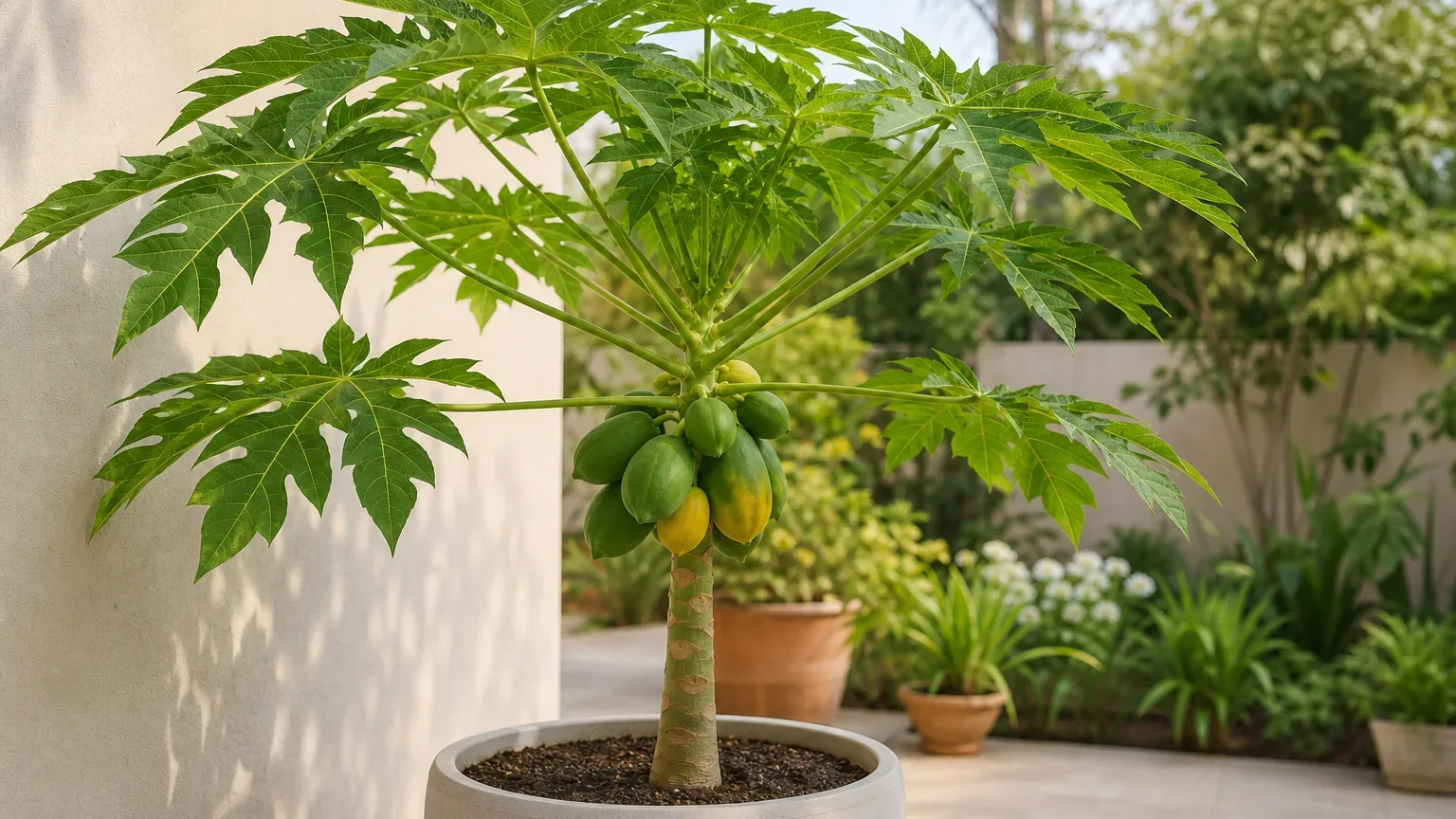
Papaya Pruning Guide: Safe Cleanup Without Topping
Papaya Pruning Guide: Safe Cleanup Without Topping
First, remove one completely dead lower leaf. Support its long stalk, then cut the petiole cleanly without slicing into the soft main stem. That single cleanup cut is the normal starting point for papaya; do not top the crown merely to shorten the plant.
Reviewed by LeafyPixels Review Board · Author: sai-ananth
Quick answer
Papaya (Carica papaya) is normally kept as a single upright stem with one terminal growing point. It is a giant herb, not a woody fruit tree that should be headed back to build scaffold branches. UF/IFAS states that papaya is generally not pruned because its growing point is terminal and branched plants may produce less; the useful exceptions are removing dead leaves and, after accidental crown loss, retaining only one or two strong replacement shoots (UF/IFAS Extension).
Routine work therefore means leaf sanitation, removal of failed or diseased fruit, and occasional shoot selection—not canopy thinning or height-control topping. Before cutting, review the plant’s overall condition in the Papaya overview and correct weak growth through Papaya light care rather than trying to reshape it with scissors.
What pruning can and cannot do for papaya
Useful pruning keeps dead petioles from rubbing fruit, removes material that can shelter pests or disease, and clears spoiled fruit before it collapses against the stem. If the original crown has died and several side shoots appear, selective removal can concentrate growth into one or two supported shoots.
Pruning cannot safely make a normal papaya permanently short, force a woody framework, repair a soft or rotting stem, or cure a systemic virus. It also cannot correct stretching caused by shade. Papaya carries flowers and fruit in leaf axils along its rising stem, so cutting off the top also removes the active crown and the next section of potential flowering sites.
When to prune papaya
Remove a dead leaf, broken petiole, or decaying fruit as soon as it can be handled safely. Choose a dry period when possible so the cut surface and surrounding crown are not immediately soaked by rain or overhead irrigation.
Delay non-urgent cleanup when the plant is wilted from drought, waterlogged, newly transplanted, or cold-stressed. Restore a steady Papaya watering routine first. Do not remove green leaves simply because they hang below the crown: those leaves are still supplying the fast-growing stem and fruit.
Structural shoot selection is only relevant after the terminal growing point has been damaged or killed and the plant has already produced replacement shoots. Wait until those shoots are long enough to compare for vigor and attachment, then retain the best one; a second can be kept as insurance on a strong, well-supported plant.
Inspect before making the first cut
Stand back and identify the highest healthy leaf emerging from the crown. That center point is the structure to protect. Then inspect downward:
- Green, firm leaf: retain it, even if it is low or untidy.
- Fully yellow or brown leaf: remove it if the petiole is dry or declining.
- Spotted leaf: identify the cause before cutting; one spot is not proof that the leaf should go.
- Cracked petiole: remove it if it hangs against fruit or is tearing at the stem.
- Fruit: harvest mature fruit; remove fruit that is split, collapsed, badly wounded, or actively rotting.
- Stem and crown: do not cosmetically prune tissue that is soft, blackened, constricted, or collapsing—diagnose the underlying problem.
Papaya ringspot virus can cause mottling, narrowed or distorted leaves, stem streaks, and ring patterns on fruit. Pruning individual symptoms does not cure an infected plant; University of Hawaiʻi guidance calls for infected plants to be removed as a disease-management measure (CTAHR).
Tools, sanitation, and latex PPE
Use sharp bypass pruners for thick leaf stalks and a clean harvest knife or secateurs for fruit stems. Disinfect cutting surfaces before starting and again after cutting suspicious tissue; Iowa State Extension recommends household disinfectants such as 70% alcohol for pruning-shear sanitation (Iowa State Extension).
Wear nitrile or other liquid-resistant gloves, long sleeves, and eye protection, especially when working overhead. Keep cut surfaces away from your face. Papaya leaves, petioles, stems, and unripe fruit release milky latex, and papaya latex contains proteolytic enzymes including papain (PubMed). Papain has documented occupational sensitization and respiratory-allergy risk (PubMed review), so minimizing skin and eye contact is more prudent than treating the sap as harmless.
Bag diseased material, wash exposed skin, clean the tool, and change contaminated clothing after the job. Do not let children or pets handle fresh cuttings.
How to remove papaya leaves cleanly
- Confirm that the leaf is fully dead, collapsed, badly broken, or being removed for a diagnosed sanitation reason.
- Support the long petiole with one hand so its weight does not peel tissue from the stem.
- Cut across the petiole with one decisive stroke, close enough to prevent a long snag but without gouging the trunk.
- Let the wound drain naturally. Do not smear pruning paint, soil, ash, or homemade paste onto it.
- Remove the leaf from the growing area and reassess the crown before making another cut.
Dead-leaf removal is specifically recommended for papaya because it can reduce fruit scarring and disease or insect problems. It is not an invitation to strip the lower green canopy. If many leaves yellow together, stop pruning and investigate roots, moisture, nutrition, cold, or disease.
Fruit removal is harvesting and sanitation, not thinning
Healthy papaya fruit generally does not need routine thinning by a home grower. The stem is built to carry fruit close to the trunk, and unnecessary thinning sacrifices a crop without fixing weak roots, wind exposure, or poor pollination.
Harvest fruit with a clean cut or controlled twist before its weight becomes awkward. Penn State’s PlantVillage papaya guidance describes cutting fruit with a sharp knife as one harvesting option and documents fruit diseases such as anthracnose and black rot (PlantVillage). Remove fruit that is split, leaking, collapsed, badly wounded, or showing expanding sunken rot; do not leave it pressed among healthy fruit. Support the fruit with one hand and cut its short stalk without levering against the soft trunk.
Small fruit that yellows and drops after heat, drought, or failed pollination is not a pruning emergency. Clear fallen fruit and stabilize care. If a heavy crop makes the crown sway, reduce risk by harvesting mature fruit promptly and sheltering or staking the plant—do not solve the load by topping the stem.
Maintain a single-stem form
A healthy papaya normally needs no side-branch pruning because it has no conventional branch framework. If small shoots appear while the crown remains healthy, do not automatically cut into the trunk searching for more. Observe whether they persist and remove only obvious competing shoots that would create weak, crowded attachments.
After the terminal point is killed, several shoots may emerge below the injury. Select the most upright, vigorous shoot with the soundest attachment. Remove weaker competitors at their bases without cutting into the parent stem, and tie the retained shoot loosely to a stake. On a vigorous plant, retaining two shoots is possible, but the extra fruit load and wind leverage make support more important.
This is salvage, not ideal training. A branched papaya remains structurally less predictable than an intact single stem, and its succulent attachments can break under fruit or wind.
Structural limits: why topping is a poor routine
Do not apply apple, citrus, or guava pruning rules to papaya. It lacks normal woody secondary growth, carries a large crown high on a soft stem, and keeps its active growth at the top. Topping creates a large wound, removes the only active leader, and leaves recovery dependent on uncertain side shoots.
It also does not solve the conditions that made the plant inconveniently tall. A replacement shoot still grows upward, while a multi-shoot crown catches more wind and may carry fruit on weaker attachments. UF/IFAS notes that fruit-laden papayas are vulnerable to toppling in high winds, which is why shelter and support matter more than ambitious shaping.
For a plant that will outgrow its terrace or protective structure, use a compact cultivar, plan replacement from seed, or relocate a young specimen before it becomes difficult. Follow the Papaya propagation guide for planned replacement rather than treating a severed crown as a reliable cutting.
Aftercare and signs of recovery
Return the plant to full sun and wind shelter without changing several care variables at once. Follow the Papaya watering guide and keep the root zone evenly moist but never saturated. Do not repot or apply a heavy feed merely because a leaf was removed; if a container is unstable or root-bound, plan that work separately with the Papaya repotting guide.
After simple leaf sanitation, success means a dry, firm attachment area, a stable crown, and continued emergence of new leaves. After shoot selection, success means the retained shoot stays firm, extends steadily, and does not split away from the old stem.
Stop cutting and reassess if the wound turns soft or black, the stem bends below the crown, green leaves drop rapidly, or retained shoots wilt despite moist soil. Those are not cues to prune harder.
Common papaya pruning mistakes
- Topping a healthy plant solely for height control
- Removing green lower leaves to create a bare, decorative trunk
- Tearing petioles downward and peeling the stem
- Cutting several replacement shoots before their vigor can be compared
- Keeping too many shoots after crown damage
- Thinning healthy fruit instead of supporting the plant and harvesting on time
- Cutting diseased tissue and then using the same tool on another plant without disinfection
- Handling fresh latex without gloves or eye protection
- Assuming pruning can cure ringspot virus, stem rot, poor light, or damaged roots
Related Papaya guides
- Papaya overview — whole-plant growth habit and care priorities
- Papaya light guide — prevent weak, stretched growth before considering cuts
- Papaya watering guide — stabilize moisture before and after cleanup
- Papaya soil guide — protect the root zone from chronic saturation
- Papaya repotting guide — manage an unstable or root-bound container separately
- Papaya propagation guide — plan replacement instead of routine topping
Conclusion
Papaya pruning is deliberately limited: protect the terminal crown, keep one main stem, remove dead leaves cleanly, harvest or discard problem fruit, and select one or two replacement shoots only after genuine crown damage. Clean tools and latex PPE protect the grower as well as the plant. When height, wind, rot, or virus is the real problem, structural cutting is not a shortcut around cultivar choice, site planning, support, diagnosis, or replacement.