Root Rot on Papaya: Soft Stem & Mushy Root Salvage
Quick answer
Root rot on Papaya is decay of the shallow fleshy roots and soft stem base—usually Phytophthora or Pythium—after the mix stays saturated. Confirm with a heavy wet pot, brown mushy root cortex, foul smell, and a softening soil-line trunk. First step: stop watering, unpot the same day, cut roots and collar tissue back to firm white flesh, and remount in freer-draining mix without burying or soaking the soft trunk.
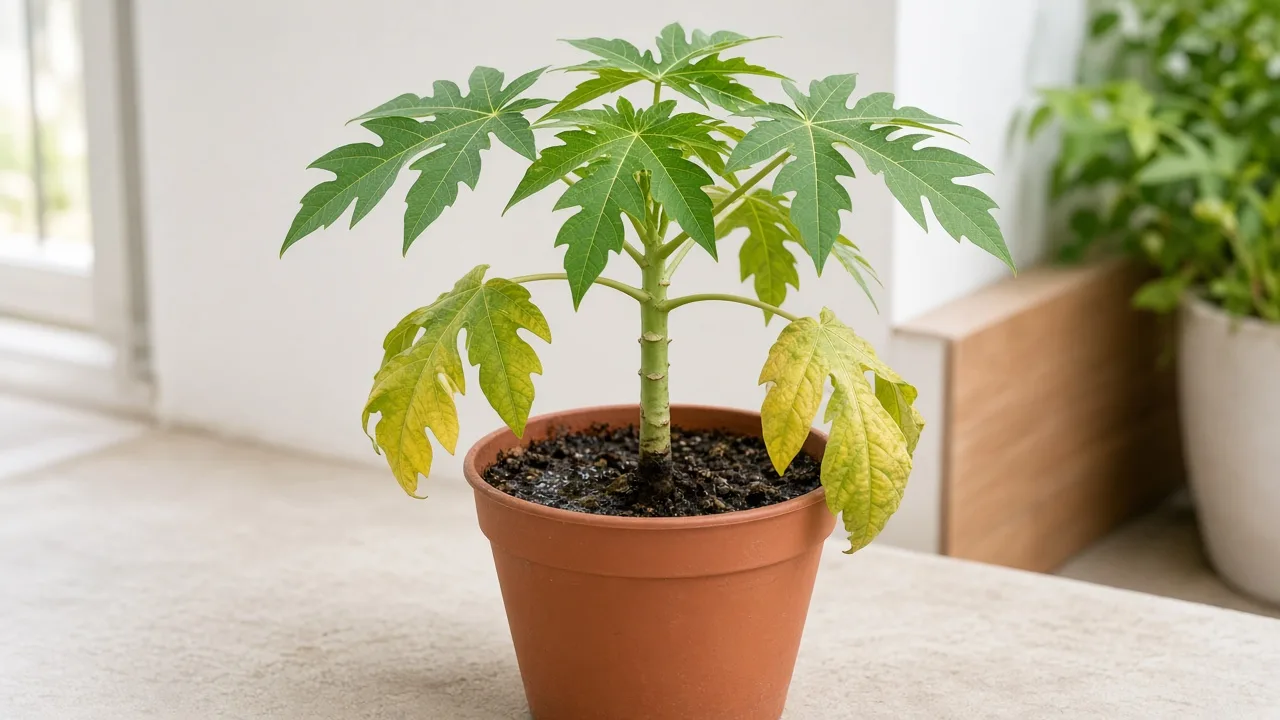
Root Rot on Papaya: Causes, Checks & Fixes
This guide covers root rot on Papaya. See also the general Root Rot guide, watering, and light pages for this plant.
Root Rot on Papaya: Causes, Checks & Fixes
Quick answer
Root rot on Carica papaya is decay of the shallow fleshy roots and the soft, herbaceous stem base—often from Phytophthora or Pythium—after the mix stays saturated. For how chronic wet soil kills roots in general, see our root rot hub. On papaya, the tell is a heavy wet pot, brown mushy root cortex that slips off the stele, a foul smell, and a softening or water-soaked collar at the soil line while the lobed crown yellows, wilts, or drops—even though you have kept watering.
First step: stop all watering and unpot the same day. Slide the plant out, rinse the root ball, cut every mushy brown root and darkened collar tissue back to firm white flesh, then remount in freer-draining mix with the soft trunk at the original soil line—not buried deeper and not left sitting in a saucer of runoff.
When to use this page vs other Papaya guides
| Pattern | Read next |
|---|---|
| Heavy wet pot, yellowing leaves, roots still firm and pale | Overwatering — fix before full rot sets in |
| Limp lobes on a light dry pot | Underwatering or drooping leaves |
| Yellow lower leaves without soft stem or foul roots | Yellow leaves |
| White surface mold, mix still smellable as “earthy,” roots firm | Mold on soil |
| Tiny flying gnats over constantly damp mix | Fungus gnats — moisture warning, not proof of rot alone |
| Soft stem + mushy brown roots + foul smell | This page |
What root rot looks like on Papaya
Papaya is a fast tropical herb with a soft, mostly unbranched stem and a shallow root system, not a woody tree with tough bark. Root rot shows first underground, then at the soil-line collar, then as canopy collapse.
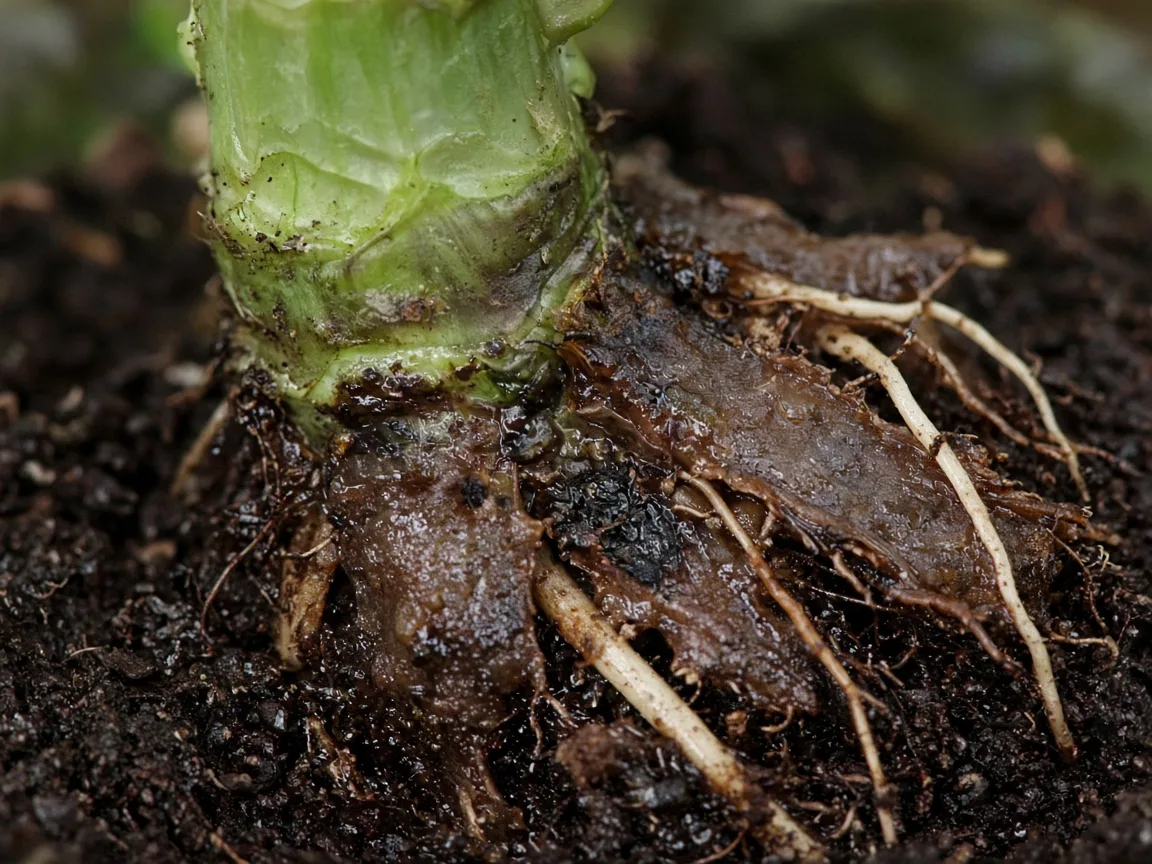
Brown mushy root cortex that slips off firm white tissue, plus a soft or water-soaked collar at the soil line—confirm with smell and pot weight, not leaf color alone.
Early signs (roots failing, crown still partly upright)
- Pot stays heavy for days; surface may crust while the core stays cold and wet
- Sour, swampy, or rotten smell from drainage holes or when you slide the plant out
- Roots soft and brown instead of firm and pale; outer cortex slips off when pinched (UW Extension on root rots)
- Lower lobed leaves dull, yellow, or wilt while the mix is still wet—unlike drought wilt on a light pot
- New crown leaves stall even in warm sun
- Fungus gnats or mold on soil on mix that never dries between drinks
Advanced signs (collar and canopy collapse)
- Soft, water-soaked, or dark patches on the stem near ground level that enlarge and girdle the trunk
- Softening of collar tissue that dents when pressed; rot may turn dark brown or black
- Yellowing and wilting of the leaf canopy followed by leaf drop, while fruit may still hang for a time (P. palmivora orchard symptoms)
- Soft rot progressing up the main stem with root destruction, then the plant leans or collapses
- Whole plant fails to recover after irrigation—UC IPM notes Phytophthora-affected plants often do not recover when watered, unlike simple drought stress (UC IPM Phytophthora root and crown rot)
Do not confuse limp lobes on a light, dry pot with rot. Rot pairs wet mix + soft roots or soft collar. Drought and heat stress belong on the underwatering and drooping leaves pages.
Why Papaya gets root rot
Papaya needs steady moisture and abundant oxygen at once. UF/IFAS describes it as a plant that fruits best with well-distributed water in well-drained soils, and warns that sites that flood or remain wet after summer rain are poor choices (UF/IFAS MG054). Epic Gardening likewise notes a somewhat shallow root system and that saturated soil promotes disease (Epic Gardening).
Phytophthora / Pythium complex on fleshy tissue. UF/IFAS lists Phytophthora blight (Phytophthora spp.) as damping-off, root rot, stem rot, and fruit rot that can kill plants, and recommends starting seedlings in clean, unused potting media (UF/IFAS MG054). Field and container outbreaks of Phytophthora palmivora show canopy yellowing, soil-line stem soft rot, root destruction, and collapse (Springer / EJPP). Pythium species cause similar root and collar soft rots under warm, wet conditions. You do not need a lab ID to act—brown mushy roots plus a soft collar on wet mix is enough for home salvage.
Timer irrigation and closed cachepots. UF/IFAS specifically warns that lawn sprinkler systems on a timer may overwater papaya and cause root rot because water arrives too often (UF/IFAS MG054). The same pattern shows up indoors when a decorative outer pot traps runoff against the soft stem.
Heavy peat mixes and oversized pots. A container blend that holds water around shallow roots—dense peat without enough perlite, pumice, or bark—keeps the cortex oxygen-starved. See the soil guide for a freer-draining target mix.
Cool, dim spells that slow dry-down. Root growth slows when soil temperatures drop; the watering rhythm that worked in hot sun then keeps the pot saturated for a week—pair with not enough light if the crown stretches while the pot never lightens.
Soft stem and soil-line collar: the papaya failure point
Unlike woody fruit trees with tough bark, papaya’s succulent stem is easy for water molds to girdle at the soil line. Early collar infection shows as water-soaked lesions near ground level, soft tissue, and dark brown or black patches that enlarge until they ring the stem. Once the collar fails, the tall leafy crown has no mechanical support and tips over even if a few upper leaves still look green.
When you inspect, press the stem at and just below the soil line after wiping mix away. Firm, cool, intact tissue can wait for a careful dry-down if roots are still mostly white. Soft, slimy, or darkened tissue means cut into sound flesh the same day—do not hope a fungicide spray on the leaves will fix a collapsing collar.
How to confirm before you cut
- Weigh the pot and probe depth. Heavy + wet core = stop watering. Light + dry = not this page.
- Smell the drainage holes or root ball. Foul or swampy odor supports rot (UW Extension).
- Unpot and rinse. Compare firm pale roots to soft brown ones; pinch a suspect root—rotted cortex slips off.
- Check the soft trunk. Water-soaked or soft collar confirms urgency; firm stem with only mild yellowing on wet mix may still be early overwatering.
- Rule out lookalikes. Sudden leaf drop from drought, cool nights, or transplant shock without soft roots is not root rot. Discrete fruit or leaf spots without root failure point to other diseases on the problems hub.
The first fix: emergency unpot and cut to firm white tissue
Unpot immediately. Tip the container, support the soft stem so it does not kink, and ease the root ball out. Rinse mix away under lukewarm water so you can see root color and the collar clearly.
Cut ruthlessly to firm tissue. With clean, sharp shears, remove every soft brown root. Where the cortex is mushy, keep cutting until you reach firm white or cream tissue. If the collar is dark or soft, slice upward into the stem until the cut face is clean and firm—sterilize the blade between cuts if tissue is slimy.
Discard the old mix and scrub the pot (or use a new pot with drainage holes). Do not reuse soggy peat that smelled foul.
Remount without drowning the soft trunk. Use a freer-draining blend (see soil): roughly half quality potting mix, some compost, and a large share of coarse perlite, pumice, or bark so water exits fast. Set the plant so the original soil line stays level—never bury the soft stem deeper “for stability.” Stake loosely if the crown is top-heavy. Water once just enough to settle the mix, then empty any saucer. Do not soak the remounted plant daily “to help it recover.”
Hold fertilizer until you see a new firm crown leaf and the pot begins a normal dry-down cycle. Leaf sprays and systemic fungicides are secondary; oxygen and dry-down at the roots are the salvage.
Step-by-step recovery after remount
- Place the plant in bright, warm light—papaya wants sun—but shield a freshly cut stem from harsh afternoon scorch for a few days if the canopy is thin.
- Water only when the top 2–4 cm feels dry and the pot lightens; follow the watering guide rather than a calendar soak.
- Keep mulch or decorative moss away from the soft trunk—UF/IFAS keeps mulch 8–12 inches from the trunk in the landscape (UF/IFAS MG054); in pots, leave the collar visible and dry.
- Watch the next crown leaf and stem firmness, not the yellowed older lobes—those rarely re-green.
- If rot returns within two weeks, unpot again; remaining infected tissue or a still-waterlogged mix will re-trigger the same pathogens.
Recovery timeline
- 24–72 hours: Pot should feel lighter; foul smell should fade; soft stem should not soften further.
- 1–2 weeks: Remaining firm roots hold the plant; no new water-soaked collar spots; wilt on wet mix stops spreading.
- 3–6 weeks: A new crown leaf opens with normal color while the stem stays firm—your real success marker.
- If the trunk softens through the base and the crown collapses: The whole plant is rarely worth remounting; compost it and start clean seedlings in unused media rather than reusing the diseased mix.
Mistakes to avoid
- Watering because leaves wilt while the pot is still heavy — wilt on wet mix is classic root failure, not drought.
- Burying the soft stem deeper at remount — invites collar rot and keeps the failure point wet.
- Leaving the nursery pot in a water-filled cachepot — papaya’s soft trunk sits in a swamp.
- Reusing foul mix or previously diseased media for seedlings — UF/IFAS flags clean unused media to avoid root rots (UF/IFAS MG054).
- Fertilizing or stacking fungicide, heavy pruning, and a huge pot upgrade the same day — finish the cut-and-remount first; judge response before adding stress.
- Relying on lawn sprinklers or automatic timers — too-frequent water is a documented papaya root-rot driver (UF/IFAS MG054).
How to prevent it next time
Keep the root zone evenly moist without saturation—papaya drops flowers and fruit under drought, but continuous waterlogging invites Phytophthora and Pythium (UF/IFAS Gardening Solutions; UC IPM). Use freer-draining mix, a pot with open holes, and hand-watering guided by pot weight. In the ground, choose a site that does not pond after rain, or plant on a mound. Start new plants in clean media, quarantine nursery stock with dark soil-line constrictions, and match light so the pot can dry on a tropical schedule—see the overview and watering guides.
Related Papaya guides
- Papaya overview — growth habit, soft stem, and placement basics
- Watering — even moisture without calendar drowning
- Soil — freer-draining container blends
- Overwatering — earlier wet-mix stress before roots turn mushy
- Problems hub — other papaya symptom pages
Related tool
Use the Plant Watering Calculator to sanity-check how often a container papaya should dry down in your light and pot size before you resume a soak schedule after salvage.
Conclusion
Root rot on papaya is a soft-stem, shallow-root emergency: brown mushy cortex, foul smell, and a failing soil-line collar on wet mix. Unpot, cut to firm white tissue, and remount high in airy soil without drowning the trunk. Damaged leaves will not heal; a firm stem plus a clean new crown leaf means the salvage worked.