Black Spots on Peace Lily: Causes, Checks & Fixes
Quick answer
Black spots on peace lily are usually fungal leaf spot from wet leaves and poor airflow, cold-damaged tissue, or pest feeding—not random blight. First step: stop overhead watering and misting, then check whether spots have yellow halos and spread after leaves stay wet overnight.
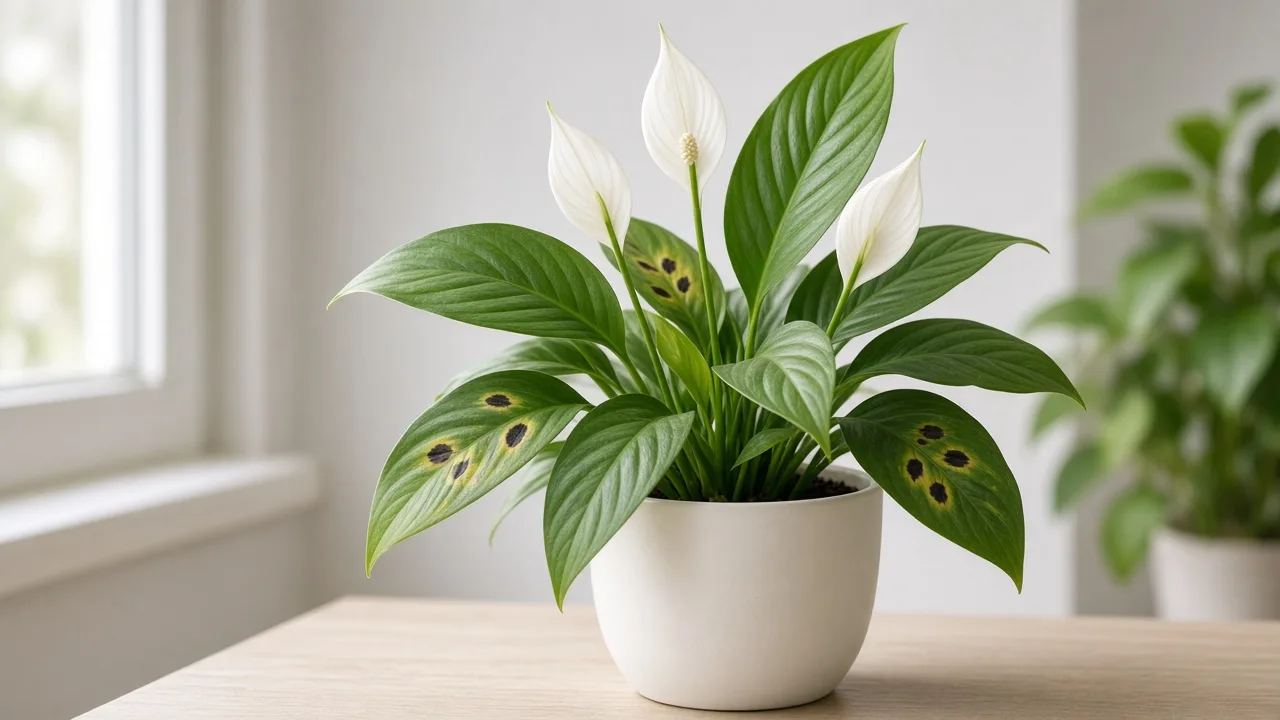
Black Spots on Peace Lily: Causes, Checks & Fixes
This guide covers black spots on Peace Lily. See also the general Black Spots guide, watering, and light pages for this plant.
Black Spots on Peace Lily: Causes, Checks & Fixes
Quick answer
Black or dark brown spots on peace lily foliage are usually localized tissue death—not the same problem as brown tips or whole-leaf browning. The most common indoor cause is fungal leaf spot when broad leaves stay wet overnight with poor airflow. Cold injury after a draft near glass can also darken patches. Pest feeding leaves small scars but rarely large spreading blotches.
First step: Stop misting and overhead watering onto leaves. Water at soil level only, improve spacing for airflow, and note whether spots have yellow halos and spread after wet nights.
For general spot disease mechanics, see our black spots guide. On peace lily, wide horizontal blades hold water like a tray—making this species more prone to leaf-surface fungi than narrow-leaved plants when owners mist for “humidity.”
Route to overwatering if spots coincide with soggy mix and yellowing—root stress weakens leaves and invites secondary infection.
When to use this page vs other peace lily guides
| Pattern | Start here | Or route to… |
|---|---|---|
| Discrete dark spots with halos | This page | — |
| Only tip/margin brown | Brown tips | Low humidity |
| Whole leaf tan or mushy | Brown leaves | Root rot |
| Yellow before spots | Yellow leaves | Overwatering |
| Chewing holes, not spots | Holes in leaves | Caterpillars |
What black spots look like on Peace Lily
Peace lily leaves are broad, glossy, and often horizontal—water pools on the surface when misted or splashed.
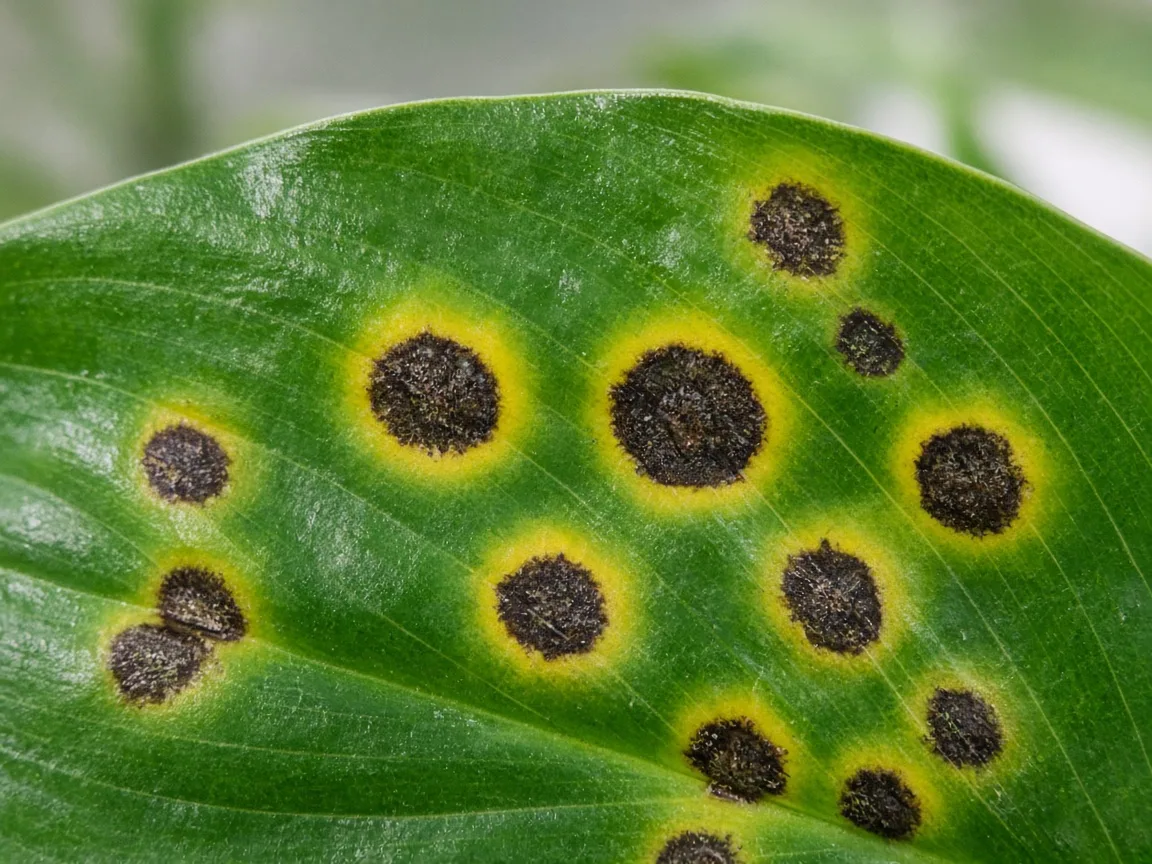
Dark brown to black spots with yellow halos on a peace lily leaf—typical fungal leaf spot on broad blades that hold overnight moisture.
Fungal leaf spot — Round to irregular dark brown or black spots, often with a yellow halo. Spots may merge as infection spreads. Worse on lower, older leaves in crowded groupings. Tied to leaves staying wet and stagnant air.
Cold injury spots — Darkened, water-soaked patches after cold exposure near winter glass or AC vents—not always circular, may not have halos. Missouri Botanical Garden notes cold below 40°F damages peace lily tissue.
Physical / pest scars — Small dark pits from mechanical damage or sucking insects. Check undersides for mealybugs, scale, or aphids.
Fluoride or salt necrosis — Usually starts at tips and margins (brown tips), not isolated round spots—unless advanced marginal death has darkened centrally.
The wide-leaf water-trap (peace lily only)
Unlike narrow strap-leaves, peace lily blades are wide enough that evening mist or splash from watering collects in the leaf center and stays wet for hours. In a cool bedroom or office, that film is ideal for leaf-spot fungi. Humidity goals are better met with a pebble tray or grouping plants than wetting the blade surface—see low humidity without foliar soaking.
Diagnosis traps on peace lily
Tip burn mistaken for spots — Fluoride and salt necrosis start at margins and tips, not as isolated round blotches in the leaf center. If every damaged leaf shows the same margin pattern, route to brown tips instead of fungicide.
Old lower-leaf spots vs active infection — One or two dark marks on the lowest blade after months of stable care may be old mechanical damage or healed infection. Active fungal leaf spot adds new halos on upper or center leaves within one to two weeks of wet nights. Photograph the worst leaf weekly to track spread.
Overwatering without wet leaves — Chronic soggy mix weakens tissue so spots develop faster once any spore lands. If spots appear while you never mist, still check whether mix stays damp 7+ days and lower leaves are crowded against the pot rim where splash collects.
Why Peace Lily gets black spots
Wet foliage + poor airflow is the primary fungal pathway. Peace lily tolerates moderate humidity but does not need leaves drenched—NC State recommends wiping leaves and watching for pests on wide foliage.
Chronic overwatering at the root zone weakens leaves and keeps ambient humidity high around crowded lower foliage—stacking risk. Clemson links excess soil moisture to disease problems on peace lily.
Cold damage darkens cells without a fungal halo pattern.
Pests are secondary; Clemson lists mealybugs as common on peace lily—honeydew and weakened tissue can look spotty.
Confirm the cause in five checks
- Watering method: Do you mist leaves or splash water on blades? Evening wetting?
- Halo test: Yellow ring around dark center → fungal leaf spot likely.
- Spread speed: New spots after wet nights → cultural fix first.
- Temperature history: Cold window night before spots appeared?
- Undersides: Sticky residue, insects, or webbing → pest route.
- Soil moisture: Wet 7+ days at 3–5 cm → also correct overwatering.
First fix by confirmed cause
| Confirmed cause | First fix | After 10–14 days if stable |
|---|---|---|
| Fungal leaf spot | Stop foliar wetting; water soil only; improve airflow | Remove worst leaves; fungicide only if spread continues |
| Cold injury | Move to stable warmth off glass | Trim only fully dead tissue |
| Pests | Isolate; rinse undersides | Mealybugs or relevant pest guide |
| Root-zone weakness | Dry-down protocol | Overwatering |
One action first: dry the leaf routine before any spray.
Recovery timeline
| Phase | Timing | Improvement | Worsening |
|---|---|---|---|
| Cultural fix | Days 3–10 | No new spots on old leaves | Halos spread on wet nights |
| New growth | Weeks 2–4 | Clean emerging leaves | Spots on new blades = escalate |
| After prune | Weeks 4–6 | Fuller crown from center | Crown rot smell → root rot |
Spotted tissue does not heal. Spot-free new leaves are the marker.
What not to do
- Do not mist leaves every evening on peace lily—use pebble trays instead.
- Do not overhead-water in a cool room.
- Do not apply fungicide while still wetting foliage—culture change comes first.
- Do not confuse tip burn with leaf spot—margins vs round blotches.
How to prevent black spots on Peace Lily
- Water at soil level; let blades dry before night.
- Space plants for airflow around wide leaves.
- Use pebble trays for humidity per RHS peace lily guidance—not foliar mist in cool rooms.
- Wipe dust from leaves monthly—NC State notes cleaning helps pest visibility on wide foliage.
- Keep bright filtered light and correct watering so roots stay healthy.
See peace lily overview and problems hub.
Related Peace Lily guides
- Brown leaves — whole-blade necrosis vs spots
- Brown tips — margin burn, not blotches
- Overwatering — weak leaves + damp crowd
- Low humidity — humidity without wetting leaves
- Mealybugs — common pest on peace lily
- Peace lily watering — soil-level moisture hub
Conclusion
Black spots on peace lily usually mean wet leaf surfaces met poor airflow on broad blades—not mysterious blight. Stop foliar wetting first, improve spacing, and watch whether new center leaves stay clean for two weeks. Cold and pests leave different patterns—match history before spraying. Route to root guides if soggy mix stacks with leaf failure.
Related tool
Use the Plant Problem Diagnosis Tool to narrow causes for black spots on this plant before changing multiple variables at once.