Whiteflies on Peace Lily: Causes, Checks & Fixes
Quick answer
Whiteflies on peace lily show up as tiny moth-like insects on glossy lance leaf undersides that flutter into a white cloud when you disturb the crown. First step: isolate the plant immediately and wash every leaf underside with lukewarm water to knock down nymphs.
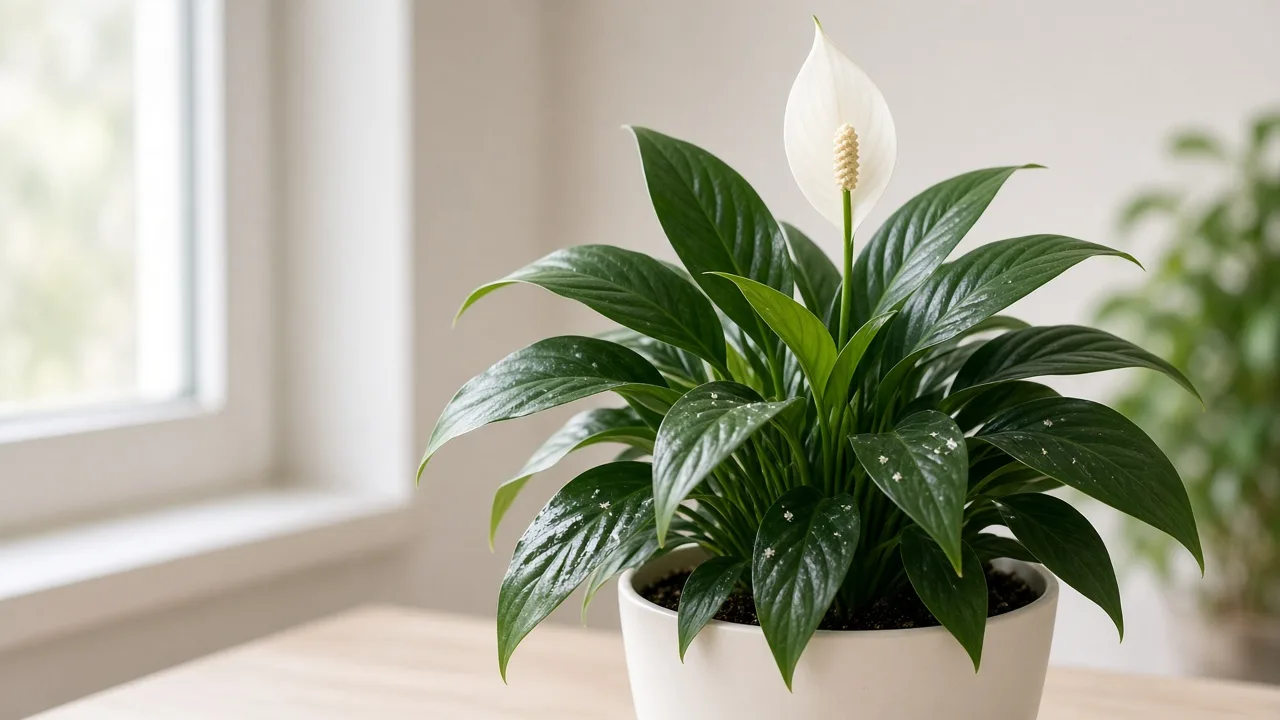
Whiteflies on Peace Lily: Causes, Checks & Fixes
This guide covers whiteflies on Peace Lily. See also the general Whiteflies guide, watering, and light pages for this plant.
Whiteflies on Peace Lily: Causes, Checks & Fixes
Quick answer
Whiteflies on peace lily (Spathiphyllum wallisii and common hybrids) appear as tiny white, moth-like insects on the undersides of glossy lance-shaped leaves. Disturb the plant and they flutter away in a white cloud before resettling on sheltered backs.
Nymphs look like flat disks glued to leaf undersides. Both stages excrete sticky honeydew on glossy Spathiphyllum foliage. For universal whitefly biology and life stages, see our whiteflies guide. On peace lily, inspect the glossy backs of lower lance leaves pressed against the pot rim—sheltered undersides whiteflies favor in rosette plants.
First step: isolate the peace lily the same day you see flying white insects, then wash every leaf underside with lukewarm water.
When to use this page vs other Peace Lily guides
| What you see | Likely cause | Next step |
|---|---|---|
| White cloud when leaves are brushed + flat disks on undersides | Whiteflies | Stay on this page—isolate and wash undersides |
| Cottony wax in crown axils | Mealybugs | Mealybugs guide |
| Silvery streaks + black frass on new crown leaves | Thrips | Thrips guide |
| Fine stippling + webbing at petiole bases | Spider mites | Spider mites guide |
| Immobile tan or brown bumps on stems | Scale insects | Scale insects guide |
| Tiny dark flies rising from wet soil when you water | Fungus gnats | Fungus gnats guide |
| Tacky shine only at leaf tips, no insects | Fluoride or dry air | Brown tips guide |
Honeydew on peace lily feels uniformly tacky across multiple glossy blades when you rub with a damp cloth—unlike isolated guttation droplets at leaf margins.
What whiteflies look like on peace lily
Adults are about 1/10 to 1/16 inch long, wedge-shaped, and moth-like with powdery white wings. On peace lily they cluster on the glossy undersides of arching lance leaves, especially where lower blades press against the pot rim and where new foliage overlaps at the crown.
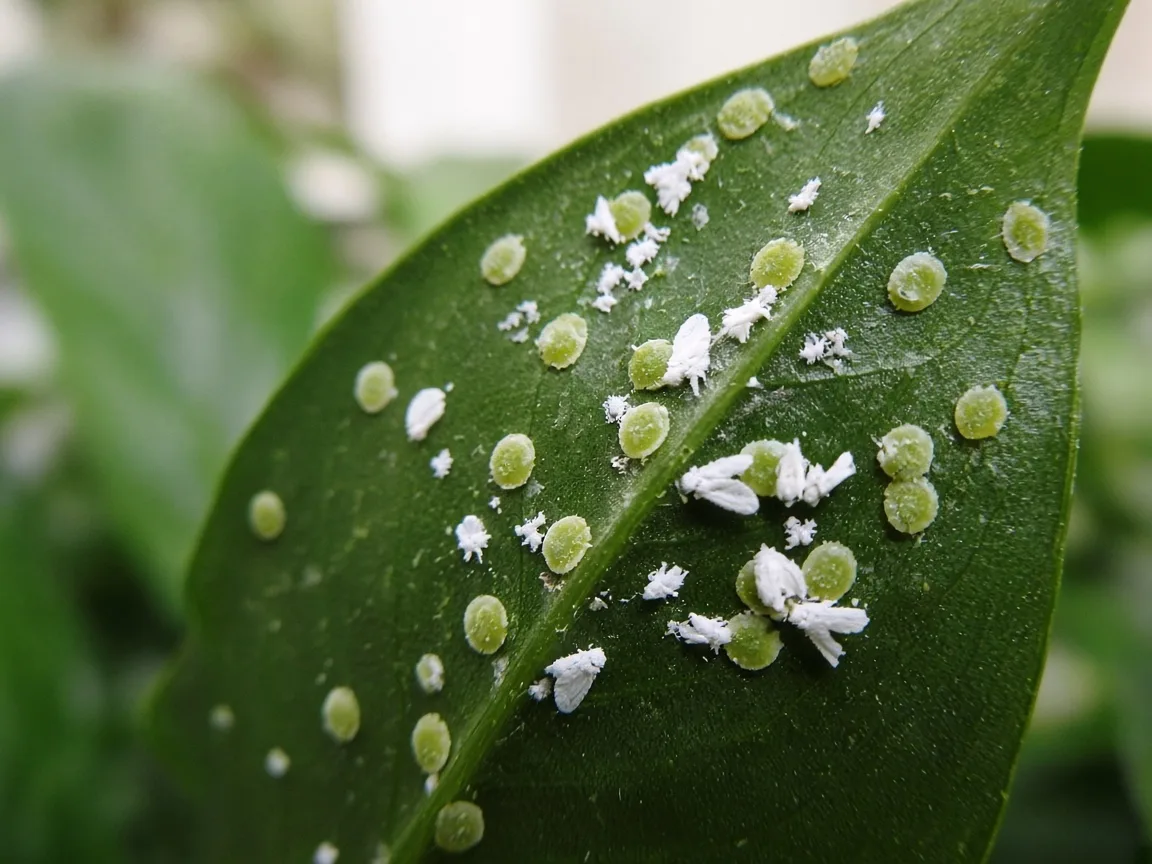
Flat nymph disks and powdery adults on a peace lily lance leaf underside—compare with clean tissue on the same blade.
Typical signs on peace lily:
- White cloud when you water, mist, or move leaves
- Flat pale nymph disks on glossy undersides—easy to miss without parting the rosette
- Sticky honeydew on lance leaves, pot edges, and shelves below
- Black sooty mold growing on honeydew in humid rooms
- Yellowing or dulling of older lower leaves while crown growth stays pale
- Stunted new lance leaves emerging from the center
Unlike mealybugs, whiteflies fly when disturbed and lack cottony wax. Unlike thrips, damage shows as honeydew and flying insects—not silvery scrape marks with black frass. Unlike spider mites, there is no fine stippling or webbing at petiole bases.
Why peace lily gets whiteflies
Peace lily’s basal rosette creates overlapping lance leaves with humid, sheltered undersides. Warm indoor rooms let whiteflies reproduce year-round without the outdoor cold break that slows populations in temperate gardens.
Common entry routes on peace lily:
- Nursery stock without quarantine—whiteflies hide on undersides of glossy lower leaves before you notice flight.
- Summer patio stays—peace lilies moved outdoors for shade often pick up greenhouse whitefly; populations explode once back in stable indoor heat.
- Shared office shelves—fluorescent-lit rows of peace lilies on one tray let adults drift between pots within days.
- Over-fertilized soft growth—nitrogen-pushed crown leaves give sap feeders tender tissue to colonize.
- Open windows near garden beds—adults can enter and land on indoor Spathiphyllum near the sill.
Whiteflies are extremely difficult to control on houseplants once nymph disks cover many undersides. The immobile nymph stages—not the flying adults—sustain most of the population through incomplete spray coverage.
Glossy lance rosette: where whiteflies hide on peace lily
Peace lily’s basal rosette presses lower lance leaves against the pot rim, creating a humid sheltered zone where whitefly nymph disks cluster on glossy undersides. Adults resettle here after flight because the overlap blocks direct light and spray drift from above.
Part leaves at the crown during every treatment rather than only misting from overhead. The inner overlap zone between arching blades is where nymphs survive a quick top-down shower. Peace lily’s smooth glossy surface makes honeydew and sooty mold especially visible—use that shine as an early warning before yellowing spreads up the plant.
Guttation droplets vs honeydew on Spathiphyllum blades
Peace lily commonly pushes guttation water from leaf margins after a thorough drink, especially in humid rooms. Guttation forms discrete droplets or dried white mineral rings at tips—not a uniform tacky film.
Honeydew from whiteflies feels consistently sticky across multiple leaf undersides and upper surfaces below infested zones. Rub a damp cloth on a glossy blade: honeydew smears tacky; guttation wipes away as plain water or light mineral residue. If stickiness appears without insects, rule out overwatering stress before assuming pests—but flying white insects plus tacky undersides confirm whiteflies.
How to confirm
Work through these checks in order:
- Disturbance test—brush or mist foliage. A white cloud that resetstles on undersides within seconds is diagnostic.
- Underside inspection—part rosette leaves and check lower blades against the pot rim and inner crown overlap.
- Nymph disk check—look for flat pale scales on glossy backs; all life stages can be present at once.
- Honeydew tackiness—test multiple leaves, not just one margin droplet.
- Yellow sticky traps—adults are attracted to yellow; catches within 48 hours confirm an active population.
- Neighbor scan—inspect other plants on the same office shelf or windowsill row.
- Lifecycle timing—eggs hatch in about a week; repeat treatments must outlast nymph development, not just knock down flying adults.
First fix for peace lily
Isolate the plant and wash every leaf underside with lukewarm water.
Iowa State recommends washing undersides as a first mechanical step. Peace lily fits in many sinks for a gentle shower rinse if the pot is manageable—tilt the rosette to run water across backs without flooding the crown daily. Let foliage dry the same day; peace lily tolerates rinsing better than constant wet crowns in low light.
Do not return the plant to a shared shelf until you have completed at least one full underside wash and checked neighbors.
Step-by-step recovery
- Isolate in a bright spot away from other houseplants—peace lily handles medium indirect light during treatment.
- Yellow sticky traps—one trap per couple of plants at canopy height to catch adults and monitor progress.
- Repeat washing every two to three days for two weeks, parting the rosette each time to reach rim-sheltered undersides.
- Insecticidal soap on leaf undersides—repeat every five to seven days through four cycles; cover lower backs and crown overlap, not just upper blades.
- Remove heavily infested lower leaves at the base when nymph disks cover most of the underside and washing is impractical.
- Two clean weeks—no new adults on traps and no fresh honeydew—before returning to an office row or mixed shelf.
Avoid spraying open white spathes; treat leaf blades and stems, not pollen-heavy blooms. Test one leaf if using soap in bright direct sun—glossy peace lily blades can show temporary spotting when soap dries in hot window light.
Mistakes to avoid
- Do not mist only from above—overhead misting misses the rim-sheltered undersides where peace lily whiteflies cluster.
- Do not confuse guttation droplets at leaf tips with honeydew—check for flying insects and flat nymph disks.
- Do not fertilize a stressed infested plant—soft nitrogen-pushed crown growth feeds the next whitefly generation.
- Do not place the peace lily back on a shared tray after one rinse—generations overlap indoors and surviving nymphs restart the cloud within days.
- Do not assume droop means thirst—heavy sap loss can wilt leaves, but wet soil with sour smell points to overwatering or root rot instead of whiteflies alone.
Recovery timeline
Expect two to four weeks of consistent washing and soap cycles before the population collapses. Scarred or dull older lance leaves may not regain full gloss—judge success by clean new foliage emerging from the crown without fresh honeydew or flying adults.
If new center leaves stay stunted and traps stay full after four soap cycles, the infestation may be beyond practical indoor control; consider discarding severely coated plants before they spread to an entire shelf row.
Prevention
- Quarantine new peace lilies two to three weeks before placing them on shared office shelves.
- Inspect glossy undersides during weekly watering checks—peace lily’s droop signal is a natural moment to flip lower leaves.
- Yellow sticky traps near susceptible plants catch adults early in warm rooms.
- Rinse dusty leaves monthly in winter when heating dries indoor air—clean glossy surfaces expose nymph disks sooner.
- Avoid heavy nitrogen feeds on indoor peace lilies; match fertilizer to actual growth in low light.
- Inspect after summer outdoors—quarantine patio peace lilies for 14 days before reuniting with indoor collections.
Related Peace Lily guides
- Peace lily overview
- Peace lily watering
- Peace lily light
- Thrips
- Mealybugs
- Scale insects
- Peace lily problems hub
Conclusion
Whiteflies on peace lily are a sheltered-underside pest—the white cloud is only the visible tip. Isolate, wash every glossy lance back including rim-pressed lower leaves, and repeat soap on a five-to-seven-day rhythm until new crown growth emerges clean.