Thrips on Peace Lily: Causes, Checks & Fixes
Quick answer
Thrips on peace lily leave silvery scrape marks and black frass on glossy lance-shaped leaves, often scarring the newest center foliage still unfurling from the crown. First step: isolate the plant and shake suspect leaves over white paper to confirm slender insects before rinsing every underside.
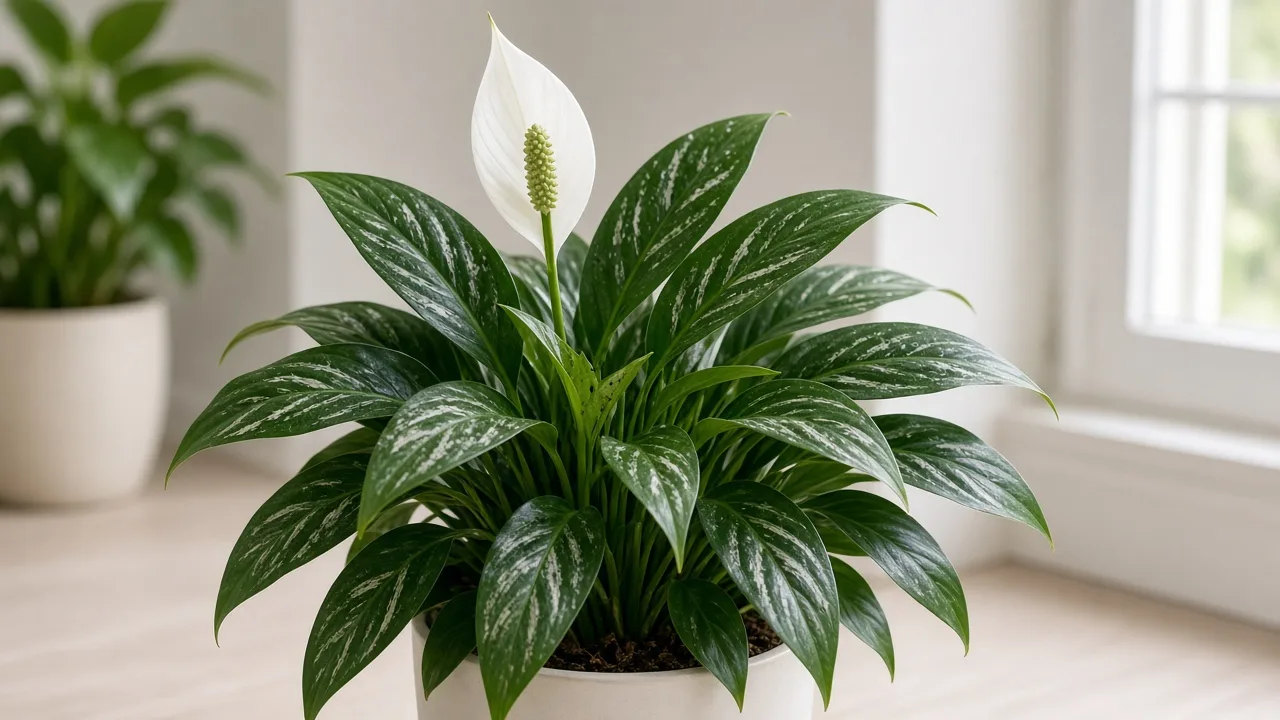
Thrips on Peace Lily: Causes, Checks & Fixes
This guide covers thrips on Peace Lily. See also the general Thrips guide, watering, and light pages for this plant.
Thrips on Peace Lily: Causes, Checks & Fixes
Quick answer
Thrips on peace lily (Spathiphyllum wallisii) show up as silvery or bronze scrape marks on glossy lance-shaped leaves, often with black frass specks and distorted new leaves emerging from the crown. Thrips rasp leaf surfaces and suck cell contents, leaving scars that stand out sharply on dark green blades.
For how thrips feed and spread in general, see our thrips guide. On peace lily, damage often starts on the newest lance leaf still unfurling at the crown center—not on random lower leaves unless the infestation is advanced.
First step: isolate the peace lily and shake suspect leaves over white paper to confirm thrips before spraying.
When to use this page vs other Peace Lily guides
| Pattern | Read next |
|---|---|
| Silvery streaks + black frass dots, no webbing | This guide — isolate and shake-test first |
| Fine stippling + silk at petiole bases | Spider mites |
| Brown tips or margins only, no frass or moving specks | Brown tips or low humidity |
| Twisted or puckered new tips without frass | Distorted leaves |
| Immobile brown bumps on stems or leaves | Scale insects |
| Whole plant limp on wet soil | Overwatering or wilting |
What thrips look like on peace lily
Peace lily carries glossy, lance-shaped leaves in a dense basal rosette. Thrips damage reads differently here than on thin-leaved pothos or fenestrated Monstera—the scrape marks show as pale silvery bands across the wide blade surface.
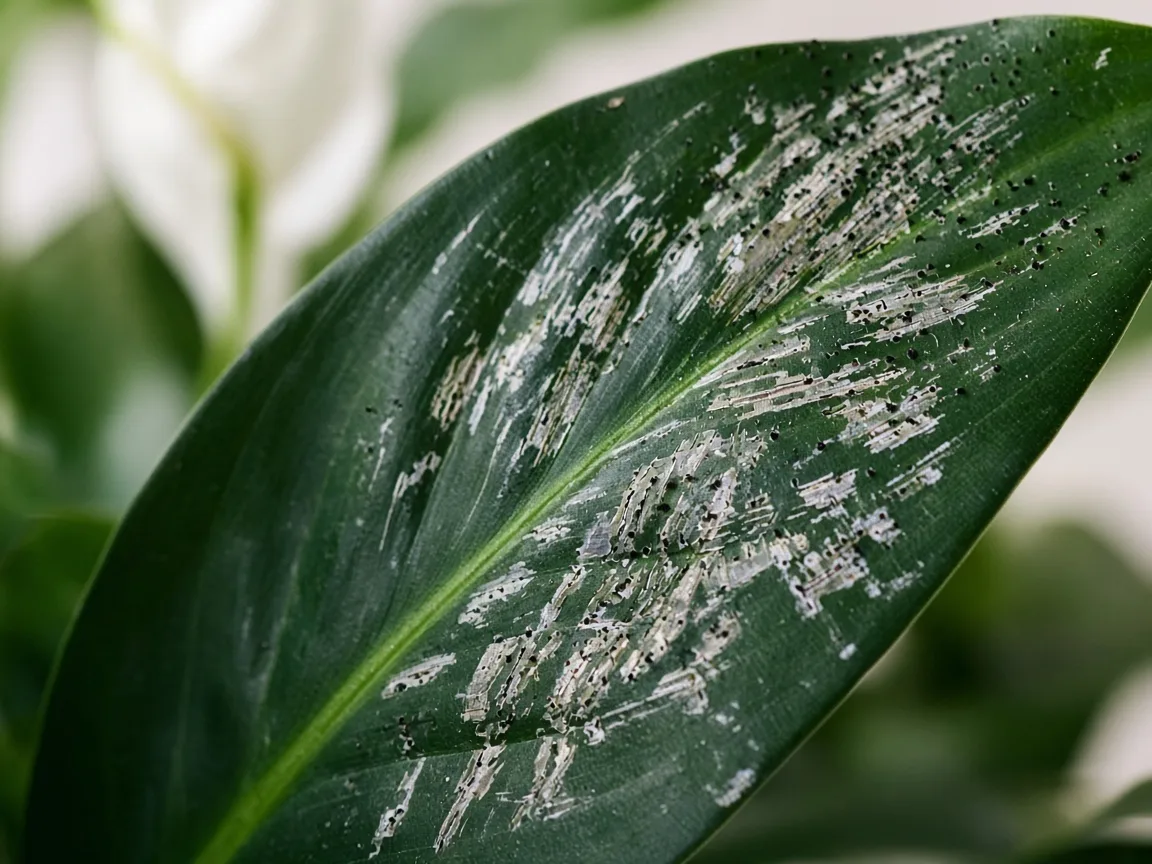
Silvery scrape marks and black frass specks on a peace lily lance leaf—the glossy surface makes thrips feeding scars easy to spot.
Early crown damage:
- Silvery or scabby streaks on the lance leaf still rolled at the center
- Black varnish-like frass dots on upper or lower blade surfaces
- Slight bronzing on the newest foliage before leaves fully expand
Established infestation:
- Distorted or scarred center leaves that unfurl with rippled edges
- Older lance blades with scattered silvery patches and dried brown zones
- Scarred or stunted spathe bracts on flowering specimens
Adults are less than 1/20 inch long—easy to miss until you shake a leaf over white paper. Unlike spider mites, thrips leave no webbing.
Why peace lily gets thrips
Peace lily’s dense crown rosette shelters thrips in overlapping lance leaves. Most pest thrips feed hidden in buds and shoot tips, so you often see silvery scars before you spot the insects themselves.
Peace-lily-specific factors:
- Crown unfurling zone — New lance leaves emerge from a tight center where thrips feed unseen until the blade expands and reveals streaks.
- Glossy surface shows streaks clearly — Silvery damage contrasts on dark green blades in a way that is harder to see on matte or heavily patterned foliage.
- Spathe development — Thrips can scar developing flower stalks on blooming specimens, leaving pale streaks on white spathes.
- Soft nitrogen-pushed growth — Excess nitrogen can increase thrips populations; heavy feeding after a fertilizer spike pushes tender crown tissue thrips prefer.
Thrips arrive on nursery stock and walk between shelf plants. A new peace lily in a shared collection is often the entry point—not a spontaneous outbreak from dry air alone.
Lookalike symptoms
| Sign | Check | Likely cause |
|---|---|---|
| Silvery streaks + black frass | Shake test over white paper | Thrips (this guide) |
| Stippling + webbing at petioles | Tap test, hand lens | Spider mites |
| Brown tips only, no frass | No moving specks on shake test | Brown tips |
| Immobile bumps | Does not move when touched | Scale insects |
| Uniform yellow, wet soil, no pests | Root smell, stem firmness | Overwatering |
Do not confuse thrips with low humidity brown tips or fluoride edge burn—those lack frass and moving insects on shake tests.
How to confirm
- Shake test — Hold white paper under a suspect lance leaf and tap the blade; thrips dislodge as tiny moving lines.
- Crown center inspection — Part overlapping leaves gently and check the newest unfurling blade and its sheath for silvery scarring and frass.
- Frass check — Black specks on silvery streaks confirm rasping insect feeding, not environmental burn.
- Sticky traps — Hang yellow sticky traps near the pot to catch flying adults and monitor whether numbers drop after treatment.
- Rule out thirst — If leaves yellow uniformly without frass or moving specks, probe soil moisture per drooping leaves before assuming pests.
By the time damage is visible on expanded leaves, thrips may have already moved to another sheltered bud—check the crown, not only scarred lower foliage.
First fix for peace lily
Isolate and rinse every leaf underside under lukewarm water.
Forceful washing reduces thrips numbers. Part crown leaves to reach sheltered undersides where lance blades overlap. Peace lily tolerates rinsing well if foliage dries the same day—avoid leaving the crown soggy overnight in a cold room.
Do not start with repotting, pruning, and pesticide on the same day. Confirm active thrips with the shake test, knock down adults with water, then add contact sprays only if rinsing alone is not enough after one week.
Step-by-step recovery
- Repeat rinsing every two to three days for two weeks, targeting crown overlap zones.
- If thrips persist, apply insecticidal soap to all leaf surfaces on five-to-seven-day intervals through three cycles—repeated treatments disrupt the thrips life cycle.
- Prune badly scarred center leaves only if distortion blocks new growth from unfurling.
- Keep yellow sticky traps near the pot to monitor adult counts.
- Return the plant to its shelf only after two clean weeks with no new silvery streaks on emerging foliage.
Pesticides alone rarely control thrips well—washing plus contact sprays on a schedule beats a single spray-and-forget approach.
Mistakes to avoid
- Do not mist the crown as your only treatment—surface moisture does not reach thrips hiding in folded buds, and wet foliage in low airflow can invite fungal problems.
- Do not fertilize a thrips-stressed peace lily to “push new growth”—soft nitrogen-rich tissue attracts more feeding.
- Do not return the plant to a shared shelf after one rinse—thrips walk between pots and reinfest from untreated neighbors.
- Do not confuse silvery thrips scars with distorted leaves from chill or fluoride—those patterns lack frass and fail the shake test.
Recovery timeline
Expect two to four weeks of active treatment before you judge success. Scarred lance leaves do not revert—track recovery by clean new crown foliage without fresh silvery streaks. If new center leaves keep scarring after three soap cycles, inspect every plant on the same shelf and extend isolation.
Spathe scarring on flowering specimens is permanent on that bloom stalk; focus on stopping feeding before the next flower spike develops.
Crown center unfurling: where thrips hide on peace lily
Peace lily shows thrips on the lance leaf still emerging from the basal rosette—a pattern distinct from trailing pothos tips or Monstera moss-pole splits. The sheltered overlap zone at the crown center is where thrips escape overhead watering and where feeding scars first appear as the blade unfurls.
Part the center gently during each rinse. If spathes are forming, inspect the flower stalk sheath for silvery scarring before the white bract opens—early feeding there leaves permanent pale streaks on the bloom.
Prevention
- Quarantine new peace lilies two to three weeks and inspect crown foliage before placing near other plants.
- Rinse glossy leaf undersides monthly during weekly watering checks—dusty foliage is easier for pests to colonize.
- Avoid heavy nitrogen feeds outside the growing season; follow the fertilizer guide schedule instead of boosting weak plants with quick-release feed.
- Keep plants in appropriate light so they stay vigorous without pushing excessive soft crown growth.
Related Peace Lily guides
Conclusion
Silvery streaks on peace lily lance leaves with black frass specks point to thrips in the crown rosette, not thirst or fluoride burn. Isolate, shake-test to confirm, rinse every underside, and repeat contact treatment through several thrips generations before returning the plant to a shared shelf.