Underwatering on Philodendron Imperial Red: Causes, Checks
Quick answer
Underwatering on Philodendron Imperial Red usually means the self-heading crown went too long without a full drink-often from fear of overwatering, fast-drying perlite mix, or bright light without adjusted checks. First step: confirm the top 3–5 cm and deeper mix are dry and the pot feels light, then water thoroughly until runoff drains away.
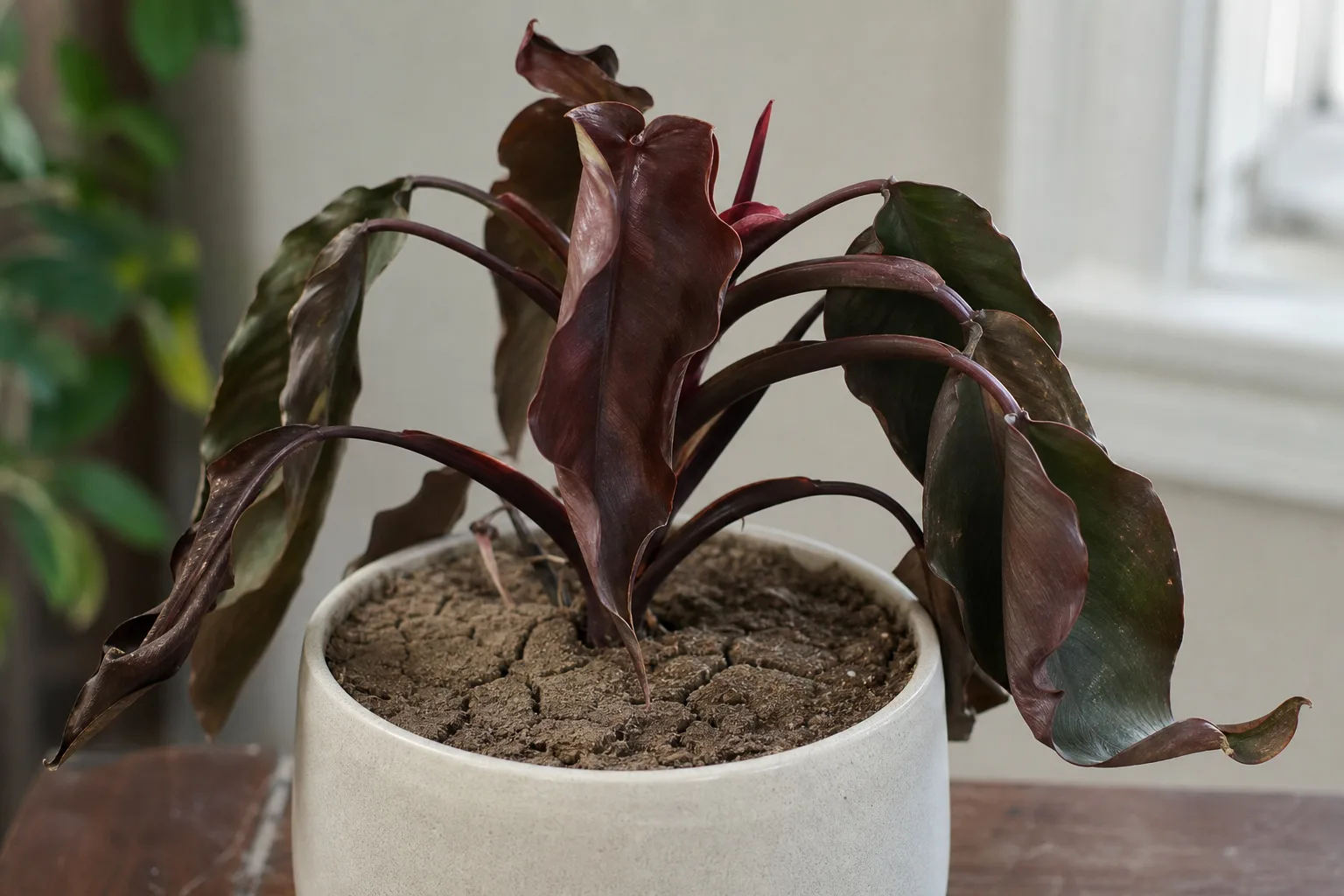
Underwatering on Philodendron Imperial Red: Causes, Checks & Fixes
This guide covers underwatering on Philodendron Imperial Red. See also the general Underwatering guide, watering, and light pages for this plant.
Underwatering on Philodendron Imperial Red: Causes, Checks & Fixes
Quick answer
Underwatering on Philodendron Imperial Red usually means the self-heading crown went too long without a full drink-often from fear of overwatering, fast-drying perlite mix, or bright light without adjusted checks. First step: confirm the top 3–5 cm and deeper mix are dry and the pot feels light, then water thoroughly until runoff drains away.
Philodendron erubescens ‘Imperial Red’ is a self-heading philodendron with thick burgundy petioles and red-bronze new leaves that mature darker. Unlike drought-tolerant succulents, it expects evenly moist-but never soggy-root zone between drinks. When the mix stays dry too long, fine roots lose function and the upright rosette cannot pull water fast enough to support broad leaves. The confusing part is that underwatered Imperial Red can look similar to overwatering at first-petioles droop and leaves curl-but the pot is light, the mix is dusty dry, and roots stay firm rather than mushy when you check.
Why Philodendron Imperial Red gets underwatering
Fear of overwatering is the most common trigger. After a past root-rot scare, many growers wait too long between drinks. Clemson Extension notes that symptoms of over-watering and underwatering are similar-both lead to poor root health-so a drooping Imperial Red in a dry pot is easy to misread as “still too wet.” The safe move is always pot weight and soil depth, not leaf posture alone.
Calendar watering without soil checks makes the problem worse. RHS guidance is to wait until the top of the compost dries out before watering-but on Imperial Red in medium to Philodendron Imperial Red light guide, that dry-down can arrive in five to seven days in summer and take two weeks in winter. Watering every two weeks year-round in a warm, sunny window often leaves the self-heading crown chronically dry.
Fast-draining perlite-amended mix dries predictably-which is good for root health-but punishes skipped checks. NC State Extension notes that Philodendron erubescens prefers moist, well-drained soil rich in organic matter; perlite-heavy blends in terracotta or small pots can go from ideal to bone dry within days during active growth. Imperial Red in an AC-cooled office with 50–60% humidity still uses water faster when new red-bronze leaves are unfurling.
Bright light and warm rooms accelerate water use without changing the grower’s schedule. A plant moved closer to an east or west window for better burgundy color will dry the top 3–5 cm sooner than one in low light. Clemson recommends keeping philodendron soil evenly moist, but not soggy-on Imperial Red, “evenly moist” means re-watering once the dry surface check passes, not waiting until leaves wilt.
Travel gaps, forgotten cachepots that wick moisture outward, and peat that dries to a hard hydrophobic block also push underwatering forward. Clemson warns that if peat is allowed to dry completely, it is difficult to rewet and will not hold as much water as before-relevant when a dry Imperial Red still sheds water around the root ball after a quick top splash.
What underwatering looks like on Philodendron Imperial Red
Early signs are easy to miss because the upright rosette holds structure until several leaves lose turgor. Watch for these patterns together rather than in isolation:
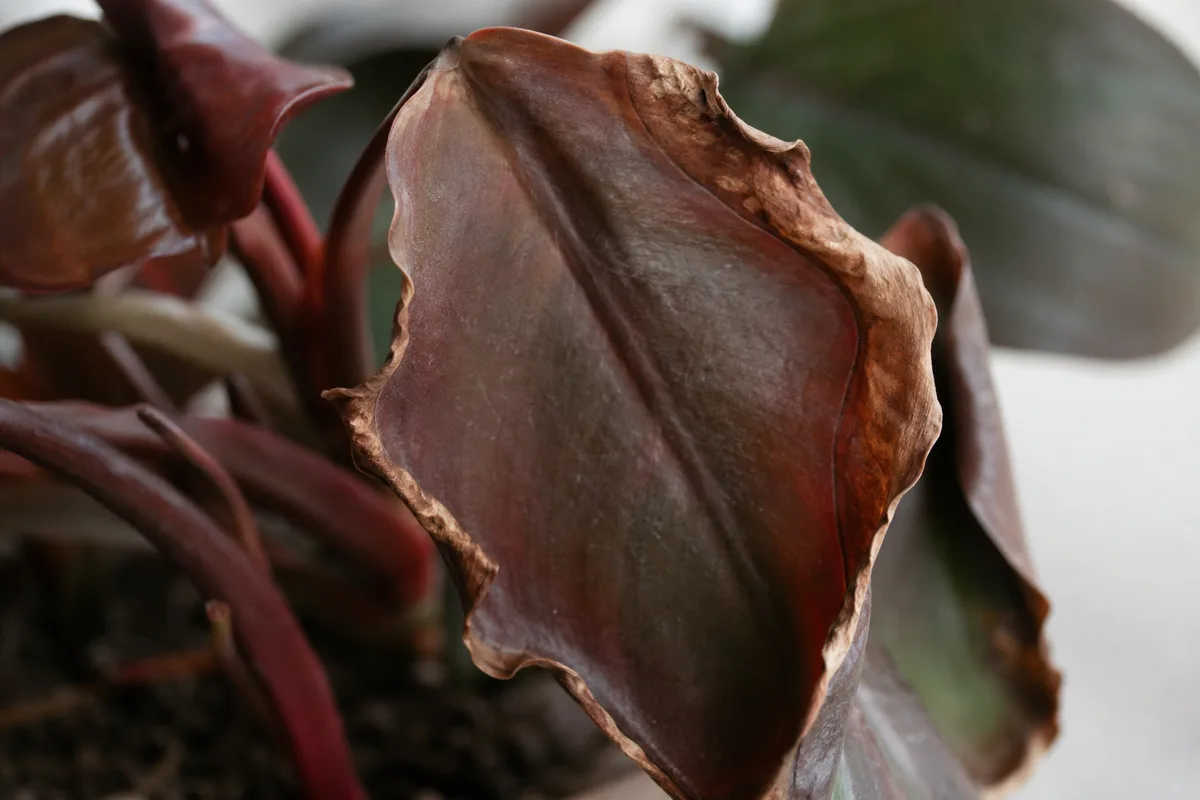
Underwatering symptoms on Philodendron Imperial Red - compare with healthy tissue on the same plant.
- The pot feeling noticeably light when lifted
- Top 3–5 cm of mix dry, dusty, or pulling away from the pot edge
- Burgundy petioles drooping while tissue at the base stays firm-not soft and wet
- Crispy brown edges or tips on mature leaves, especially on the outermost foliage
- New red-bronze leaves stalling, emerging smaller, or browning before they harden off
- Leaves curling inward or folding along the midrib
- Wilting that improves within hours after a thorough soak
- Faded or pale new growth where burgundy color should be strongest
On Imperial Red, do not mistake normal darkening of maturing leaves for drought stress. Chronic dryness shows up with lightweight pots, dusty dry mix throughout the top half of the root ball, and crispy margins-not with firm petioles and gradual red-to-green hardening on healthy older foliage.
How to confirm the cause
Do not guess from one drooping leaf. Use this inspection order:
- Pot weight - Lift the pot. Light and easy to tilt suggests dryness; heavy days after the last watering points elsewhere.
- Soil moisture at depth - Push your finger or a chopstick to 3–5 cm, then deeper near the drainage hole. Dry, crumbly mix throughout confirms underwatering.
- Leaf tissue texture - Crispy edges and curling with firm petiole bases fit drought. Soft, wet bases on damp soil suggest overwatering instead.
- New growth check - Healthy Imperial Red should keep producing firm red-bronze leaves. Stalled or collapsed new leaves with dry soil point to underwatering.
- Water response test - If safe to water, soak thoroughly once. Perking within two to six hours strongly supports drought; no change with dry soil may mean damaged roots from repeated drought cycles.
If several clues align and the plant wilted repeatedly despite dry soil, unpot and inspect roots. Healthy roots feel firm and pale. Drought-stressed fine roots may look tan and brittle but should not be squishy or black-that pattern belongs to rot, not simple underwatering.
Lookalike symptoms to rule out
Overwatering on Imperial Red causes heavy wet pots, sour smell, yellow lower leaves, and soft petiole bases despite moist soil. Low humidity alone can crisp edges in winter, but the pot should still hold normal moisture between drinks-pair dry tips with a light pot before blaming air alone. Normal old-leaf yellowing usually affects one or two lowest leaves while the crown and new red growth stay active. Spider mites cause stippling and webbing but roots stay firm and soil odor stays neutral.
First fix for Philodendron Imperial Red
Water thoroughly the same day you confirm dry soil-not a small cup on the surface. A drought-stressed self-heading philodendron needs the entire root ball rehydrated, not a top mist.
Once you are ready to water:
- Move the pot to the sink or use a saucer you can empty easily.
- Water slowly until water runs freely from the drainage hole, then wait thirty seconds and water again if the mix absorbed quickly.
- If the peat has shrunk away from the pot wall, use Clemson’s double watering method or bottom-water until the surface darkens.
- Empty the saucer immediately so the crown is not left standing in runoff.
- Place the plant back in medium to bright indirect light with 50–60% humidity if possible.
Make one correction at a time. Do not fertilize, repot, and move to harsh sun on the same day as the recovery soak.
Step-by-step recovery
After the initial deep watering:
- Watch for petioles to firm and leaves to uncurl within two to six hours; severe cases may take overnight.
- Resume the dryness check: water only when the top 3–5 cm feels dry-roughly every 7–10 days in summer and 10–14 days in winter in typical homes.
- Trim fully brown crispy tips if they bother you cosmetically, but leave mostly green foliage in place until new growth appears.
- Watch for new firm red-bronze leaves over the next three to six weeks.
- If the plant wilts again within days despite wet soil, switch to an overwatering or root-health check-do not keep adding water to a heavy pot.
If repeated drought left many fine roots dead and the plant wilts on both wet and dry cycles, unpot, trim only truly mushy tissue, and repot into fresh perlite-amended mix before the next soak.
Recovery timeline
A single missed watering caught early-dry surface but firm roots and crown-often perks up within hours of one thorough drink. Moderate cases with several crispy leaves may need one to two weeks before confident new burgundy growth. Cases with repeated drought cycles and root damage can take three to six weeks to stabilize.
Old crispy tips and edges will not green up again. Use new red-bronze leaves, firm petioles, normal pot weight between drinks, and leaves that hold turgor for days as recovery markers.
What not to do
- Do not keep withholding water because you fear root rot on Philodendron Imperial Red when the pot is light and mix is dusty dry throughout.
- Do not give tiny daily sips instead of a full soak; surface moisture without root-zone saturation prolongs stress.
- Do not mist heavily as a substitute for watering the mix-Imperial Red needs root moisture, not leaf humidity alone.
- Do not fertilize a drought-stressed plant before Philodendron Imperial Red watering guide is stable.
- Do not repot into a much larger pot to “hold more water”; extra dry soil volume makes consistent moisture harder to judge.
- Do not assume wilting always means “add water”-Clemson notes wilting can also follow root rot from too much water; confirm dryness first.
- Do not handle cut tissue without gloves; philodendrons contain calcium oxalate crystals that irritate skin and are toxic to pets if chewed.
How to prevent underwatering next time
Match watering to how fast your pot dries, not a fixed schedule. For most indoor Imperial Red plants, check the top 3–5 cm before every drink. Use medium to bright indirect light, perlite-amended mix, and aim for 50–60% humidity so new red-bronze leaves unfurl without sticking.
Adjust for season: faster dry-down in warm bright months, slower in winter. Terracotta and small pots need more frequent checks than glazed ceramic. RHS recommends letting compost dry out slightly between waterings-on Imperial Red, that means the surface check passes, not that leaves wilt first. Weekly glance checks-pot weight, soil depth, firm petiole bases-catch dryness while a single deep soak still fixes the problem.
When to worry
Treat advancing underwatering as medium severity on Imperial Red. Escalate if:
- Multiple leaves collapse at once and do not perk after a thorough soak
- New red-bronze leaves brown and die before unfurling repeatedly
- The mix has been bone dry for more than ten days in warm bright conditions
- The plant wilts again within two days of watering despite a heavy pot-possible root damage from drought cycles
- Fine roots are mostly dead or mushy on inspection
If one deep watering restores turgor within hours and new burgundy growth follows within weeks, the odds are good. If the plant cycles between wilt and soggy soil, inspect roots before the next correction.
Conclusion
Underwatering on Philodendron Imperial Red is almost always a skipped soil check or overly cautious watering rhythm, not bad luck. Confirm with light pots, dry mix at 3–5 cm depth, crispy edges, and firm-not mushy-roots; act with one thorough soak and empty the saucer. Prevent it by checking before every drink, adjusting for light and season, and keeping perlite-amended mix evenly moist between dry-downs-not constantly wet, but never left to bake hard. Judge success by perky burgundy petioles and new red-bronze growth-not by old crispy tips returning to perfect form.
When to use this page vs other Philodendron Imperial Red guides
- Philodendron Imperial Red watering guide - Use for routine moisture checks before assuming underwatering is the main issue.
- Philodendron Imperial Red problems hub - Browse all 10 common issues on this species.
- Brown Tips on Philodendron Imperial Red - Different entry point when symptoms overlap with underwatering.
- Yellow Leaves on Philodendron Imperial Red - Different entry point when symptoms overlap with underwatering.
- Leaf Drop on Philodendron Imperial Red - Different entry point when symptoms overlap with underwatering.