Wilting on Philodendron Imperial Red: Causes, Checks & Fixes
Quick answer
Wilting on Philodendron Imperial Red usually means water stress at the roots-not always too little water. First step: lift the pot and probe the top 3–5 cm of mix; a heavy wet pot calls for a dry-back pause, while a light dry pot needs one thorough soak.
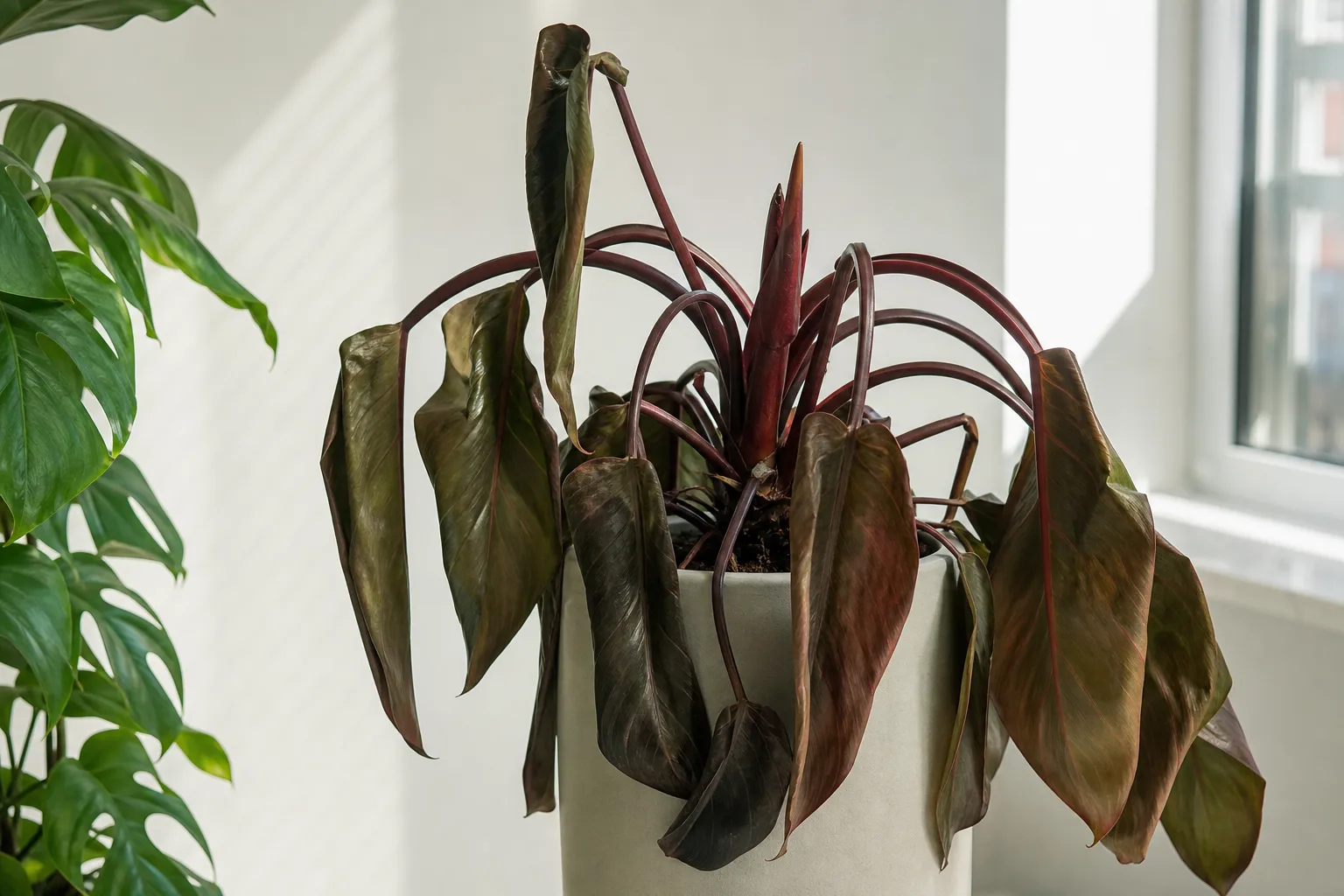
Wilting on Philodendron Imperial Red: Causes, Checks & Fixes
This guide covers wilting on Philodendron Imperial Red. See also the general Wilting guide, watering, and light pages for this plant.
Wilting on Philodendron Imperial Red: Causes, Checks & Fixes
Quick answer
Wilting on Philodendron Imperial Red usually means water stress at the roots-not always too little water. First step: lift the pot and probe the top 3–5 cm of mix; a heavy wet pot calls for a dry-back pause, while a light dry pot needs one thorough soak.
Philodendron erubescens ‘Imperial Red’ is a self-heading philodendron with thick burgundy petioles and red-bronze new leaves that mature darker. When the root zone fails-whether from chronic wetness or prolonged dryness-the upright rosette loses turgor and petioles droop even though the plant looks structurally strong. The confusing part, shared by many houseplants, is that over-watering and underwatering symptoms are similar: both can cause wilting. On Imperial Red, pot weight and soil depth at 3–5 cm tell you which path to take before you add or withhold water.
Why Philodendron Imperial Red wilts
Wilting is a turgor problem-the plant cannot keep cells firm because water is not moving effectively through the system. On Imperial Red, that almost always traces back to how the root zone has been managed, not to a random “sick plant” event.
Overwatering path. When perlite-amended mix stays wet too long, oxygen drops out of the root zone and fine roots decline. Clemson Extension notes that the main cause of death of potted plants is over-watering because roots surrounded by water cannot take up oxygen. Imperial Red prefers evenly moist but never soggy soil; calendar watering without checking whether the top 3–5 cm has dried pushes the self-heading crown toward chronic wetness. NC State Extension notes that overwatering can cause root rot on Philodendron erubescens-the same species lineage as Imperial Red.
Underwatering path. Fear of root rot, fast-draining perlite mix, bright light, or travel gaps can leave the crown dry too long. NC State lists moist, well-drained soil as the baseline for P. erubescens; perlite-heavy blends in terracotta or small pots can go from ideal to bone dry within days during active growth. When fine roots desiccate, the plant cannot pull water fast enough to support broad leaves even minutes after you finally notice drooping.
Why both look alike. Damaged roots from either direction fail to transport water. Penn State Extension explains that wilting despite wet soil is a classic sign of root failure-not thirst-because decayed roots cannot take up water even when the mix is saturated. An underwatered Imperial Red also wilts, but the pot is light, the mix is dusty dry, and leaves often show crispy edges rather than yellow lower leaves on wet soil.
Low light, oversized pots, blocked drainage, and saucers that hold standing water push the overwatering path forward. RHS guidance warns that if the pot is much bigger than the rootball, compost stays wet for longer, which can cause roots to rot-a pattern that shows up as limp burgundy petioles on a heavy pot days after the last drink.
What wilting looks like on Philodendron Imperial Red
Early wilting is easy to miss because the self-heading rosette holds its shape until several leaves lose turgor. Watch for these patterns together rather than in isolation:
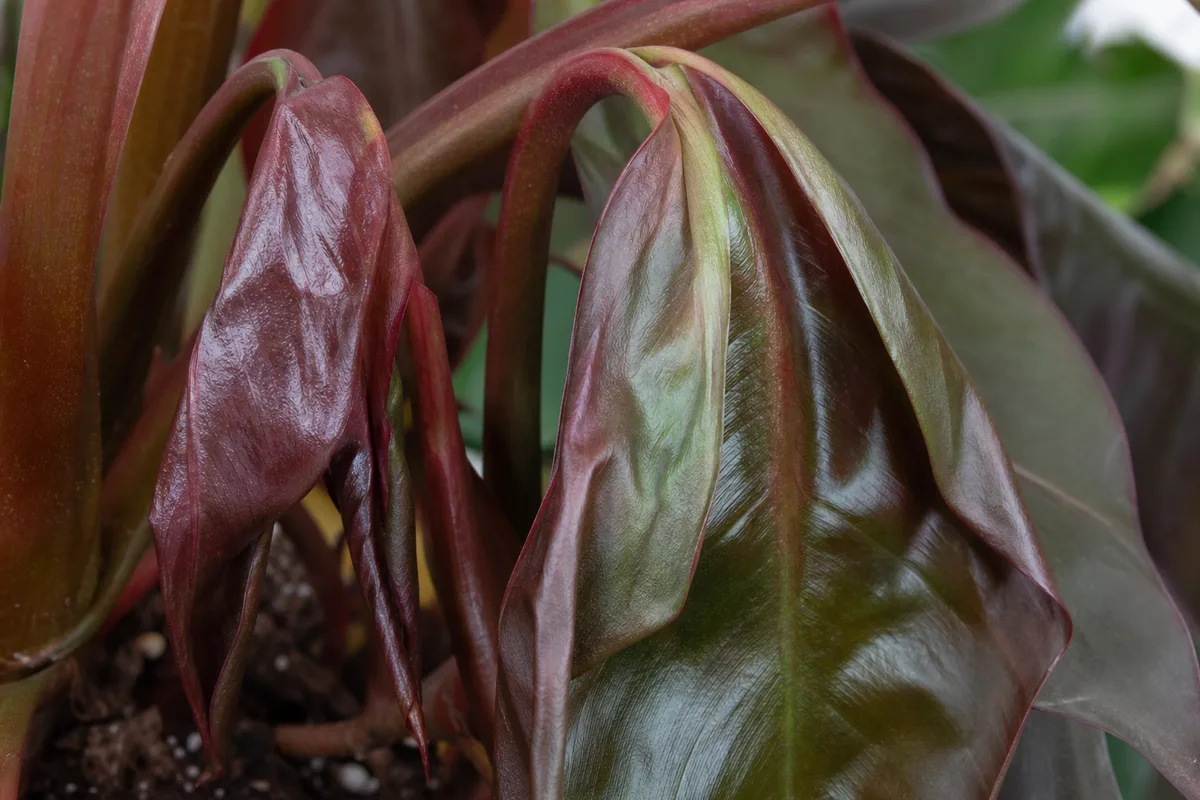
Wilting symptoms on Philodendron Imperial Red - compare with healthy tissue on the same plant.
- Burgundy petioles drooping outward or folding downward while the leaf blade still has color
- Lower leaves yellowing on a heavy pot with damp mix at 3–5 cm depth
- Crispy brown edges or tips on a light pot with dusty dry surface mix
- New red-bronze leaves stalling, emerging small, or collapsing before they harden off
- Leaves curling inward along the midrib
- Soil pulling away from the pot wall on dry plants, or a sour smell from drainage holes on wet ones
- Wilting that improves within hours after one thorough soak-strong evidence for underwatering
- Wilting that persists or spreads despite wet, heavy soil-strong evidence for overwatering or root decline
On Imperial Red, do not treat normal burgundy-to-green hardening on maturing leaves as wilting. Chronic water stress shows up with pot weight, soil smell, and petiole texture at the crown-not with gradual color change on firm older foliage.
How to confirm the cause
Do not guess from one drooping leaf. Use this inspection order-the same pot-weight-first logic used for root rescue on tough houseplants:
- Pot weight - Lift the pot. Heavy and hard to tilt suggests saturation or slow drainage; light and easy to tilt suggests dryness.
- Soil moisture at 3–5 cm - Push your finger or a chopstick to depth. Cool, clinging mix on a heavy pot points to overwatering. Dry, crumbly mix on a light pot points to underwatering.
- Soil smell - A sour odor from the drainage hole suggests anaerobic conditions and declining root health on a wet pot. Neutral odor on dry mix fits drought.
- Petiole bases - Press where burgundy petioles meet the crown. Firm tissue fits drought or early stress. Soft, wet, collapsing tissue on a heavy pot is not simple underwatering.
- Leaf margins and color - Crispy edges with firm bases fit drought. Yellow lower leaves with limp petioles on wet soil fit overwatering.
- New growth check - Healthy Imperial Red keeps producing firm red-bronze leaves. Stalled new growth with wet heavy soil points to root-zone stress from excess moisture; stalled growth with bone-dry mix points to drought.
If wet-soil clues align and wilting keeps spreading, unpot and inspect roots. Healthy roots feel firm and pale. Rot shows as brown, slippery, or squishy tissue. If dry-soil clues align, a single thorough soak that restores turgor within hours confirms underwatering without unpotting.
Diagnostic split: overwatering vs underwatering
| Check | Points to overwatering | Points to underwatering |
|---|---|---|
| Pot weight | Heavy days after watering | Light, easy to tilt |
| Top 3–5 cm mix | Damp, cool, clinging | Dry, dusty, crumbly |
| Soil smell | Sour from drainage hole | Neutral |
| Petiole base | Soft, wet at crown | Firm, not mushy |
| Leaf pattern | Yellow lower leaves, limp on wet soil | Crispy edges, curling |
| After one deep soak | No improvement; may worsen if already wet | Perks within 2–6 hours |
When in doubt, trust weight and depth over leaf posture alone. Clemson notes that wilting can follow root rot from too much water-adding another drink to a heavy pot deepens the problem.
Lookalike symptoms to rule out
Low humidity alone can crisp edges in winter, but the pot should still hold normal moisture between drinks-pair dry tips with a light pot before blaming air alone. Normal old-leaf yellowing usually affects one or two lowest leaves while the crown and new red growth stay active. Mealybugs or spider mites cause stippling, stickiness, or webbing but roots stay firm and soil odor stays neutral. Heat stress from a hot window can wilt leaves temporarily; check whether the mix dried faster than usual rather than assuming root failure.
First fix for Philodendron Imperial Red
Make one targeted correction based on the diagnostic split-never water and dry-back at the same time.
If the pot is heavy and mix at 3–5 cm is still damp: Stop watering immediately. Move the plant to medium to Philodendron Imperial Red light guide with good airflow, empty any saucer or cachepot, and wait until the top 3–5 cm feels dry and pot weight drops noticeably before the next drink. Do not mist heavily or add a small top-up because petioles look limp while soil is still wet.
If the pot is light and mix at 3–5 cm is dry: Water thoroughly the same day. Soak until water runs from the drainage hole, wait thirty seconds, and water again if the perlite mix absorbed quickly. Empty the saucer immediately. Place the plant back in medium to bright indirect light with 50–60% humidity if possible.
Make one correction at a time. Do not fertilize, repot into a much larger container, and move to harsh sun on the same day.
Step-by-step recovery
After the initial correction:
- Overwatering track - When the top 3–5 cm is dry-often one to two weeks in a badly saturated pot-water thoroughly until runoff, then empty the saucer. Resume checking depth before every drink, roughly every 7–10 days in summer and 10–14 days in winter in typical homes.
- Underwatering track - Watch for petioles to firm within two to six hours; severe cases may take overnight. Resume the dryness check: water only when the top 3–5 cm feels dry.
- Watch for new firm red-bronze leaves over the next three to six weeks on either track.
- Remove leaves that collapse completely, but leave mostly green foliage until new growth appears.
- If petiole bases soften on a heavy pot despite dry-back, or the plant wilts again within days of a thorough soak on a heavy pot, unpot and inspect roots before the next correction.
If petiole bases are already soft or roots are mostly mushy, switch to the root-rot rescue path: trim decayed tissue, repot into fresh airy perlite-amended mix, and wait one week before the first drink.
Recovery timeline
Mild underwatering caught early-dry surface but firm roots-often perks up within hours of one thorough soak. Mild overwatering caught before crown softness often stabilizes within one to two weeks once watering stops and the mix dries. Moderate cases on either track may need three to six weeks before confident new burgundy growth. Cases with crown softness or mostly dead roots rarely recover fully without pruning and Philodendron Imperial Red repotting guide.
Old limp, yellow, or crispy leaves will not return to perfect form. Use new red-bronze leaves, firm petioles, appropriate pot weight between drinks, and a neutral-smelling mix as recovery markers.
What not to do
- Do not add water because leaves look limp when the pot is already heavy and mix at 3–5 cm is damp.
- Do not keep withholding water when the pot is light and mix is dusty dry throughout.
- Do not give tiny daily sips instead of a full soak on the underwatering track.
- Do not mist heavily as a substitute for correcting root-zone moisture.
- Do not repot into a much larger pot; extra wet or dry soil volume makes consistent moisture harder to judge.
- Do not fertilize until new growth shows and watering is back on a stable rhythm.
- Do not assume self-heading toughness means the plant can wait-crown tissue softens fast once roots fail on the overwatering path.
- Do not handle cut tissue without gloves; philodendrons contain calcium oxalate crystals that irritate skin and are toxic to pets if chewed.
How to prevent wilting next time
Match watering to how fast your pot dries, not a fixed schedule. For most indoor Imperial Red plants, check the top 3–5 cm before every drink. Use medium to bright indirect light, perlite-amended mix, and aim for 50–60% humidity so new red-bronze leaves unfurl without sticking. Clemson recommends keeping philodendron soil evenly moist, but not soggy-on Imperial Red, that means dry surface checks, not constant dampness and not letting the mix bake hard.
Pour away excess runoff, reduce frequency in winter or dim rooms, and refresh compacted mix every one to two years. RHS recommends letting compost dry out slightly between waterings-on Imperial Red, that means the 3–5 cm check passes, not that leaves wilt first. Weekly glance checks-pot weight, soil depth, firm petiole bases-catch trouble while a single dry-back or deep soak still fixes the problem.
When to worry
Treat advancing wilting as medium to high severity on Imperial Red. Escalate immediately if:
- Petiole bases soften and collapse at the crown
- Soil smells sour on a heavy pot even though you have stopped watering
- Wilting spreads to multiple leaves despite wet mix
- The pot stays heavy for more than ten days after you stopped watering on the overwatering track
- Multiple leaves collapse and do not perk after a thorough soak on the underwatering track
- Roots are brown, slippery, or mushy on inspection
If one correction restores turgor within hours or days and new burgundy growth follows within weeks, the odds are good. If the plant cycles between wilt on wet soil and wilt on dry soil, inspect roots before stacking more treatments.
Conclusion
Wilting on Philodendron Imperial Red is a diagnostic problem, not a single fix. Confirm with pot weight and soil at 3–5 cm depth before you add or withhold water: heavy wet pots need a dry-back pause; light dry pots need one thorough soak. Prevent it by checking before every drink, using perlite-amended mix, keeping 50–60% humidity, and never leaving the self-heading crown in standing water. Judge success by firm burgundy petioles and new red-bronze growth-not by old leaves returning to perfect form.
When to use this page vs other Philodendron Imperial Red guides
- Philodendron Imperial Red watering guide - Use for routine moisture checks before assuming wilting is the main issue.
- Philodendron Imperial Red problems hub - Browse all 10 common issues on this species.
- Root Rot on Philodendron Imperial Red - Different entry point when symptoms overlap with wilting.
- Yellow Leaves on Philodendron Imperial Red - Different entry point when symptoms overlap with wilting.