Holes in Leaves on Heartleaf Philodendron: Causes, Checks &
Quick answer
Holes in Heartleaf Philodendron leaves are damage, not a natural leaf pattern—indoor P. hederaceum keeps whole glossy heart-shaped blades. First step: inspect the hole edge and the newest unfurling leaf still wrapped in its stipule under bright light before you change watering or spray.
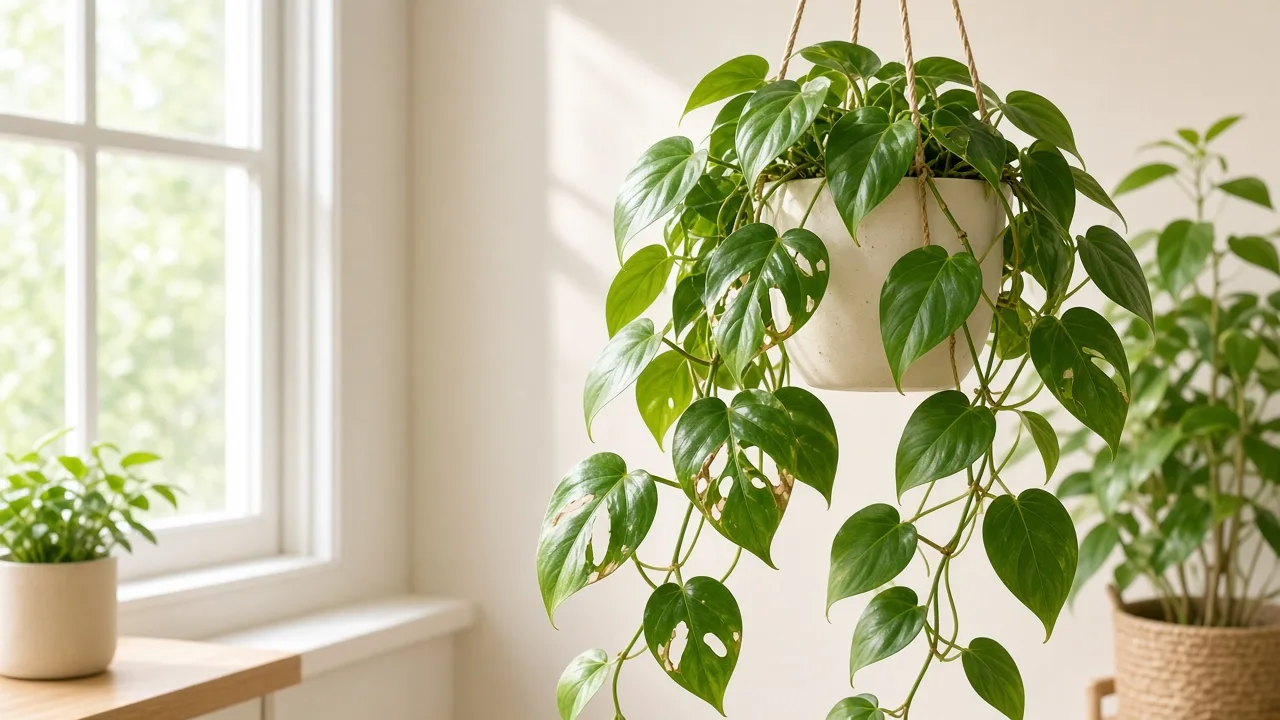
Holes in Leaves on Heartleaf Philodendron: Causes, Checks & Fixes
This guide covers holes in leaves on Heartleaf Philodendron. See also the general Holes in Leaves guide, watering, and light pages for this plant.
Holes in Leaves on Heartleaf Philodendron: Causes, Checks & Fixes
Quick answer
Holes in Heartleaf Philodendron (Philodendron hederaceum) leaves mean something removed or tore tissue—chewing insects, leaf miners, physical snags on trailing vines, stuck unfurling leaves in dry air, or pet damage. Unlike split-leaf monsteras, indoor heartleaf philodendron keeps whole glossy heart-shaped leaves on cascading stems. Any open hole is damage, not a natural fenestration pattern.
For how chewing pests and mechanical tears work in general, see our holes in leaves guide. On Heartleaf Philodendron, the diagnostic clue is usually at the vine tip still wrapped in its stipule—soft new leaves unfurl along trailing stems where caterpillars hide, banded greenhouse thrips scar tissue, and dry air can split a blade before it fully opens.
First step: look at the hole edge, then inspect the newest unfurling leaf inside its stipule and every leaf axil along trailing stems under bright light. Ragged chew marks with frass need a different fix than a clean tear on one leaf that brushes a shelf.
When to use this page vs other Heartleaf Philodendron guides
| Pattern | Start here | Or route to… |
|---|---|---|
| Ragged holes with frass on vine tips | This page | Caterpillars |
| Serpentine tunnels inside the blade | Leaf miners | This page if holes are full-thickness |
| Silver streaks, black specks, scarred new tips | Thrips | — |
| Sticky honeydew on soft new growth | Aphids | — |
| Brown halos before tissue drops out | Black spots | Leaf spot disease |
| Crispy tips without open holes | Brown tips | Low humidity |
What holes in leaves look like on Heartleaf Philodendron
Heartleaf philodendron leaves are glossy, heart-shaped, and grow along long trailing or climbing vines. Indoor P. hederaceum foliage stays whole—unlike mature Monstera deliciosa, which develops ornamental splits as it ages. When you see a hole, sort it by pattern:
Caterpillar chewing — Irregular holes and notched margins, often starting on soft new leaves at vine tips. Dark frass pellets on leaves, stems, or the shelf below. You may find a larva tucked in a leaf axil or inside a partly unfurled stipule. See caterpillars on Heartleaf Philodendron.
Leaf miner trails — Winding pale or brown tunnels inside the leaf with only a small exit hole—not a large ragged chew. Miners are uncommon indoors but show up after outdoor summer placement. See leaf miners.
Thrips rasping — Tiny scrape marks, silvery streaks, and black varnish-like specks on upper leaf surfaces; new leaves may look scarred or distorted at tips. Full-thickness holes are less common than stippling. See thrips.
Trailing-vine mechanical tears — Clean linear splits or one-time holes on outer leaves that brush walls, door frames, shelf lips, or other plants. Damage stays on the same leaf after you reposition the vine; no frass, no trails.
Unfurling tears in dry air — Small holes or splits at the center of a newly opened heart-shaped leaf where the blade stuck together while unfurling. Often paired with crispy leaf edges in winter rooms. See low humidity on Heartleaf Philodendron.
Pet chewing — Torn sections on lower, accessible hanging leaves without insect signs. Heartleaf Philodendron is toxic to cats and dogs if ingested—isolate the plant and contact your veterinarian if you suspect chewing; this guide does not replace medical advice.
Fungal leaf spots that fall out — Dark spots with yellow margins may be fungal leaf spot; dried centers sometimes drop, leaving small shot-hole appearance—usually with preceding brown halos, unlike clean mechanical tears. Route persistent spotting to black spots or leaf spot disease.
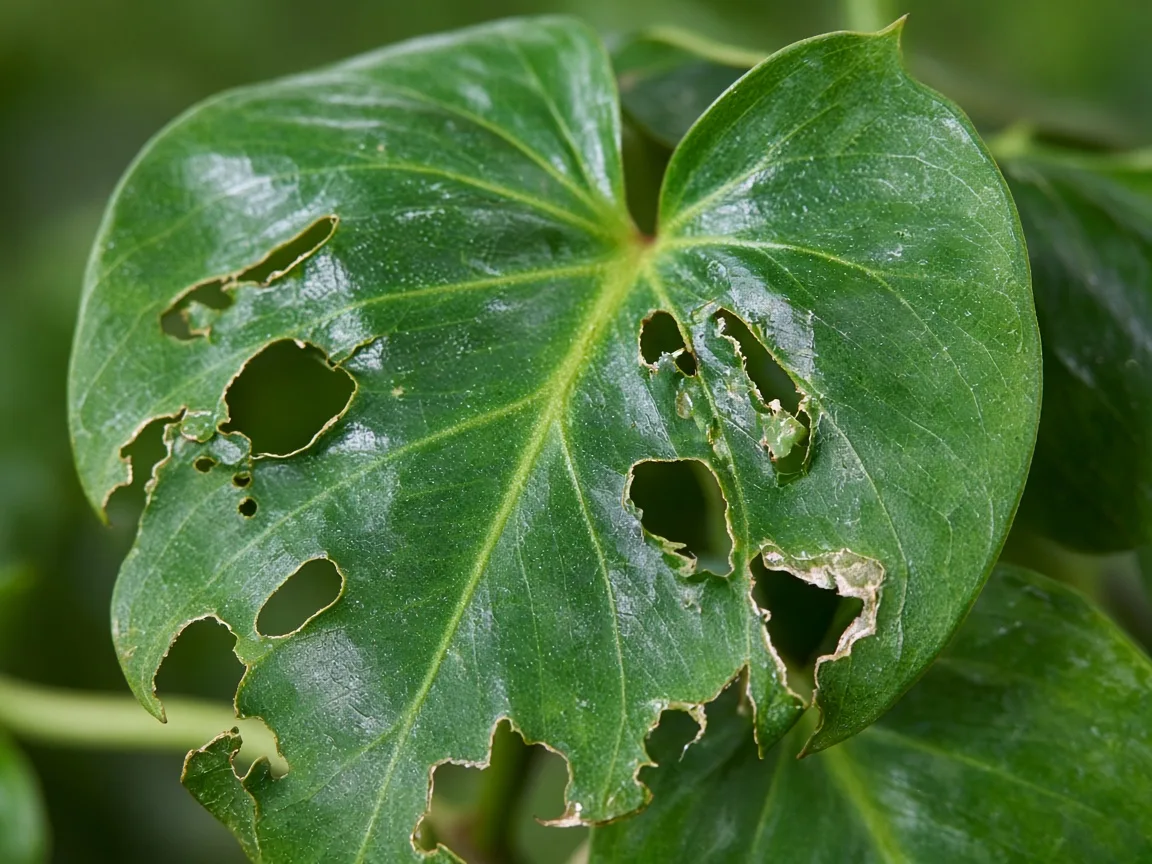
Irregular chew damage on a glossy heart-shaped philodendron leaf—compare torn margins with intact tissue on the same vine.
Stipule-sheathed unfurl tears (philodendron only)
Heartleaf philodendron pushes new leaves rolled tight inside a papery stipule at each vine tip—conspicuous stipules distinguish philodendron from pothos. In dry winter air below the 40–60% humidity range this species prefers, the unfurling blade can stick to itself inside the sheath and split as it opens, leaving a small hole or linear tear through the center. No frass, no night feeding, and damage limited to the newest one or two leaves on dry-room plants points here—not caterpillars.
Non-grooved petiole axil hiding (philodendron only)
Philodendron petioles are entire and non-grooved, meeting the vine in a shallow axil where caterpillars and small larvae shelter on lower, uninspected sections of a long trailing arm while damage shows first on the softest new leaf at the tip. When you inspect, work from the stipule-covered growing point backward along the stem—not only the most obvious holed leaf.
Not a Swiss cheese plant (philodendron only)
Readers often confuse Heartleaf Philodendron with split-leaf monsteras because both are glossy trailing aroids. P. hederaceum does not develop natural oval fenestrations indoors. If someone suggests “your philodendron is supposed to have holes,” that advice applies to mature Monstera—not this species. A clean oval window in an older leaf on a different plant in the same room is a species mix-up, not a philodendron trait.
Why Heartleaf Philodendron gets holes in leaves
Chewing pests are the most common cause of true holes indoors. Heartleaf philodendron has no serious pest problems under normal care, but aphids, spider mites, mealybugs, and scale appear episodically when eggs hitchhike on nursery stock, patio placements, or open windows. Caterpillars chew ragged full-thickness holes; leaf miners tunnel between leaf surfaces.
Trailing growth hides damage until tips look shredded. A six-foot philodendron in a hanging basket can carry insects on lower axils while the owner notices holes only when a new heart-shaped leaf opens at the bottom of the cascade. Dense overlapping foliage on a moss pole creates the same blind spots on climbing specimens.
Outdoor summer brings eggs indoors. Philodendrons on shaded patios pick up moth eggs; damage often appears weeks after the plant returns to a windowsill. One larva can chew through several tender new leaves in sequence because philodendron concentrates soft growth at each vine tip inside its stipule.
Dry air splits unfurling tissue. Low humidity causes brown tips and edges on houseplants; on philodendron it can also tear new leaves apart as they emerge from the stipule. This is not infectious and does not spread leaf to leaf like pest feeding.
Pets reach hanging arms. Cats bat at trailing vines; dogs chew accessible lower leaves. Tears at pet height on multiple plants suggest placement, not insects.
Fungal leaf spots can fall out. Dried necrotic centers sometimes drop, leaving small shot-hole appearance—usually with preceding brown halos, unlike clean mechanical tears.
Heartleaf philodendron does not develop natural perforations indoors the way mature Monstera deliciosa fenestrates. If holes appear on whole heart-shaped blades, something damaged the tissue.
How to confirm the cause
Work through these checks in order:
- Edge test — Ragged, irregular margin with chew marks → insects. Clean linear tear → mechanical or unfurl snag. Serpentine trail visible when you backlight the leaf → leaf miner.
- Frass check — Dark pellets on leaves or below the pot → caterpillars. Neither frass nor slime → consider mechanical, pet, or dry-air unfurl tears.
- Stipule tip first — Peel back the papery sheath on the newest growth and inspect the unfolding leaf inside. Active feeding usually hits soft tissue at vine tips before older, leathery blades lower on the stem.
- Night patrol — Check leaf axils and unfurling tips with a flashlight after dark. Caterpillars feed when room lights are low.
- Shake test — Hold white paper under a suspect leaf and tap the petiole. Slow-moving worms confirm caterpillars; quick jumping specks point to thrips.
- Timeline — New holes on different leaves weekly signal active feeding. One unchanged tear for a month suggests past snag or pet contact.
- Placement trace — Follow which outer leaves contact walls, shelves, or neighboring plants. Isolated damage along that path needs repositioning, not spray.
- Humidity check — If only the newest leaf inside a dry stipule has a center split and edges are crispy, raise humidity before treating for pests.
First fix for Heartleaf Philodendron
Photograph the holed leaf, examine the hole edge, then inspect every stipule-covered growing tip and leaf axil along trailing stems before you spray or repot.
| Confirmed pattern | First fix |
|---|---|
| Caterpillar or frass found | Isolate and hand-pick larvae into soapy water; see caterpillars |
| Serpentine trail inside leaf | Pinch off and bag affected blades; see leaf miners |
| Silver streaks + live thrips on shake test | Isolate and rinse every leaf underside; see thrips |
| Clean tear on one leaf along a wall path | Reposition the vine or trim the snagged leaf—no pesticide |
| Center split on newest leaf in dry air | Raise humidity to 40–60%; see low humidity |
| Pet chewing suspected | Move philodendron out of reach; seek veterinary advice if ingestion occurred |
Do not change watering or fertilize a holed philodendron before you know whether insects are active. Extra nitrogen pushes soft new growth that chewers prefer. Do not compost mined or infested leaves indoors where insects can disperse.
Step-by-step recovery
After the first targeted fix:
- Re-inspect every three to five days for two weeks—one missed caterpillar can open new holes on the next unfurling leaf inside its stipule.
- Hold isolation until no new damage appears on emerging tips. Philodendron vines touch neighbors easily on shared shelves.
- Rinse dusty trailing leaves monthly in the shower to dislodge early colonizers and improve your view of new damage.
- Prune only when necessary — Remove leaves more than half destroyed after pests are gone. Partial holes on green blades still photosynthesize.
- Adjust placement — Route hanging vines away from traffic paths and heating vents that dry unfurling tissue.
- Scout after outdoor time — Rinse and quarantine patio philodendrons before mixing them back into your collection.
For a small starter plant with mines or caterpillars on every leaf, rooting one clean node cutting in water may be faster than fighting entrenched pests—philodendron roots readily from stem cuttings.
Recovery timeline
| Phase | Timing | Good sign | Bad sign |
|---|---|---|---|
| After first fix | Days 1–5 | No new holes on unfurling tips | Fresh chew marks on new leaves |
| New growth | Weeks 2–4 | Clean heart-shaped leaves at vine tips | Frass returns or trails spread |
| Cosmetic | Ongoing | Old holed leaves stable | Multiple vines declining |
Holed tissue does not fill in. Judge recovery by clean new leaves, not by old perforated blades. Philodendron in bright indirect light with stable watering often outgrows light damage within one to three weeks once the cause is removed.
Lookalike symptoms to rule out
Yellow lower leaves without holes point to overwatering or low light—not chewing.
Brown crispy tips without open holes suggest low humidity or brown tips from dry air—not caterpillars.
Sticky honeydew without ragged holes suggests aphids, mealybugs, or scale—sap feeders, not chewers.
Fine stippling and webbing suggest spider mites in dry rooms—not large irregular holes.
Natural fenestration does not apply to Heartleaf Philodendron. Missing splits on a monstera is a different problem; philodendron leaves should stay whole.
Mistakes to avoid
Do not spray insecticide before confirming live pests—mechanical tears and dry-air unfurl splits do not need chemical treatment.
Do not assume one holed leaf means the problem is solved. Follow the vine and check axils on lower sections behind the stipule.
Do not use homemade dish soap on philodendron without understanding leaf burn risk; commercial insecticidal soaps are formulated for foliage when pests are confirmed.
Do not hang philodendron where trailing arms brush the same sharp edge daily—a recurring tear is not a mystery pest.
Wear gloves when handling damaged philodendron; sap contains calcium oxalate crystals that irritate skin.
How to prevent holes next time
- Quarantine new philodendrons and cuttings two to three weeks before mixing collections.
- Rinse patio plants before winter bring-in; inspect stipule-covered tips on long vines.
- Route trailing stems away from doorways, shelves, and walls they scrape daily.
- Keep humidity at 40–60% during heating season to protect unfurling tips—see low humidity.
- Hang above pet reach; Heartleaf Philodendron is toxic if chewed.
- Scout growing tips weekly during spring and summer when moths and thrips are most active near open windows.
- Water from soil dryness, not leaf appearance—stressed philodendron in wet soil is more vulnerable to secondary problems.
When to worry
Escalate when:
- Fresh holes appear on multiple vine sections within a week
- Leaf-miner trails spread through several new leaves
- Frass accumulates across a long trailing plant despite handpicking
- New tips stop unfurling because tissue is stripped or mined
- Pet ingestion is suspected—contact a veterinarian promptly
A single old tear on one outer leaf, with firm stems and clean new growth elsewhere, is usually not an emergency. Discard and restart from a cutting only when every leaf is mined or stripped, repeated treatment failed, and the plant has no clean nodes left to salvage.
Conclusion
Holes in Heartleaf Philodendron leaves always mean damage—chewing, mining, tearing, or spotting—not a natural leaf pattern. Read the hole edge, inspect stipule-covered vine tips and axils, and match the pattern before you spray or repot. Philodendron recovers quickly from light hits once the cause is gone; focus on clean unfurling leaves, quarantine discipline, and keeping long vines away from snags and dry-air splits.
Related Heartleaf Philodendron guides
- Heartleaf Philodendron overview — placement, growth habit, and care baseline
- Philodendron watering — when wet soil is not the issue
- Philodendron light — bright indirect light for steady new growth
- Philodendron soil — drainage that keeps roots healthy
- Caterpillars on Heartleaf Philodendron — ragged holes with frass
- Leaf miners on Heartleaf Philodendron — tunnels inside the blade
- Thrips on Heartleaf Philodendron — silver streaks and scarred tips
- Low humidity on Heartleaf Philodendron — unfurl tears in dry air
- Philodendron problems hub — all common issues on this species
Related tool
Use the Plant Problem Diagnosis Tool to narrow causes for holes in leaves on this plant before changing multiple variables at once.